When UK businesses should build with Amazon Bedrock
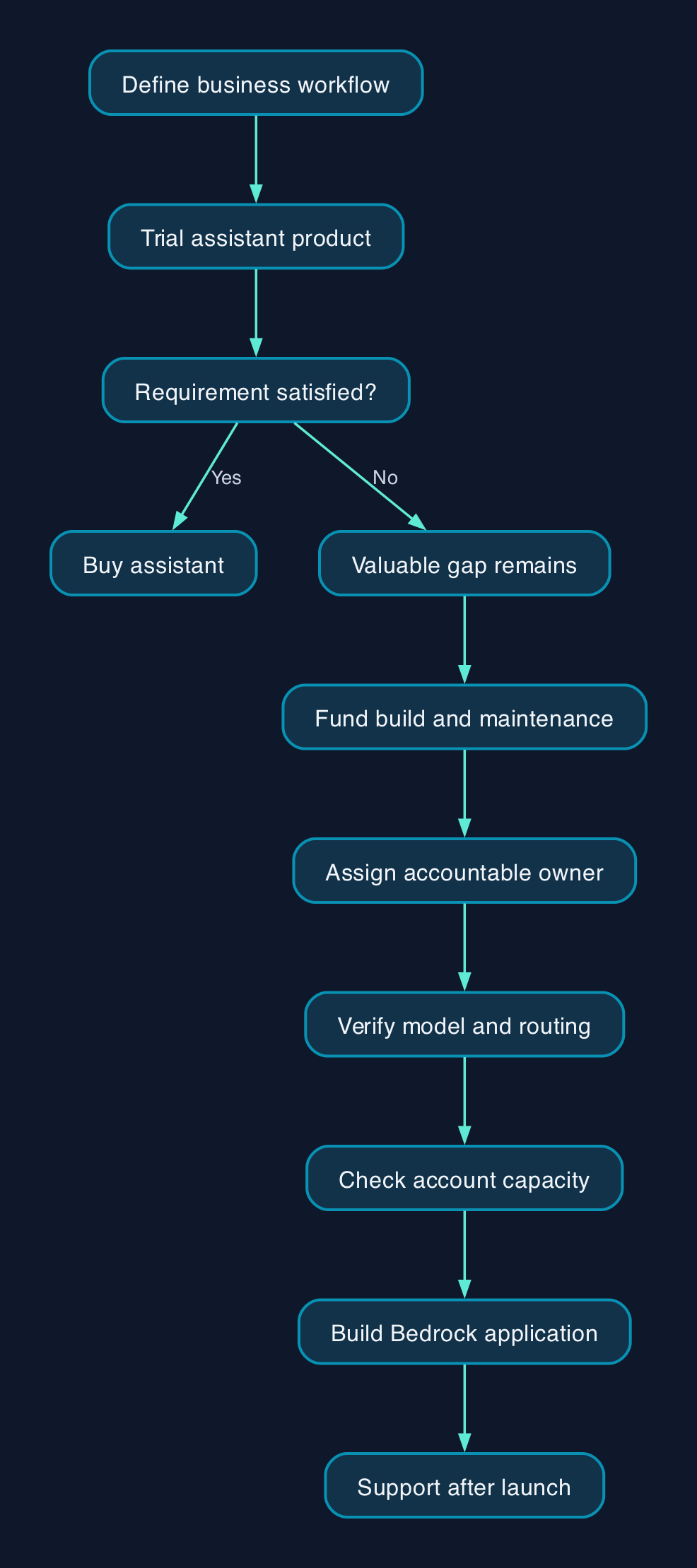
Build with Amazon Bedrock when a valuable workflow needs a custom application and you can fund its upkeep. Trial purchased assistants first, then judge the remaining gap against the full cost of ownership.


Build with Amazon Bedrock when a defined business workflow needs a custom application and you can fund its operation after launch. For general staff assistance, our editorial default is to trial a suitable ChatGPT, Claude or Microsoft Copilot subscription first. Bedrock provides managed access to foundation models for application development. The deciding question is whether owning the application will create enough value to justify maintaining it.
Buy assistance unless the workflow earns a build
Our position is that a UK small or mid-sized business should make the proposed application prove its value against an available assistant before commissioning development.
Write down the task that fails today. “We need AI” is not a development brief. “Our service team repeatedly assembles draft responses from order records, product instructions and warranty terms” is a workflow worth investigating.
Then test whether a purchased product can handle that task under the permissions, review arrangements and working practices you need. If it can, the case for custom development becomes narrower. Improving the source documents or training staff may be the more useful investment.
The evidence available for this article covers Bedrock, but does not establish current ChatGPT, Claude or Microsoft Copilot subscription editions, UK prices, integrations or contractual terms. It therefore supports a build-versus-buy judgement, not a ranking of those subscriptions. Before selecting one, require a demonstration of your actual task and the terms for the exact edition.
For a hypothetical British equipment distributor, drafting occasional customer replies would be a sensible assistant trial. A proposed application that retrieves the correct order, restricts access by account and sends a draft through an approval process deserves a separate assessment. Those are requirements to demonstrate, not capabilities to assume are missing from every packaged product.
When Bedrock deserves a place on the shortlist
Bedrock becomes a credible candidate when your business can identify a valuable gap between the workflow it needs and the products it can buy.
That gap might concern the interface customers use, the sequence of approvals, the systems involved or the way results must be recorded. Require the development proposal to name the gap precisely. A custom chat window, by itself, is a weak reason to take on an application.
AWS provides access to models from multiple suppliers through Bedrock. That creates a route for evaluating alternative models within the service, but the catalogue alone does not demonstrate that changing models will preserve your application's behaviour. AWS’s service overview supports the availability of model choice; acceptance testing remains part of the proposed engineering work.
Our recommendation is to shortlist Bedrock when all these conditions hold:
- A purchased option has failed a documented requirement in a realistic trial.
- The unresolved requirement matters enough to fund development and maintenance.
- An internal owner can accept the application and take responsibility for its business results.
- Your team or delivery partner can support AWS access, application changes and incident handling.
- The chosen model, routing arrangement and account capacity can support the intended workload.
An existing AWS team strengthens the organisational case for evaluating Bedrock. It does not establish that Bedrock will be the cheapest or best-performing platform.
Who owns the application after launch
A proposed implementation should trace a request from the user, through identity and permission checks, into approved business data, then to the model and back through any required review. If the application can change records or trigger actions, specify who authorises those actions and how failures are recovered.
The following is a recommended responsibility split for a custom application, not an AWS service commitment.
| Responsibility | Business owner | Internal team or contracted partner |
| --- | --- | --- |
| Define acceptable results | Approve examples, failure tolerance and review rules | Turn those requirements into repeatable evaluations |
| Control data access | Decide which users may access which records | Implement and test those boundaries |
| Select model and routing | Approve operational and location constraints | Verify compatibility and configure the chosen route |
| Handle service failures | Agree escalation and an alternative working process | Monitor failures and implement recovery behaviour |
| Control spending | Set the budget and approve expansion | Measure usage and investigate unexpected changes |
| Maintain and exit | Retain ownership of requirements and acceptance criteria | Document code, configuration, dependencies and handover |
Do not accept “AWS manages it” as an answer to every row. AWS describes Bedrock as a managed model service, while separately documenting customer account permissions and inference quotas. Those documents do not amount to a commitment to operate your complete business application. Bedrock overview, access prerequisites and quotas
If a supplier builds it, request the support scope before accepting the development quote. Name the response hours, exclusions, change charges, access arrangements and handover deliverables.
UK processing requirements need an explicit design
For a UK buyer with a contractual processing-location requirement, the important question is where the selected configuration sends requests.
AWS states that in-Region inference processes requests within the specified Region. Geographic inference routes within a defined geography, while global inference can route to supported commercial Regions worldwide. These are materially different arrangements. AWS routing definitions
Require the implementer to identify the exact model and permitted processing destinations. The available extracts do not establish that every model you might choose supports an appropriate UK-only route.
AWS also warns that cross-Region profiles can include opt-in Regions that the account has not enabled. Blocking a destination through an organisation's Service Control Policy can cause the request to fail. A location restriction therefore belongs in both the design review and the operational test. Inference profile behaviour
Compare the complete cost of the working process
A subscription quote and a model-usage rate answer different questions. For this decision, compare the cost of delivering an accepted business result over the same period.
Use a budget covering implementation and ongoing operation. The table below is a costing framework, not a priced estimate.
| Cost component | Purchased assistant route | Custom Bedrock application |
| --- | --- | --- |
| Supplier charges | Exact edition, seats, commitment and additional usage | Selected model, usage, service options and supporting resources |
| Setup | Administration, configuration and access review | Application development, deployment and access controls |
| Business data | Preparation and any supported connection work | Preparation, integration and ongoing data maintenance |
| Quality | Staff review, training and task acceptance | Evaluation, human review and testing after changes |
| Operations | Administration and escalation | Monitoring, incident response and application maintenance |
| Exit | Export and replacement arrangements | Code handover, data export and replacement of dependencies |
AWS’s pricing page separates model pricing from areas including Knowledge Bases, Guardrails and Model Evaluation. Request a bill of components for the proposed design rather than accepting a model rate as the whole service estimate. Amazon Bedrock pricing
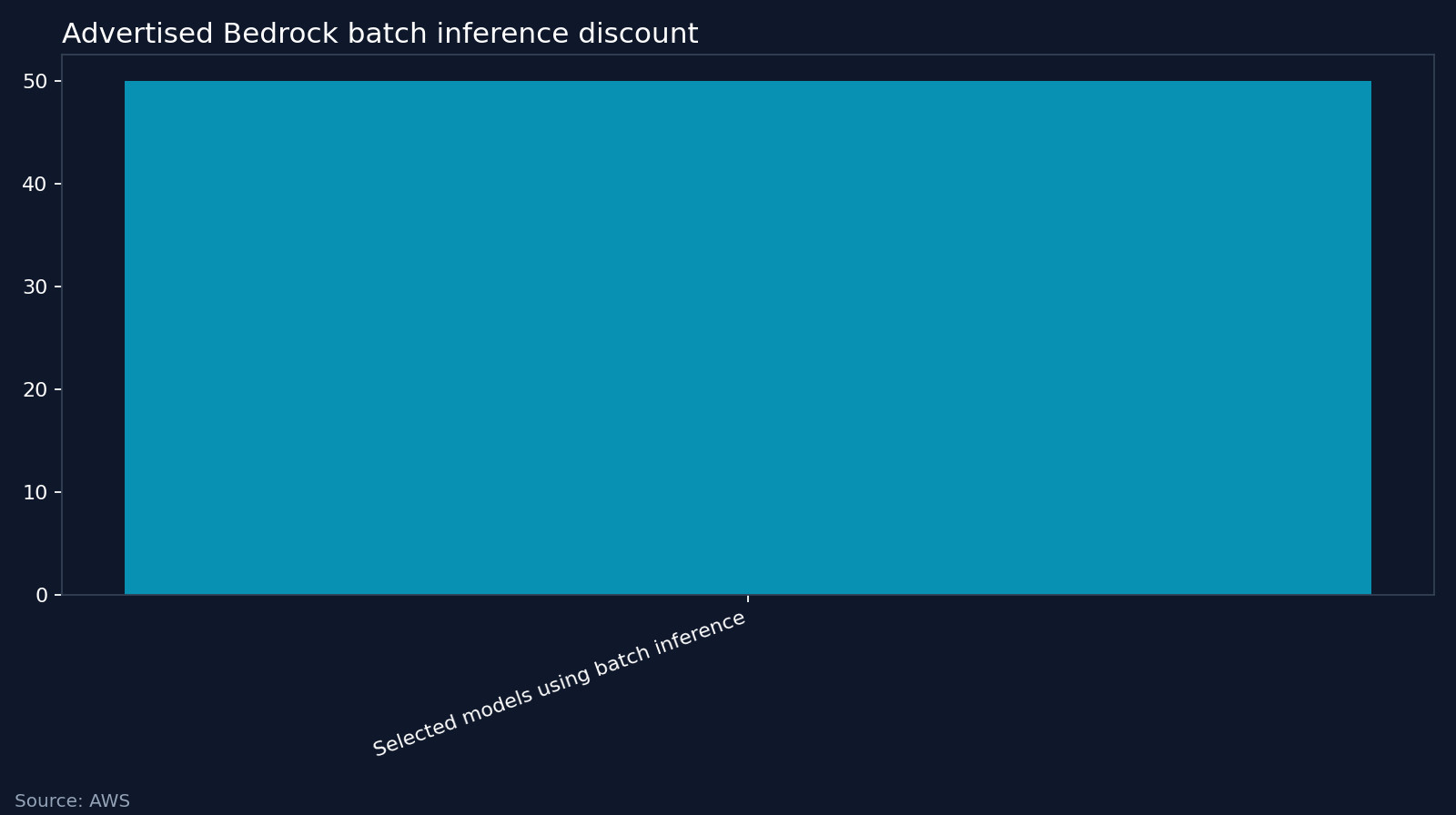
The supplied pricing snapshot, dated 25 September 2026, advertises a 50% batch inference discount against on-demand pricing for selected models. That may matter for a workload suited to batch processing. It does not establish savings on development, support or human checking. AWS batch pricing statement
No comparable verified subscription prices or complete application quotation are available here, so a break-even figure would be false precision. Ask suppliers to state currency, billing commitment, VAT treatment, exclusions and any exchange-rate assumptions in the UK budget.
Editorial analysis
The strongest reason to build is a workflow whose measured value survives the cost of ownership.
We would approve a bounded pilot before a broad platform programme. Give it representative inputs, an existing process to compare against, an accountable owner and explicit acceptance criteria. Measure completed work, correction effort, failure handling and full operating cost.
A demonstration that produces a convincing answer has cleared only one part of that test. The business still needs evidence that the application retrieves permitted information, handles unavailable dependencies and leaves staff with a workable fallback.
If an assistant subscription passes the same business test, buy it. If a valuable requirement remains unmet and Bedrock can support a maintainable implementation, build that specific application. A company can reach both decisions for different tasks.
FAQ
Is Amazon Bedrock an alternative to buying Claude?
At the application level, building with Bedrock and buying an assistant are different delivery choices. At the model level, AWS lists Anthropic among Bedrock's providers, so a Bedrock application can itself use a Claude model. Amazon Bedrock overview
Is Bedrock cheaper than ChatGPT or Microsoft Copilot?
The available evidence does not support that conclusion. Compare verified subscription terms with the complete cost of your proposed application, including development, maintenance and review. AWS’s pricing page shows multiple chargeable components, so a model rate alone cannot settle the comparison. Bedrock pricing
Does a UK company using Bedrock keep its requests in the UK?
That cannot be assumed from the company's location or the Region where a request starts. AWS distinguishes in-Region processing from geographic and global routing. Verify the exact model and inference configuration against your processing requirements. Regional availability and routing
What should a small business require before commissioning a build?
Require a demonstrated gap in available products, an accountable owner, acceptance criteria and a funded support arrangement. Before production, have the implementer verify model-access prerequisites and the account's relevant quotas. AWS documents both as conditions that need attention beyond a successful prototype. Model access and Bedrock quotas
Sources
Source extracts were supplied for this article; their recorded snapshot dates are given below, rather than inferred publication dates.
- AWS — Overview of Amazon Bedrock, snapshot 28 September 2026.
- AWS — Regional availability by models, snapshot 28 September 2026.
- AWS — Quotas for Amazon Bedrock, snapshot 28 September 2026.
- AWS — Amazon Bedrock pricing, snapshot 25 September 2026.
- AWS — Request access to models, snapshot 28 September 2026.
- AWS — Supported Regions and models for inference profiles, snapshot 28 September 2026.