Amazon Bedrock in London needs more than a regional setting
Amazon Bedrock in London is a credible candidate for tighter regional control, but the endpoint alone proves little. The buying decision depends on the exact model, processing route, supporting services and operational ownership.


Amazon Bedrock is a practical candidate for UK businesses seeking tighter regional control, provided the chosen model and every supporting component fit the intended boundary. AWS distinguishes in-Region processing from geographic and global routing. Our view is that London should be a deployment requirement to verify, with named technical ownership and tested failure handling. Selecting a London endpoint alone is insufficient evidence that the whole application stays there.
What regional control should mean for a UK business
Our editorial position is that a regional requirement should describe permitted processing and storage locations for a specific application. “Use London” leaves too much undecided.
Consider a hypothetical UK engineering consultancy building an assistant over internal project manuals. Its buyer should specify where documents, extracted passages, prompts, answers and operational records may go. The application owner should also decide what happens when an approved model is unavailable or its capacity limit is reached.
Those decisions precede model selection. AWS distinguishes single-Region inference, routing within a defined geography and global routing. Each has a different processing boundary, even when the application starts its request from the same place. AWS’s inference options
The distinction matters for storage as well as processing. AWS says geographic cross-Region inference can move prompts and outputs outside the source Region, with destination-region storage where required for abuse detection. A description limited to the original document store therefore misses part of the route. Geographic cross-Region considerations
This article assesses technical placement. The cited service documentation does not establish that a particular deployment meets a customer contract or legal obligation.
Design the complete application boundary
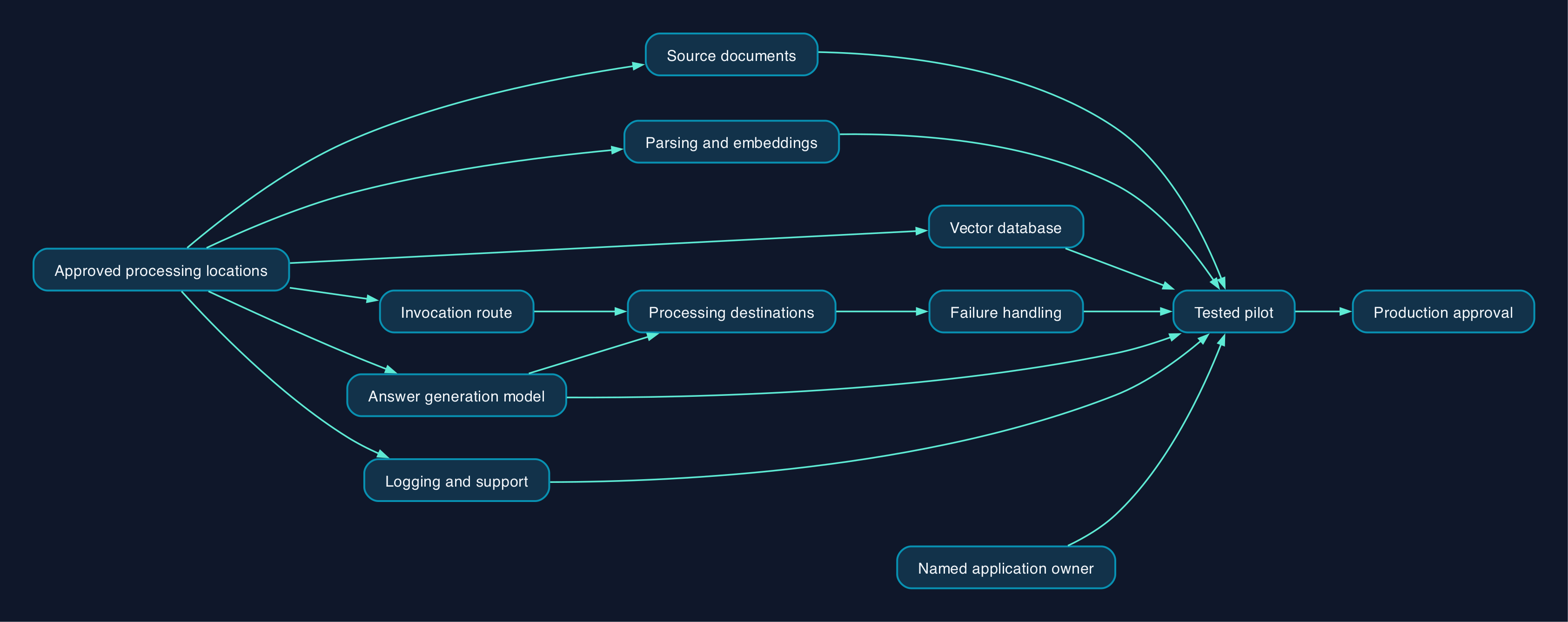
For the consultancy example, a sensible proposed design would let authorised employees retrieve approved passages and submit them to an explicitly selected generation model. A named application owner would approve both the processing route and changes to it.
Knowledge Bases introduces another model choice before answer generation. It uses an embedding model to convert content into numerical representations stored in a vector database. AWS lists Titan Text Embeddings V2 among the options with London support. Embedding models and regional support
The following responsibility map is a proposed procurement requirement, not a claim that AWS automatically configures these controls.
| Component | Evidence to require | Accountable owner |
| --- | --- | --- |
| Source documents | Approved content, access permissions and storage location | Business data owner |
| Parsing and embeddings | Exact processing option, model and permitted Regions | Application engineer |
| Vector database | Hosting location, access controls, retention and recovery arrangements | Platform owner |
| Answer generation | Exact model, invocation method and permitted processing destinations | Application engineer |
| Logging and support | Recorded content, retention, locations and support access | Operations owner |
| Failure handling | Tested behaviour when approved processing is unavailable | Application owner |
Flows availability does not settle those component choices. AWS explicitly makes its supported models dependent on the nodes used, including prompt, agent and knowledge-base nodes. Flows dependencies
The decisive evidence gap is the chosen generation model. The sources cited here establish London support for particular components, but do not establish a complete, current London-only configuration for the reader’s preferred text-generation model. Require that confirmation before approving the build.
For a new agent-based application, also reject a proposal that assumes access to Agents Classic. AWS directs new customers towards AgentCore, but the cited notice does not establish AgentCore’s London availability or equivalent delivery scope. Those remain separate checks. AWS’s Agents Classic notice
Price the application and its operation
A token price cannot answer whether this application is affordable. AWS says Bedrock pricing depends on modality, provider and model, and its pricing page separates model charges from capabilities including Knowledge Bases, Guardrails and evaluation. Amazon Bedrock pricing
For a small business, our recommendation is to request a budget over a stated operating period that includes:
- Model usage, with assumptions for request volumes, context length and answer length.
- Document preparation, embedding and updates.
- Database, application hosting and monitoring.
- Integration, access configuration and acceptance testing.
- Staff training, support and incident investigation.
- Model replacement, data export and supplier handover.
These are quotation requirements. Their inclusion does not imply that every item has a separate AWS charge.
The available pricing evidence does not establish a complete London-specific GBP price, commitment or VAT treatment. Obtain those details for the exact configuration, and keep implementation labour visible beside recurring usage charges.
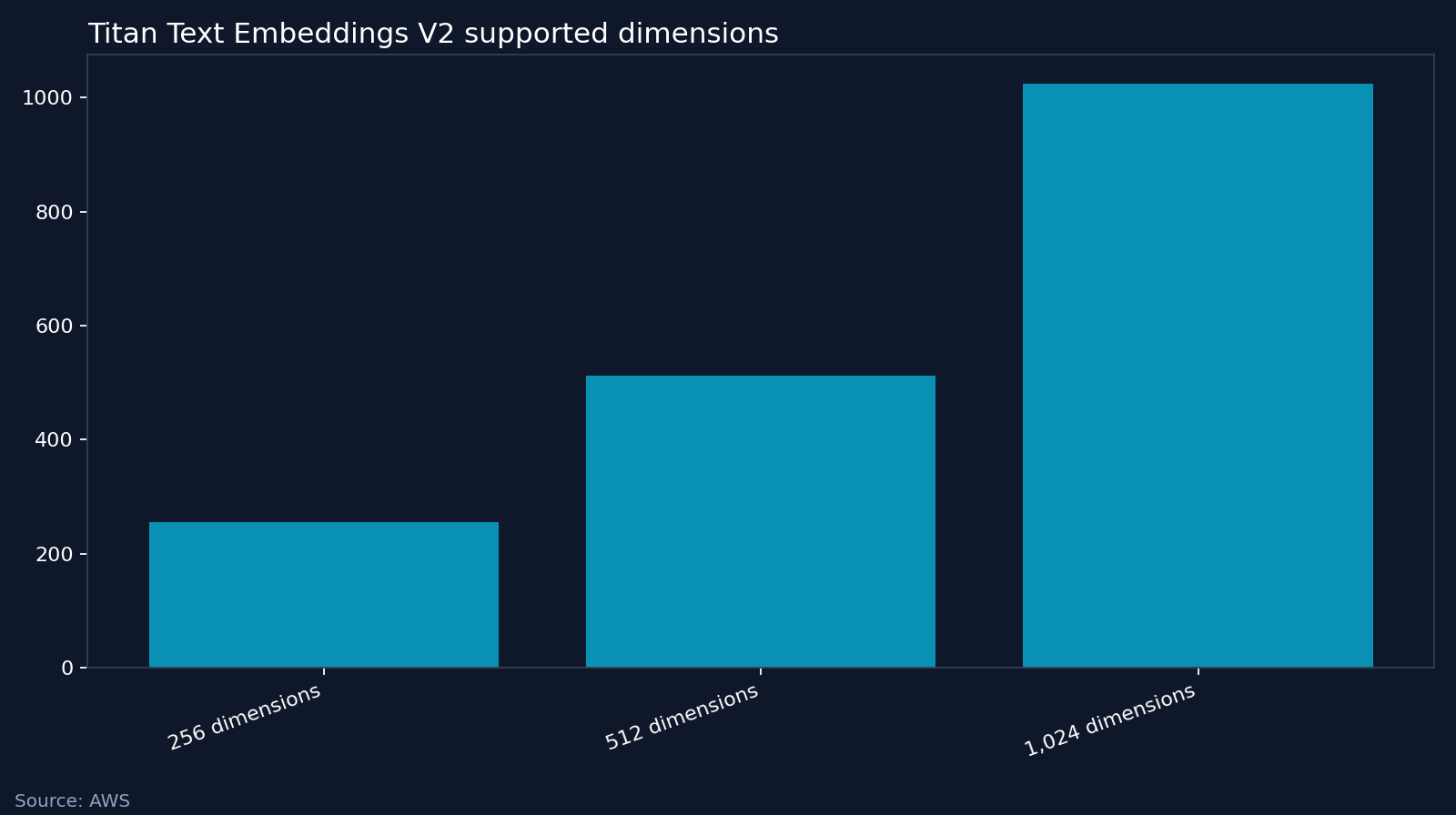
Embedding dimensions provide one concrete sizing choice. AWS lists 256, 512 and 1,024 dimensions for Titan Text Embeddings V2. These are supported representation sizes, not accuracy scores or measured cost savings. Evaluate retrieval quality and the selected database’s charging basis before choosing among them. Supported embedding dimensions
Capacity belongs in the same discussion. AWS’s runtime documentation describes per-model token quotas and model-specific request limits. A pilot should therefore measure demand against the account’s actual allowances, rather than assume a successful demonstration proves sufficient production capacity. Runtime quotas
Choose routing before optimising price
The practical alternatives here are different processing arrangements within Bedrock. Their suitability depends on the boundary the business has approved.
| Arrangement | AWS-documented behaviour | Our assessment for the buyer |
| --- | --- | --- |
| In-Region inference | Processes the request within the specified Region | The candidate for a London-only inference requirement, subject to exact model availability and capacity |
| Geographic cross-Region inference | Routes within the profile’s defined geography | Suitable only where every permitted destination fits the requirement |
| Global cross-Region inference | Routes across supported commercial Regions worldwide | Unsuitable where inference must remain in London |
The processing descriptions come from AWS’s regional availability documentation. The suitability assessments are editorial judgements against the stated requirement.
Regional restrictions also affect failure behaviour. AWS says a cross-Region profile request fails if a destination Region is blocked by an applicable Service Control Policy. Buyers should not assume that blocking unwanted destinations automatically turns the profile into a narrower routing service. Inference profiles and regional policy controls
For cross-Region requests, AWS documents the CloudTrail field `additionalEventData.inferenceRegion` as a way to identify where processing occurred. Use that evidence during acceptance testing when evaluating cross-Region operation. It does not, by itself, establish the location of every application component. Cross-Region monitoring guidance
Editorial analysis
Bedrock in London deserves a shortlist place when a business can name the application, its permitted processing locations and the person responsible for keeping those aligned. Our judgement is that an existing AWS team has a more credible starting point than a business expecting a finished assistant from a regional setting.
The strongest counterargument is operational effort. A smaller organisation may have a legitimate need for restricted processing but no engineer available to maintain model choices, permissions, retrieval quality and failure handling. In that case, compare an internally run build with a supported application or a managed implementation against the same requirements. Require delivery scope, escalation arrangements and exit assistance in the quotation.
Start with one bounded task, such as answering questions from approved manuals. Set acceptance conditions for answer quality, document access, processing destinations, capacity and monthly operating cost. If the proposed configuration cannot demonstrate those conditions, retain the existing workflow while resolving the gap.
Our recommendation is conditional approval for a pilot. Approve production only when the exact application, including its failure paths, demonstrates the regional control being purchased.
FAQ
Does choosing the London endpoint keep every request in London?
No. With cross-Region inference, the source Region and processing destination can differ. Check the exact model invocation or inference profile, rather than relying on the endpoint location. AWS inference profile definitions
Can a UK business build a document assistant using London components?
AWS lists London support for several Knowledge Bases embedding models, including Titan Text Embeddings V2. That supports part of the design, but the generation model, parsing option, database and other dependencies still need separate checks. Knowledge Bases support
Will changing the inference API solve a capacity problem?
Not necessarily. AWS says a model’s quotas on `bedrock-runtime` are shared across its inference APIs. Check the applicable model and Region quotas before deciding whether to reduce demand or seek additional capacity. Runtime quota scope
Should a small business build this without a support partner?
Our view is that it should do so only if someone can own permissions, model selection, testing, monitoring and recovery. Otherwise, request a managed implementation with explicit responsibilities and handover terms. Require the supplier to demonstrate the approved processing route as part of acceptance.
Sources
- AWS — Regional availability by models
- AWS — Supported Regions and models for inference profiles
- AWS — Supported Regions and models for flows
- AWS — Supported models and Regions for Amazon Bedrock Knowledge Bases
- AWS — Supported Regions for Amazon Bedrock Agents
- AWS — Quotas for the bedrock-runtime endpoint
- AWS — Geographic cross-Region inference
- AWS — Amazon Bedrock pricing
- AWS — Route model inference requests across AWS Regions with cross-Region inference