UK businesses should make AI agents prove they can be stopped
A successful purchase proves only half an AI agent workflow. UK businesses should demand evidence that receiving systems reject expired, revoked and out-of-scope authority before expanding autonomy.


UK businesses should refuse to give AI agents purchasing or other consequential powers until the receiving systems demonstrate that they reject unauthorised actions. That should be a procurement condition, not a promise to improve governance after launch. Estonia’s Aruait project puts limited, auditable and revocable authority at the centre of its proposed framework. British buyers should adopt that priority and keep existing controls wherever they pass the same tests.
Key pointers
- Make rejection of an unauthorised transaction an acceptance condition for any agent deployment.
- Ask suppliers to demonstrate withdrawal of access using credentials issued before revocation.
- Assess everything an agent can achieve by combining its permissions.
- Keep human approval where the receiving application cannot enforce the business’s limits.
- Require a named owner for exceptions, access changes and recovery.
- Fund integration and testing before purchasing another governance product.
A successful purchase proves only half the workflow
An agent demonstration should include an order that must fail.
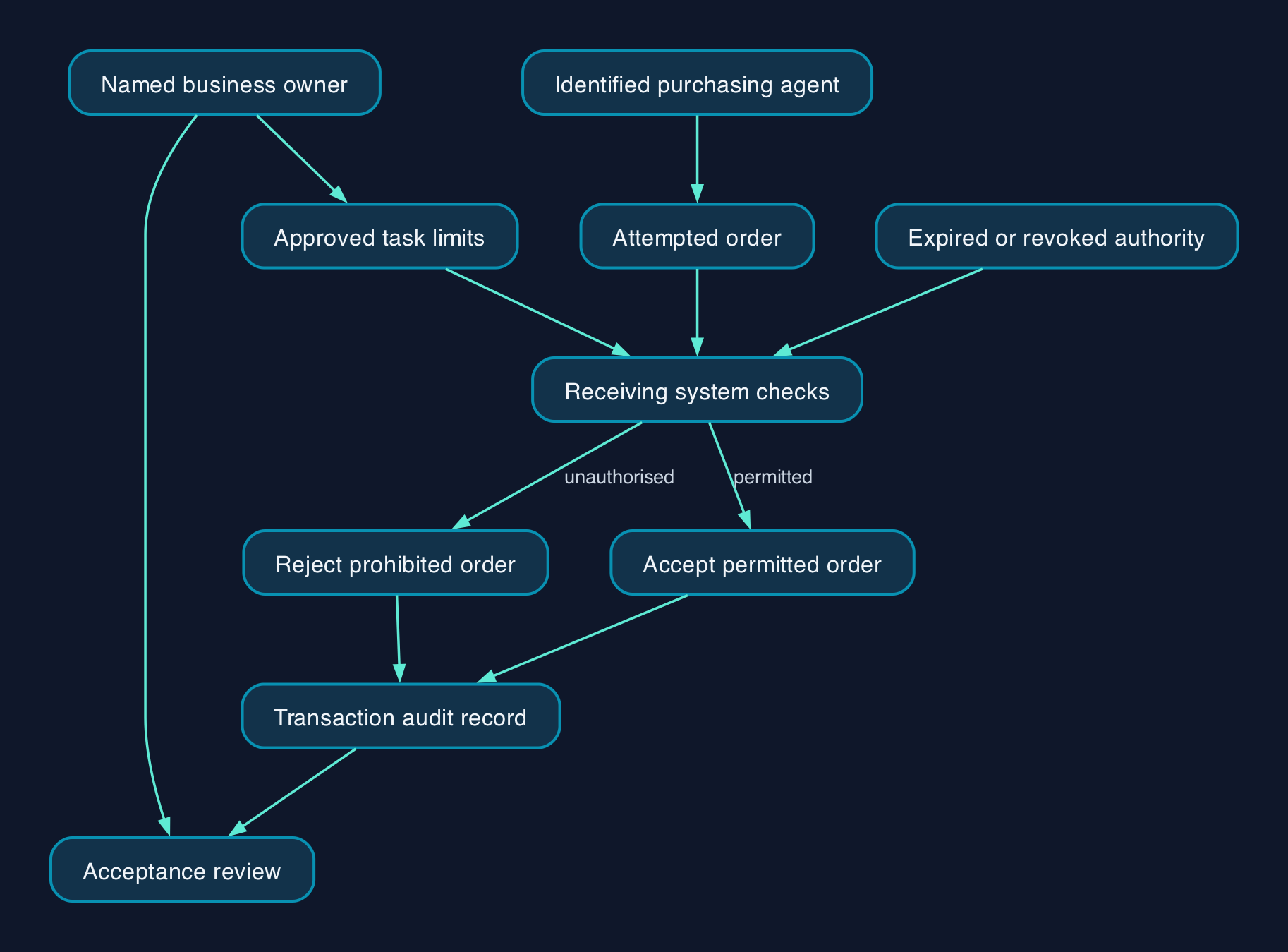
Consider a hypothetical UK wholesaler evaluating a purchasing agent. The approved task is to prepare orders and submit them within limits agreed by management. The supplier demonstrates a successful purchase. The buyer should then withdraw the agent’s authority and ask it to repeat the transaction using its existing access.
My position is straightforward. If the purchasing system still accepts that order, the deployment should fail acceptance, however useful the agent’s stock analysis or supplier recommendations may be.
This test follows a specific failure mechanism. Microsoft’s guidance warns that tokens can persist, credentials can be shared and downstream systems can omit fresh authorisation checks. Switching an agent off in one dashboard does not establish that every connected service will refuse its next request.
The purchasing system is therefore the place to demand evidence. A supplier should show the rejected transaction and the record explaining why it was refused. A screenshot of a disabled identity answers a different question.
For a small business with limited technical staff, this is also a useful procurement boundary. The supplier must explain which controls it delivers, which require application changes and who maintains them after handover.
Estonia has identified the right problem without claiming to have solved it
Aruait’s proposed machine-identity framework would let people and businesses grant agents limited, auditable and revocable authority. Its planned trust registry would verify public-sector and private-sector agents. Its pilot would demonstrate an automated interaction between agents representing different participants. These are project objectives, rather than evidence of a functioning autonomous state.
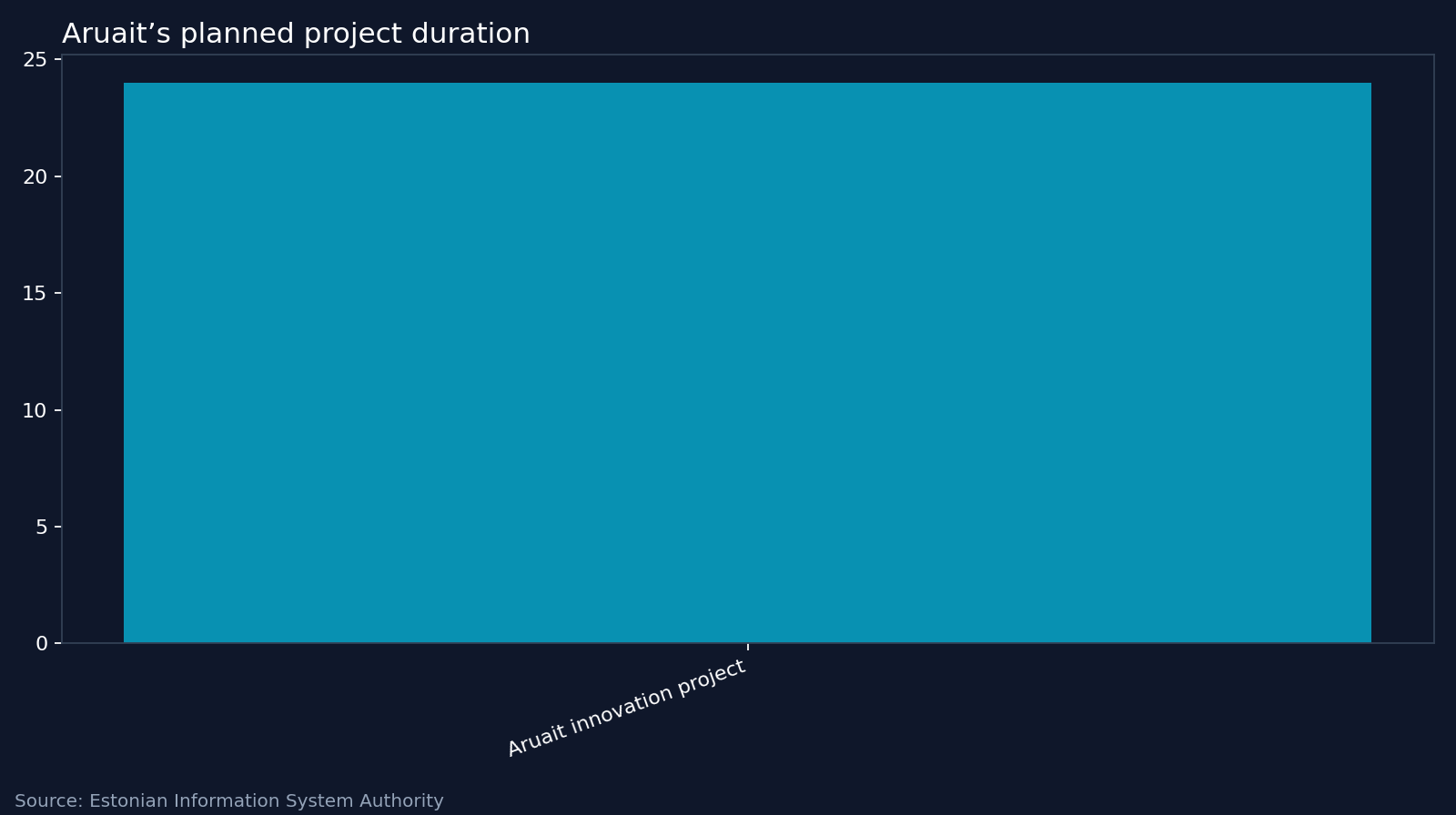
The 24 months allocated to the project should temper any claim that its governance questions are settled. The launch summary describes a blueprint and working pilot, and records unresolved questions about autonomy, accountability and responsibility for errors. It was prepared with AI assistance and revised by the project manager.
The lesson for British buyers is the order of the work. Establish who grants authority, what it permits and how it ends before expanding what the agent can execute.
That lesson does not require importing Estonia’s proposed registry or treating its legal discussions as conclusions about UK contracts. The supplied evidence does not establish whether a particular automated transaction would bind a British company. Where that matters, the business should obtain advice on its intended delegation and contractual terms.
This is not legal advice; consult your legal counsel.
Judge suppliers by the action they can refuse
AWS and Microsoft provide primary documentation for useful controls. Neither should receive a procurement exemption because its platform supplies an agent identity.
AWS’s identity guidance calls for distinct service identities, short-lived credentials and user context propagated through signed claims. Its AgentCore Identity implementation on Amazon ECS also makes an implementation responsibility visible. The customer hosts a service that binds an authorisation response to the correct user session. A managed identity component still leaves integration work for someone to own.
Microsoft’s Entra Agent ID documentation describes restrictions on specified privileged roles and permissions. Its separate least-privilege guidance requires assessment of combined permissions and downstream enforcement. Buyers should test both the individual permission and what a sequence of permitted actions allows the agent to accomplish.
Google Cloud belongs on the shortlist too. Agentic Fabriq’s documentation review describes distinct agent identities and user-delegated access, but the supplied pack lacks the underlying Google pages needed to validate that account independently. It is a research lead, not grounds for awarding Google a higher or lower score.
Give each shortlisted supplier the same purchasing task and ask for the same evidence. Can its proposed deployment refuse an out-of-scope order, reject expired authority and stop further execution after revocation? Can the audit record identify the agent, the person whose authority it used and the action performed?
Those questions allow fair comparison without pretending the products are interchangeable.
The strongest objection is that existing controls already do this
A purchasing system may already enforce approval limits, separate preparation from execution and record who authorised an order. Adding an agent registry or a new mandate database could duplicate that work and create another system to maintain.
That objection should defeat a purchase when the existing controls pass the tests.
I would retain an established workflow that reliably rejects prohibited actions, enforces withdrawal of authority and preserves attribution. A dedicated agent identity may help with those requirements, but its presence should not become a substitute for demonstrating them.
The case for extra work arises when the agent can combine permissions across systems. Microsoft specifically warns about excessive aggregate access, while AWS describes permission creep caused by repeatedly expanding access in response to denied requests. An access error may reveal a correctly enforced boundary. Treating every refusal as a defect can dismantle the controls the buyer intended to preserve.
The related objection is operational. Extra approvals can remove the speed that justified automation. Microsoft acknowledges that approval gates and restricted tools can slow privileged workflows.
My answer is to make autonomy conditional on demonstrated enforcement. Let the agent complete a precisely bounded task where the receiving system can check its authority. Keep a person at the unresolved boundary. For a low-volume business, permanent human approval may cost less than engineering every exception into software.
Spend the budget on the boundary
The evidence supports no comparable UK implementation price, so a licence table would offer false precision. The useful commercial question is who pays to make the receiving application enforce the agreed limits.
Request separate estimates for identity configuration, application integration, audit records, approval handling and revocation testing. Include ongoing access reviews and recovery work. Microsoft identifies upfront design effort, lifecycle administration and downstream dependencies as trade-offs of its recommended controls.
For a managed service proposal, require a named operational owner who can withdraw authority and verify the result across connected services. Specify responsibility for exceptions and changed workflows in the service scope.
CTC’s position is that an agent’s authority should expand only after its limits have been demonstrated. Keep the current system if it passes. Repair the missing control if it fails. Buy another platform only when the supplier can show which unmet requirement it will satisfy.
FAQ
Does Aruait already operate autonomous public services?
The project overview lists an automated pilot as a planned outcome. The supplied materials do not establish that a production service is operating.
What should a UK small business test first?
Start with a consequential action that the agent must be refused permission to perform. In a purchasing pilot, I would test an attempted order after authority has been withdrawn and inspect the purchasing system’s response.
Does giving an agent its own identity solve the problem?
It helps distinguish the agent as an actor, but permissions and enforcement still need attention. Microsoft’s guidance separately calls for named owners, scope controls, tool restrictions and downstream checks.
What should a revocation demonstration include?
Require an attempted action using previously issued access after authority is withdrawn. Microsoft identifies persistent tokens, shared keys and missing downstream checks as containment problems, so inspecting the receiving service’s response matters.
Must a business purchase a new governance platform?
My recommendation is to retain existing controls when they demonstrably enforce the required limits and preserve attribution. A supplier proposing another platform should identify the specific gap it closes and the integration work left to the customer.
Should every transaction require human approval?
I would retain approval where the business cannot yet enforce a clear execution boundary. For a bounded workflow that passes the relevant tests, removing routine approval can be a deliberate management decision rather than an assumption built into the software.
Sources
- RIA – Reason Reserve / Aruait, updated 28 August 2026
- RIA – Aruait launch event summary, event held 12 June 2026
- AWS – Agent identity and permission management
- Microsoft Learn – Least privilege for AI agents
- AWS – Secure AI agents with Amazon Bedrock AgentCore Identity on Amazon ECS
- Microsoft Learn – Authorization in Microsoft Entra Agent ID, updated 12 June 2026
- Agentic Fabriq – Which Identity Providers Support AI Agent Management?, published 25 September 2026