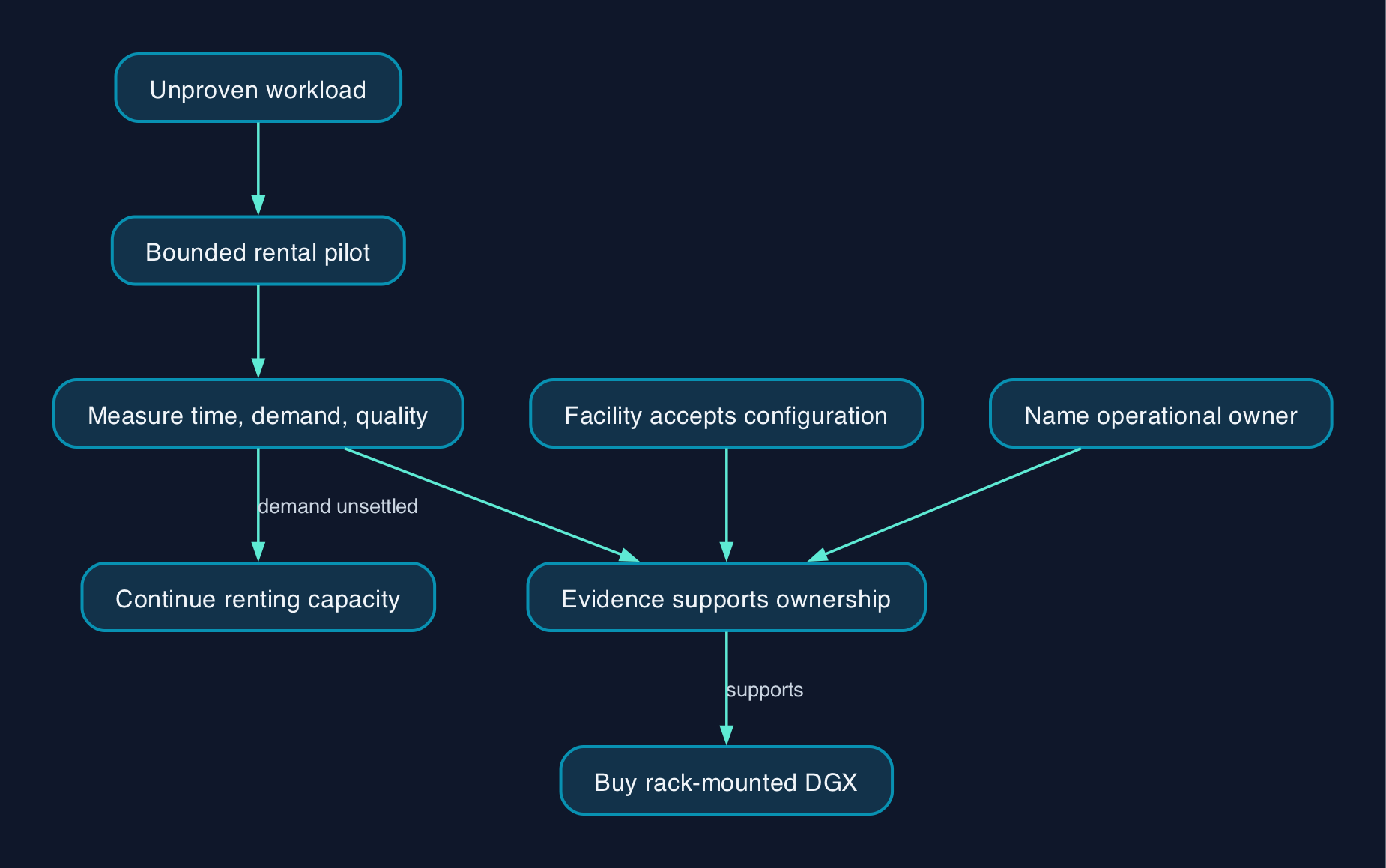
For a UK small or mid-sized business with an unproven AI workload, my recommendation is to rent suitable GPU capacity for a bounded pilot before buying a rack-mounted NVIDIA DGX system. Ownership becomes credible when repeated measurements show sustained demand, the facility can support the equipment, and someone owns its operation. Renting first is a way to establish those facts, not a promise of lower lifetime costs.
The decision starts with useful work
Editorial position: approve a workload test before approving the server.
For this decision, the relevant DGX systems are rack-mounted machines such as H100 and B300. NVIDIA also documents a desk-side DGX Station GB300, so a proposal labelled simply “DGX” needs a precise model before anyone compares costs or facilities requirements. NVIDIA DGX Station description
A hypothetical British manufacturer developing visual inspection software should first establish how long a representative training run takes, how frequently retraining is needed and whether production inference must run at the factory. Those answers define the buying problem. “We need AI capability” does not.
For a software business serving customers continuously, the test should instead measure response time, throughput and output quality under realistic demand. The finance director needs the cost of meeting that service requirement, including quiet periods and failures.
I would favour ownership when an identified queue of valuable work repeatedly fills the proposed machine and predictable access matters enough to justify the commitment. I would favour a rental pilot when demand, model choice or technical feasibility remains unsettled.
Neither position requires an invented utilisation threshold. A busy GPU producing unusable results is not an economic success.
Facilities and operations belong in the proposal
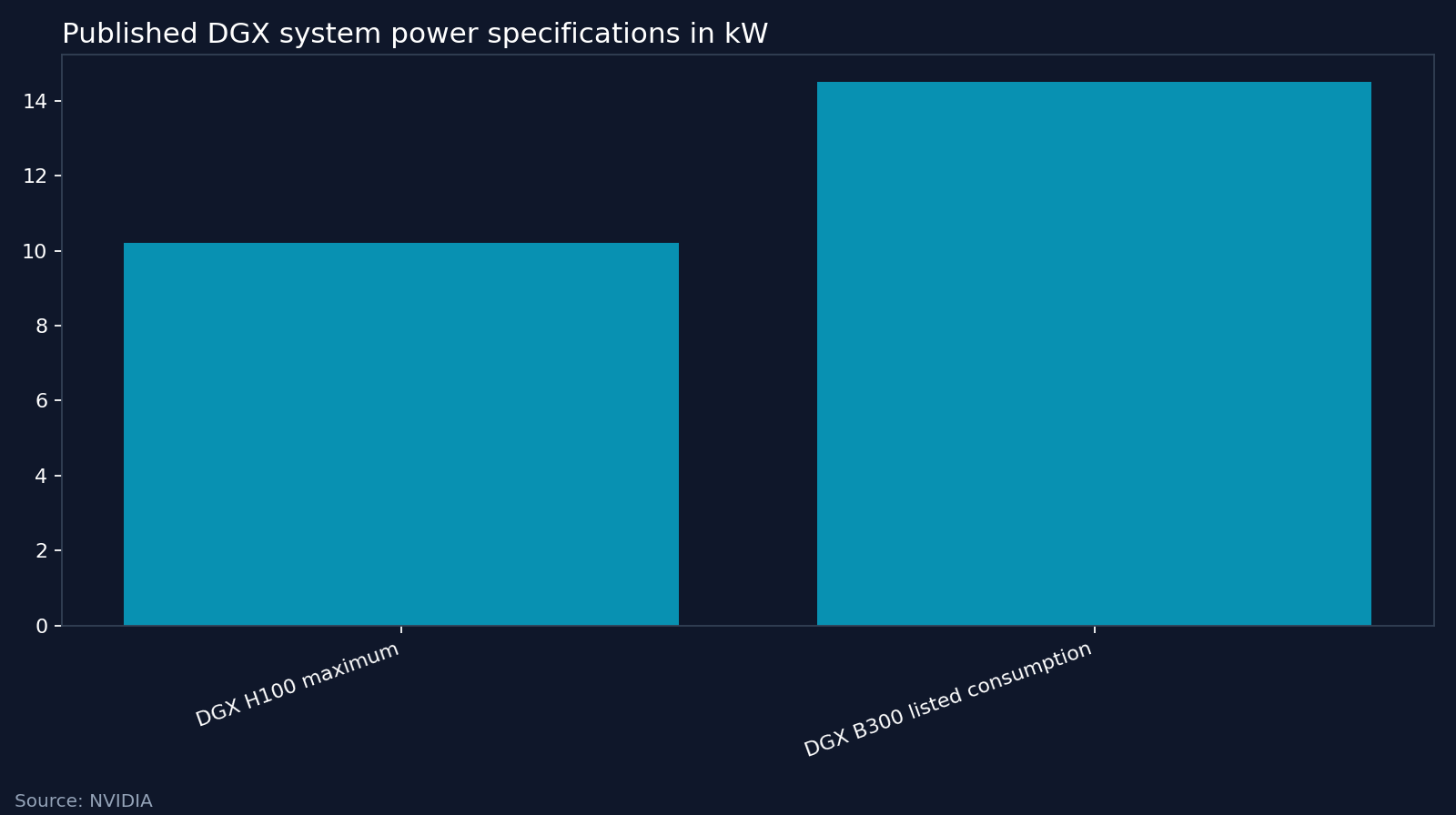
The physical specifications make the ownership decision concrete. NVIDIA lists DGX H100 at 10.2 kW maximum, while its B300 guide lists 14.5 kW power consumption. These figures describe different systems and specification labels; they do not establish which delivers more useful work per unit of electricity. H100 specifications, B300 specifications
Ask the proposed UK hosting facility to accept the exact configuration in writing. Its assessment should cover electrical supply, cooling, rack space, delivery access and maintenance arrangements. NVIDIA’s planning guide explicitly describes the interaction between power, cooling, space and networking. NVIDIA facility planning
The proposed workflow is straightforward. Approved data reaches the compute environment, the application runs, and results return to the business. Management access, stored copies and recovery arrangements need named owners at each stage.
The following is a proposed allocation for procurement, not a description of any supplier’s contract.
| Responsibility | Buying a DGX system | Renting GPU capacity |
| --- | --- | --- |
| Physical infrastructure | Name the internal facility team or hosting contractor responsible for installation and faults | Obtain the provider’s infrastructure scope and escalation terms |
| Software operation | Assign responsibility for updates, dependencies and workload scheduling | Establish which software layers the service includes and which your team runs |
| Data handling | Define access, storage, backup and recovery ownership | Specify permitted locations, access, retention and export arrangements |
| Application failure | Name the team that diagnoses failed jobs and restores service | Separate application support from infrastructure support in the contract |
| Exit | Plan data removal, equipment disposal and any replacement platform | Test export and deletion procedures and price the transfer work |
For a small IT team, the decisive question may be who can restore the workload when its specialist is unavailable. Put that answer beside the hardware specification.
Compare complete costs in pounds
The available evidence does not establish a current rack-mounted DGX purchase price, equivalent UK-located rental capacity or a comparable GBP rental quotation. It therefore cannot support a break-even date or a claim that renting is cheaper.
Lambda’s published H100 SXM rate of US$3.99 per GPU-hour, plus applicable taxes, is a useful commercial reference. However, the supplied page does not establish the deployment region for that offer, and its GPU-count selectors require confirmation of the configuration being purchased. It is not a verified UK-hosted, single-GPU quotation. Lambda instance pricing
For a UK procurement exercise, request both proposals over the same operating period. Require the currency, VAT treatment, payment commitment, hardware configuration, support scope and exclusions. If a rental offer remains in dollars, make exchange-rate exposure visible rather than presenting a converted estimate as the supplier’s UK price.
| Cost component | Ownership proposal should include | Rental proposal should include |
| --- | --- | --- |
| Compute | Exact system, installation and financing charges where relevant | Total instance charge, GPU count, minimum billing period and commitment |
| Facilities | Rack space, power, cooling and connectivity | Included infrastructure and any dedicated-capacity charges |
| Data | Storage, backup and network equipment | Persistent storage, transfers and any retrieval or exit charges |
| People | Deployment, training, administration and incident cover | Environment setup, application operation and purchased support |
| Continuity | Repair arrangements and capacity during an outage | Capacity assurance, interruption conditions and recovery arrangements |
| Exit | Migration, data sanitisation and disposal, less any evidenced residual value | Export, deletion, contract termination and migration work |
Avoid counting the same service twice when a hosting or support package bundles several components. Equally, do not treat an unpriced task as free.
My preferred comparison is total cost per accepted workload result, alongside the time required to deliver it. That might mean an approved training run or a defined batch of inference requests meeting the business’s quality and response-time requirements.
When each approach deserves a place
Buy the rack-mounted DGX when measured demand supports the specific configuration, the facility has accepted it, and the operational team can maintain the service. Require a workload test before treating a specification sheet as evidence of business value.
Rent capacity when the immediate decision is whether the workload works, how much compute it needs or whether demand will persist. Make availability and commitment terms part of that choice. Lambda’s distinction between first-come instances and reserved-capacity enquiries illustrates why rental access needs its own procurement scrutiny. Lambda capacity options
Consider owned baseline capacity with rented overflow only after testing the workload in both environments. Treat that as a proposed design requiring compatible software, acceptable transfer times and a clear process for moving jobs.
Keep or improve existing equipment when it already meets the required completion time and quality. Before replacing it, establish whether compute is actually the constraint.
Editorial analysis
The strongest case for buying DGX is a repeatable workload with a named owner, an accepted facility design and a costed operating model. The weakest case is a forecast of future AI activity with no measurements behind it.
Renting can provide the evidence needed to make ownership a disciplined decision. Set the pilot’s acceptance conditions in advance, record the full bill and staff time, and take the results back to procurement. Buy when those results justify the machine.
FAQ
Is NVIDIA DGX too large a commitment for a UK mid-market company?
Company size alone does not decide suitability. I would assess the proposed model against measured workload demand, facilities and operational cover; NVIDIA’s DGX H100 specification alone requires planning for up to 10.2 kW of system power. NVIDIA H100 planning guide
Does renting guarantee access when a project needs it?
Do not assume it does. Lambda describes its self-service instances as first-come access and separately invites reserved-capacity enquiries, so obtain availability and reservation terms before committing to a delivery date. Lambda pricing
Does a rack-mounted DGX always require liquid cooling?
No. NVIDIA explicitly lists air cooling for DGX H100, but the chosen facility must still meet that system’s operating requirements. Confirm the exact model and installation design rather than extending one model’s specification across the range. NVIDIA H100 cooling specifications
What evidence should unlock a purchase?
I would require a representative workload test, a complete ownership quotation and a rental proposal meeting the same output and timing requirements. The purchase should also have named operational cover and written acceptance from the hosting facility.
Sources
- NVIDIA — Planning a Data Center Deployment for DGX H100 Systems
- NVIDIA — Introduction to NVIDIA DGX B300 Systems
- NVIDIA — DGX Station Software Stack
- Lambda — GPU Cloud Pricing