UK IoT buyers should demand an eSIM exit test
CTC argues that new, hard-to-reach cellular IoT equipment should pass a supplier-switching test before acceptance. Buyers need a working recovery procedure and contractual exit rights, while small laptop fleets may justify a lighter approach.


UK businesses should make a demonstrated change of connectivity supplier a purchase condition for new, hard-to-reach cellular IoT equipment. A blanket requirement for office laptops is harder to justify. GSMA defines the remote management mechanisms, but buyers still need proof that their chosen service lets them use those mechanisms and leave. Our position is simple: pay for control you can exercise, with recovery and exit tested before acceptance.
Key pointers
- Require a supplier-change demonstration before accepting new cellular equipment that would be expensive to reach.
- Ask who can authorise profile changes and who restores connectivity after a failed change.
- Put the right to change provider, associated charges and transition assistance in the contract.
- Keep user-driven provisioning on the shortlist for a small laptop fleet.
- Compare complete service quotations in GBP, with VAT treatment and exit costs stated.
- Treat consumer eSIM awareness as market context, never as evidence that a business fleet is ready.
Make supplier switching an acceptance condition
For new remote equipment, Compare the Cloud’s editorial position is that accepting untested connectivity exit arrangements is the wrong buying decision.
Consider a hypothetical UK agricultural business installing cellular sensors in locations that require a separate maintenance visit. Its buying question is whether it can move those devices to another connectivity supplier without visiting each installation. A successful demonstration would answer that question more directly than a specification sheet carrying an eSIM label.
GSMA’s architecture description supplies the technical basis. An eIM can trigger profile downloads and remotely enable, disable or delete profiles. An IoT Profile Assistant, or IPA, sits on the device or its secure SIM component and acts as a proxy in the process.
That is enough to justify asking for a working demonstration. It is not evidence that every commercial combination supports the buyer’s intended change.
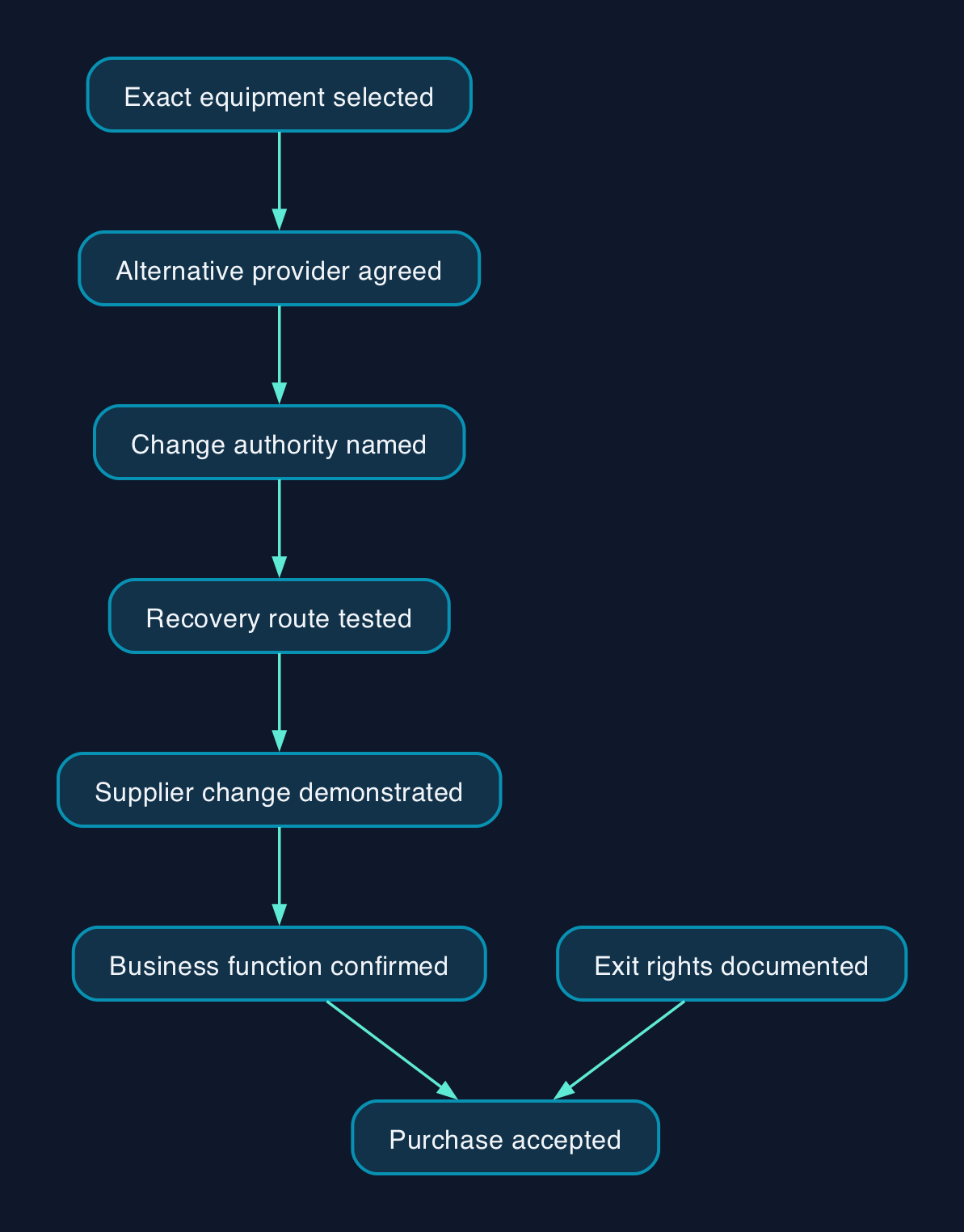
Our proposed acceptance test therefore starts with the exact equipment being purchased. Require the supplier to demonstrate a controlled move to an agreed alternative connectivity provider, confirm that the device’s business function still works, and demonstrate the agreed recovery procedure. Record who authorises the change and who handles a failure.
Before disabling a working profile, establish and test the recovery route. A demonstration that depends on someone standing beside the device cannot establish that the same operation will work unattended.
A remote switching feature needs a contractual right
One detail in the commercial evidence makes the case for reading beyond the headline.
Onomondo’s pricing page says its eIM can manage remote profile changes alongside its connectivity plans or independently with customers’ own SIMs and connectivity. The same page marks “Freedom to Leave” as available on Enterprise, with “No” against Sandbox, Pro and Fleet.
Those statements may describe different services or entitlements. The supplied extract does not explain their relationship, so it would be unfair to infer that a particular customer cannot leave.
It does establish a precise question for the quotation: what does the purchased package permit the customer to move, under whose authority, and at what charge?
That question belongs in every relevant tender. Ask whether the buyer can appoint another connectivity provider, retain the equipment and obtain the assistance needed for the transition. Require the supplier to distinguish technical capability from contractual entitlement.
A successful profile change during a sales demonstration is only half the acceptance test. The contract must give the customer the right to perform the corresponding change after purchase.
Buy the layer you need
These offerings address different responsibilities. Ranking them as interchangeable eSIM products would obscure the decision.
| Offering | What the supplied evidence establishes | The buying question |
| --- | --- | --- |
| Microsoft Intune | [Download-server configuration for supported Windows 11 devices](https://learn.microsoft.com/en-us/intune/intune-service/configuration/esim-device-configuration-download-server) | Can the existing device-management arrangement provision the intended laptops through the chosen operator? |
| Microtalk Business eSIM | [Supplier-described central activation, suspension, usage monitoring and shared data pools](https://microtalk.co.uk/business-esim) | Which exact devices are supported, and who owns recovery and supplier transition? |
| Onomondo eIM | [Supplier-described remote IoT profile management, bundled or standalone](https://onomondo.com/en-gb/pricing/) | Can the proposed device and service combination complete the required supplier change? |
For a UK buyer, require written coverage and support terms for the intended locations. A UK-facing product page does not answer whether a particular installation will work.
Avoid expanding the shortlist merely to include familiar technology brands. This evidence supports examining laptop administration, workforce connectivity and IoT profile management as distinct purchases. It does not support a comparative reliability ranking.
The strongest objection is paying for flexibility you never use
A finance director can reasonably object that remote management adds another service to buy and administer. If the business never changes connectivity supplier, the promised flexibility may deliver no visible return.
For a small laptop fleet, that objection can win. Microsoft explicitly describes Mobile Plans as suitable for businesses with a few PCs, while explaining that per-device user interaction becomes a greater effort at scale. We would not require another management platform simply because remote provisioning exists.
For hard-to-reach IoT equipment, we would still make demonstrated supplier switching the default purchase condition. The reason is the buyer’s exposure if a future change requires physical access. That is an editorial assessment of the decision, not a claim that the evidence proves financial savings.
The requirement must remain challengeable. If a supplier’s premium exceeds the buyer’s defensible estimate of administration and physical-access costs, accepting a less flexible arrangement may be sensible. Record that trade-off explicitly. Do not replace a working fleet solely to satisfy a new purchasing preference.
This distinction gives the position its boundary: stronger acceptance requirements for new remote equipment, with an economic exception, rather than a compulsory replacement programme.
Price the freedom before signing for it
The evidence does not provide comparable GBP totals for these services.
In the supplied 24 September 2026 snapshot, Onomondo lists data starting at €0.0025 per MB for Pro, Fleet and Enterprise. That starting rate does not establish the complete eIM price, applicable UK VAT treatment or the cost of the buyer’s intended deployment. Microtalk requests a personalised quotation.
Ask competing suppliers to price the same contract period and operating scenario.
| Cost component | What the quotation needs to settle |
| --- | --- |
| Equipment and setup | Supported hardware, configuration, pilot work and training |
| Connectivity | Allowances, overage, roaming and inactive-device charges |
| Management | Platform access, profile operations and minimum commitments |
| Support and recovery | Service hours, incident ownership and chargeable visits |
| Supplier exit | Transition assistance, cancellation charges and continuing access during handover |
Keep unknown costs visible. An attractive data rate cannot resolve an unpriced requirement to visit equipment or negotiate a supplier transition.
Consumer awareness cannot settle this decision
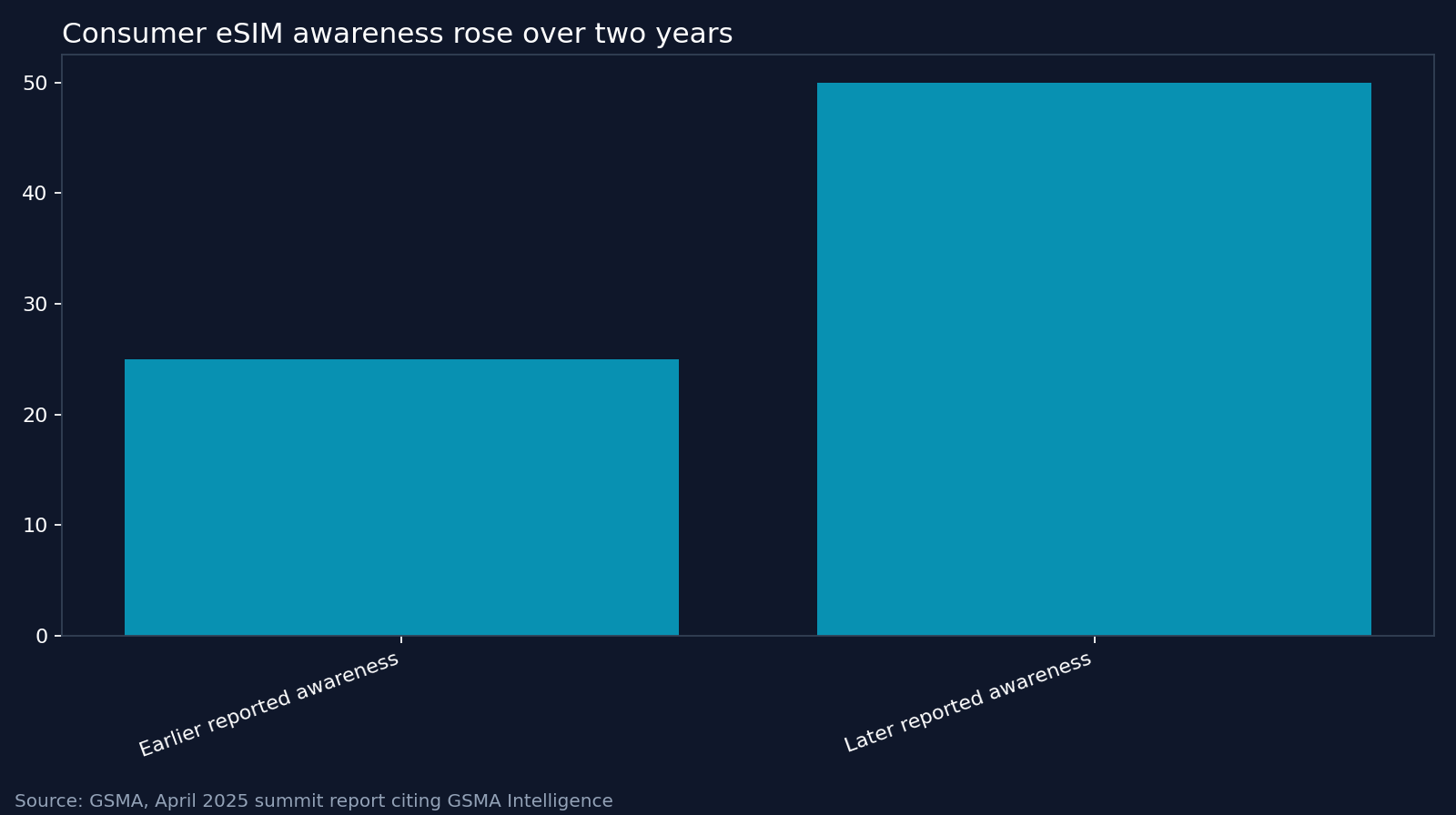
GSMA’s April 2025 summit report, citing GSMA Intelligence, puts consumer eSIM awareness at 25% and then 50% over two years. The supplied extract lacks the survey detail needed to interpret those figures as UK fleet demand.
A procurement deadline derived from that increase would be arbitrary. GSMA’s SGP.32 v1.3 publication establishes a technical specification, not a mandatory adoption date.
The useful deadline is the buyer’s own acceptance date. By then, a remote-equipment supplier should have demonstrated the agreed change and recovery procedure, and the contract should preserve the customer’s right to use it. That is the standard we would apply before signing.
FAQ
Should every UK business require eSIM management now?
Our recommendation applies primarily to new cellular IoT equipment that is difficult or expensive to reach. For a few laptops, Microsoft documents a lighter, user-driven approach. Require central management when the work and administration justify it.
Does SGP.32 guarantee supplier portability?
No such guarantee is established by the supplied evidence. GSMA describes the specification’s technical scope, including provisioning and management interfaces. Test the intended combination and obtain the necessary contractual rights.
What should an exit test demonstrate?
Our proposed test covers a controlled change to an agreed alternative connectivity provider on the equipment being purchased. It must also confirm that the device still performs its business function and that the agreed recovery procedure works.
Is remote profile switching the same as automatic failover?
The supplied GSMA architecture description establishes remote profile operations, not a blanket promise of automatic failover. If automatic recovery is required, specify its trigger and acceptance conditions separately.
Can we calculate savings from the published data rate?
Onomondo’s starting data rate is insufficient for that calculation. Obtain the full service quotation, then compare it with equipment, staff time, support and exit costs over the same period.
Should existing equipment be replaced to meet this requirement?
We would not replace working equipment solely to adopt remote management. Apply the acceptance requirement at the next relevant purchase, and assess an earlier change only against a documented business need.
Sources
- GSMA, SGP.32 v1.3, resource page dated 28 May 2026
- GSMA, What is eSIM for Consumer and IoT?
- GSMA, What next for eSIM? Challenges and opportunities in the SGP.32 era, 14 April 2025
- Microsoft Learn, Configure eSIM download server using the settings catalog in Microsoft Intune
- Microtalk, Business eSIM
- Onomondo, IoT Data Plans and SIM Pricing, supplied snapshot dated 24 September 2026