British fleets should buy proven flexibility before V2G promises
Australia's expanding vehicle-to-grid trial gives British fleets a reason to investigate energy flexibility. Buy only when a supported service beats smart charging on full cost and protects vehicle availability.


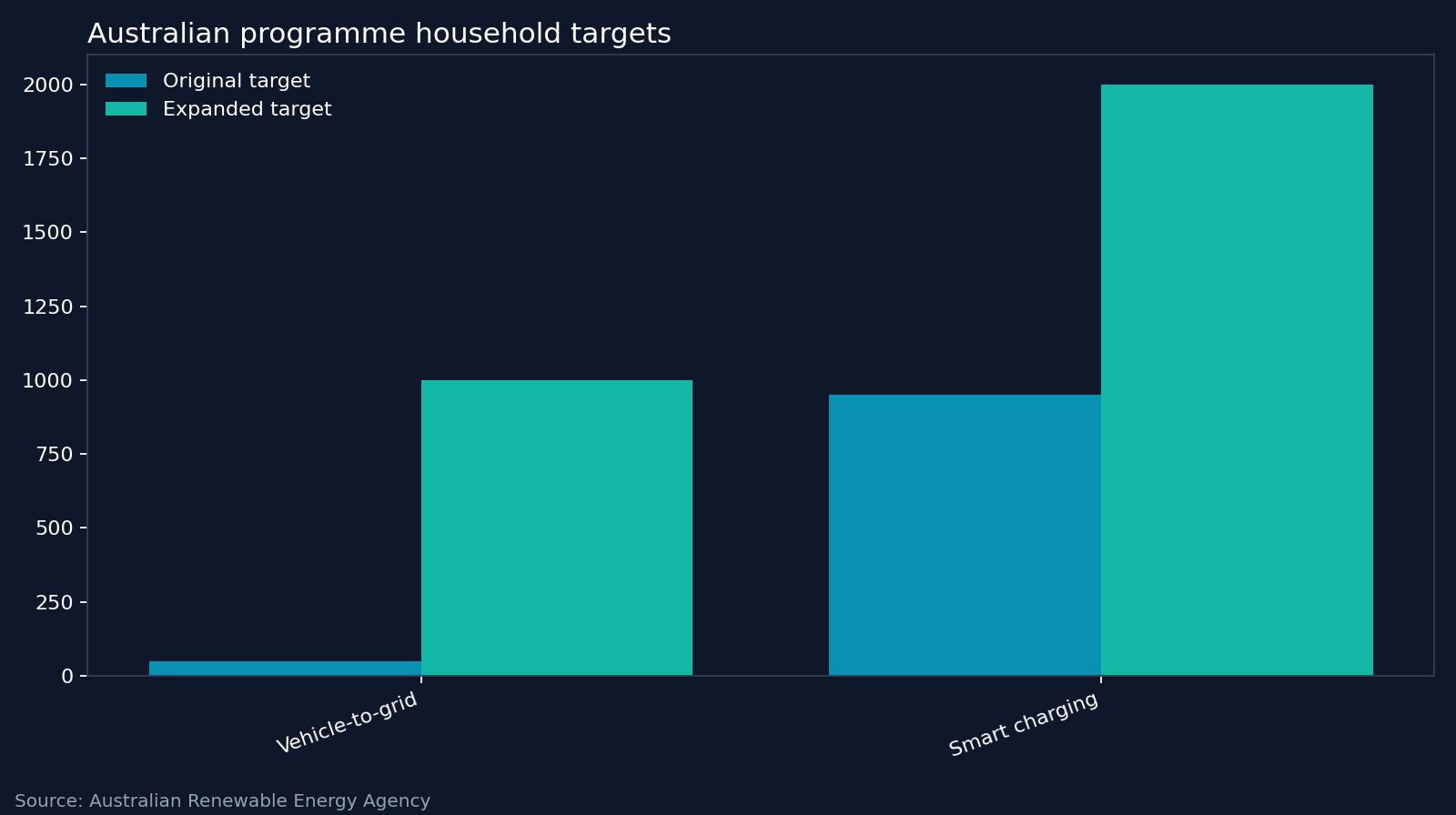
British companies should assess vehicle-to-grid at fleet renewal, but approve it only when the additional value exceeds the full cost and protects every departure. Australia’s planned trial expansion from 50 to 1000 households makes the technology worth examining, without establishing a British fleet return. The procurement question is whether a supported service can use parked vehicles profitably around the work those vehicles must perform.
Key pointers
- Ask for a separately priced vehicle-to-grid option at fleet renewal.
- Record actual connection windows before assigning an income to parked batteries.
- Require written confirmation of the vehicle, charger, software and energy-service combination.
- Compare the proposal with improving existing smart charging.
- Include installation, replenishment electricity, support and battery-use terms in the financial assessment.
- Reject any pilot that earns export income by compromising required departures.
Australia is testing a service, not just a charger
Vehicle-to-grid, or V2G, allows a compatible electric vehicle to export stored electricity to the grid. Smart charging controls when it takes electricity in. ARENA’s project covers both, with wholesale electricity prices guiding the charging and bidirectional operation. ARENA’s project description
British buyers should keep those propositions separate. A proposal to reduce charging costs should have to demonstrate why exporting electricity adds enough further value to justify its equipment and operating requirements.
The Australian expansion matters because its stated research covers customer behaviour, technology performance and market integration. Those are precisely the questions a fleet buyer should ask before treating a vehicle as an energy asset. The expanded trial’s intended learning
My position is that fleet tenders should invite a priced flexibility option, with acceptance tied to transport performance. Asking the question creates a chance to evaluate the service. It creates no obligation to buy it.
Start with the working day
A hypothetical British maintenance business with predictable depot returns could begin by recording arrival times, departure requirements and charging demand. An emergency call-out fleet should test the proposal against its need to leave unexpectedly.
These are proposed assessment cases, not customer results. They expose the same constraint. Battery capacity only has commercial value for an export service when the vehicle is connected and sufficient energy remains available for driving.
For UK procurement, require evidence of a complete supported installation. TeslaCharger’s UK bidirectional charging assessment identifies the need to align the vehicle, bidirectional hardware, energy service and network approval, and distinguishes that arrangement from a charger marketed as “ready”.
The supplied research does not establish a verified UK fleet tariff, installed price or complete compatibility list. A buying decision therefore needs a written proposal for the actual vehicles and site.
Give one supplier contractual responsibility for resolving failures across the arrangement. Before signing, ask who investigates when the car accepts a charge but refuses an export instruction. A list of compatible components is insufficient if nobody owns the failed service.
Compare commercial approaches fairly
Amber describes an Australian model combining wholesale prices with automated charging and discharge, without a minimum plug-in time. It also reports a customer earning AU$500 during one heatwave afternoon. These are supplier statements about its programme, not a dependable annual return. Amber’s programme and reported customer outcomes
Other Australian programmes illustrate different approaches. Zecar reports that AGL’s residential trial covers several vehicle brands, while Origin’s trial combines a leased vehicle, bidirectional charger and energy offer with connection commitments. The evidence supports comparing those delivery models, not ranking their economics or assuming British availability. Reported AGL and Origin trial arrangements
For British procurement, each model suggests a different contractual test.
| Approach to evaluate | Question the buyer should settle |
| --- | --- |
| Wholesale-linked automated service | Who carries price risk, and how are receipts and charges calculated? |
| Vehicle, charger and energy bundle | What is the combined commitment, and what happens when the vehicle or supplier changes? |
| Trial participation | Which costs are subsidised, and what survives when the trial ends? |
| Improved smart charging | How much of the proposed saving can be achieved without exporting? |
These are assessment criteria, not verified UK offers. Keeping existing equipment and improving scheduling should remain eligible to win the comparison.
Price the additional work
The financial case should measure V2G against improved smart charging over the intended ownership or lease period. Comparing it only with unmanaged charging risks crediting export capability for savings that better scheduling could deliver.
Ask for separate figures for avoided charging costs, reduced building imports and export receipts. Require the supplier to explain the measurement behind each figure and prevent the same energy benefit appearing twice.
The quotation should include compatible hardware, installation, site work, commissioning, metering, software and support. The operating model should also account for electricity bought to replenish exports, conversion losses, staff time and exit costs. Unknown inputs belong in the decision as unresolved costs.
Battery use deserves a written agreement rather than an assumed allowance. ARENA’s planned degradation study establishes that battery performance is part of the research programme; it does not establish a universal wear rate or warranty outcome. Battery testing in the project scope
My acceptance test would require the proposal to remain worthwhile without exceptional export events. A business should be able to understand the return during ordinary operations before assigning any value to a rare price spike.
Give transport requirements control of the system
ARENA places software at the centre of the Australian project, including development of Amber’s SmartShift platform, vehicle-to-charger communications and home energy management. These are specified project activities, not proof that arbitrary vehicles and chargers will work together. Software and integration work
For a British fleet pilot, I would use the following operating model.
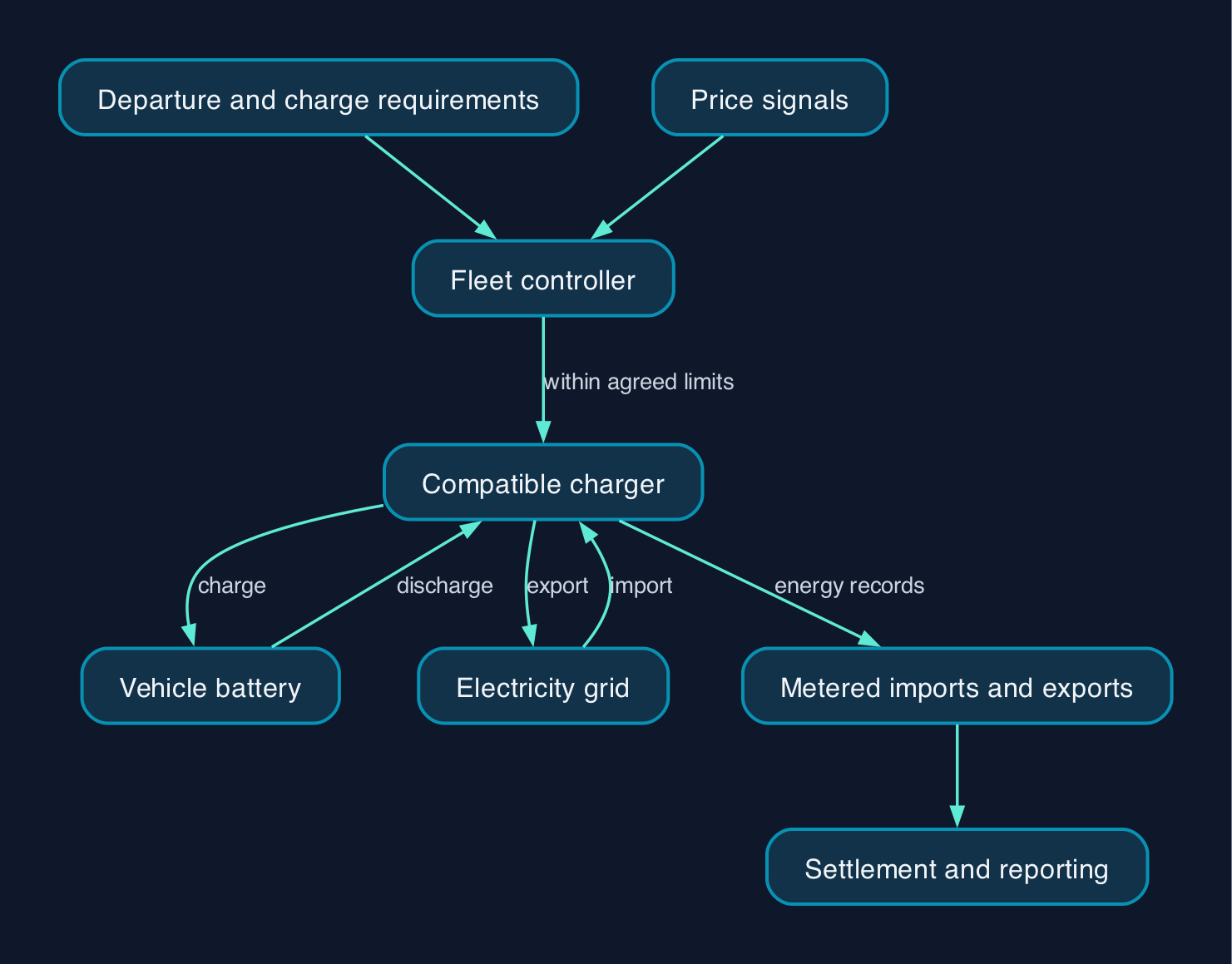
The driver or dispatcher supplies a departure time and required charge. A controller considers those requirements alongside price signals and instructs compatible equipment within agreed limits. Electricity moves between the grid, charger and vehicle battery, while metered imports and exports feed settlement and reporting.
That is a proposed design. Its acceptance checks should establish that the controller honours transport requirements and leaves records explaining each charging or export decision.
Assign fleet operations responsibility for vehicle readiness, facilities for the installation and site constraints, IT for access and integration records, and finance for reconciliation. Name one accountable service owner to resolve disputes across those responsibilities.
For technology providers, dependable coordination is the useful product. A fleet manager needs to see whether the next departure was protected, alongside what the battery earned.
The strongest objection is that the battery drives away
The strongest argument against fleet V2G is that transport demand can remove the storage exactly when an energy service wants it. A stationary battery stays at the premises; a working vehicle follows its jobs.
That objection should defeat proposals whose returns depend on unrealistic connection windows. Exclude periods when vehicles are away, preserve the energy required for driving and assess what remains.
Predictable schedules create a case for testing, not automatic approval. Run a limited pilot against actual departures and metered results. Reject the arrangement if energy optimisation repeatedly compromises readiness, even when export receipts look attractive.
The useful outcome may be a smaller participating group rather than the whole fleet. Vehicles with suitable schedules can be assessed separately from those whose operational requirements make export impractical.
Editorial analysis
British businesses should make suppliers compete on demonstrated additional value and clear responsibility. At renewal, request a priced V2G option, a supported vehicle-and-charger pairing, written battery-use terms and a named owner for service failures.
Approve expansion only after the pilot protects departures and shows a return against improved smart charging. Where that test fails, retaining the simpler arrangement is a sound procurement result.
FAQ
What is the difference between smart charging and vehicle-to-grid?
Smart charging controls when a vehicle takes electricity from the grid. V2G adds the ability to export stored electricity through compatible equipment. ARENA’s programme tests both approaches with separate participation targets. Programme scope
Should a British company replace working chargers now?
My recommendation is to measure charging patterns and improve scheduling first. Replace equipment only after a site-specific proposal demonstrates enough additional value from export capability. Require the supplier to demonstrate the complete supported configuration before purchase.
Does the Australian expansion prove that British fleets will make money?
No, the announced household targets establish the planned research scale. ARENA says the expansion will investigate behaviour, technical performance and market integration. A British fleet needs evidence from its own schedules, costs and proposed contract. Purpose of the expanded trial
What should a first fleet pilot measure?
Measure departure readiness, connection time, imported and exported energy, net financial benefit and support incidents. Compare the results with smart charging without export. Give one accountable owner authority to resolve failures across fleet operations, facilities, IT and suppliers.
Sources
- ARENA – Amber vehicle-to-grid expansion, announced 29 May 2026 and updated 01 June 2026
- ARENA – Automating EV charging in line with wholesale pricing, updated 29 May 2026
- Amber Electric – Vehicle-to-grid expansion and commercial approach, published 29 May 2026
- TeslaCharger – UK vehicle-to-grid and vehicle-to-home assessment, updated 19 July 2026
- Zecar – Australian trial expansion and alternative service approaches, published 29 May 2026