
UK manufacturers should use the government’s AI adoption push to seek practical support, test a specific production problem and strengthen an investment case. The strongest idea in the advanced manufacturing plan is its proposed Scan, Pilot, Scale pathway. Compare the Cloud’s view is that public support should help companies establish whether a project deserves investment, with expansion conditional on measurable results, affordable running costs and clear responsibility when something fails.
What the programme changes for a manufacturing buyer
The practical opportunity is a more organised route to expertise, testing and support. The manufacturing plan’s summary proposes connecting existing institutions around a common adoption pathway, with workforce readiness and phased co-investment alongside technology deployment. These are proposals in an industry-led plan. The government’s interim response says it will consider the champions’ ideas; publication alone does not establish implementation of every recommendation.
For a small manufacturer, the first useful conversation should therefore concern a production problem. Bring a record of rejected parts, maintenance interruptions or time spent preparing quotations. Ask an adviser which intervention could improve that outcome, what evidence would establish success and what the business must contribute.
A director should also ask which support actually applies to the company’s location, size and project. The sources cited here do not establish a currently open manufacturing application window, an individual award amount or a confirmed local service appointment.
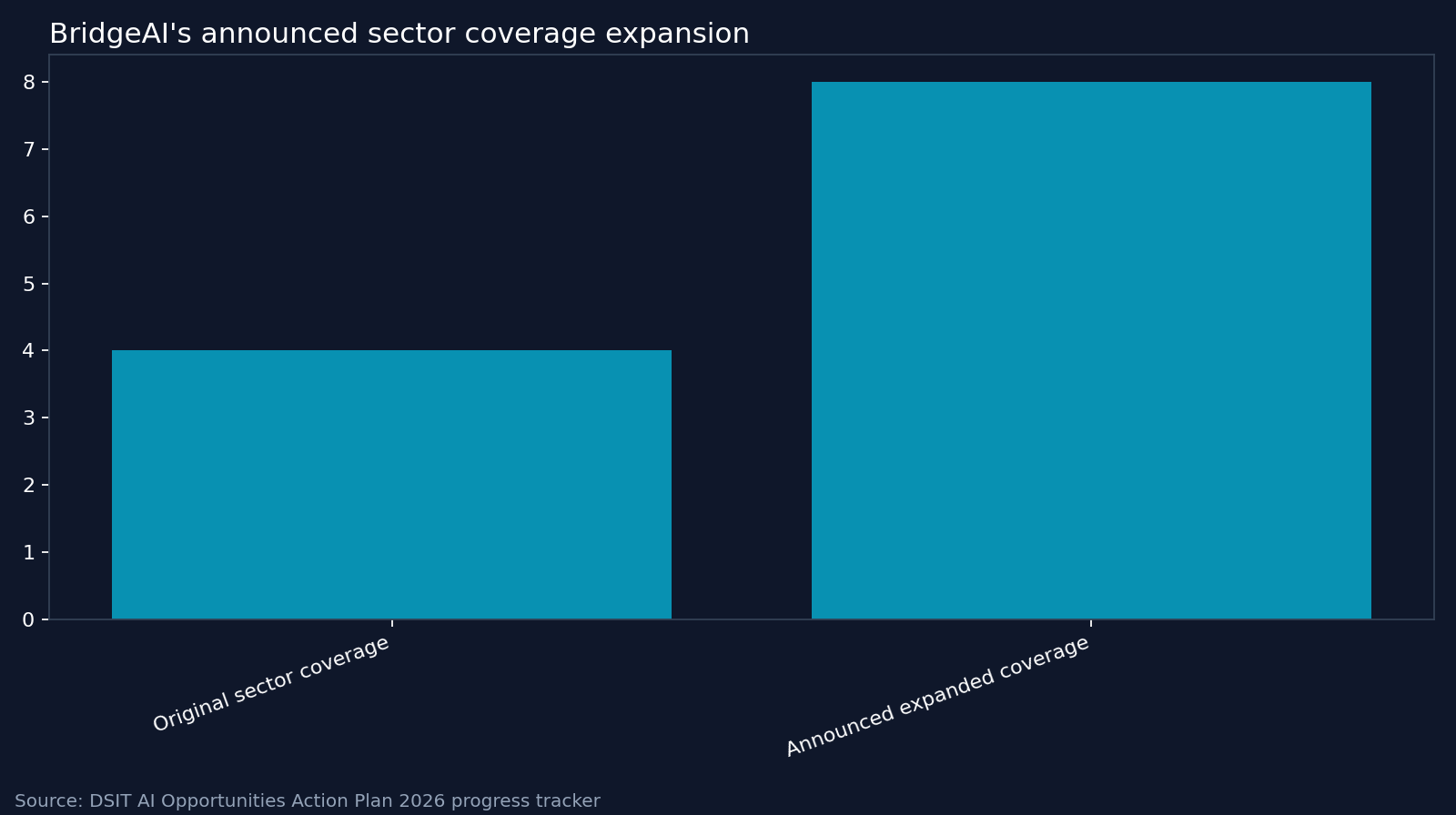
The policy’s ambition is visible in BridgeAI’s announced expansion from 4 sectors to 8, recorded in the government progress update. A broader remit may create more routes into support. It does not tell a buyer how quickly an adviser can inspect a production line or whether funding will cover integration.
Start with the loss your factory can measure
The manufacturing report identifies predictive maintenance, quality control and supply-chain optimisation as potential applications. It also stresses that industrial systems must work reliably alongside equipment, workers and live processes, with stronger evidence required before expansion. Those are potential uses and deployment conditions, not guaranteed returns.
Consider a hypothetical components manufacturer investigating visual inspection. Its starting point should be the cost and frequency of defects, the variation between products and the availability of reliable inspection records. Before buying anything, the quality manager should define both unacceptable missed defects and the burden of incorrectly rejecting good parts.
That creates a fair test. An AI proposal must compete against the existing inspection process and credible improvements such as better lighting, clearer tolerances or conventional automation. If a simpler intervention solves the problem at lower whole-life cost, choosing it is sound investment management.
Made Smarter’s published toolkit introduction supports beginning with tasks and outcomes. It also describes business and operational support applications as a possible starting point before moving into production and engineering systems. A manufacturer can therefore investigate an administrative bottleneck without committing to automated machine control.
Give each stage an owner and a stopping point
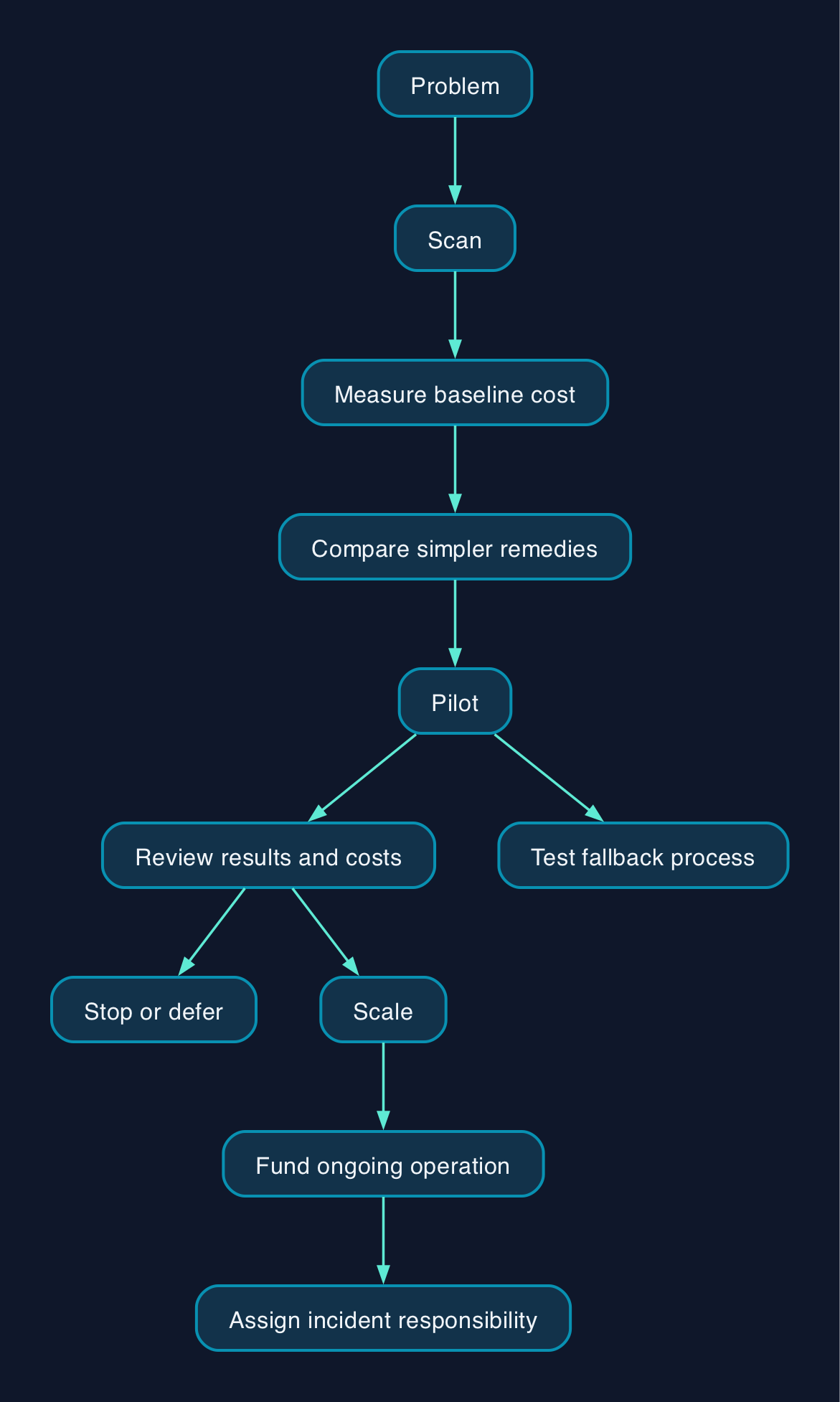
The proposed national pathway is useful because it separates investigation from commitment. Compare the Cloud would turn it into the following internal decision process, adapting the responsibilities to the size of the business.
| Stage | Proposed owner | Evidence required before proceeding |
| --- | --- | --- |
| Scan | Operations lead with finance and an adviser | A defined problem, baseline cost, usable data and comparison with simpler remedies |
| Pilot | Process owner with workers, IT and the delivery supplier | Performance on representative work, recorded errors, staff feedback and a tested fallback |
| Scale | Accountable director with operations and finance | Accepted results, funded support, trained staff and an agreed route to stop or replace the system |
For an initial inspection pilot, we would favour a controlled flow from approved production records or images into an evaluation environment, with results reviewed by the quality team. Give access only to the data and systems needed for that test. Any proposal to change machine behaviour should face a separate engineering and safety decision.
Supplier responsibilities should be equally explicit. Name who maintains the connection to existing equipment, investigates unexpected outputs, approves updates and restores the previous process. A demonstration is incomplete if nobody can explain who answers the telephone during the next production shift.
Budget for operation after the pilot
The government announced £100 million for BridgeAI’s expansion as part of its wider June support package. A finance director should keep that announcement separate from the project’s own cash-flow forecast until eligibility, eligible expenditure and an award are confirmed.
Build the investment case over the company’s normal appraisal period. Include the following items wherever the proposed design requires them.
| Cost component | What the quotation or internal budget should specify |
| --- | --- |
| Assessment and data preparation | Staff time, data extraction, cleaning, labelling and ownership of the resulting records |
| Equipment and integration | Cameras or sensors, computing equipment, interfaces, installation and production disruption |
| Software and hosting | Charging unit, usage assumptions, contract commitment, storage and recurring support |
| Validation and training | Representative testing, operator time, engineering review and training across shifts |
| Continuing operation | Monitoring, maintenance, updates, retesting and incident response |
| Exit | Data export, documentation, replacement support and restoration of the previous process |
Request GBP quotations with VAT treatment, exclusions and renewal terms stated. Separate one-off implementation expenditure from recurring charges, and identify internal work that a supplier has left outside its price.
We would calculate the operating case before assuming public support, then show separately how a confirmed award changes affordability. A grant can justify learning that a small firm could not otherwise finance. It cannot demonstrate that the resulting system will remain economical to operate.
Compare delivery routes before choosing a supplier
The cited policy material provides no verified product comparison, supplier prices or manufacturing performance tests. The fair comparison at this stage is therefore between delivery proposals, using the same production problem and acceptance criteria.
A shortlist could include an existing machinery supplier, a UK industrial AI specialist, integrators proposing AWS, Google Cloud or Microsoft Azure, and a provider supporting open-source components. These are candidates to investigate, not endorsements or claims of programme eligibility.
| Candidate delivery route | When to request a proposal | Evidence to demand |
| --- | --- | --- |
| Existing machinery or production-software supplier | The project depends heavily on installed equipment | Supported interfaces, warranty implications, recurring charges and export arrangements |
| UK industrial AI specialist | The project needs factory-specific development or on-site delivery | Comparable deployments, named engineers, support hours and handover documentation |
| Integrator proposing AWS, Google Cloud or Microsoft Azure | The proposed design includes cloud processing or shared data services | An itemised design, usage costs, connectivity assumptions and a workable outage procedure |
| Provider supporting open-source components | The business wants to assess control over software and deployment | Licence terms, maintenance ownership, security updates and replacement-provider options |
Ask every bidder to price the same test and describe the same failure scenario. Keep platform selection separate from delivery accountability: the business needs a named organisation responsible for making its proposed system work.
Retaining the current process should remain an explicit option. A weak baseline, inaccessible machine data or an unfunded support requirement can be sufficient reason to defer procurement.
Editorial analysis
Compare the Cloud’s position is that the programme should be judged by what happens after the pilot team leaves. The manufacturing plan identifies difficulty moving from experiments to sustained deployment; its proposed pathway directly addresses that problem. The official summary also makes workforce capability and trust part of adoption.
Public support has a useful role where it helps a firm afford assessment, realistic testing or staff development. Our concern would be a delivery model that rewards starting projects without requiring evidence of affordable operation and effective handover.
The strongest next step for a manufacturing director is a short investment brief containing the production problem, baseline, accountable owner, available data and conditions for stopping. Take that brief into support and supplier discussions. Commit to expansion only when the pilot evidence and operating budget justify it.
FAQ
Can a UK manufacturer apply for a grant immediately?
The June announcement establishes funding commitments, but the cited sources do not confirm a current manufacturing application window. Ask the relevant programme team for the live competition terms, geographical scope and eligible costs before including an award in your budget.
Is Scan, Pilot, Scale an approved funding scheme?
The manufacturing plan summary presents it as a proposed national adoption pathway. It is useful as a decision framework, but that description does not establish a specific grant offer or entitlement.
Should we buy AI software before approaching an adviser?
Our recommendation is to prepare the problem and baseline first, then discuss suitable interventions. Made Smarter’s toolkit introduction describes an approach grounded in tasks, outcomes and operational readiness. Ask any prospective supplier to demonstrate how its proposal improves that baseline.
What would justify stopping a pilot?
Set stopping conditions before the test begins. Examples include unacceptable missed defects, excessive operator intervention, an unreliable integration or running costs that exceed the agreed business case. A stopped pilot can still provide useful evidence if it prevents a larger commitment and records what would need to change.
Sources
- Cabinet Office and DSIT — AI Adoption Plan for Advanced Manufacturing, published 8 June 2026
- Cabinet Office and DSIT — AI Champions’ Adoption Plans summaries, published 8 June 2026
- DSIT — AI Opportunities Action Plan progress tracker, private-sector adoption recommendation 47
- DSIT — Government partnerships and investment to boost AI adoption, published 8 June 2026
- DSIT — Interim government response to the AI Champions’ AI Adoption Plans, published 8 June 2026
- Made Smarter — AI Adoption in Manufacturing toolkit introduction, published 22 April 2026
- Innovate UK — AI Solutions to improve productivity in key sectors, competition closed 8 November 2023