
A UK small business should choose an AI consultant by comparing a defined piece of work, the evidence needed to accept it and the responsibilities left behind. Our view is that the first purchase should resolve a specific uncertainty, with permission to stop afterwards. Give shortlisted suppliers the same brief, require them to explain their assumptions and judge their proposals against your workflow, budget and ability to run the result.
Make suppliers answer the same business question
The buying problem is that “AI consulting” can describe a report, staff training, a prototype or responsibility for a working system. The supplier descriptions above cover materially different deliverables. Comparing their headline fees without first defining the output will not establish value.
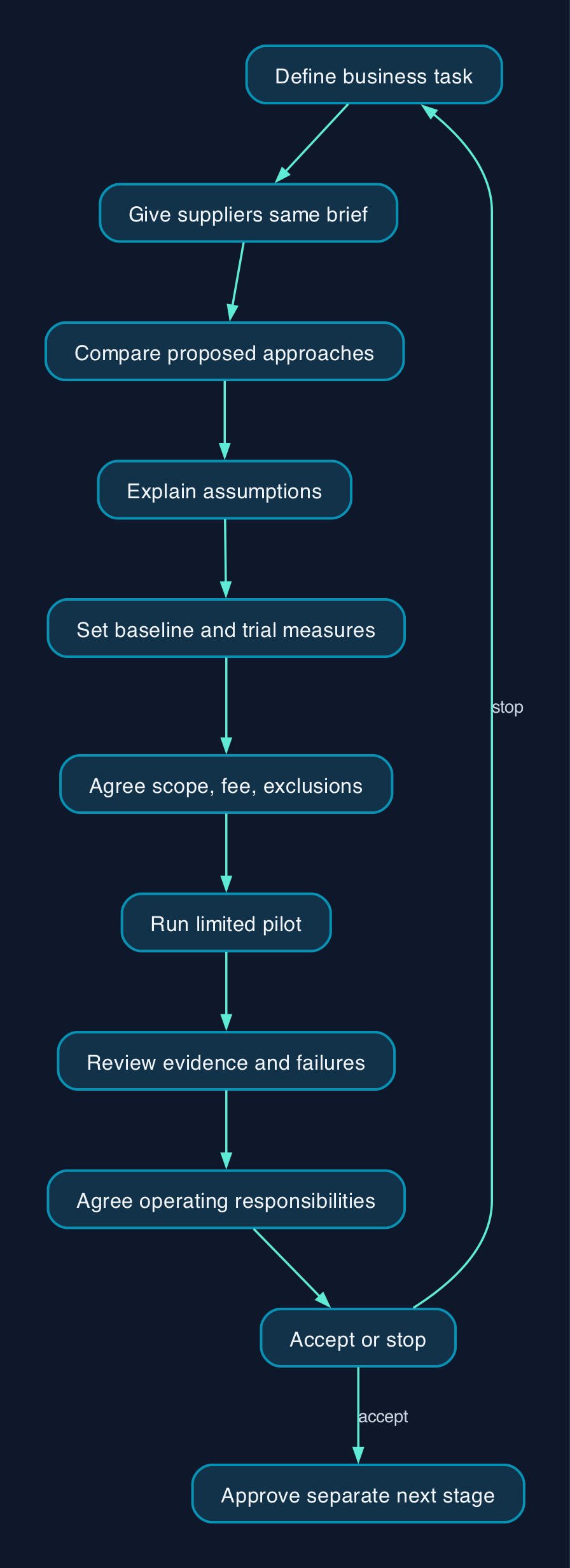
Our recommendation is to write a short brief around a task your business already performs. Name the person responsible, the systems involved, the current difficulty and the result you want to improve. Ask every candidate to respond to that brief before presenting a broader programme.
For a hypothetical UK wholesaler, the brief might concern drafting replies to stock enquiries. Staff currently check availability, confirm customer terms and prepare a response. The consultant’s proposal should explain which steps would change, which records it needs and who approves the reply.
Ask for a baseline covering handling time, corrections and unresolved enquiries. Then agree how a trial would measure improvement, including the time staff spend checking its output. A faster draft has limited commercial value if checking it consumes the saving.
Require candidates to consider improving the existing process, configuring existing software and building something new. A supplier should explain why its preferred route earns the additional cost and responsibility.
Decide who owns the work after delivery
For a small business, the operating arrangement deserves as much scrutiny as the demonstration. Before granting access, ask the consultant to describe how information moves from your systems into the proposed service, where outputs return and which actions require human approval.
The following is a proposed allocation of responsibilities for a limited pilot. It is a negotiation aid, not a description of any supplier’s standard contract.
| Responsibility | Proposed consultant contribution | Retained business responsibility | Evidence to request |
| --- | --- | --- | --- |
| Define the task | Map the workflow and identify dependencies | Appoint an owner and approve the boundary | Written scope and exclusions |
| Arrange access | Document required permissions and external services | Approve access and identify restricted information | Data-flow description and access list |
| Test outputs | Run agreed cases and record failures | Define acceptable errors and review disputed results | Test results, including unsuccessful cases |
| Handle failures | Document escalation and recovery steps | Name the person authorised to pause use | Demonstrated recovery procedure |
| Transfer operation | Supply configuration, documentation and training | Assign someone to operate the service | Handover accepted by that person |
| End the engagement | Explain export, access removal and transition support | Retain control of business accounts and records | Priced exit terms and ownership schedule |
For the wholesaler example, begin with drafts that staff approve. Give the pilot permission to retrieve only the information needed for that task. Expansion into sending messages or changing records should require a separate acceptance decision.
Request the names and roles of the people who will deliver the work, including subcontractors. Ask who answers a support request, during which hours, and what happens when that person is unavailable. “Handover included” should become a list of documents, training sessions and acceptance checks.
Read prices as descriptions of scope
Published prices in the supplied evidence illustrate different purchases. They do not establish a reliable UK market average or demonstrate which supplier delivers better results.
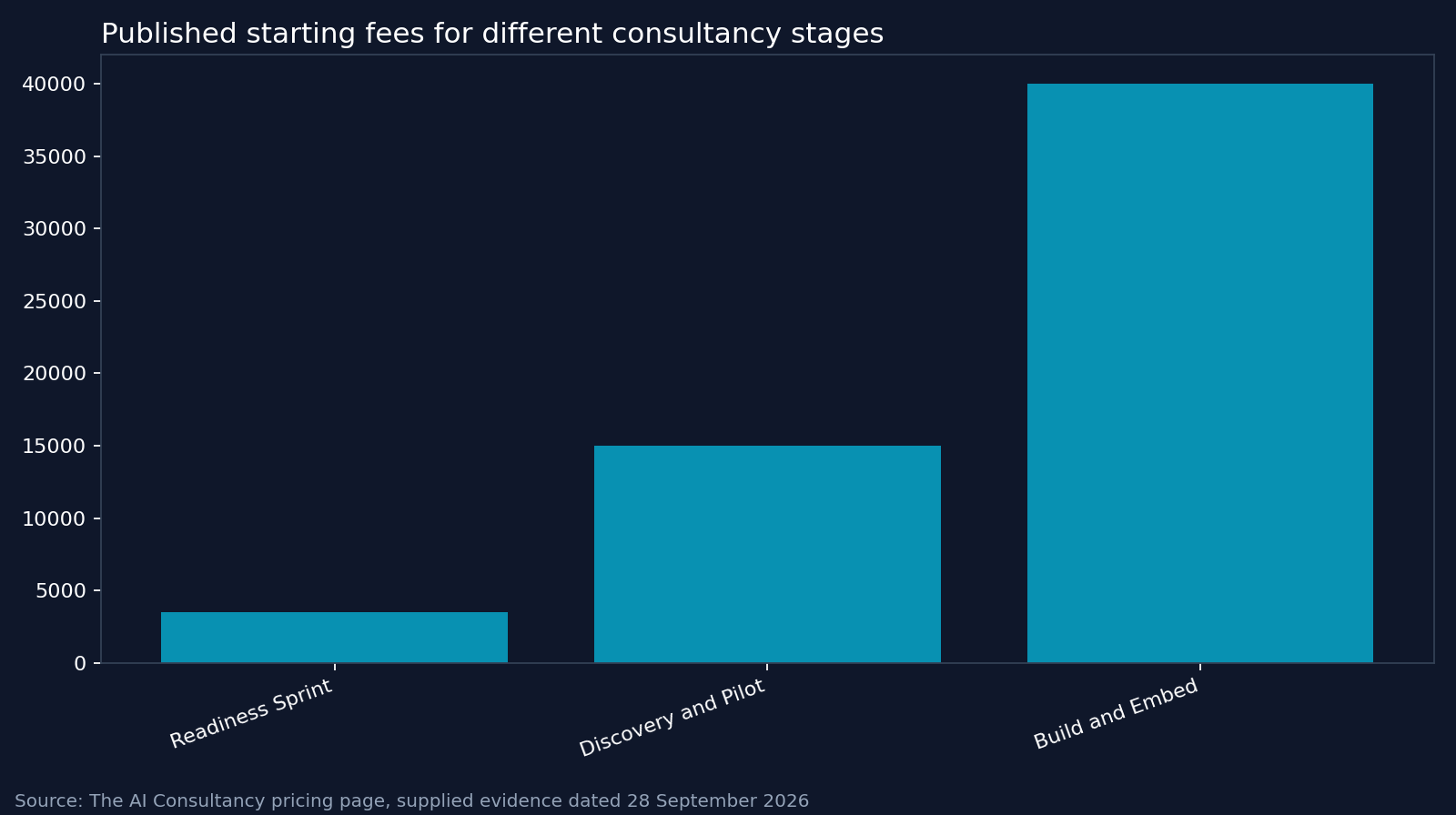
The pricing extracts supplied for this article on 28 September 2026 include these starting fees from The AI Consultancy’s package page:
- Readiness Sprint from £3,500, excluding VAT.
- Discovery and Pilot from £15,000, excluding VAT.
- Build and Embed from £40,000, excluding VAT.
These are advertised starting fees for different engagements, not equivalent bids or a complete project budget. The page describes the sprint as an assessment, the pilot as producing a prototype, and the build phase as implementation and embedding. Payment terms and stage gates are agreed before work begins.
There is also a useful inconsistency to resolve before buying. The supplier’s readiness service page advertises a focused, single-department assessment from £1,000. Its package page describes a different starting offer. The available extracts do not establish whether the lower-priced service remains separately bookable or precisely how the scopes overlap. Request the exact package and deliverables in writing.
Our preferred starting arrangement is a bounded fee for answering a bounded question. Where discovery is genuinely uncertain, a capped time-based engagement can also work. Specify the spending limit, the output due at that limit and who may authorise an extension.
Budget for operating the result
Ask each bidder to cost the same operating period. A first-year comparison should identify which of the following are included, excluded or still unknown:
- Discovery, data preparation and connection to existing systems.
- Software subscriptions, model usage, hosting and monitoring.
- Staff participation, training and time spent reviewing outputs.
- Maintenance, support, changes and repeated testing.
- Data export, documentation and transition to another provider.
Do not count a bundled service twice. Equally, do not treat an unpriced responsibility as free.
Ask for GBP quotations stating VAT treatment, payment milestones, minimum commitments, travel costs and change-request rates. If usage charges remain uncertain, require the assumptions and spending controls that would govern them. A conditional budget is more useful than a precise total built on missing inputs.
Compare delivery approaches before choosing a firm
The evidence supports comparing several UK-serving providers by their stated scope. It does not support a quality ranking, verified customer outcomes or confirmed platform partnerships.
| Provider and source | Stated offer | Circumstances worth exploring | Question the proposal must settle |
| --- | --- | --- | --- |
| [OpenKit](https://openkit.co.uk/blog/posts/ai-consulting-uk-business-guide) | Audit producing findings, a roadmap and cost-benefit assumptions; implementation and training excluded from the standard audit | You need a plan that an internal team or separately appointed supplier could execute | Can another delivery team use the outputs without repeating discovery? |
| [Talk Think Do](https://talkthinkdo.com/services/ai-consulting/) | Strategy, readiness, build-versus-buy advice and integration planning, with delivery available from its engineering team | A mid-sized organisation needs advice closely connected to implementation | How will its proposed Azure-based approach be tested against your existing systems and alternatives? |
| [CDS](https://www.applytosupply.digitalmarketplace.service.gov.uk/g-cloud/services/814089042578835) | Readiness assessment covering data architecture, governance, maturity analysis and an action plan | Uncertainty about data quality or ownership needs resolving before a build | What staffing, number of days and deliverables does the quoted unit rate represent? |
| [The AI Consultancy](https://theaiconsultancy.ai/pricing) | Separate assessment, pilot and build packages with published starting fees | You want distinct decisions between assessment, experimentation and implementation | What must be accepted at each stage, and what remains outside the fee? |
These are candidates for different briefs, not endorsements. The CDS source is a public procurement listing; it does not establish the terms available to a private small business.
A supplier with a preferred platform may be appropriate when your requirements fit that platform. Ask it to disclose commercial incentives and explain the alternatives it considered. Likewise, a claim to be platform-independent should be backed by a reasoned selection, including the option of keeping your current setup.
Editorial analysis
Our position is that an AI consultant should earn the next stage through evidence produced in the current one.
That does not make advisory work inferior to implementation. A report can be the right purchase if it resolves a decision your team cannot make confidently. Judge it by whether it identifies the relevant constraints, exposes assumptions and gives you something another competent supplier could act on.
Nor should every small assignment require an extensive procurement exercise. For a narrow training engagement, inspect the agenda, trainer’s relevant experience and intended staff outcomes. For a system that accesses business records or takes actions, demand a fuller account of testing, permissions, support and recovery.
Ask shortlisted suppliers to show a redacted example of a deliverable resembling the work you need. Request a reference for comparable scope and ask about failures, changes and handover, alongside results. Treat badges and testimonials as leads to investigate.
The strongest selection signal is a proposal that makes rejection possible. It should state the conditions under which the work should stop, the evidence that would challenge the business case and what you retain if you appoint someone else. Buy that clarity before committing to a wider programme.
FAQ
Should a small business always pay for an AI readiness assessment?
Our view is no. Buy one when unresolved questions about the workflow, data or feasibility could materially change the investment decision. Ask for a narrower assignment when you already know the task and need a specific technical or training gap addressed.
How much should the first engagement cost?
There is no defensible universal budget in the supplied evidence. One supplier lists a Readiness Sprint from £3,500 excluding VAT, but that is a particular package rather than a market benchmark. Request a quotation against your defined scope, including your staff’s contribution and any subsequent operating costs.
Is a consultant who also builds the system a better choice?
That arrangement can suit a business seeking continuity between advice and implementation. Our recommendation is to make the assessment portable and approve the build separately, so the recommendation remains open to challenge. Ask an advisory-only supplier to explain who could implement its work and what a delivery team would still need.
What should make us reject a proposal?
Reject or return a proposal that cannot identify its deliverables, acceptance conditions, exclusions or responsible people. Do the same when claimed savings omit checking time, or when the supplier cannot explain ongoing charges and exit arrangements. These are proposed buying criteria, not findings about the firms discussed here.
Sources
The following pages were supplied as evidence extracts for this article on 28 September 2026. They support attributed service descriptions and published prices; delivery quality and current quotation terms were not independently verified.
- The AI Consultancy — AI Readiness Assessment
- The AI Consultancy — AI Consultancy Pricing
- OpenKit — AI strategy and consulting
- Talk Think Do — AI Consulting Services
- Digital Marketplace — CDS AI readiness assessment