Smaller UK AI companies need usable compute, not just bigger capacity
Smaller UK AI companies can benefit from AIRR when they have a prepared experiment and a plan for deployment. National capacity matters, but usable access, engineering time and the full project budget decide its practical value.


Smaller UK AI companies can make practical use of the AI Research Resource when they have a defined research problem, prepared data and the engineering capacity to run experiments. Its Rapid Access guidance explicitly includes smaller businesses developing products before launch. Our view is that founders should judge the programme by the experiments it makes possible, the work required to access it and the route to commercial deployment afterwards.
The useful question is which experiment becomes possible
Our editorial position is that AIRR deserves consideration when access to compute is preventing a company from answering a specific technical question.
Consider a hypothetical UK materials start-up testing whether a new model predicts useful material properties more accurately than its existing method. Its proposed experiment could specify a dataset, a baseline, an evaluation method and a decision that follows from the result. That gives its technical lead a basis for estimating the compute request and judging whether the work was worthwhile.
A company that has yet to establish what customers need should resolve that uncertainty before designing a supercomputer project. More processing capacity cannot decide which product deserves to be built.
The published routes support this distinction. Rapid Access covers feasibility studies, industrial research and experimental development. Those categories make it relevant to commercial research, without turning it into a general entitlement to subsidised business hosting.
For a founder, the practical test is straightforward. Can the team explain what it will learn, why the experiment needs the requested resources and what it will do with the result?
Access windows matter as much as national ambition
The government’s expansion commitment provides a reason to follow the programme. It does not provide a delivery date for a company’s next experiment.
The supplied guidance records that the AI open access call is closed, while the cloud pilot’s application deadline has also passed. Founders should therefore distinguish an available guidance page from an available application window.
This assessment uses the supplied source extracts. They do not establish live application availability for Rapid Access or Gateway, complete award conditions or the cloud pilot’s approved supplier list.
Our recommendation is to prepare a reusable research proposal while checking the appropriate route. Avoid making a customer delivery commitment depend on an allocation that has not been awarded.
Eligibility includes subsidy conditions
The Rapid Access guidance requires a UK-registered business with a Companies House registration number and states that AIRR awards operate within the Subsidy Control Act 2022 framework. Treat the route’s eligibility and subsidy declarations as part of the application work, with a named finance or legal owner.
This is not legal advice; consult your legal counsel.
Put an owner against the work around the compute
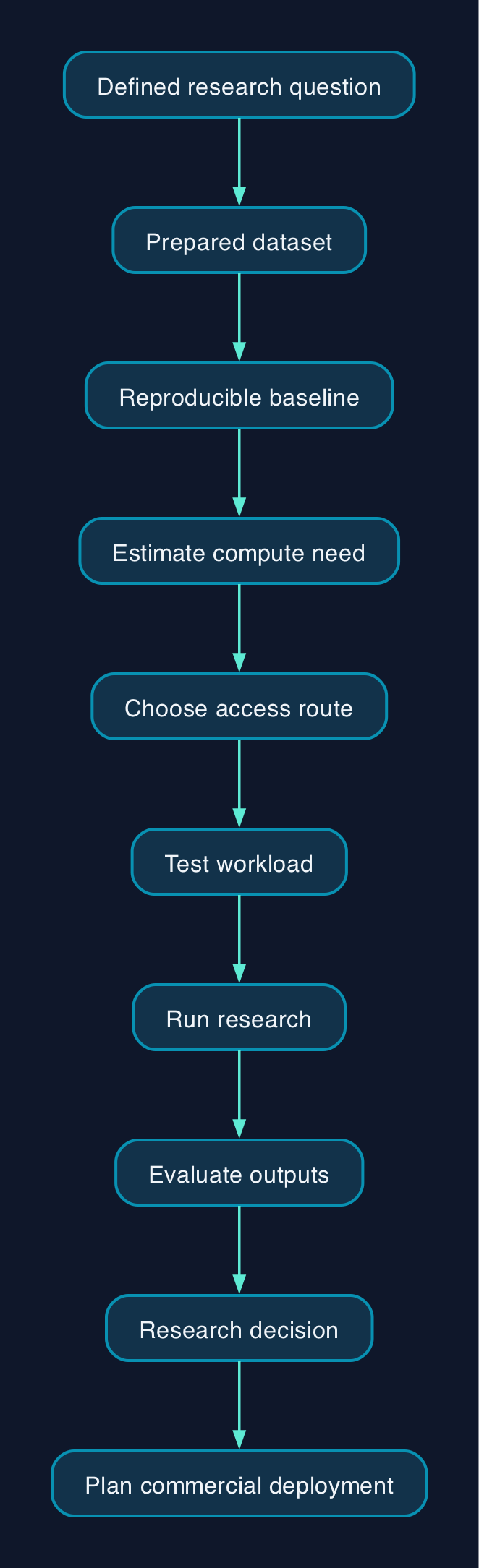
For a smaller team, we would organise an AIRR project around a sequence of responsibilities. Prepare an authorised dataset, establish a reproducible baseline, test the workload on the allocated service, run the research and evaluate the outputs before deciding how to deploy them.
The following is a proposed division of work, not a description of support guaranteed by AIRR.
| Responsibility | Proposed owner | Evidence to obtain before committing |
| --- | --- | --- |
| Research objective | Founder and technical lead | A measurable question and a decision tied to the result |
| Data preparation | Data lead | Usable data, documented permissions and a separate evaluation set |
| Workload compatibility | Machine-learning engineer | A successful test using the intended software dependencies |
| Resource management | Project lead | A schedule that fits the confirmed allocation and usage conditions |
| Service boundaries | Project lead and service contact | Written answers on storage, access, support and permitted workloads |
| Commercial handover | Product and operations leads | An export plan and a separately costed deployment approach |
An application should have an engineering owner who can act when a job fails or a dependency behaves differently. Outsourcing that work may be sensible, but the statement of work should specify deliverables, access permissions, troubleshooting and handover.
Budget for the whole experiment
The clearest financial distinction in the evidence is between an allocation of resources and funding for the people using them. The AI open access call explicitly provided compute without cash funding. The cloud pilot offered credits, with approved providers and supported services to be explained during onboarding.
Neither description supports treating an award as a complete project budget.
For a proposed AIRR project, we would ask the finance lead to cost these components before accepting an allocation.
| Cost component | Budget question |
| --- | --- |
| Application and preparation | Who will write the proposal, prepare the dataset and establish the baseline? |
| Engineering | How much staff or contractor time is needed to adapt, test and run the workload? |
| Data and storage | Which storage, transfer and retention requirements are covered by the award? |
| Evaluation | Who will check accuracy, robustness and suitability for the intended use? |
| Support | What assistance is included, and what specialist help must the company procure? |
| Exit and deployment | Where will the outputs go, and what will continued development and operation cost? |
These are quotation and planning questions, not published AIRR charges. The evidence does not provide enough information for a defensible total cost in pounds.
The most useful internal measure would be the cost of reaching a research decision. That gives a founder a way to compare an AIRR application with paying for a smaller experiment immediately.
Compare routes against the work you actually need
A fair comparison must separate national research allocations from commercial procurement and from improving an existing setup.
| Route | When we would consider it | Main question to resolve |
| --- | --- | --- |
| AIRR Gateway | Testing whether a first supercomputing workload is feasible | Can the pilot establish a reliable resource estimate? |
| AIRR Rapid Access | A smaller business developing an AI product before launch | Can the prepared experiment fit the confirmed allocation period? |
| Commercial compute procurement | The company needs to negotiate capacity, timing and support directly | What does a quotation cover, including storage, transfers, support and exit? |
| Existing infrastructure and a smaller experiment | The research question can first be tested at reduced scale | Would more compute change the decision, or merely enlarge the experiment? |
The Gateway and Rapid Access descriptions are grounded in UKRI’s published guidance; their suitability above is editorial judgement.
For commercial procurement, a shortlist could include AWS, Google Cloud and UK providers against the same workload specification. The supplied evidence cannot establish their relative prices, available configurations or suitability, so there is no supported supplier ranking here. Nor should those names be read as confirmed participants in the AIRR cloud pilot.
Open-source software belongs in the workload assessment too. Before choosing where to run it, ask who will maintain the dependencies and whether the relevant licences permit the intended use.
Editorial analysis
The strongest argument for AIRR is that it gives smaller companies a route into research infrastructure explicitly intended to serve them. The official programme overview includes small and medium-sized enterprises, and the entry routes describe bounded experiments rather than requiring every applicant to propose a national-scale undertaking.
The strongest counterargument is the effort required to turn an allocation into useful work. A technically stretched company could spend scarce engineering time preparing an application and adapting code when a smaller experiment would answer its immediate question.
Our judgement is that AIRR is most useful to a prepared team with a compute-constrained research programme. For that team, the next step is to assemble the baseline, resource estimate, staffing budget and deployment plan needed to assess an access opportunity.
The policy test should be whether smaller firms can complete valuable experiments and use the results commercially. Installed capacity is one input to that outcome. Predictable access, usable guidance and clear service responsibilities deserve equal attention.
FAQ
Can a small UK AI company apply without a university partner?
The Rapid Access guidance identifies UK-registered micro, small and medium organisations as its intended applicants and requires a Companies House registration number. The supplied eligibility extract does not state that a university partner is required. Check the complete conditions for the specific opportunity before applying.
How much compute could an initial project receive?
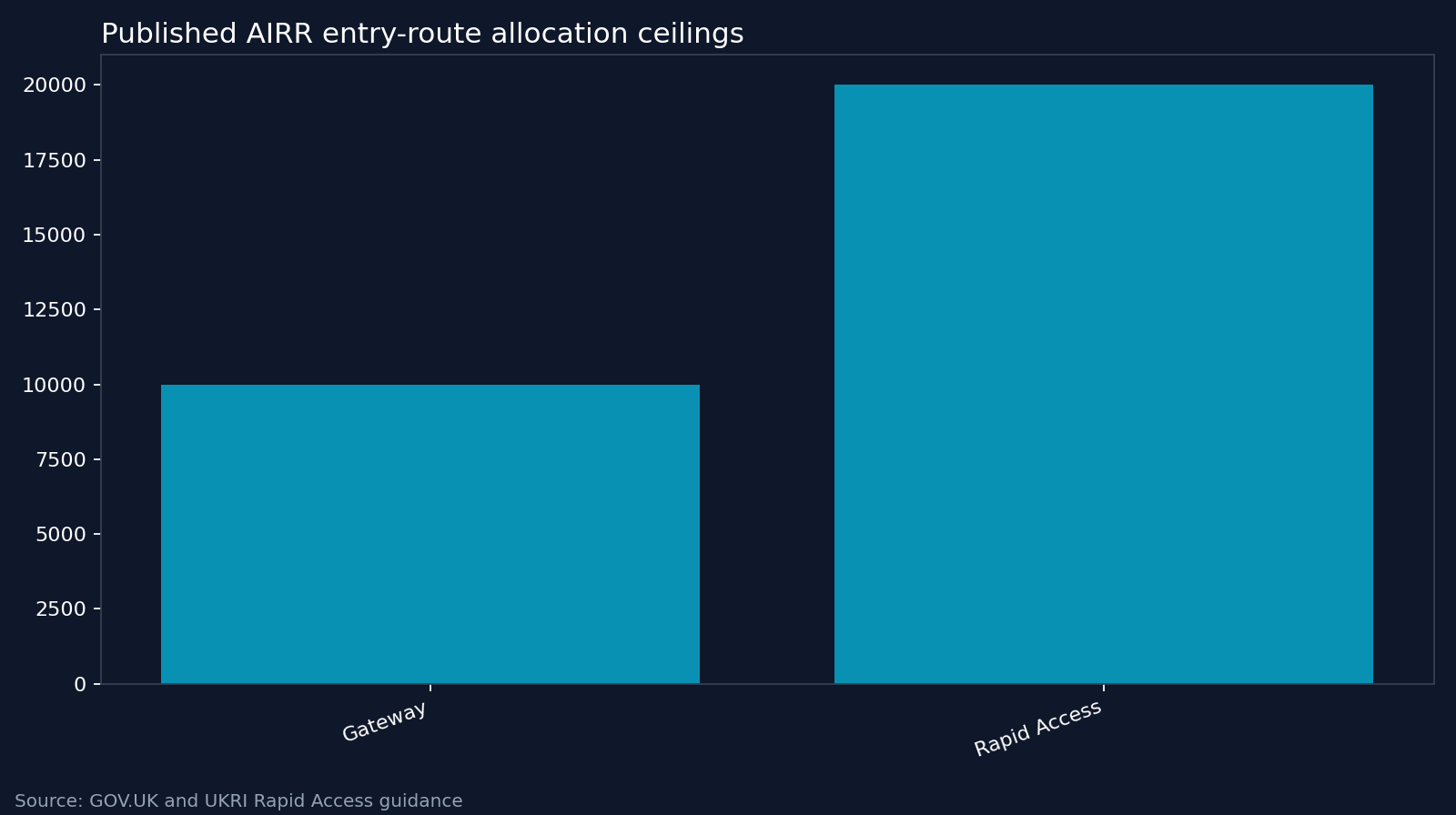
The published guidance describes ceilings of 10,000 GPU hours for Gateway and 20,000 GPU hours for Rapid Access, each within three months of project start. These are allocation limits, not guaranteed awards or measurements of comparative performance.
Does an AIRR award pay the development team?
The AI open access call expressly offered compute resources without cash funding. Budget separately for engineering and evaluation unless the terms of a particular award explicitly cover them.
Can a company plan to host its customer service on AIRR?
The Rapid Access description concerns early-stage development before market launch. It does not establish an ongoing production-hosting entitlement. Our recommendation is to plan customer deployment separately and confirm permitted uses with the service.
Sources
- GOV.UK and UKRI, AI Research Resource, updated 25 August 2026
- GOV.UK and UKRI, AIRR Rapid Access route guidance, updated 25 August 2026
- GOV.UK and UKRI, AI open access call, updated 25 August 2026
- GOV.UK and UKRI, Cloud access call, updated 25 August 2026