The future care worker may supervise a digital ward as well as a physical one
Care workers may soon supervise sensor alerts alongside physical care. Japan offers a direction, but British providers need evidence, clear response responsibilities and a business case that protects human contact.

British care providers should prepare staff to supervise sensor alerts alongside the people in their care. The investment should buy more attentive care, with staffing decisions following evidence from each setting. Japan’s expanded care technology priorities offer a useful direction, but British operators should make any reduction in routine checks conditional on resident needs, reliable alerts and a named person who can respond.
Key pointers
- Start with a specific care problem, such as unnecessary night-time disturbance, before selecting sensors.
- Give every alert an owner, an escalation route and a recorded outcome.
- Ask suppliers to distinguish movement detection, fall detection and clinical monitoring.
- Compare extending existing telecare with installing a separate monitoring platform.
- Include training, connectivity, maintenance and response time in the business case.
- Make staffing changes conditional on evidence gathered in your own service.
Japan is broadening the job of care technology
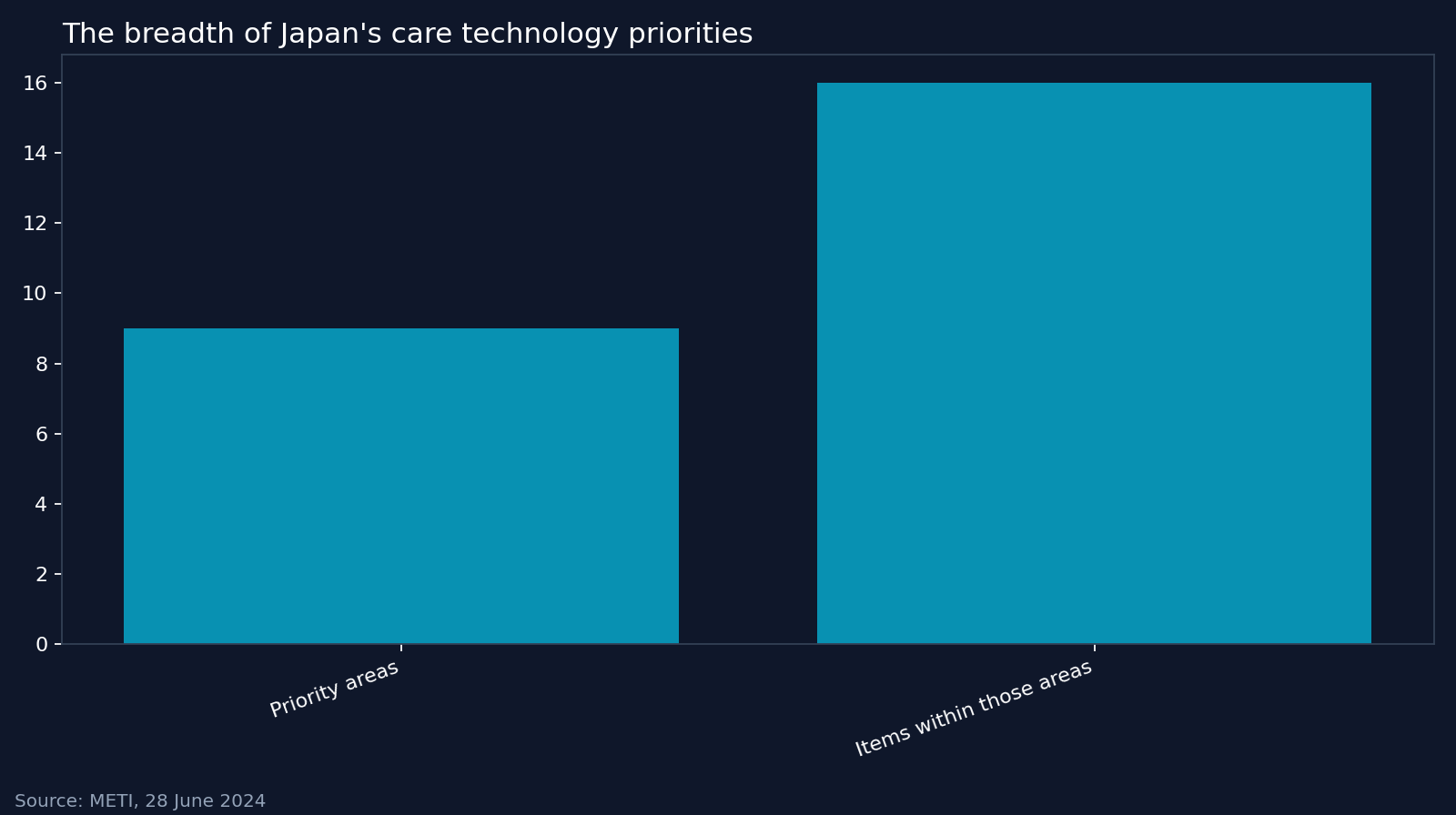
Japan’s policy change is revealing because it reaches beyond robots. In June 2024, its economy and health ministries renamed their priorities to encompass technologies for long-term care, explicitly including information and communication technology alongside robotics. The announcement scheduled operation under the revised priorities from April 2025. Its stated aims include better care, reduced burden on providers and greater independence for older people. The ministerial announcement sets out that scope.
Those 9 areas and 16 items describe the breadth of a policy programme. They are not adoption figures, measured savings or evidence that machines can replace care workers.
For British companies, the useful question is how this broader approach changes the working day. A care worker might receive an alert about movement, decide whether it warrants attention and record what happened after visiting the resident. Technology would become part of the worker’s judgement and handover, rather than a separate installation managed somewhere else.
That is what a “digital ward” means in this article. It is a proposed layer of observation and coordination alongside physical care, not a claim that a care home becomes a hospital ward.
Britain already has a starting point
The Oxfordshire and Buckinghamshire deployment gives this argument a concrete British foothold. In September 2025, the council reported passive sensors being trialled in 5 homes covering 215 residents, with early feedback describing better night-time monitoring and quicker responses to incidents. The announcement did not provide a controlled evaluation or a quantified reduction in staff workload. The deployment report describes its scale and early feedback.
For a small care provider, that distinction matters. A neighbouring service’s experience can justify investigating a system. It cannot settle how many checks your residents need or how much staff time your building will save.
My position is that providers should test whether sensor-led observation can reduce unnecessary disturbance while preserving meaningful contact. The acceptance measure should include what residents experience, not merely how many alerts appear on a screen.
Design the response before buying the sensor
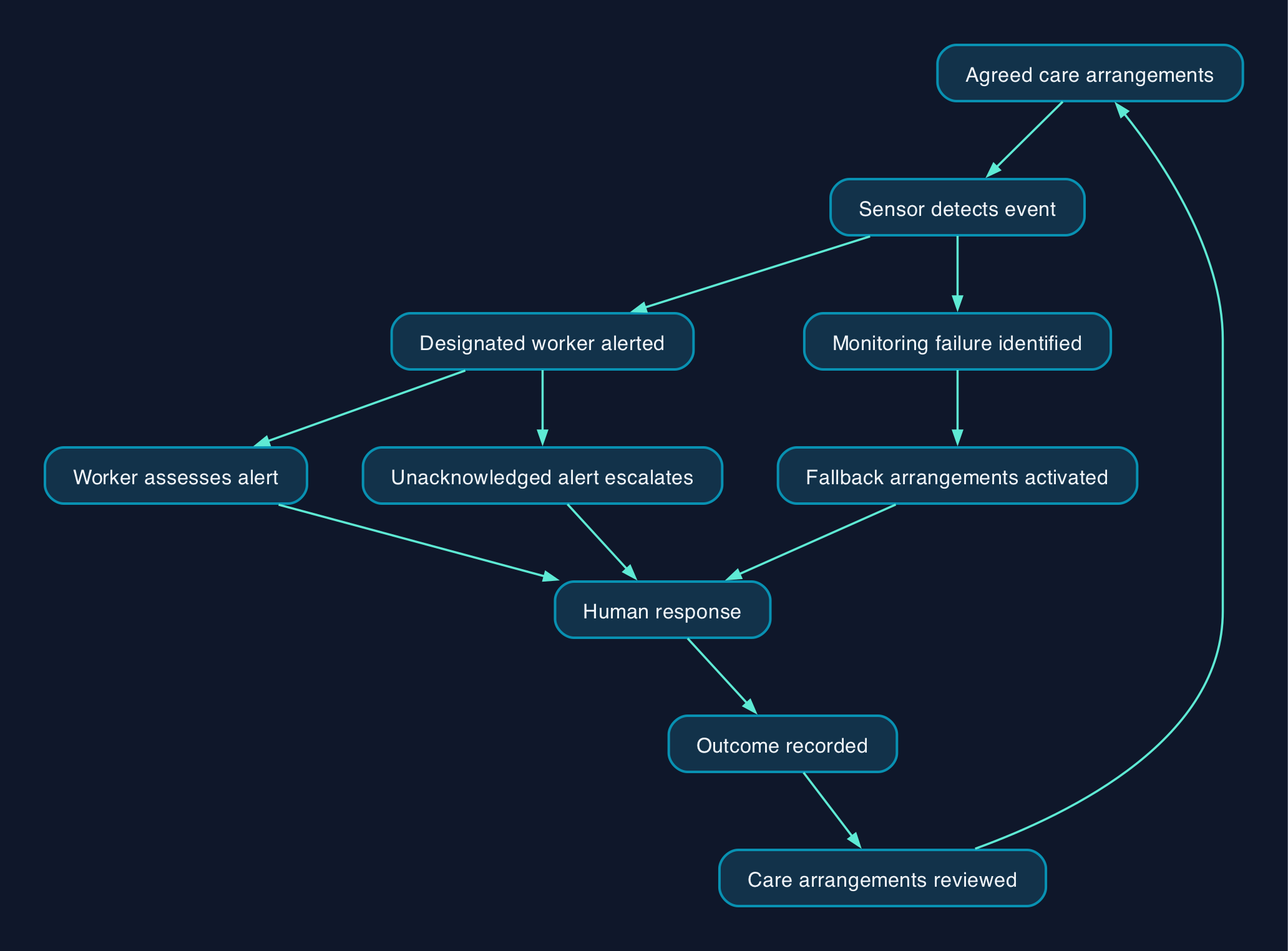
An illustrative operating model starts with a resident’s agreed care arrangements. A sensor detects an event, an alert reaches a designated worker, and that worker assesses and responds within their role. An unacknowledged alert follows an agreed escalation route. The outcome returns to the care record and informs a review.
Each connection needs an owner. The care manager should own the response procedure; the technology lead should own connectivity and access; the supplier should have clearly contracted responsibilities for equipment and faults.
This separation is especially important for home-care businesses. Before promising monitoring between visits, establish who receives alerts and who can physically attend. A notification to a relative is a different service from a staffed response arrangement.
Ask suppliers to demonstrate a disconnected sensor, a missed acknowledgement and a communications failure. The demonstration should show how staff discover the problem and resume the agreed fallback arrangements. A quiet dashboard must never become your only reason to assume that everything is well.
Compare the job each product performs
The available options illustrate different approaches rather than a single interchangeable product category.
Extending existing telecare may suit a provider that already has compatible infrastructure. Tunstall’s Universal Sensor acts as an interface between hardwired devices and specified Tunstall systems, including several Lifeline units and Group Living systems. Its documented function is to pass an appropriate device message to the home unit. Buyers should verify their exact equipment combination rather than infer universal compatibility from the product name. Tunstall lists the supported systems and connections.
Room-based wellbeing monitoring merits different questions. Wellbeing Sensors markets camera-free monitoring, but its own disclaimer says the system provides environmental wellbeing indicators and does not supply clinical measurements or inform clinical decisions. Procurement teams should reconcile every proposed use with that stated boundary before relying on a demonstration or sales presentation. The manufacturer’s page contains both the offering and its limitations.
Household activity monitoring addresses another use case. Living Made Easy’s listing describes Canary Care as recording movement and temperature, with notifications to relatives or carers when activity departs from a configured routine. That directory description is a useful research lead, but it does not establish a staffed response service or confirm current commercial terms. The Canary Care listing explains the intended workflow.
For each approach, compare who receives the signal, what it actually establishes, how someone responds and what happens when the system is unavailable. Keeping an existing system and improving its response procedure should remain an option.
The strongest objection is that monitoring could make care thinner
The strongest objection is straightforward. An operator could use sensors to justify fewer visits, leaving residents with less human contact while workers inherit another queue of demands. A detected movement cannot, by itself, explain loneliness, discomfort or why somebody is awake.
The evidence does not justify dismissing that objection. A Health Innovation Network South London roundtable reported experiences of fewer intrusive night-time checks and more time for relationships, but described the falls evidence as mostly anecdotal. Participants also identified poor infrastructure, integration difficulties and weak implementation leadership as barriers. These are implementation accounts, not proof of a dependable staffing reduction. The roundtable report records both benefits and limitations.
The answer is to make human contact an explicit pilot outcome. Record whether staff gain time to talk, assist and reassure, alongside unnecessary alerts, missed events and response delays. Review residents’ experience of monitoring and their preferences about visits.
Do not remove agreed checks simply because a system has been installed. Any change should follow an individual care review and evidence that the proposed arrangement works in that setting.
Budget for the whole response service
The supplied evidence does not establish comparable, current prices for a complete care-home deployment. A credible business case therefore needs quotations against the same scope.
Ask for a GBP quote identifying equipment, installation, connectivity work, software, integration, training and ongoing support. Specify the contract period, VAT treatment, equipment ownership, replacement charges and exit arrangements.
Then add the work retained by the provider. Somebody must configure alerts, maintain devices, manage staff access, investigate faults and review whether the system remains useful. Staff time spent responding is part of the operating model, even when the software subscription is small.
For a pilot, compare the cost with measured changes in work and resident experience. Treat released time as care capacity until there is evidence that it can safely become a cash saving. Do not count the same minutes as both additional personal attention and reduced payroll.
For UK technology firms, this creates a practical service opportunity. Installation, integration, staff training and ongoing maintenance belong in the proposal, with explicit responsibilities and acceptance checks. Another dashboard has little value if nobody has time to act on it.
Editorial analysis
The future care worker may supervise both a physical environment and a stream of information about it. British providers should prepare that worker to question alerts, recognise system failures and hand over unresolved concerns.
Japan’s broader programme offers a direction of travel. The British purchasing decision remains local and specific. Before signing, ask the supplier to demonstrate the journey from an event in a resident’s room to a recorded human response. Then ask the night team whether that journey would actually help them.
FAQ
Can sensors replace routine checks in a UK care home?
Installation alone is not a sufficient reason to change checks. Make any reduction conditional on an individual care review, evidence from the setting and a working fallback procedure.
Does a digital ward require cameras?
No. The Oxfordshire and Buckinghamshire trial used passive sensors without cameras or wearable devices. That demonstrates a camera-free approach, although it does not establish which system suits every resident. The council describes the monitoring used.
Should a provider replace its existing telecare system?
First investigate whether it can be extended and whether its response arrangements need improvement. Tunstall’s Universal Sensor, for example, connects hardwired devices to specified compatible telecare systems; suitability depends on the exact installation. Check the manufacturer’s compatibility information.
What should a small provider establish before buying?
Define the event to detect, the person responsible for responding and the procedure when monitoring fails. Obtain a complete quotation and agree pilot measures covering resident experience, staff workload, unnecessary alerts and response performance before making a wider commitment.
Sources
- METI — Priority Fields in the Use of Robot Technology for Long-term Care Revised, 28 June 2024
- Oxfordshire County Council — Sensor-based technology in care homes, 29 September 2025
- Tunstall — Universal Sensor
- Wellbeing Sensors — Product description and intended-use disclaimer
- Living Made Easy — Canary Care Monitoring Package
- Health Innovation Network South London — Exploring falls technology in care homes