Britain should fund proof that farm robots pay
Britain should fund shared growing trials before backing wider farm-automation purchases. Korea offers useful ways to organise the work, but suppliers must help prove the crop economics and public support should produce evidence other growers can use.

Britain should put farm-automation funding into shared crop trials before backing wider equipment rollout. Growers should expand planting only when those trials show a better full-season margin. South Korea offers a useful model in its planned 21.6-hectare production and validation site, but the case for British investment rests on buying evidence that farmers can use, with suppliers sharing responsibility for proving the economics.
Key pointers
- Make crop-level profitability the acceptance test for an automation trial.
- Require machinery suppliers to take responsibility for faults and recovery during testing.
- Count grower supervision and rejected produce when assessing savings.
- Compare equipment ownership with a contracted service and improvements to the existing operation.
- Make reusable trial findings a condition of public support.
- Reject expansion when the business case depends on unmeasured labour savings or assumed sales.
Korea gives the grower a job beyond hosting the demonstration
South Korea’s proposed agricultural AI platform contains a division of work worth borrowing. Local government provides land. Technology companies develop agricultural models and machinery-based services. An agricultural organisation grows crops and validates the models in the planned greenhouse facilities.
That last responsibility deserves more attention than the acreage. A British trial needs a grower with authority to reject a technically impressive result that makes no commercial sense. Harvested fruit that fails the buyer’s quality requirements cannot be counted as a successful outcome merely because a robot picked it.
My proposed funding rule is straightforward. A machinery company seeking support for a growing trial must agree, with the grower, what constitutes useful output and who carries the cost of interruptions. The software supplier must account for human corrections. Whoever runs the trial must record whether the crop was sold.
That arrangement asks technology businesses to prove the part of their proposition that matters to the customer. It also gives the grower a defined role, with payment for trial work and clear limits on responsibility.
Public support should buy evidence another farm can use
Korea’s computing programme makes a more interesting offer than access to hardware alone. Its April announcement links company support to the creation of agricultural training datasets intended for public release. Public resources are meant to produce something reusable alongside private product development.
Britain should adopt that principle for farm-automation trials. Where public money pays for testing, the published result should describe the crop and growing system, the human work retained, equipment interruptions and saleable output. Commercially sensitive details can require agreed handling; an uninterpretable success claim is an inadequate public return.
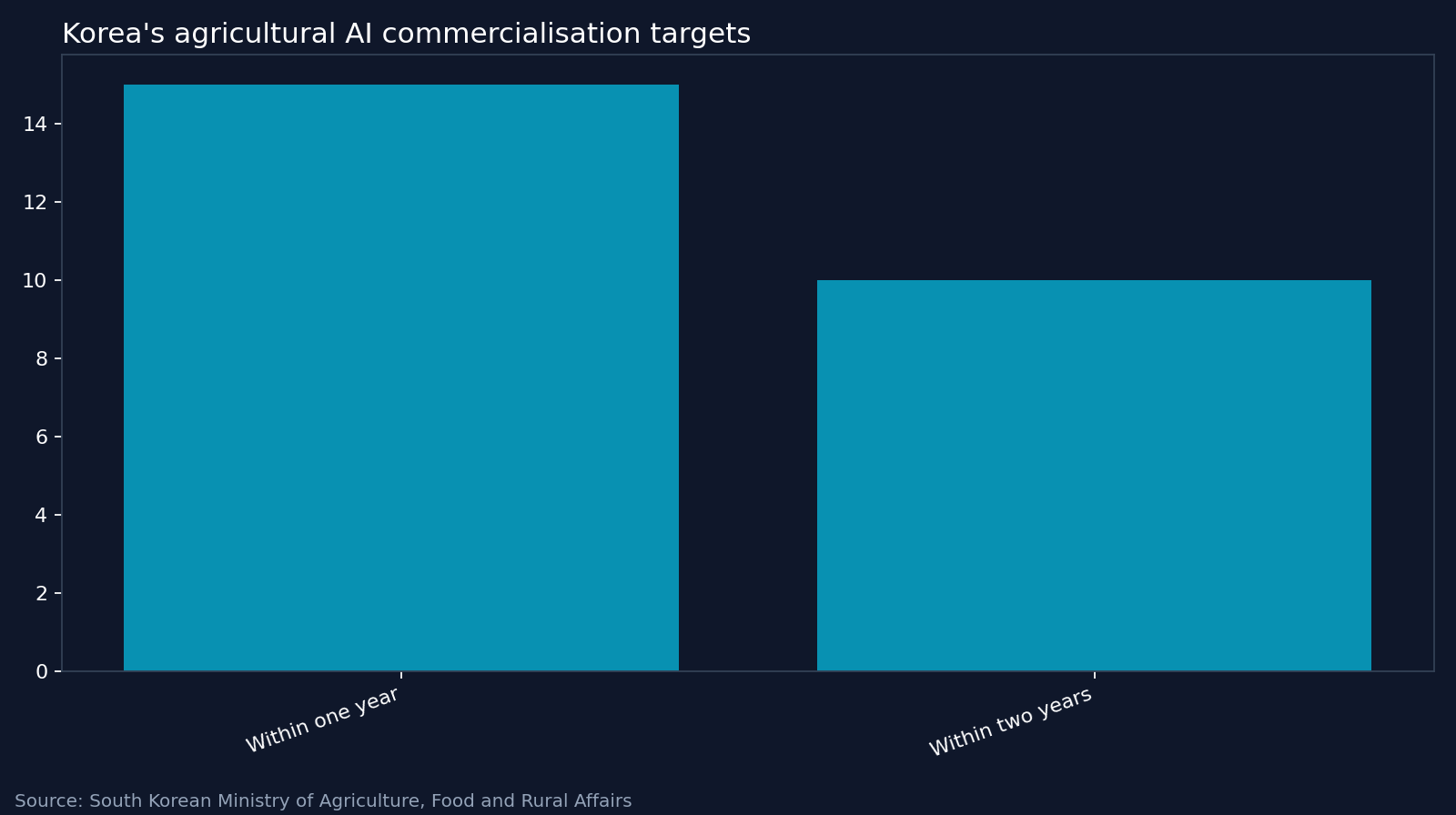
Korea also puts a clock on commercialisation. Its AX-Sprint programme targeted 15 projects capable of reaching market within one year and 10 within two. Those are selection targets, not reported successes. For a British programme, I would pair any commercialisation deadline with a requirement to disclose what the trial actually established, including a decision to stop.
A failed trial that prevents another grower buying unsuitable equipment can justify its cost. Funding terms should allow that result without dressing it up as a deployment success.
The planting decision is the test of ambition
Consider a hypothetical British soft-fruit grower deciding whether to plant an additional area. For this example, assume harvesting capacity is the constraint. Automation earns its place if the business can collect and sell the extra crop at a margin that covers the additional costs.
Now change the assumption. Suppose the grower can already harvest everything, but cannot obtain a selling price that covers production. Faster picking might leave the expansion decision unchanged. That distinction needs settling before a supplier demonstration becomes a purchase proposal.
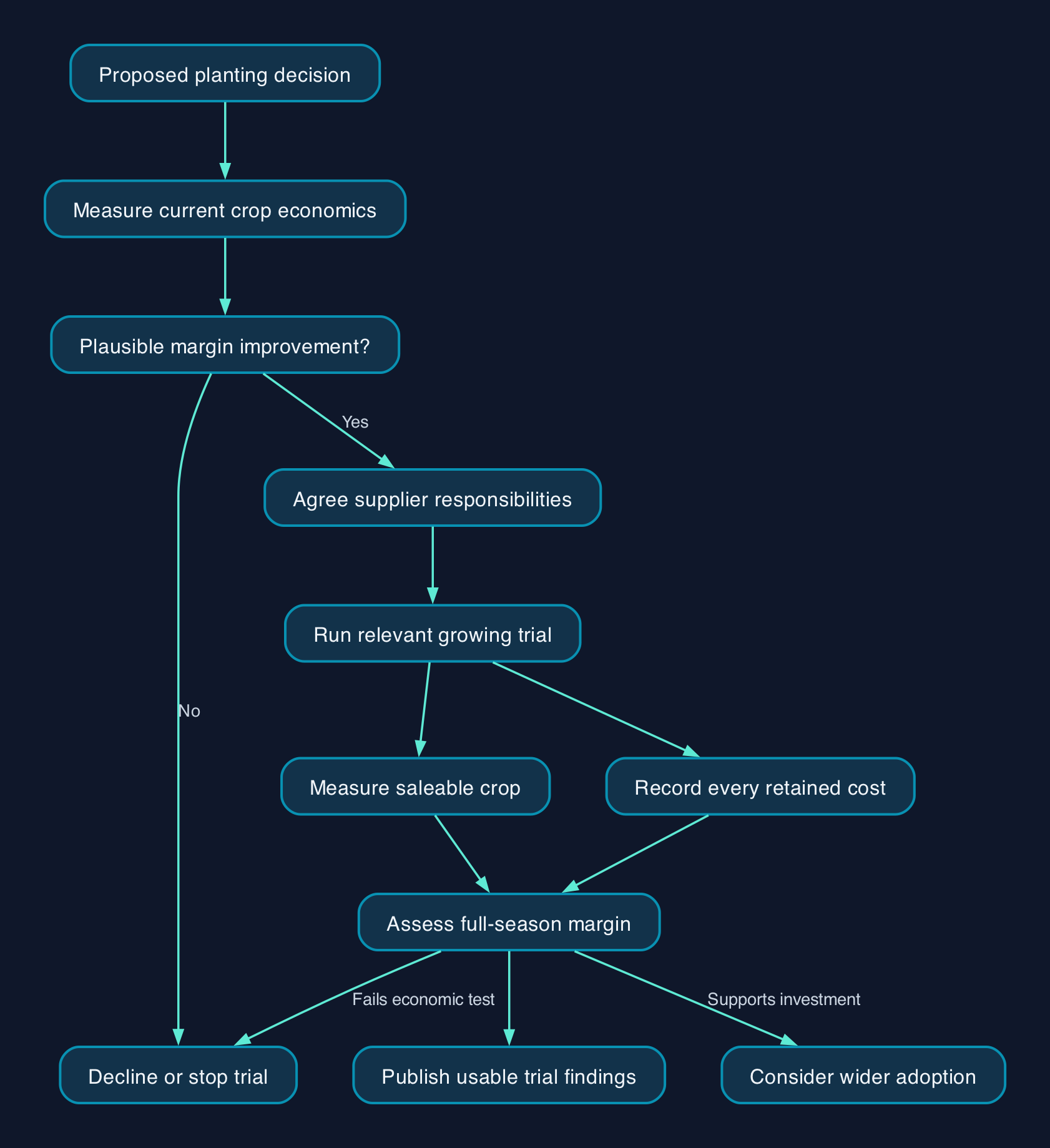
For this reason, I would ask a trial team to write down the planting decision it hopes to change. Keep the existing crop area? Expand it? Test a crop previously rejected on cost grounds? Then identify the task that prevents that decision today.
Measure the machine against that task over the relevant growing and harvesting period. Record every intervention, including the grower stepping away from other work to restart it. A trial that quietly relies on exceptional attention from its hosts has not yet priced an ordinary working service.
Give competing delivery approaches the same test
The evidence supports examining different ways of delivering automation. It does not establish a shortlist of UK suppliers or comparable product performance.
Daedong and LG CNS have complementary roles in the selected Korean consortium. Their participation provides no basis for treating them as interchangeable products or recommending either to a British grower.
A fair British trial would let ownership, contracted provision and the existing operation compete against the same crop outcome.
| Approach | What to test | Cost that must remain visible |
| --- | --- | --- |
| Buy and run equipment | Whether expected use justifies ownership | Finance, maintenance, training and retained supervision |
| Contract for the automated task | Whether the provider can deliver acceptable work during the required window | Service charges, standby arrangements and recovery after missed work |
| Improve the existing operation | Whether scheduling or handling changes resolve the constraint | Staff time, altered processes and any additional equipment |
These are options to investigate through local quotations. A proposed service must establish availability at the farm and capacity during its harvest window before entering the comparison.
Use GBP quotations over a stated period. Include site changes, software and connectivity, as well as energy and backup labour. If an input remains unknown, leave the investment decision conditional.
The strongest objection is that shared trials can still waste money
A serious objection to this position is that an organised demonstration can absorb public funding while answering the wrong question. Automation may be technically successful in a purpose-built greenhouse and economically unsuitable for the farm expected to adopt it.
Korea’s 21.6-hectare proposal cannot settle that objection. The announcement describes planned production and validation facilities; it supplies no British crop margins. Nor does the KRW 51 billion research allocation establish a return on the investment.
If selling prices, energy costs or growing conditions make a crop unviable even after the proposed labour saving, automation deserves no special protection from that conclusion. Improving the current operation, or declining to expand, may be the better decision.
Shared trials therefore need an economic screening stage before machinery arrives. Require a baseline and a credible explanation of how the targeted task affects margin. Then test under conditions relevant to the intended adopters, with a stopping rule agreed in advance.
I would refuse funding where the proposal cannot identify a plausible planting or production decision that the result could change. A public demonstration does not become worthwhile merely by being shared.
Editorial analysis
Britain has a reason to investigate whether automation changes what it can grow profitably. Korea’s announcements show concrete ways to organise that investigation, particularly the combination of crop production with model validation and the proposed release of training data.
The choice I favour is to share the cost of proving a useful agricultural service before asking growers to finance its wider adoption. Public support should leave behind results that another farm can examine. Suppliers should carry agreed responsibility for the equipment and software they bring.
For the hypothetical soft-fruit grower, the decisive document would be a season’s account showing additional saleable crop, every retained cost and the resulting margin. Until that account supports expansion, the extra planting remains a proposal.
FAQ
Could automation make a crop commercially viable in Britain?
Yes, if changing a particular task improves the crop’s full-season economics enough. That is the mechanism proposed here, not an outcome demonstrated by the supplied Korean announcements. A British trial must establish whether the improvement survives all the associated costs.
Why favour shared trials over immediate equipment rollout?
My judgement is that public funding should first produce evidence growers can use to decide whether to invest. Korea’s computing programme offers a relevant principle by pairing company support with planned public training datasets. For British growing trials, that principle should extend to usable findings about crop performance and retained human work.
Has South Korea proved that its proposed platform is profitable?
The cited preferred-bidder announcement establishes a proposed production and validation site with assigned participant roles. It does not provide achieved profitability figures. This article uses that design to support an argument about how to test automation.
What should a small British grower ask a supplier first?
Ask which production constraint the system will remove and how the supplier proposes to prove it on the intended crop. Request a quotation that includes supervision, support and recovery arrangements. Keep expansion conditional on measured results and compare the offer with improving the current operation.
Sources
- South Korean Ministry of Agriculture, Food and Rural Affairs, 2026 agricultural research and development funding announcement, 4 January 2026.
- South Korean Ministry of Agriculture, Food and Rural Affairs, agricultural AI product commercialisation programme, 18 March 2026.
- South Korean Ministry of Agriculture, Food and Rural Affairs, smart-agriculture data and GPU support programme, 22 April 2026.
- South Korean Ministry of Agriculture, Food and Rural Affairs, preferred bidder for the national agricultural AI platform, 28 April 2026.