British facilities teams should prepare for more pilots
British facilities firms should test aerial inspection before investing in fleets. Singapore shows the direction, but useful evidence, competent review and targeted physical access will determine the value.

Drones can make aerial inspection a standard first step for suitable facilities jobs, gathering evidence before teams decide whether people need physical access. That could change workforce skills considerably, although the evidence does not establish that pilots will outnumber scaffolders. Singapore already identifies drones as tools for inspecting roofs, bridges, sewers and façades. The opportunity for Britain is to separate initial observation from physical intervention, then connect the evidence to maintenance decisions.
Key pointers
- Start with a recurring inspection where better imagery could change a maintenance decision.
- Specify who interprets the images and who authorises further investigation.
- Compare quotations for the same coverage, reporting and file delivery.
- Ask suppliers to show how their operating permissions cover your actual site.
- Budget for weather delays, repeat visits and any subsequent physical access.
- Give existing building specialists a role in designing the inspection service.
Singapore shows a change in the inspection job
Singapore’s example matters because it places drones inside everyday infrastructure operations. Its Smart City solutions programme describes inspection alongside robots handling hazardous tasks and a digital platform integrating systems in Punggol Digital District.
That is evidence of an operating direction, rather than proof of a particular financial return. The page supplies no inspection workforce forecast, independently measured savings or evidence that all these systems form one autonomous service.
For British owners, the useful question is therefore narrower. Which inspection currently requires difficult access simply to establish whether further work is necessary?
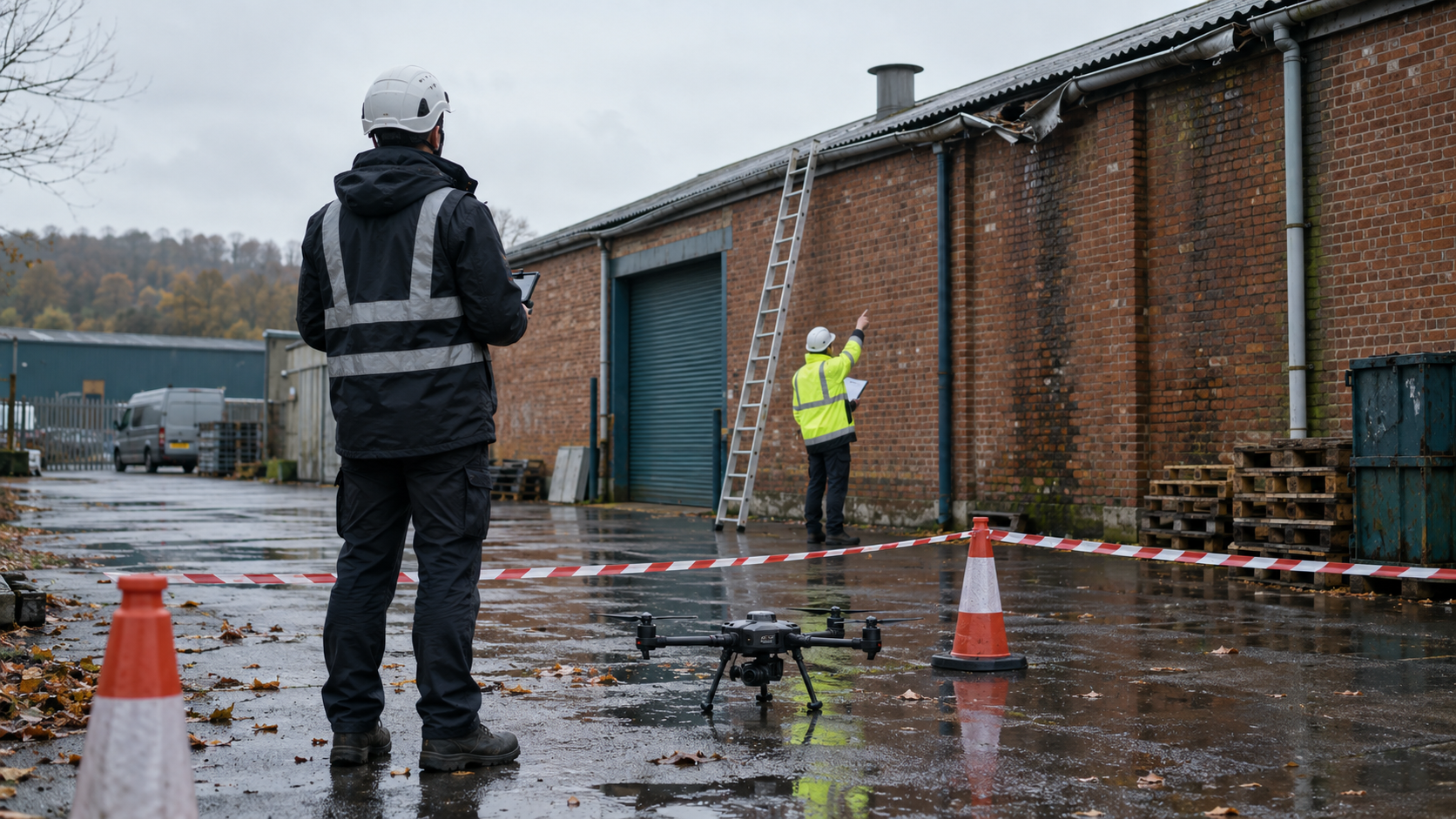
A hypothetical warehouse owner investigating a damaged gutter could commission aerial evidence first, with a building specialist deciding whether physical investigation is needed. The proposed benefit is avoiding an unnecessary access visit or making the necessary visit more targeted. The business should measure whether either outcome actually happens.
Roof inspection is a sensible starting point for that experiment. A sewer, bridge or industrial installation needs its own feasibility assessment; inclusion in Singapore’s programme does not make those environments interchangeable.
Britain already has a route towards remote inspection
The British version is more than an imported possibility. In its October 2024 infrastructure inspection announcement, the CAA described work involving sees.ai and National Grid Electricity Transmission, including the prospect of inspection from a central control room.
The policy concerned atypical air environments, where proximity to infrastructure reduces the expected presence of conventionally piloted aircraft. It was a bounded route towards more operations, not unrestricted permission to fly across Britain.
For a utility with repeated inspection work, central coordination offers an organisational possibility worth testing. For a small facilities business with occasional roof jobs, buying an inspection service is a more proportionate first experiment than building an aviation department.
My position is that British firms should develop the ability to commission and use aerial evidence now. Owning a fleet can wait until the workload and results justify it.
The permission must fit the inspection
The CAA’s Specific Category guidance distinguishes between operations covered by PDRA01 and those requiring UK SORA. Beyond visual line of sight flying falls into the latter route.
That distinction separates a pilot attending a roof inspection from the future prospect of fleets managed remotely. A supplier’s ability to carry out the first does not establish permission for the second.
For procurement, request the proposed operating category and, where required, the authorisation covering the work. Check its conditions against the site, aircraft and flight plan rather than accepting a general claim of being approved.
Under PDRA01 conditions, relevant requirements include pilot competence, insurance, flight records and permissions to enter restricted airspace. The same page also flags the potential application of data-protection rules when images capture identifiable individuals.
This is not legal advice; consult your legal counsel.
Build the handover before buying the aircraft
A useful inspection service should finish with a maintenance decision attached to an identifiable asset.
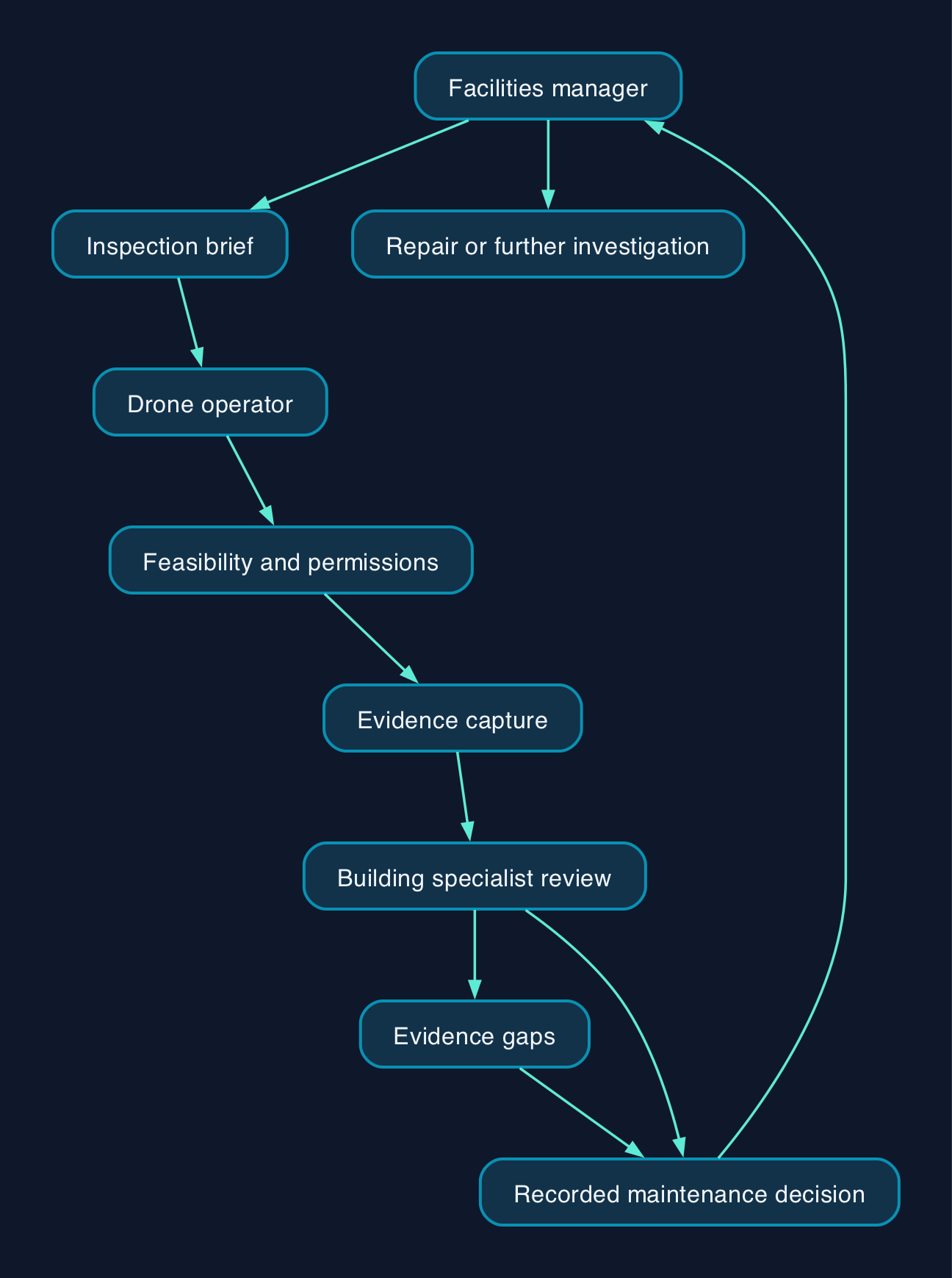
For an illustrative workflow, the facilities manager defines the question and supplies the asset record. The operator checks feasibility and captures the agreed evidence. A competent building specialist reviews the findings, identifies gaps and recommends the next action. The facilities manager then assigns any repair or further investigation.
The technology leader’s responsibility should be to make that chain traceable. Specify asset identifiers, capture dates, file formats, access permissions and retention periods before commissioning the work. Require the supplier to mark areas it could not inspect.
An image archive without an owner for the findings is an unfinished inspection process. A clear photograph of a defect should lead to a recorded decision, including a decision that more evidence is needed.
This creates a practical opportunity for British software and service firms. Connecting inspection evidence to existing maintenance records may be more useful to a customer than another standalone viewing portal.
Buy the evidence you need
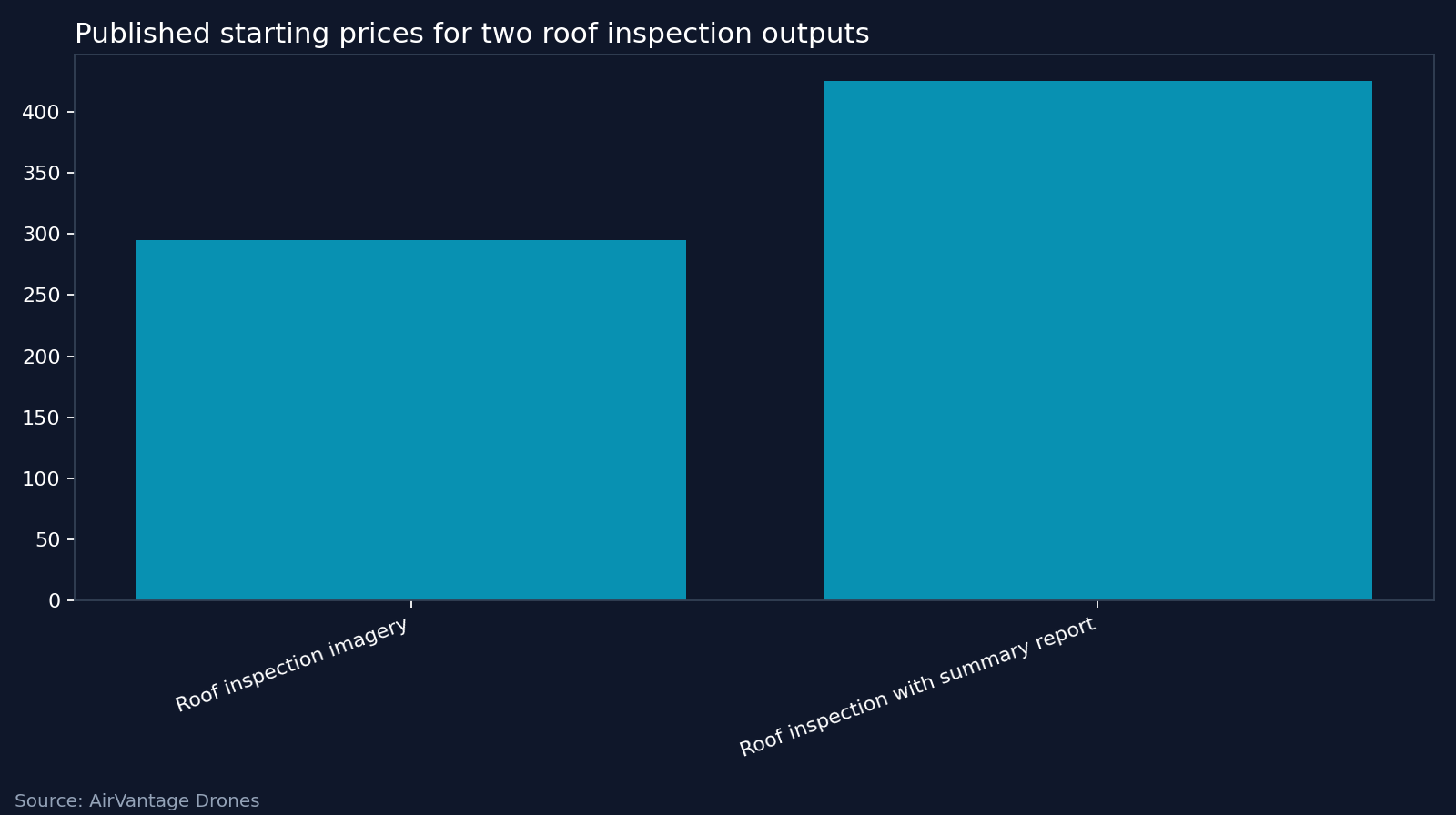
Published service prices show why the deliverable matters. AirVantage Drones lists roof inspection imagery from £295 and roof inspection with a summary report from £425. These are starting prices dated 1 April 2026, subject to VAT where applicable; site complexity, permissions, travel and additional processing can affect the quotation.
Those figures compare two outputs from one provider. They do not establish a market average or a saving against scaffolding.
Other suppliers illustrate different purchasing criteria. Sky Scan Surveys’ pricing page describes quotations with stated scope, file formats and documented accuracy. Skytech Cambridge’s roof survey service describes geotagged imagery organised by location, with optional modelling and coordination alongside surveyors or contractors.
These are supplier descriptions, not independently tested performance rankings. Ask competing bidders for a sample deliverable against the same inspection brief, then assess whether your own specialist can use it.
For outsourced work, budget for the inspection, interpretation, internal review, data handling, repeat attendance and any subsequent physical investigation. Confirm who pays when weather or access restrictions prevent completion.
For an internal operation, add aircraft, sensors, maintenance, training, insurance, staff time, authorisation and replacement equipment. The CAA fee is one operating input, not the cost of running the service.
The strongest objection is that a camera cannot finish the job
The strongest objection to this argument is practical. If a defect needs physical investigation or repair, people may still need access, and the drone visit could become an additional expense.
That objection should determine the pilot project. Do not select a job merely because it produces striking footage. Select one where aerial evidence could change the need, location or scope of subsequent access.
Weather and visibility also constrain the service. The roof survey service description identifies high winds, heavy rain, low cloud, obstructions and restricted airspace as potential limitations. A maintenance plan must accommodate an incomplete or postponed flight.
The evidence supplied does not support a universal cost-saving percentage or an employment forecast. It supports testing a change in how some inspections begin.
If the trial produces images that require another visit before anyone can act, count that as a failure against the original brief. If it gives the repair team enough evidence to plan the right intervention, count the full cost of reaching that decision.
Editorial analysis
The workforce implication is a change in responsibilities before it is a change in headcount.
Facilities firms should involve experienced inspectors and tradespeople in specifying what the drone must capture. Their knowledge of where defects occur and what evidence matters belongs inside the service.
An autonomous fleet would also complicate the headline prediction. More drone inspections need not mean a proportionate increase in pilots; some additional work could sit in planning, evidence review, maintenance coordination and aircraft support instead.
The defensible ambition is to reduce the occasions when someone must climb merely to find out what needs doing. Start with a bounded inspection, compare it with the existing process and retain the approach only when the evidence improves the decision.
FAQ
Will drones replace scaffolders in British facilities management?
There is no workforce evidence here establishing that outcome. The argument is that aerial evidence could reduce some initial access requirements, while physical investigation and repair remain separate decisions.
Can a supplier inspect our estate from a remote control room?
Do not assume that a roof inspection service includes remote fleet operation. The CAA identifies beyond visual line of sight flying as requiring UK SORA-based authorisation, so ask how the proposed operation fits the supplier’s permissions.
Should a small facilities firm buy its own drone?
My recommendation is to commission a clearly specified inspection first. Consider ownership after repeated work demonstrates sufficient demand, useful results and a credible plan for staffing and operation.
What should an inspection contract require?
Specify coverage, evidence quality, asset references, review responsibility and how missed areas will be reported. Include delivery formats, rescheduling terms, data access and the process for escalating findings into physical investigation.
Sources
- Smart Nation Singapore, Smart City solutions — updated 18 August 2026.
- UK Civil Aviation Authority, Specific Category overview — supplied evidence dated 28 September 2026.
- UK Civil Aviation Authority, PDRA01 overview — supplied evidence dated 28 September 2026.
- UK Civil Aviation Authority, Infrastructure inspections with drones made easier under new rules — published 15 October 2024.
- AirVantage Drones, Drone Services Pricing — prices dated 1 April 2026; supplied evidence dated 28 September 2026.
- Sky Scan Surveys, Survey pricing — supplied evidence dated 20 August 2026.
- Skytech Cambridge, Commercial Drone Roof Surveys — supplied evidence dated 28 September 2026.