UK travel buyers should fund connections before air taxis
Dubai’s air-taxi plans make a compelling flight-time comparison, but British travel buyers need a complete journey case. Fund connection handling first, test aerial access through bounded trials, and demand clear responsibility when a booking fails.

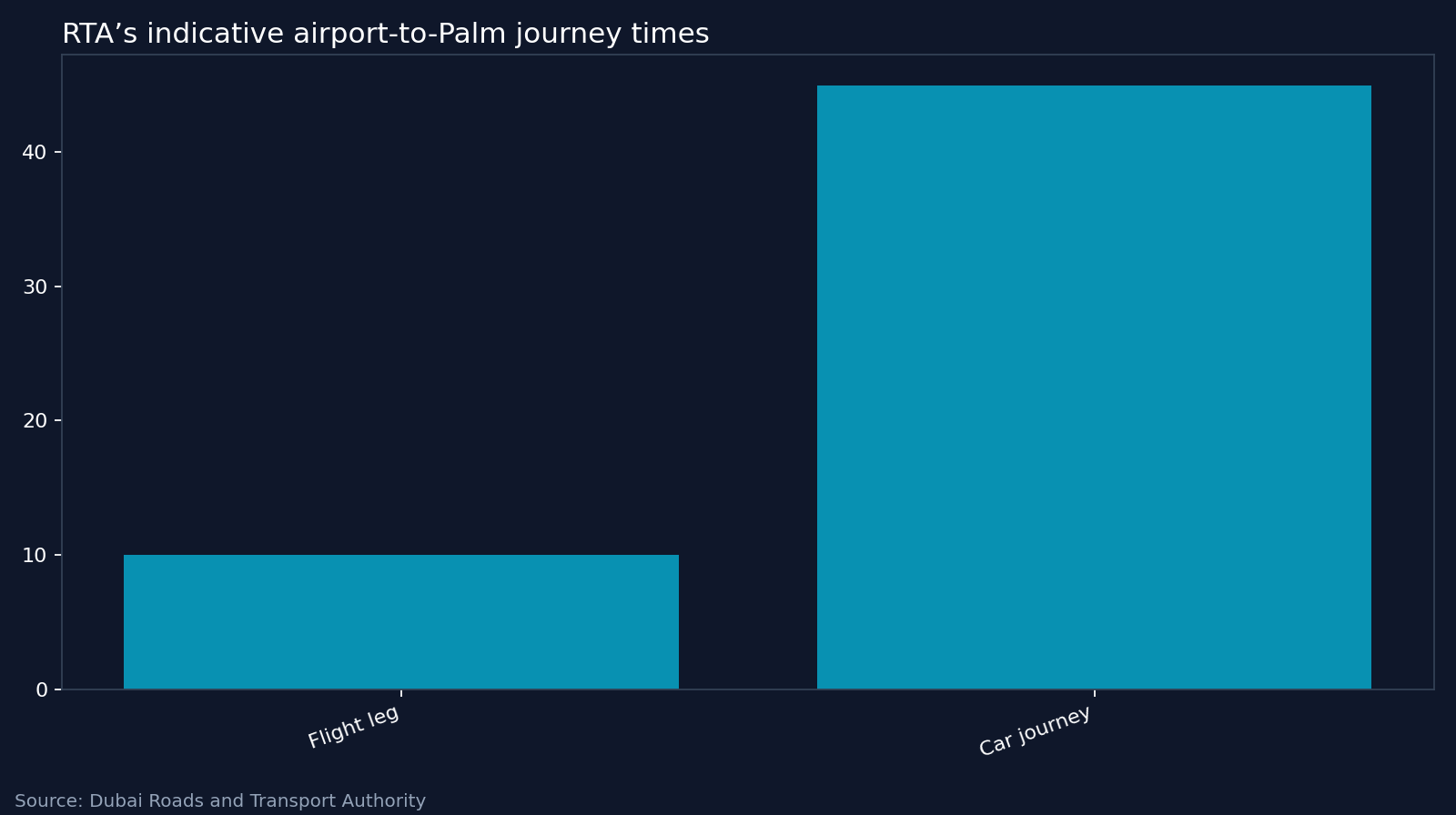
British travel technology buyers should fund reliable connections before paying for dedicated air-taxi integrations. An aerial booking option should earn its place through a demonstrable benefit to the complete journey. Dubai’s Roads and Transport Authority compares a 10-minute flight with 45 minutes by car, but that comparison does not establish door-to-door savings. Until suppliers can show the complete fare, transfers and disruption arrangements, aerial access deserves a bounded trial rather than a core procurement requirement.
Key pointers
- Make complete journey time the acceptance test for an aerial booking feature.
- Require a ground-only comparison for the same destination, arrival deadline and baggage.
- Ask who pays for replacement transport when a connection fails.
- Keep experimental integration spending separate from essential travel-platform improvements.
- Demand documented booking access and commercial terms before commissioning custom development.
- Reject any business case that treats a regulatory target as a confirmed service launch.
A flight time is an inadequate buying argument
The procurement question is whether the traveller reaches the required destination sooner, at an acceptable total cost, with a workable recovery plan. An airborne duration cannot answer that question.
Dubai provides a particularly concrete reason to insist on this distinction. During an April site visit, The National reported a Skyports target of no more than ten minutes from check-in to departure, with heavier luggage travelling by road. It also reported that journey pricing had yet to be confirmed. These were reported plans and statements at the time of the visit, rather than measured commercial service results.
Those details change the software requirement. A booking platform needs to account for passenger processing and baggage delivery before it can recommend a flight on the strength of its duration.
Consider a hypothetical British exhibitor travelling to a meeting with demonstration equipment. If the equipment goes by road, the useful arrival time is when both person and equipment are ready. An app that optimises only the passenger’s arrival could recommend a faster flight without advancing the meeting at all.
I would therefore reject a supplier demonstration that ends when the aircraft lands. The demonstration should end at the customer’s destination, with the required belongings and an explanation of the total charge.
The suppliers are solving different problems
Joby Aviation, Skyports Infrastructure and Vertical Aerospace should not be treated as interchangeable answers to a travel buyer’s needs.
A Skyports announcement reproduced by AeroMorning describes the Dubai airport vertiport’s technical completion, access to Emirates Metro Station, Joby’s dedicated booking app and automated check-in. It establishes the announced infrastructure and passenger processes. It does not establish a protected booking covering both a ground connection and a flight.
Vertical Aerospace’s September 2025 company statement, published by Vertical Mag, described its work towards VX4 aircraft certification in 2028. That manufacturer’s target answers a different question from whether a business can obtain bookable seats, integration access or support for a disrupted itinerary.
Buyers should compare delivery approaches against those distinctions.
| Approach | When I would consider it | Evidence I would require |
| --- | --- | --- |
| An operator’s own booking app | A specific journey with manageable onward arrangements | Available service, complete fare, baggage rules and cancellation terms |
| A travel-management supplier | Journeys requiring support across separate bookings | A demonstration of connection handling, rebooking responsibility and human escalation |
| A custom integration | A recurring use case that existing booking channels cannot serve adequately | Documented access rights, commercial terms, maintenance costs and a viable recovery process |
This is a procurement framework, not a ranking of available platforms. The supplied evidence does not establish which travel-management suppliers can deliver these functions.
The strongest objection is that early integration buys learning
The best argument against waiting is that integration work can expose problems before customers depend on a service. A travel business that postpones every experiment until commercial operations are established may then discover that its booking, payment and support processes need substantial changes.
Dubai’s combination of a dedicated booking app, passenger processing and ground connections makes that a credible argument for experimentation. The interfaces between those processes are precisely where a useful trial should concentrate.
I would fund that learning, but give it a different approval test from a production commitment. A trial should identify a specific uncertainty, such as whether booking changes can be handled across separate legs, and define what evidence would resolve it. It should have a spending limit and a stopping condition.
The distinction is commercial. A successful trial can justify further work; an announcement alone cannot justify making aerial access a mandatory feature in the next travel-platform contract.
Early participation and disciplined procurement can coexist. The burden is on the proposed integration to show what the buyer learns or gains.
Britain’s target gives buyers time to demand evidence
The CAA’s delivery-model announcement sets out an ambition for a framework enabling commercial electric vertical take-off and landing flights by the end of 2028. It is a regulatory programme, not a reservation for a particular aircraft, route or departure.
A UK buyer should use that distinction when evaluating supplier roadmaps. “Ready for 2028” is too vague to be an acceptance criterion. The supplier should specify whether it means a prototype interface, a commercial agreement, a supported booking connection or a service that customers can actually use.
For a small business, my recommendation is to put these questions to its existing travel supplier before commissioning bespoke development. For a larger travel platform, the sensible preparation is to make transfer times, baggage restrictions and disruption responsibilities explicit in its journey model.
That work has a purpose even if an aerial service arrives later than expected. Its value can be tested against journeys the buyer already needs to support.
Approve the integration only after testing the failure
The supplied research contains no confirmed fare or integration tariff on which to build a complete purchasing case. Buyers should therefore request the missing commercial inputs rather than substitute a headline time saving for a cost model.
Ask for implementation and maintenance charges, booking and payment costs, change and refund terms, and the scope of customer support. Require the supplier to identify which costs are included and which remain with the buyer.
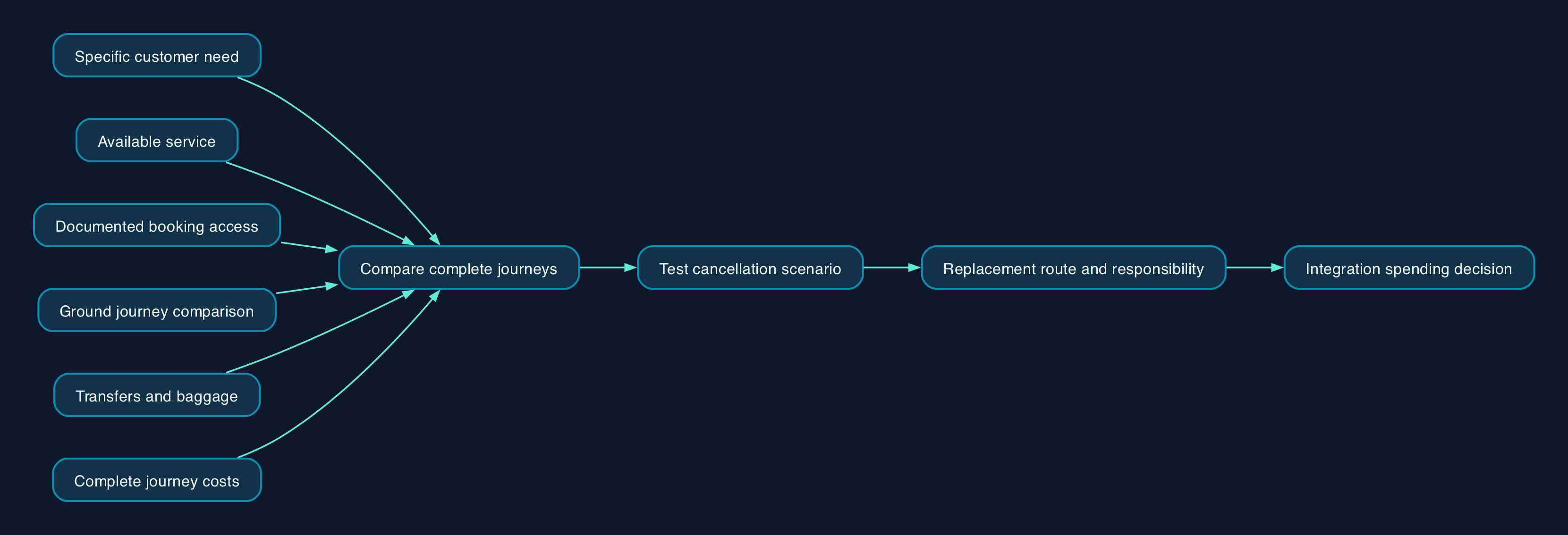
Then run a cancellation scenario. The platform should show the replacement ground journey, any additional charge and the organisation responsible for resolving the booking. A traveller should not have to discover those responsibilities while trying to reach a meeting.
My spending rule is straightforward. Fund better journey comparisons and recovery handling now. Approve dedicated aerial integration when an available service, documented access and a specific customer need make the additional work defensible.
A travel app earns its fee by helping the customer arrive. Sometimes its strongest recommendation will be to stay on the ground.
FAQ
Does a shorter flight mean a faster business journey?
Not necessarily. The RTA journey example does not establish equivalent door-to-door timings. Compare access, passenger processing, waiting and onward travel before accepting a time-saving claim.
Is the UK guaranteed to have commercial air taxis in 2028?
No particular service is guaranteed by the CAA’s stated ambition. Its programme concerns the framework and operational systems needed to enable initial commercial passenger operations from the end of 2028.
Should a small British company commission an integration now?
My recommendation is to start with its existing travel supplier. Custom work should require a recurring customer need, documented booking access and a costed support arrangement.
What would justify an early trial?
A trial should answer a named question that affects the purchasing decision. Define the evidence required, spending limit and stopping condition before development begins.
Does access to a Metro station prove that bookings are connected?
No. Physical interchange does not establish shared booking changes, refunds or protection against a missed connection. Ask the supplier to demonstrate those functions and identify the contractual responsibilities.
What is the decisive supplier demonstration?
Show the complete journey under normal conditions, then cancel a leg. Require the supplier to explain the replacement route, additional cost, refund process and human support without leaving the customer to coordinate the answer.
Sources
- Dubai Roads and Transport Authority – Aerial Taxi in Dubai by 2026. Publication date not stated in the supplied extract.
- UK Civil Aviation Authority – Enabling advanced air mobility. Update date not stated in the supplied extract.
- The National – First look inside Dubai’s air taxi vertiport. Published 23 April 2026.
- AeroMorning – Air taxi ready, first commercial vertiport in Dubai. Published 18 April 2026, reproducing a Skyports announcement dated 16 April 2026.
- Vertical Mag – Vertical Aerospace welcomes UK CAA’s eVTOL delivery model. Company press release published 26 September 2025.
- UK Civil Aviation Authority – Regulator publishes Delivery Model for commercial eVTOL flights. Published 18 September 2025.