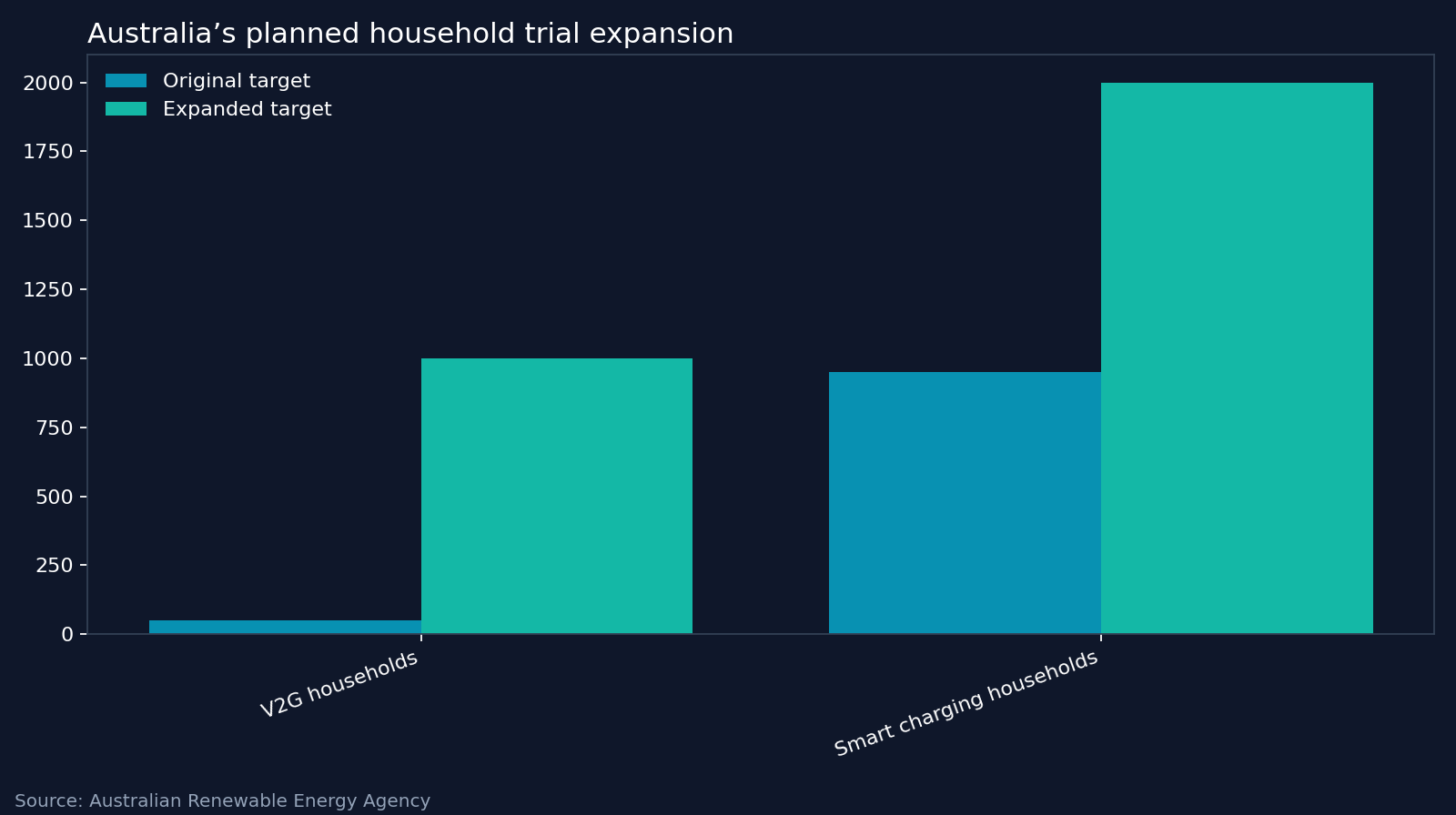


UK fleets should fund limited vehicle-to-grid (V2G) trials to resolve specific uncertainties, but require measured additional value over smart charging before approving wider deployment. Exceptional household earnings cannot establish a fleet business case. Australia’s expanded Amber programme is investigating compatibility, battery use and operation at greater scale. British buyers should use that work to sharpen their questions while testing whether exports justify additional costs without compromising vehicle availability.
Key pointers
- Use smart charging as the baseline for measuring V2G’s additional value.
- Separate spending on learning from investment justified by expected savings.
- Obtain written warranty coverage for the exact vehicle and proposed battery use.
- Base export forecasts on when vehicles will actually be connected.
- Require separate figures for export receipts, avoided electricity purchases and additional costs.
- Agree who restores normal charging when an export session fails.
- Expand only when measured benefits justify the costs and vehicles remain ready for work.
Household success is a starting point
Amber reports that a Victorian household eliminated its EV energy costs and generated additional savings over a 12 month period. It also describes a South Australian customer earning money during a single heatwave afternoon. These are supplier-reported examples, and the account provides neither a complete installed cost nor a representative distribution of customer returns. Amber’s account of customer outcomes
Those examples justify investigation. They do not tell a British finance director what to enter in a fleet budget.
Start with what better charging schedules could achieve. ARENA’s programme separately addresses smart charging and bidirectional charging, with the latter enabling vehicles to send electricity back to the grid. Both sit within a project designed around wholesale electricity prices. ARENA’s project description
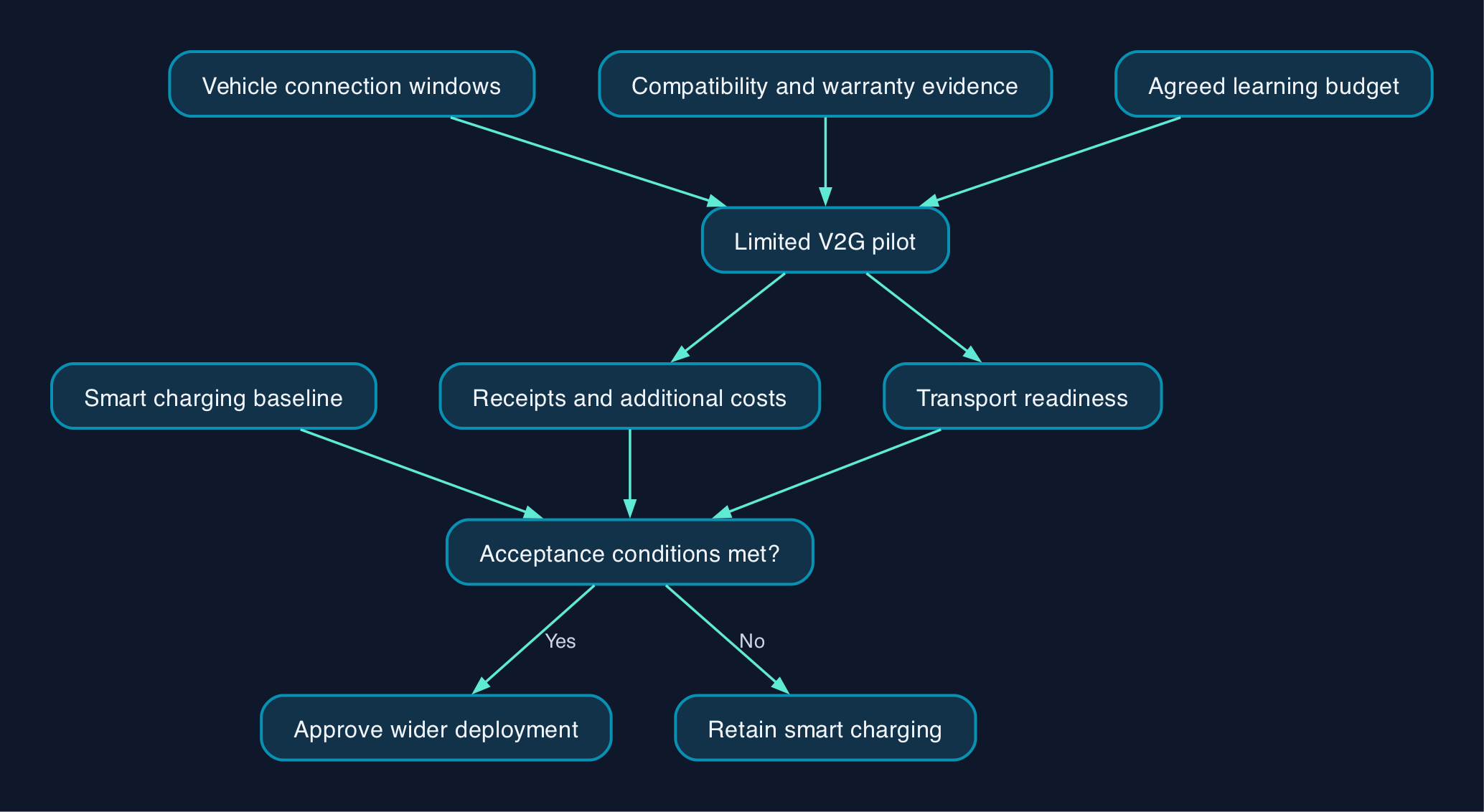
My buying test follows that distinction. Establish the smart charging baseline, then measure what exporting adds. A proposal that attributes every scheduling saving to V2G has not isolated the value of the additional capability.
For a small business, that distinction should determine the approval. Ask for the incremental costs and benefits before deciding whether exporting deserves a budget.
Australia is funding questions that remain open
The expanded project includes work on communication between vehicles and chargers, battery degradation, home energy management and grid services. Those are planned workstreams, not completed proof that every proposed combination operates successfully. ARENA’s technical workstreams
That makes the programme useful to buyers beyond Australia. It identifies what a credible supplier should be prepared to demonstrate.
For a UK fleet, I would require evidence covering the proposed vehicle, charger and controlling service together. Written warranty coverage should describe the intended battery use. ARENA explicitly identifies manufacturer confidence in battery use and warranties as part of the work needed to expand V2G. ARENA’s explanation of deployment barriers
The contract should also name who diagnoses a failed export session and who restores ordinary charging. A buyer should not have to negotiate responsibility between suppliers while vehicles wait for power.
The car park must pass the availability test
Consider two hypothetical businesses. An office whose employees take company cars home cannot base an overnight workplace export forecast on those vehicles remaining in its car park. A maintenance depot with pool vehicles parked overnight has a different connection window, but must still test whether that window suits the proposed service.
Count usable connection hours, not fleet registrations.
For the pilot, I would assign responsibilities explicitly. Fleet management should record departure times and required charge reserves. Facilities should establish site constraints. The technology team should test controls and access to records. Finance should reconcile receipts and costs against the agreed baseline.
Acceptance should depend on practical results. Can a driver override an export schedule and still depart with the required charge? Can finance trace the bill to recorded activity? Does the support arrangement restore charging when something fails?
A trial that generates export income by disrupting the next day’s work has failed the buying test.
Compare delivery models before choosing equipment
The Australian programmes illustrate different commercial approaches. Amber centres its approach on automation linked to wholesale prices, AGL’s residential trial involves multiple vehicle manufacturers, and Origin combines a vehicle subscription with a bidirectional charger and energy tariff, according to Zecar’s account of the programmes. These examples do not establish equivalent UK fleet offers.
Each approach deserves a different procurement question. For wholesale-linked operation, ask how variable earnings enter the forecast. For a bundled vehicle and energy package, establish what happens when either agreement ends. For a service involving several equipment suppliers, require a named owner for fault resolution.
Give bidders the same vehicle schedules and site requirements. Request itemised GBP quotations with VAT treatment, installation and electrical alterations clearly identified. Include software, maintenance, staff time and exit costs, and require suppliers to explain their treatment of charging losses and battery wear.
Keep avoided electricity purchases separate from export receipts. Ask which benefits can be earned together, so the same stored energy is not credited twice.
The strongest objection is that caution can delay useful investment
The strongest objection is that requiring V2G to beat smart charging for each buyer could undervalue learning and wider electricity-system benefits. Early deployments help establish the evidence later customers need. The Electric Vehicle Council argues that coordinated exports during peak periods can reduce costs across the system, including for people outside the trial. That is an industry body’s argument for broader benefits, rather than a measured return for an individual fleet. The Electric Vehicle Council’s statement
That objection supports a bounded learning budget. ARENA’s programme explicitly includes battery research, interoperability work and testing of grid services, showing why deployment can have a purpose beyond immediate customer payback. ARENA’s research and service-testing scope
A business can therefore approve a pilot before export receipts cover its costs, provided it states what it is paying to discover. The pilot might establish usable connection windows, test charge reserves or demonstrate reliable billing records.
Wider deployment requires a separate decision. If learning or system benefits remain part of the justification, name and fund them explicitly. They should not be presented as demonstrated fleet savings.
Editorial analysis
I would approve a well-defined V2G learning trial before accepting a V2G savings forecast. The trial needs a question, an owner, a spending limit and agreed acceptance conditions.
The supplied evidence does not establish a complete UK fleet package with an installed price and dependable net return. It does show an Australian programme designed to investigate several of the uncertainties buyers face.
The next procurement step is to request a pilot proposal with a smart charging baseline and itemised additional costs. Expansion should follow evidence that exporting adds worthwhile value while preserving transport readiness.
FAQ
Should a UK business buy V2G chargers now?
A limited pilot can be justified when compatibility, warranty coverage and learning objectives are documented. The Australian expansion supports investigation, but does not establish a UK fleet payback forecast. I would require measured additional value before approving wider deployment on savings grounds.
Why compare V2G with smart charging?
Smart charging changes when electricity enters the vehicle, while V2G adds the ability to send stored electricity back to the grid. ARENA addresses both within its project scope. Comparing V2G only with unmanaged charging risks attributing scheduling benefits to the export capability.
Does the Australian trial settle battery warranty concerns?
No, it does not establish coverage for a different vehicle or UK contract. ARENA describes battery use and warranties as matters requiring manufacturer collaboration. Require written coverage for the proposed operation before committing to equipment.
Can household results support a fleet forecast?
They can suggest what to investigate, but cannot establish the fleet’s expected return. Amber’s customer examples do not provide a complete installed cost or representative distribution of returns. Build the forecast around the fleet’s own schedules and pilot measurements.
Can a pilot be worthwhile without paying for itself?
Yes, as an explicitly approved learning exercise. ARENA’s technical workstreams illustrate the questions deployment can investigate, including battery degradation and interoperability. Agree the learning objective and spending limit before starting.
What result would justify expansion?
My threshold is worthwhile additional value after costs, with vehicles consistently ready for their transport duties. Measure connection time and charge reserves alongside financial results. Agree those acceptance conditions before the trial begins.
Sources
- ARENA expansion announcement, published 29 May 2026 and updated 01 June 2026
- ARENA project scope and timetable, updated 29 May 2026
- Amber Electric programme expansion and customer outcomes, published 29 May 2026
- Zecar account of Australian V2G programmes, dated 29 May 2026
- Electric Vehicle Council statement on the trial expansion, dated 29 May 2026