The biggest robot market in Britain may emerge in care rather than factories
Britain’s robotics opportunity may emerge through everyday care tasks. Japan points towards specialised equipment and services, but British buyers need evidence of better care, manageable workloads and dependable support.

Britain’s biggest future robotics opportunity may lie in care, and technology businesses should prepare for it. My position is that equipment which helps people deliver care deserves more commercial attention than the promise of an autonomous carer. Japan’s expanded care-technology priorities show the direction. The British opportunity depends on turning specific tasks into dependable services, with demonstrable benefits for residents and staff.
Key pointers
- Start with a care task that needs improving, then decide whether it needs a robot.
- Judge a pilot by resident experience, staff workload and reliability, rather than the number of devices installed.
- Compare robotic equipment with sensors, ordinary assistive equipment and improvements to existing processes.
- Ask who responds when a device raises an alert or stops working.
- Include training, maintenance, connectivity and human response in the business case.
- Expand only when the service works across ordinary shifts without depending on its most enthusiastic champion.
Japan is organising a market around care tasks
The significant change in Japan is the wording of its programme. In June 2024, the government replaced “robot technology” with the broader category of “technologies” for long-term care. Its stated aims include improving care quality, reducing the burden on staff and supporting older people’s independence through robots, information and communications technology, and other systems. The official announcement makes the care task the organising principle.
That is a useful commercial lesson for Britain. A care provider does not need a robotics strategy before it can identify an exhausting transfer routine, an unreliable handover or a monitoring process that interrupts residents unnecessarily. It needs a clear account of the problem and evidence that a proposed change improves it.
The headline remains an editorial proposition. The available evidence does not establish that British care robotics will overtake industrial robotics by revenue or installed machines. Nor should every sensor be counted as a robot to make the market look larger. The case is that care could become a major source of recurring demand for specialised robotics and the services needed to operate it.
For a British technology business, that suggests a different starting question. Instead of asking which impressive machine it can distribute, ask which care task it can help a provider perform more reliably, and what support it would have to supply afterwards.
The early evidence favours narrow jobs
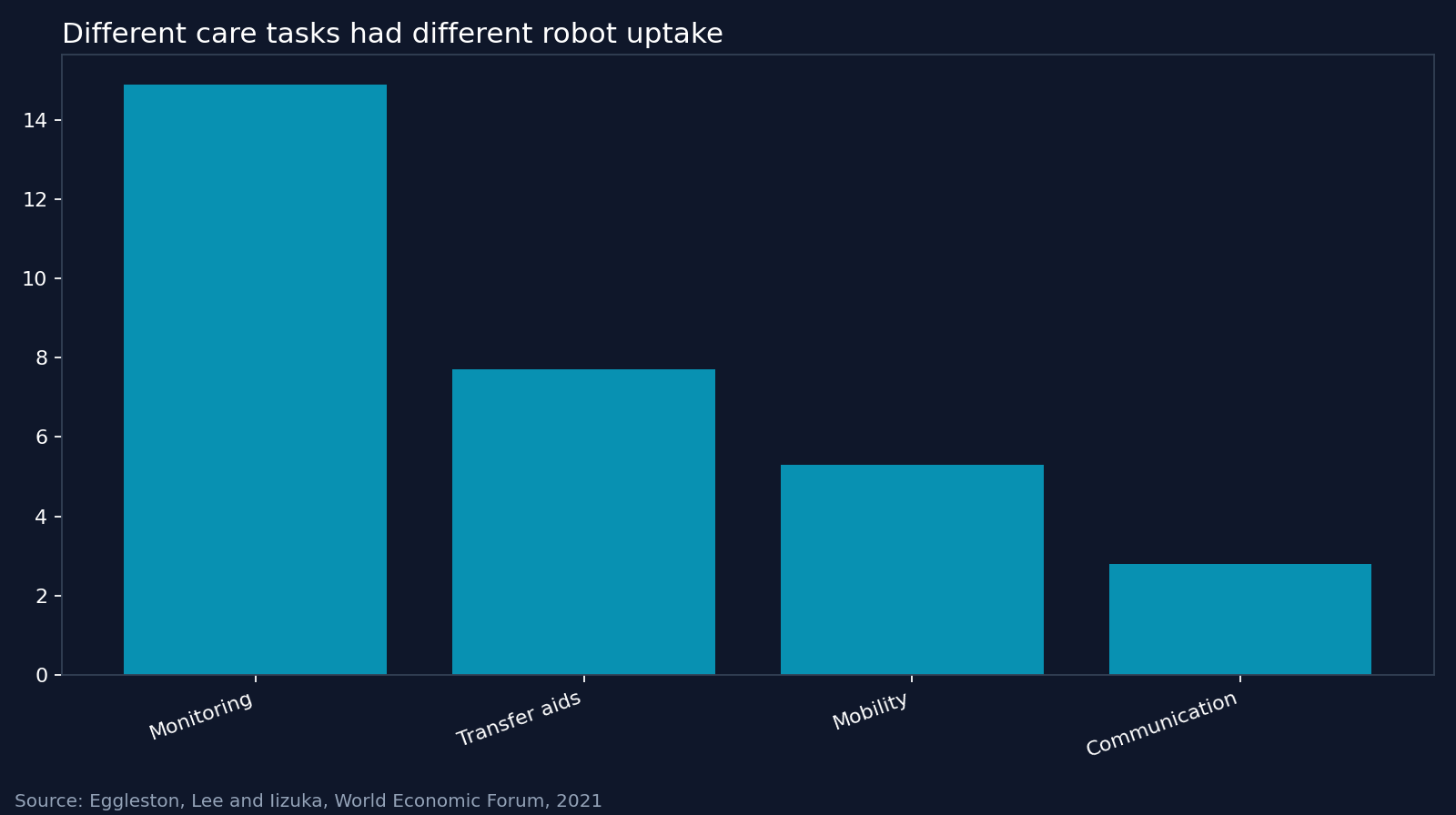
In the Japanese nursing-home data discussed by researchers in their 2021 account, monitoring robots were used by 14.9% of homes, transfer aids by 7.7%, mobility robots by 5.3%, and communication robots by 2.8%. These are historical findings associated with the research’s 2017 adoption analysis, not current penetration figures or mutually exclusive market shares. The researchers explain the categories and results.
Those figures support a modest but useful inference. Buyers were finding applications for machines with bounded jobs. Monitoring and transfer assistance had more uptake in that sample than communication robots.
They do not establish that monitoring is the right first purchase for every British care home. A provider whose principal problem is physical transfers needs a different assessment from one struggling to organise overnight checks. Procurement should follow the local problem, rather than the most popular category.
The wider Japanese pressure is substantial. The US International Trade Administration’s February 2025 briefing reports an estimated requirement for 2.72 million caregiving personnel by 2040 and a projected shortage of 570,000. These are Japanese projections, not figures that can be transferred into a British sales forecast.
My inference is that a workforce constraint changes the investment question. Technology can earn its place by helping staff continue doing demanding work, even when it does not eliminate a post.
British buyers should compare different kinds of help
A fair comparison starts by separating conversation, remote contact, monitoring and physical assistance. They are different jobs, with different failure consequences.
The Loughborough report account identifies ElliQ as a device offering reminders and conversation, alongside Amazon’s Alexa and Google Home as smart assistants supporting everyday tasks. Those examples illustrate different approaches to interaction. They do not establish equivalent care capabilities, current UK purchasing terms or suitability for a particular resident.
For a reminders-and-contact requirement, a British buyer should therefore compare a specialist companion device with an ordinary smart assistant and the option of improving existing human contact arrangements. The assessment should cover whether the person can use it, whether they welcome it, and what happens when they do not respond.
A different proposition combines a mobile device with a care service. Robotics for Good describes Dr. temi as a telemedicine robot used with an accompanying nurse or trained care professional and a remote clinician. Its health and social care page seeks a care-home partner for a pilot. That is evidence of a proposed delivery model, not independently established savings or a mature national service.
The distinction matters for purchasing. A reminder device should be assessed against other ways of delivering reminders. A mobile consultation system should be assessed against the whole consultation workflow, including the people still required. Neither belongs in a universal league table of “best care robots”.
For physical assistance, demand a separate assessment of the person, task and environment. Success at conversation says nothing about suitability for helping someone move.
The product is also a response service
Consider an illustrative British care-home deployment. A sensor flags a change, software sends a notification, a named member of staff checks it, and the care team decides what action to take. The device supplies information; the service depends on the response.
Before a pilot begins, the provider should identify who receives alerts, who covers absences, who maintains the equipment and who can stop its use. Staff should rehearse the fallback when connectivity fails or a device becomes unavailable.
This creates a plausible opportunity for UK installers, software businesses and support providers. My commercial judgement is that connecting equipment to a dependable care process may be more valuable than selling another dashboard.
For a small care operator, that could mean purchasing installation, training and maintenance together. For a larger group, it could mean retaining integration and service management internally. In either case, the contract should describe the work being bought and the responsibilities the care provider retains.
Price the whole service before counting savings
The evidence supplied here does not establish comparable UK equipment prices or complete operating costs. A credible business case therefore needs quotations, rather than a borrowed price from an overseas demonstration.
Ask suppliers to separate equipment purchase or rental, installation, software subscriptions, connectivity, maintenance, replacement provision, training and exit charges. Add the provider’s own staff time for assessment, administration, responding to alerts and reviewing results.
Time released is not automatically cash saved. If staff use it to give residents more attention, record that as a care benefit. If a provider expects lower expenditure, identify the actual spending that would change and test whether the proposed service makes that change possible.
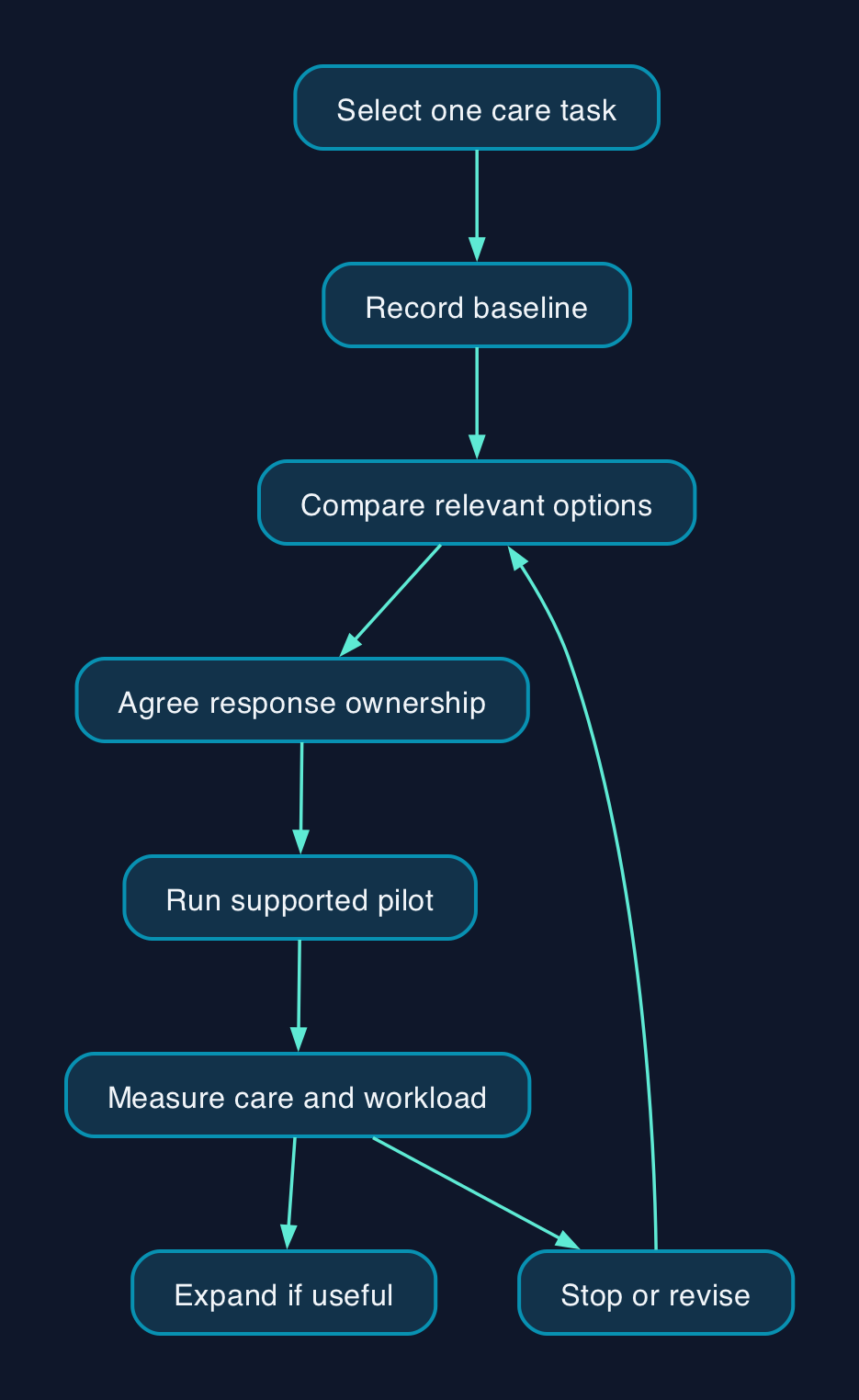
My recommended evaluation sequence is straightforward. Select one task and record its baseline. Compare relevant options, agree response ownership and run a supported pilot. Measure care experience and workload together, then expand, revise or stop.
A pilot that produces more alerts while leaving nobody time to answer them has not solved the original problem.
The strongest objection is that care resists standardisation
The strongest case against this thesis is practical. Care involves changing needs, intimate interactions and environments that equipment cannot assume will remain predictable. Demand for help does not guarantee that a machine is acceptable, affordable or dependable.
The 2025 report described by Loughborough University argues that domestic settings introduce challenges involving clutter, pets, untrained users and changing personal needs. It calls for tailored safety arrangements, clearer ethical guidance, training and continuing monitoring. These are the report’s recommendations, not evidence that new rules have since been enacted.
My answer is to limit the ambition of each deployment. A machine should have a defined task, a person responsible for its operation and a tested fallback. Residents’ willingness to use it should be an acceptance condition, rather than a communications problem to overcome after purchase.
The employment evidence also resists an uncomplicated success story. In their 2021 account, the researchers report gains concentrated among non-regular employees, alongside a modest reduction in nurses’ monthly wages. They discuss possible explanations, including changes to night work and part-time employment.
That makes staff experience part of the investment test. A provider should not count a change as progress solely because the technology works or the staffing pattern becomes cheaper.
Editorial analysis
I would prioritise the British care opportunity around equipment that staff can use repeatedly, maintain locally and stop safely. That is a more credible route to ordinary procurement than waiting for a general-purpose machine capable of taking over a carer’s role.
For suppliers, the repeat order should be the decisive commercial test. A provider buying again after observing workload, resident experience and support quality offers stronger evidence of a market than a successful demonstration.
Japan has supplied a useful direction through its task-based priorities. British companies should respond by making the operational case concrete enough for a care manager to accept responsibility for it.
FAQ
Will robots replace British care workers?
The Japanese research discussed here does not support a simple replacement narrative. Its authors report increased employment among non-regular staff and reduced retention difficulties, while also identifying wage effects that require attention. Those historical findings do not predict the staffing outcome of a British deployment.
What should a small care provider try first?
Choose a recurring task with an observable problem and a named owner. Compare equipment with changes to the existing process, then test the preferred option with staff and residents. Agree the conditions for stopping before the pilot starts.
Does a care provider need a humanoid robot?
There is no reason to make a human-like shape a purchasing requirement unless it helps the particular task. Japan’s priority framework includes transfer assistance, monitoring, bathing and care-work support across a broader technology programme. Buy against the function and its evidence.
How should a buyer judge a supplier’s savings claim?
Ask for the baseline, deployment conditions, staff involvement and full operating costs behind it. Separate time released, changes in expenditure and improvements in care. Require the pilot to test the claimed benefit without assuming that fewer human visits or fewer staff is the desired result.
Sources
- METI and MHLW — Priority Fields in the Use of Robot Technology for Long-term Care Revised, 28 June 2024.
- US International Trade Administration — Japan Healthcare Caregiving Technologies, 5 February 2025.
- Karen Eggleston, Yong Suk Lee and Toshiaki Iizuka — Impact of Robots in Nursing Home Care in Japan, Stanford University, undated page supplied in the evidence pack.
- Loughborough University — Clearer rules needed to keep home care robots safe, ethical and effective, 3 July 2025.
- Robotics for Good — Health & Social Care, undated page supplied in the evidence pack dated 28 September 2026.