The first autonomous ships that matter to Britain may never cross an ocean
Britain should prioritise defined maritime jobs over autonomous ocean crossings. Singapore’s port feeder programme shows where technology suppliers could contribute, and what buyers must prove before committing.

Britain should put harbour operations ahead of ocean crossings when deciding where to invest in maritime autonomy. The near-term opportunity is to make a defined transport job dependable, then sell the technology and services behind it. Singapore’s programme to develop autonomous container feeders between port terminals offers a useful model, provided British buyers treat it as a development programme rather than proof of commercial savings.
Key pointers
- Start with a specific cargo movement or inspection task and identify what currently makes it expensive or unreliable.
- Ask suppliers to distinguish automated navigation, remote control and the work that still requires people.
- Give responsibility for communications failures and emergency intervention to named parties before commissioning a pilot.
- Compare an autonomous vessel with improving the existing service, including scheduling and terminal coordination.
- Budget for shore staff, integration, maintenance and recovery alongside the vessel.
- Seek early regulatory engagement before committing to a British deployment.
A short route can expose the whole business problem
Singapore has chosen an unusually useful test of autonomous shipping. Containers already need to move between its terminal clusters, and those transfers currently happen by road or feeder vessel. The programme asks whether a vessel operating with minimal human intervention can perform that existing job.
That gives a buyer something concrete to evaluate. Does the container reach the receiving terminal when required? How often does a person intervene? What happens when the vessel arrives but the terminal cannot accept its cargo?
MPA and PSA require proposals to address navigation, interaction with crewed vessels, redundancy, cybersecurity and integration with PSA’s operations. They also require viable business models. These are requirements for proposals, not reported achievements.
For British technology businesses, that distinction identifies where to look for work. A sensor developer could investigate degraded visibility. A cybersecurity specialist could examine remote access and command integrity. A software business could tackle the handover between a vessel schedule and terminal cargo handling. These are potential contributions inferred from the requirements, not announced British contracts.
The commercial question is whether a supplier can solve one of those problems and carry responsibility for it after the demonstration ends.
British approval needs its own evidence
Singapore’s programme cannot establish permission to operate an equivalent vessel in Britain.
The Maritime and Coastguard Agency says the applicable route depends on vessel size, operating area and intended use. Its autonomy guidance describes support for safety cases, trials, supervision models and human-machine interfaces, with additional assurance considerations for larger vessels.
There is also an international framework to consider. The MCA’s MASS Code announcement describes a non-mandatory instrument covering remotely operated and autonomous cargo ships within SOLAS Chapter I, part of the international convention governing safety at sea. That scope does not make it a universal operating licence for every harbour craft.
A British project should therefore establish its approval pathway while defining the service, before fixing the vessel specification and delivery date. This is not legal advice; consult your legal counsel.
The shore operation belongs inside the system
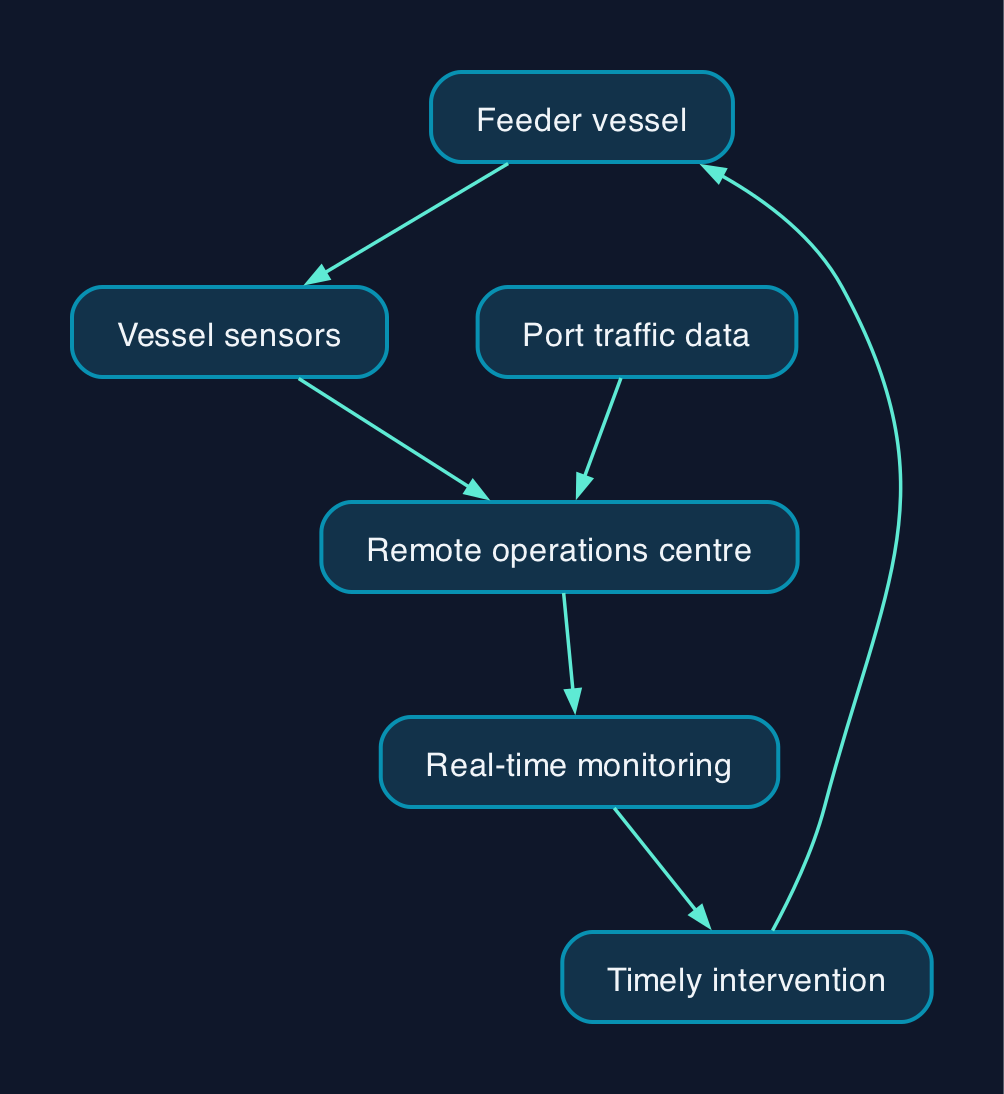
Singapore’s proposed remote operations centre makes the architecture clear. Vessel sensors and port traffic information feed a shore facility intended to support real-time monitoring and timely intervention. The programme requirements explicitly include human-machine interfaces and operational limits.
A procurement specification should describe what the shore team sees, what it can control and what happens when either capability deteriorates. “Remote monitoring included” is too vague to allocate responsibility.
Existing supplier descriptions show why buyers need that detail. Kongsberg Maritime’s remote and autonomous technology page distinguishes complete vessel technology packages, operations delivered through Massterly and individual products suitable for retrofits. Those approaches leave owners with different staffing and integration responsibilities.
British suppliers should be equally explicit about their boundaries. Providing a camera system, operating a vessel and integrating a complete service are different commitments. A contract should identify who investigates an incident that crosses those boundaries.
Price the completed movement
The supplied evidence contains no comparable feeder quotations, published service tariffs or independently measured savings. A credible British business case must remain conditional until those inputs exist.
For a port operator, I would compare the full cost of completing the required container movements over the proposed contract term. Crew reductions alone would be an inadequate basis.
| Cost component | What the buyer should establish |
| --- | --- |
| Vessel and equipment | Purchase or lease terms, installation, spares, propulsion requirements and replacement cycles |
| Shore operation | Staffing, training, communications, supervision coverage and emergency response |
| Integration and assurance | Terminal interfaces, testing, safety evidence, cybersecurity assessment and software changes |
| Downtime and recovery | Maintenance access, fallback transport, recovery arrangements and missed movements |
| Contract exit | Data export, documentation, licence continuity and the ability to appoint another operator |
The comparison should include an improved version of the existing service. Better dispatching or terminal coordination might address the immediate bottleneck without replacing the vessel.
For a small British technology supplier, this also changes the sales proposition. Offer a bounded capability with acceptance criteria, support terms and documented interfaces. Avoid taking responsibility for a complete maritime operation when the business can only maintain one component.
Different suppliers answer different questions
There is already a market beyond the image of an uncrewed ocean-going container ship, but its projects should not be treated as interchangeable.
Kongsberg Maritime describes technology packages and retrofit products, while Massterly provides an operations route within its published service offering. That distinction matters to an owner deciding whether to develop internal operating skills or procure a service.
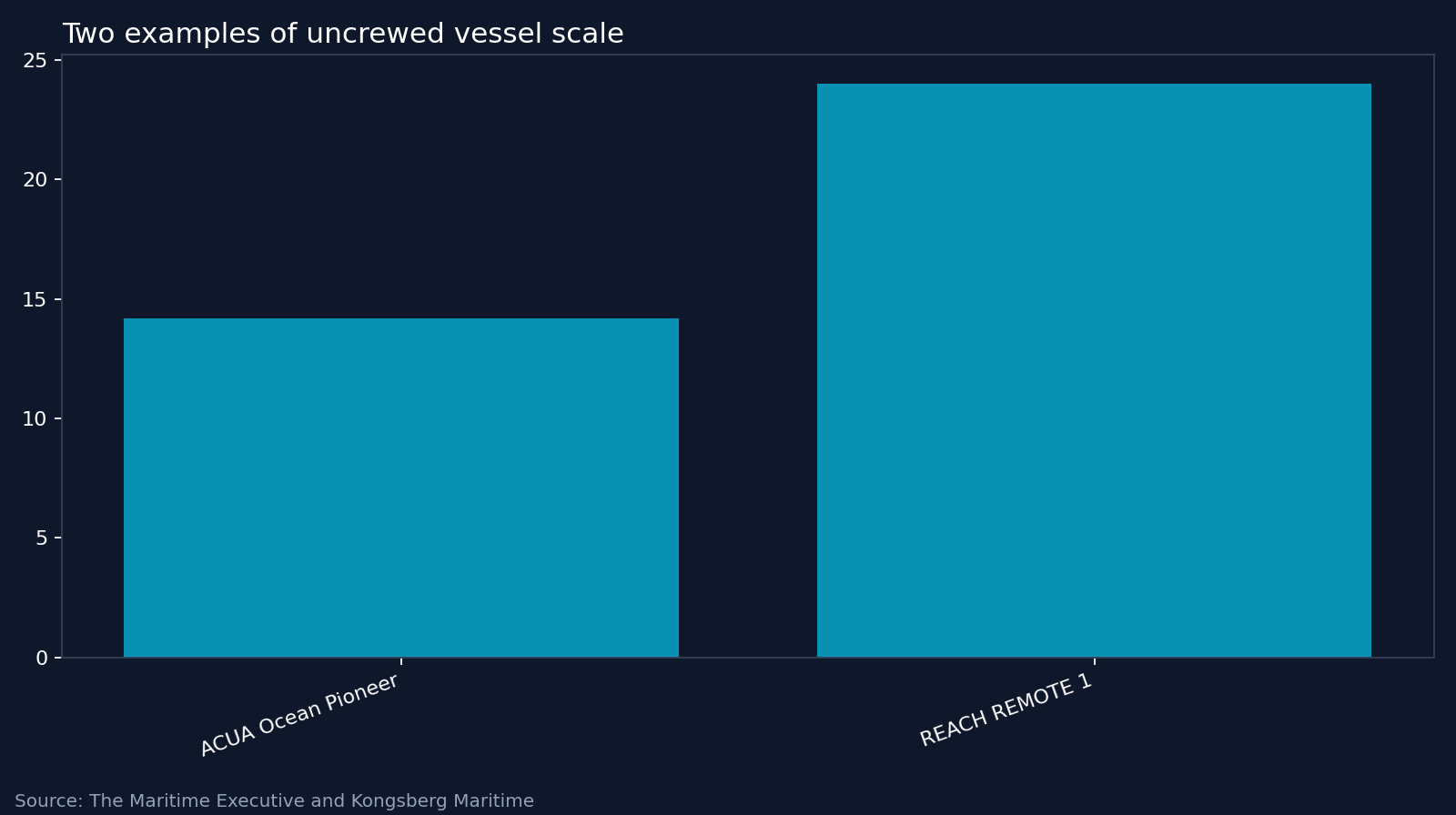
Reach Subsea represents an offshore-service application. Kongsberg’s delivery announcement for REACH REMOTE 1 describes a 24-metre vessel intended initially for underwater surveys, with remote control from a shore operations centre and increasing functionality introduced in stages.
A British example serves another task. Reporting on its certification, The Maritime Executive described ACUA Ocean’s Pioneer as a 14.2-metre vessel designed for offshore surveillance, monitoring and inspection. That report establishes a development and certification example, not a verified current service offer.
Those lengths illustrate the scale of two named vessels. They do not establish which is cheaper, safer or more capable, and neither example proves suitability for Singapore’s container-transfer requirement.
The useful comparison is between delivery models and operational purposes. British buyers should shortlist against the job, then verify availability, approvals and support for the intended waters.
The strongest objection is that offshore work may matter more
A fair challenge to the harbour-first argument is that remote offshore operations already have commercial substance.
In its account of the Reach Remote programme, Kongsberg reports North Sea campaigns and deployment in Australia. It also describes efforts to establish a route into British waters. This is supplier reporting rather than an independent performance assessment, but it prevents a credible argument from dismissing offshore autonomy as distant speculation.
Harbours are not inherently easy, either. Singapore’s own proposal requirements emphasise interaction with crewed vessels and complex traffic. A short journey can still demand difficult navigation and a convincing safety case.
The answer is to narrow the claim. Harbour operations deserve priority as a buying and development opportunity because a defined transfer task can connect the technology directly to a customer’s existing workflow. Offshore inspection may offer a stronger case for a particular operator. Neither requires proving that a fully autonomous ship can cross an ocean.
The wrong investment test is distance travelled. The better one is whether the complete service performs reliably enough to justify its cost.
Editorial analysis
Britain’s opportunity is to supply and operate the parts that make maritime autonomy dependable. Navigation matters, but so do fault diagnosis, shore supervision, maintenance and integration with the customer’s systems.
Singapore’s Smart Port Challenge outreach gives British start-ups a specific reason to study that ecosystem. It does not guarantee procurement access, funding or contracts. The useful preparation is a demonstrable capability tied to an operator’s requirement.
UK ports should apply the same discipline at home. Choose a movement with an identifiable operational problem. Record the existing performance. Define acceptance and fallback arrangements before commissioning autonomy.
The competitive risk is that other ports learn how to procure, integrate and maintain these services sooner. Britain can respond by building that operating knowledge around practical tasks. An ocean crossing is unnecessary to begin.
FAQ
Does autonomous shipping mean nobody is in control?
No. Singapore’s feeder programme includes a planned remote operations centre for monitoring and intervention. Buyers should ask which functions are automated and who remains responsible when the system reaches its operating limits.
Can a British small business participate without building a vessel?
Potentially, through a defined component or service such as sensing, cybersecurity or port-system integration. Those areas follow from the Singapore programme’s requirements, but the evidence does not identify awarded British supply contracts. A prospective supplier needs an operator or integration partner with a specific requirement.
Should UK operators wait until the mandatory international code arrives?
They can begin defining projects and engaging with the regulator now. The UK Maritime Innovation Hub supports trial planning and evidence preparation. Engagement is a route towards understanding the requirements, not permission to deploy.
What should a port ask before buying?
Ask what measurable problem the service solves, what people and infrastructure it needs, and how operations continue when it fails. Singapore’s proposal requirements combine safety, operational integration and a viable business model. A British buyer should demand equivalent clarity rather than accept an autonomy demonstration as the business case.
Sources
- Maritime and Port Authority of Singapore — MPA and PSA Singapore seek proposals for autonomous shipping
- Maritime and Port Authority of Singapore — 10th Smart Port Challenge expands support to scale maritime start-ups
- Maritime and Coastguard Agency — Autonomy guidance from the UK Maritime Innovation Hub, updated 19 June 2026
- Maritime and Coastguard Agency — Publication of the MASS Code, 1 July 2026
- Kongsberg Maritime — Remote and autonomous ship technology
- Kongsberg Maritime — Delivery of the first REACH REMOTE vessel, 16 January 2025
- The Maritime Executive — Pioneer certification ahead of trials, 12 August 2025
- Kongsberg Maritime — Remote control