Britain should build power services around home batteries
British firms should build services around coordinating household batteries. Australia shows the potential, but transparent contracts, usable capacity and customer trust will determine whether the model works.


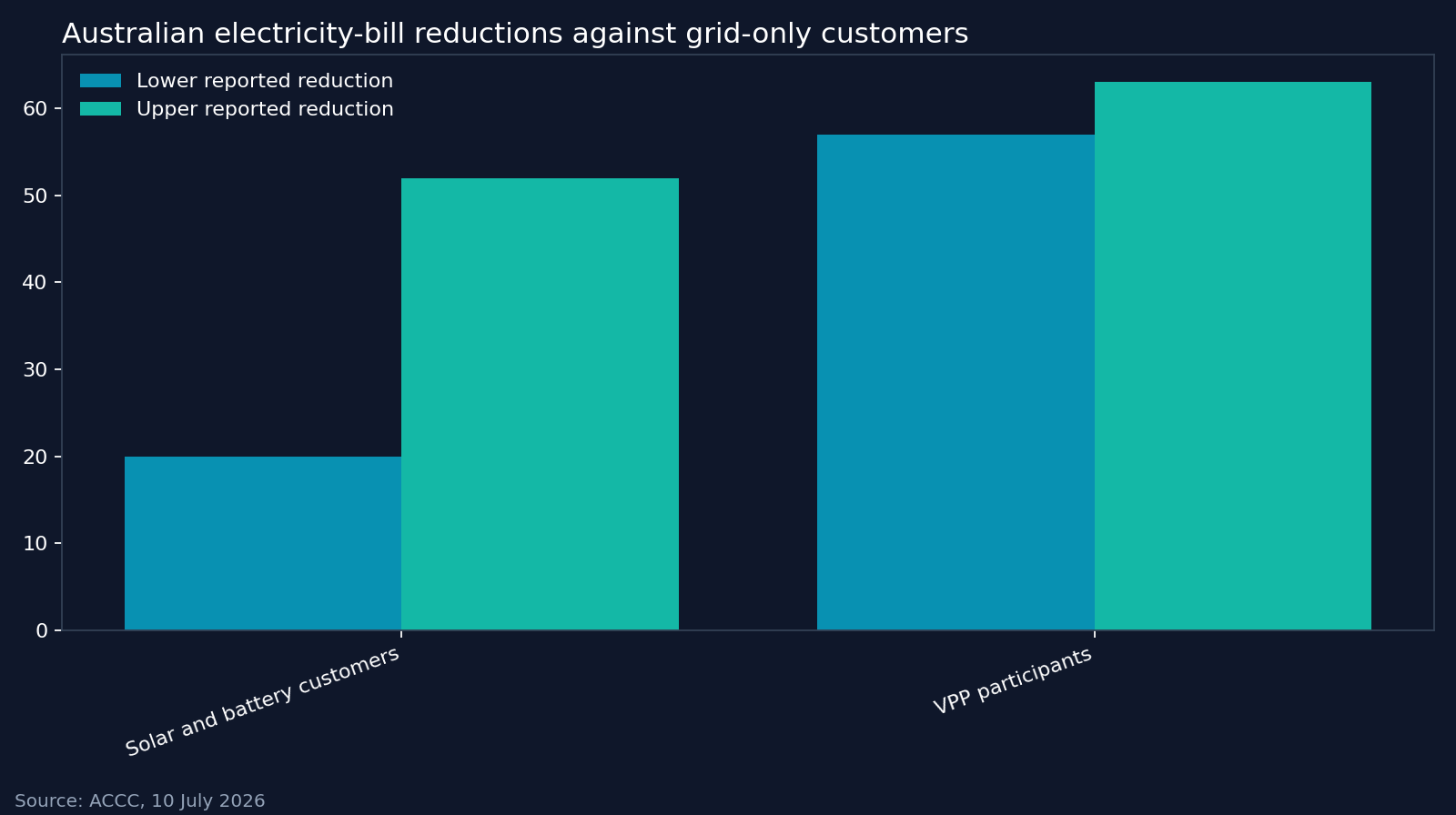
Britain should treat household batteries as the foundations of a new energy service industry. The opportunity is to coordinate equipment that owners already use, provided those owners retain meaningful control and receive a fair return. Australia shows the model operating at scale, with 24% of solar-and-battery customers in the ACCC’s study participating in virtual power plants. British companies should pursue that opportunity without promising that domestic storage can replace every function of a power station.
Key pointers
- Build the business case around coordinating usable battery capacity, rather than counting installed devices.
- Ask who controls charging, how household needs take priority and how the customer leaves.
- Treat Australian bill reductions as evidence of potential, not forecasts for British households.
- Compare automated energy tariffs and aggregation services against keeping the battery under household control.
- Require a named owner for installation faults, software failures and payment disputes.
- Start with a bounded pilot that measures customer benefit after all charges.
Australia shows the opportunity and the unfinished work
A virtual power plant, or VPP, brings distributed equipment under a central operator’s control. Household batteries remain in their separate locations, but the operator coordinates their use to support the wider electricity system. That is the ACCC’s description of the model, and it explains why this belongs on a technology leader’s agenda.
The commercial proposition extends beyond installing a box. Someone must connect the equipment, obtain permission to operate it, decide when to act and explain the resulting payment. My position is that British firms should compete on how reliably and fairly they perform those jobs.
The Australian bill figures make this worth investigating. They do not establish the additional saving caused by joining a VPP. Both reported groups are compared with grid-only customers, and electricity bills do not account for the full purchase and installation cost of the equipment. Subtracting the ranges would not produce a defensible return on investment.
Nor should Britain copy the Australian percentages into sales material. They describe outcomes in that market and study, not a guaranteed result under British tariffs.
The British opportunity is already more than a thought experiment
The July 2026 Clean Flexibility Roadmap update reports that more than 11.3 million smart meters had moved to half-hourly settlement by mid-June. This means electricity is accounted for in half-hour periods, providing a foundation for tariffs that reward changing when consumption happens.
The same update commits to considering VPP business models in balancing and settlement reform. That is policy direction, rather than proof that every small battery can already access every market.
For British battery installers, the sensible opportunity is an ongoing service relationship with clear responsibilities after commissioning. For software suppliers, it is device integration, operating records and customer controls. Energy firms would need to turn those capabilities into understandable contracts and payments.
EV businesses have a related opportunity, but should distinguish controllable charging from exporting electricity back from a vehicle. The roadmap describes future work on interoperability specifications for bidirectional charging; it does not establish universal compatibility.
A small installer need not become an electricity market operator to participate. My recommendation would be to partner for market access while retaining responsibility for the installation and a clear escalation route for the customer.
How a trustworthy service should work
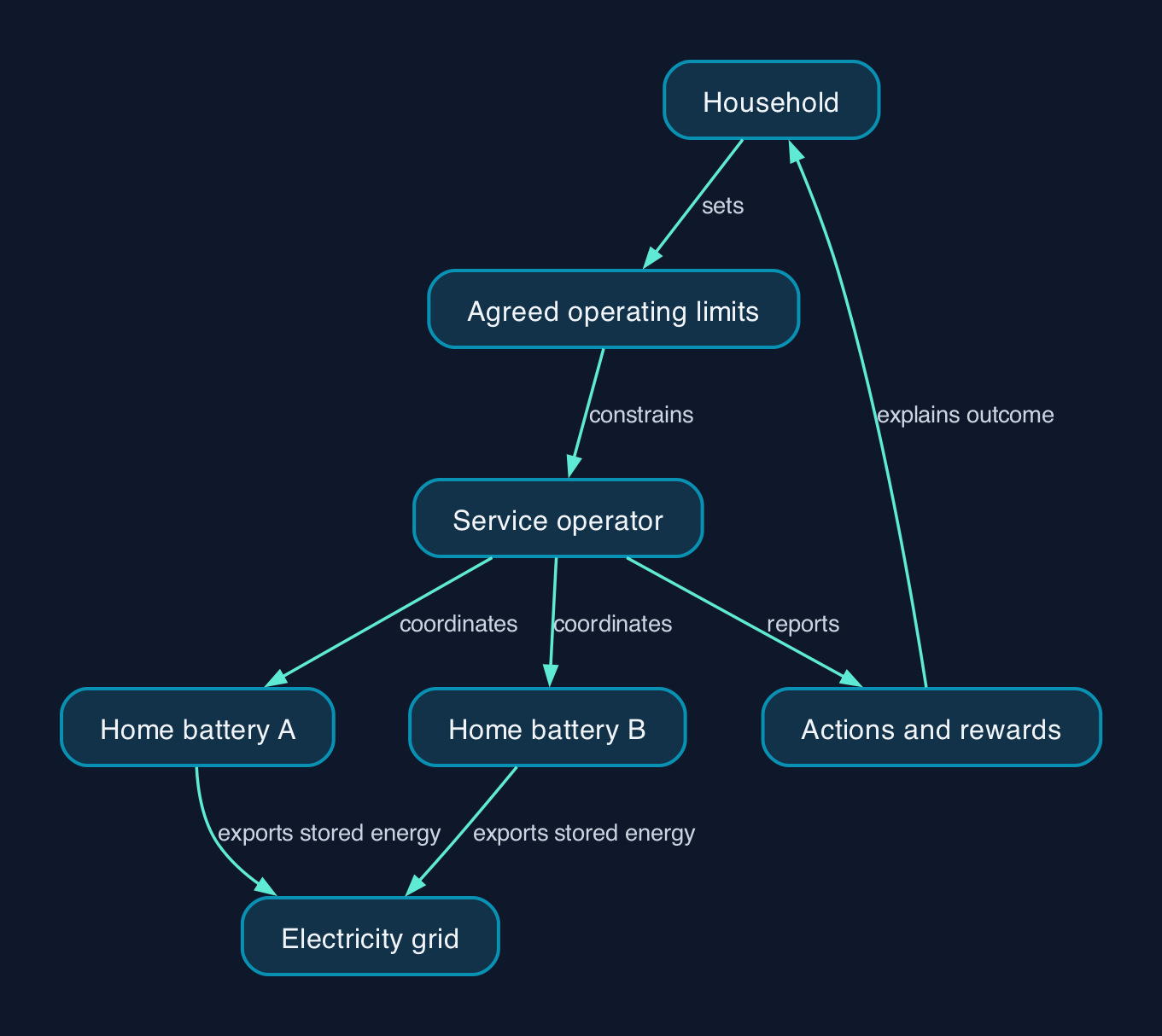
The basic mechanism is straightforward. An operator coordinates batteries at different homes, shifting energy use or sending stored electricity to the grid when valuable. The ACCC describes both the coordination and the transfer of control involved.
The proposed British service should make that transfer visible. The household sets agreed operating limits; the operator works within them; the customer receives a record of actions and rewards. These are design requirements, rather than claims that every current product offers them.
Before deploying software, establish who can issue a charging instruction, what happens when communication fails and how control returns to the customer. Require access to be revoked when the contract ends.
For a hypothetical installer coordinating customers’ batteries through a partner, a successful pilot would demonstrate three outcomes. The equipment follows authorised instructions, the customer can understand the financial result, and both parties can complete an orderly exit. A dashboard showing connected devices proves none of those outcomes by itself.
The costs belong on both sides of the contract
No verified British installation prices or comparable service quotations are available in the supplied evidence, so a pound-denominated payback forecast would be speculation.
A buyer should separate the decision to purchase a battery from the decision to enrol an existing battery in a service. The first needs a full ownership calculation. The second needs an assessment of the additional benefit and cost of giving an operator control.
For either decision, request the charging tariff, export payments, service fees, installation or connection work, support charges and exit terms. Ask how additional battery use affects warranty coverage and who pays when a device needs replacement or reconfiguration.
For the operator, budget for device integration, monitoring, customer support, payment reconciliation and supplier changes. Treating household-owned hardware as free infrastructure would conceal the cost of keeping its owners willing to participate.
The fair test is the customer’s net outcome against a credible alternative, including retaining the existing setup.
Compare delivery models before choosing a supplier
E.ON Next provides a concrete example of supplier-led automation. Its description of Next Optimise says the service manages charging and discharging around wholesale prices. That supports a claim about its stated operating approach, not a finding that it offers the best return.
Centrica and Octopus are also identified as aggregator examples in Carbon Limiting Technologies’ account of the British flexibility market. That makes them research leads for a shortlist. The available evidence does not establish equivalent household products, compatible devices or comparable commercial terms across these suppliers.
The procurement comparison should therefore ask each candidate the same questions. Does the arrangement require changing electricity supplier? Which exact equipment is supported? Who controls dispatch? How are fees and rewards calculated? Who handles faults and exit?
Keeping a battery outside a VPP remains a legitimate alternative. The ACCC explicitly says some households may be better served by solar and a battery alone. A credible provider should be able to explain when its service is unsuitable.
The strongest objection is that batteries are not power stations
The objection is correct. A fleet of household batteries is not evidence that Britain already possesses the equivalent of thousands of conventional generating stations. The evidence here supplies neither a British inventory of usable domestic capacity nor the operating assumptions needed to make that calculation.
Duration matters as much as the ability to deliver power at a particular moment. The government’s August 2022 storage response explains the distinct role of storage across days, weeks and months in managing extended low-wind periods or cold weather. Its historical policy targets should not be mistaken for current ones, but that physical distinction remains relevant.
The answer is to narrow the ambition to work these devices can demonstrably perform. Coordination can make distributed storage more useful without proving that it replaces generation, long-duration storage or network investment.
Customer consent creates another limit. The ACCC warns that households bear much of the risk associated with operator performance. A business model that depends on customers accepting opaque control arrangements deserves scepticism, however impressive its software looks.
Editorial analysis
British technology companies should pursue this market, but make retained customer participation their central measure of success.
That means giving installers a workable support model, households intelligible operating limits and energy partners evidence of what the equipment actually delivered. I would favour a provider that can demonstrate those outcomes over one advertising the largest theoretical fleet.
Australia has supplied evidence of adoption and lower bills, alongside warnings about contracts and compatibility. Britain’s opportunity is to turn those lessons into a service people can understand, challenge and leave. The hardware matters; earning permission to coordinate it is the business.
FAQ
Does Britain already have thousands of power stations in homes?
That is a metaphor, not a supported capacity estimate. The evidence establishes a model for coordinating household batteries, but does not quantify British domestic storage in equivalent power stations.
Can Australian VPP savings predict a British household’s return?
No, the ACCC’s figures describe Australian electricity-bill comparisons, not British investment returns. A British assessment needs the actual equipment costs, tariff, fees, usage and contract terms.
Must an installer build its own trading platform?
My recommendation for a smaller installer is to assess partnerships before taking on market operation. The installer should still define who owns equipment faults, software incidents, customer queries and handover when the partnership ends.
What should a business ask before joining a pilot?
Ask for written operating limits, a compatible-device list, a complete charging model and an exit process. Require the pilot to show the customer’s net benefit against keeping the existing arrangement, alongside evidence that control can be returned safely.
Sources
- ACCC — Growing home battery uptake delivering lower electricity bills, but consumer protections needed, 10 July 2026
- E.ON Next — The grid needs your battery more than you think
- Department for Energy Security and Net Zero — Clean flexibility roadmap July 2026 update, updated 13 July 2026
- Carbon Limiting Technologies — Energy Network Flexibility
- UK Government — Facilitating the deployment of large-scale and long-duration electricity storage, August 2022