Britain should learn from Germany’s industrial approach to private 5G
Germany’s local spectrum and network identifiers offer British industry a practical lesson. Judge private 5G by the production problem it solves, the full operating cost and who takes responsibility when it fails.


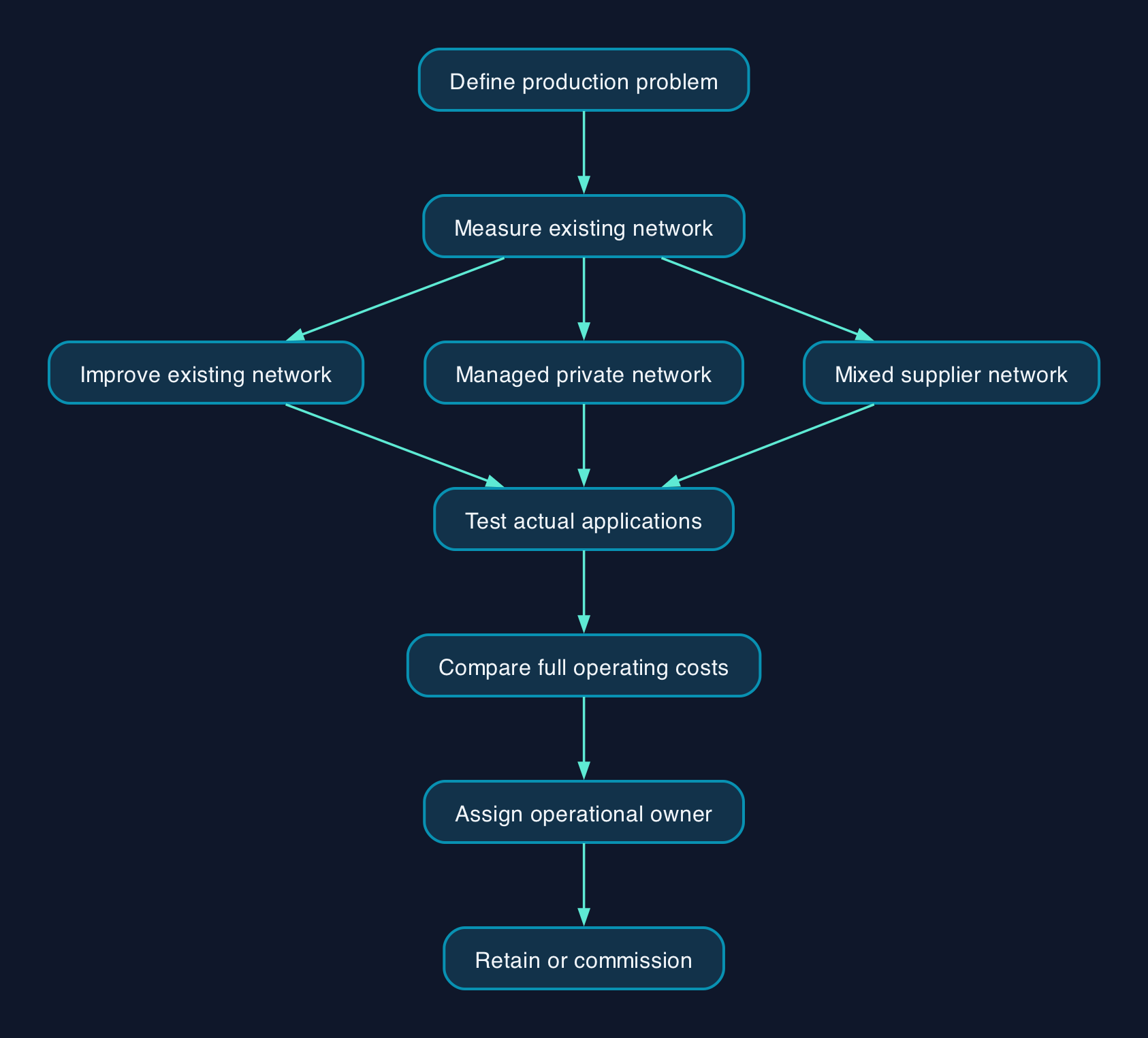
Britain should assess private 5G as factory infrastructure, with an operations budget and an accountable owner. Germany’s decision to provide local spectrum and dedicated network identifiers makes that approach tangible. The practical lesson for British businesses is to test a specific production problem, compare the alternatives and buy only when the operational benefit survives the full cost of running the network.
Key pointers
- Start with a measurable production problem, such as interrupted vehicle movements, rather than a target to install 5G.
- Give the operations team joint ownership of the business case and acceptance tests.
- Compare repairing the existing network, commissioning a managed service and operating private infrastructure.
- Ask suppliers to demonstrate your devices and applications under realistic site conditions.
- Require named responsibility for maintenance, faults, security updates and recovery.
- Treat spectrum assignments as evidence of market activity, not proof of working factories or financial returns.
Germany made the industrial buyer explicit
Germany’s contribution was a practical route through which an organisation could obtain local spectrum and network identities. Its regulator explicitly connected the numbering arrangements to industrial digitalisation and said they served both large companies and smaller businesses. That is a concrete policy choice about who gets to operate communications infrastructure. The February 2022 announcement explains that intent.
The tempting headline is that Germany built industrial networks while Britain sold faster phones. The evidence here establishes the German approach; it does not establish how British policy, investment or adoption compares. A national scorecard would require equivalent UK evidence.
The stronger argument concerns the decision British companies should make now. Put private mobile networking into the same investment discussion as warehouse automation, production equipment and maintenance capacity. Ask which operational constraint it could remove and who will carry the responsibility afterwards.
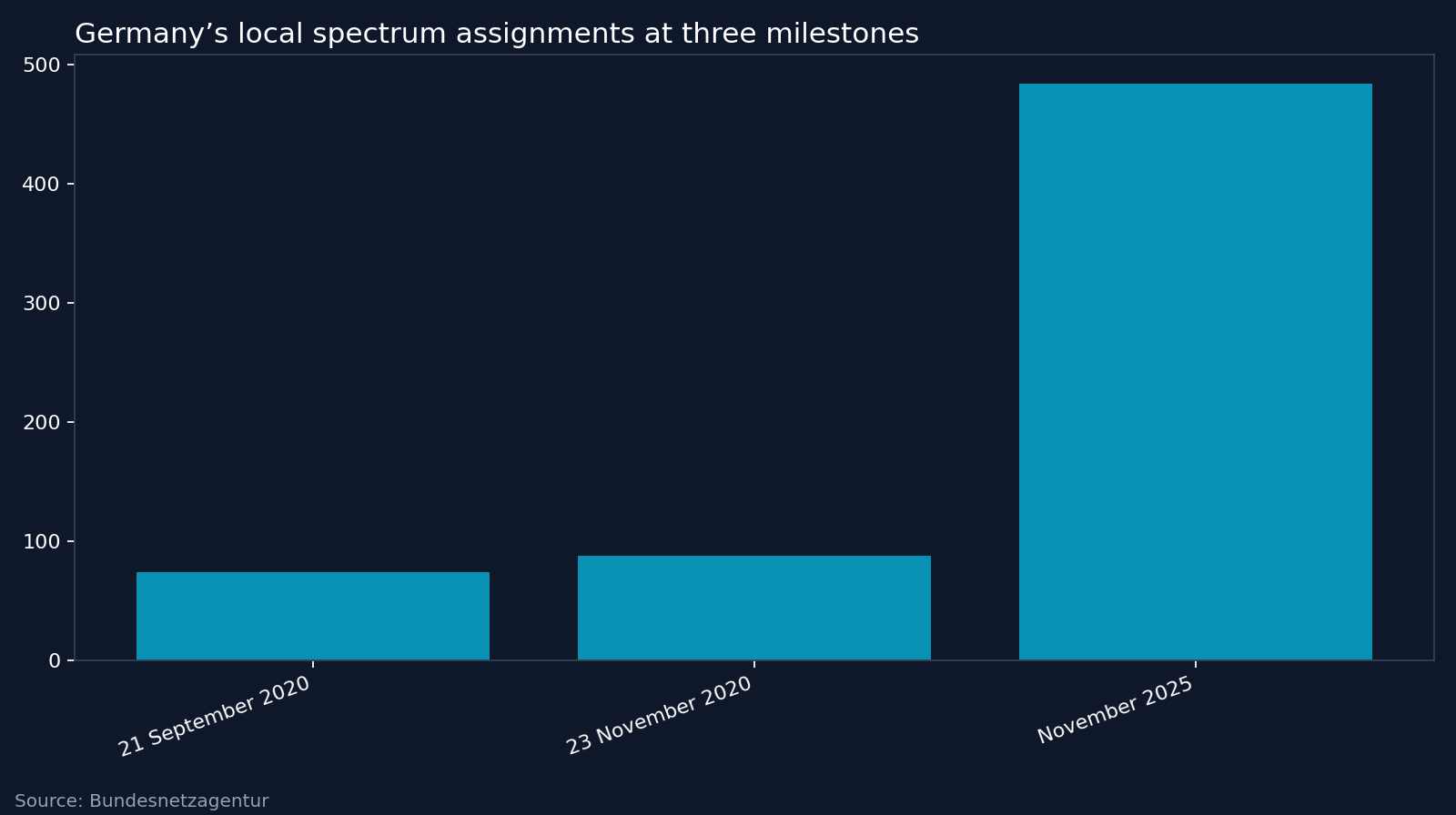
The historical assignment figures show sustained interest in Germany’s local spectrum route. They do not demonstrate that every licence became a functioning network, that every network supported production, or that every deployment paid for itself. The November 2025 register is an administrative record, not a productivity study.
For a British owner-manager, that distinction should shape the purchasing process. Overseas adoption can justify investigating an option. It cannot sign off the investment.
Buy a working process and assign an owner
Consider an illustrative British warehouse assessing connectivity for mobile robots. The first task should be to establish whether interrupted journeys actually originate in the network. A robot stopping because its application has failed will not necessarily benefit from different radios.
If connectivity is the cause, define the acceptance test around completed journeys, connection interruptions and recovery behaviour. Run it with the intended vehicles, loaded storage areas and ordinary operating traffic. Agree the pass conditions before the supplier starts the demonstration.
The underlying infrastructure has several parts. A Technical University of Munich deployment paper describes a mobile core, a radio access network comprising base stations, and a transport network connecting those components. Its experience also underlines the hardware investment and operational expertise involved.
For the proposed warehouse, the buyer should require a diagram tracing each device through those components to its application. Mark where data leaves the premises, which external services are required, and what continues working if a connection fails. These should be contractual design questions, not assumptions attached to the word “private”.
Give the operations manager responsibility for the production outcome, the IT team responsibility for agreed network and security controls, and the supplier responsibility for explicitly contracted services. Each fault should have an owner before the system carries operational work.
The spectrum fee is only one cost
Germany’s published spectrum formula makes the charging inputs visible. Beyond its base amount, the calculation depends on requested bandwidth, assignment duration and the size and classification of the area. Those are German spectrum charges, not UK prices or a complete network budget.
A British procurement should request GBP quotations with VAT treatment, contract term and exclusions stated. Ask each bidder to separate the following cost components.
- Site survey, design and applicable spectrum arrangements.
- Radios, core software, transport connections and supporting infrastructure.
- Compatible device modules, routers and application integration.
- Installation, commissioning and disruption during deployment.
- Staff training, monitoring, maintenance, updates and replacement equipment.
- Recovery arrangements, supplier transition and eventual removal.
For a smaller manufacturer, the decisive cost may be the retained work. Require a managed-service bidder to identify which tasks still fall to factory staff and which incidents require an additional charge.
Deutsche Telekom’s published campus portfolio usefully distinguishes public coverage enhancement, hybrid networks and a dedicated private offering. That distinction belongs in the quotation: buyers should be able to tell which infrastructure, dependencies and operational responsibilities they are purchasing.
Compare delivery models before supplier brands
Several suppliers can participate in the same network without offering interchangeable products. The Munich research deployment combines a CampusGenius core with Nokia and LiteOn base-station equipment. It demonstrates a mixed supplier architecture in a university setting, not a ready-made recommendation for a British factory.
Compare that approach with Deutsche Telekom’s managed private-network offer, which bundles planning, setup and operation. The purchasing question changes from who supplies each component to who takes responsibility for the assembled service.
Open-source options deserve consideration too. The Munich paper discusses deployments using projects including OpenAirInterface, srsRAN, free5GC and Open5GS. It identifies flexibility and cost advantages alongside possible limitations in scalability, robustness or performance. Those observations support evaluation, not an assumption that open-source software removes the need for specialist operations. The paper sets out these deployment approaches.
For British buyers, these are models to compare; the supplied evidence does not establish current UK delivery, support terms or commercial availability for every named offering. Invite several providers to answer the same requirements, including a UK delivery partner where appropriate, and require evidence for the proposed site and equipment.
My preference for a business with limited technical staff is clear accountability for the complete service. A mixed supplier design should earn its place through a specific benefit and a credible support arrangement.
The strongest counterargument is that the existing network may be enough
A factory does not need private 5G merely because Germany created a route to it. If repairing the existing wireless network or adding wired connections meets the operational requirement, that option deserves to win.
The evidence does not support a universal performance hierarchy. The Munich authors stress that deployment architecture, maintenance complexity, performance and cost all require examination. Their study concerns a particular research network; it does not prove that private 5G will outperform a properly designed alternative at another site. Its deployment findings make that context explicit.
Put the incumbent network through the same application test as the proposed replacement. Include normal load, moving devices, maintenance events and failure recovery. Preserve safety arrangements throughout the trial.
If private 5G cannot demonstrate a worthwhile operational improvement after integration and support costs, retain the existing approach. Taking industrial infrastructure seriously includes declining unnecessary infrastructure.
Editorial analysis
The opportunity for British technology firms is to take responsibility for connecting an operational process and keeping it working. My judgement is that site assessment, device integration, acceptance testing and ongoing support will matter more to these buyers than another generic 5G demonstration.
Germany offers evidence that this market can be organised around enterprise control of local networks. British companies should borrow that purchasing discipline: identify the production problem, test the alternatives and appoint the long-term operator before buying the equipment.
FAQ
Has Germany proved that private 5G improves factory productivity?
The cited regulator records prove spectrum assignments, not productivity gains. Its November 2025 register does not establish a financial return for each assignment. A British buyer should require an application-specific trial and a costed business case.
Should a smaller British factory replace its Wi-Fi?
Only if an assessment and trial justify the replacement. Compare improving the existing network with introducing private mobile infrastructure, using the same devices and acceptance criteria. Keep the existing system where it meets the requirement at an acceptable operating cost.
Does a private network require an internal telecoms team?
Not necessarily, because operation can form part of a managed service, as Deutsche Telekom’s private campus offering illustrates. The customer should still appoint someone who owns the application outcome and supplier relationship. Require the contract to identify retained responsibilities and escalation arrangements.
What should a supplier demonstrate before a purchase?
Require a working test of your intended devices, application traffic and failure recovery. The Munich deployment study shows why the core, base stations and connecting network must be considered together. Ask for measured results from the proposed configuration and an explanation of what changes when the installation expands.
Sources
- Bundesnetzagentur — Bundesnetzagentur fördert 5G-Campusnetze, 23 February 2022.
- Bundesnetzagentur — Zahlreiche Frequenzzuteilungen für 5G-Campusnetze, 21 September 2020.
- Bundesnetzagentur — Ein Jahr Antragsverfahren für lokale 5G-Campus-Netze, 23 November 2020.
- Bundesnetzagentur — Overview of local spectrum assignments and assignment holders, November 2025.
- Bundesnetzagentur — Nummern für Campusnetze, supplied retrieval dated 28 September 2026.
- Bundesnetzagentur — Local campus-network applications and spectrum fee formula, supplied retrieval dated 28 September 2026.
- Deutsche Telekom — 5G campus network portfolio, supplied retrieval dated 28 September 2026.
- Diederich, Haider and Kellerer, Technical University of Munich — The Chronicles of Deploying a 5G Campus Network, 2026.