Britain’s technology leaders should treat access to dependable power as a condition of cloud expansion, with geology potentially deciding where some capacity becomes viable. That is an investment judgement, not a prediction that geothermal will dominate Britain. The US Department of Energy’s work on geothermal power and data-centre cooling shows why the next infrastructure advantage could lie beneath a site, rather than inside its servers.
Key pointers
- Ask providers what supports their promised expansion capacity and when that power becomes available.
- Separate operating electricity supplies from agreements for projects still under development.
- Assess geothermal electricity and underground cooling storage as different investments.
- Require site-specific evidence before accepting a geothermal cost or delivery claim.
- Compare the cost of securing additional power with the cost of reducing cooling demand.
- Keep an alternative location or supplier available when expansion depends on unfinished energy infrastructure.
America is testing a different foundation for computing
The American development worth watching is the explicit pairing of computing demand with underground energy resources. The Department of Energy is examining both geothermal electricity and a research project using underground thermal storage to reduce data-centre peak cooling demand. These are separate approaches to the same operational requirement, keeping computers powered and within their temperature limits. Its programme description covers both.
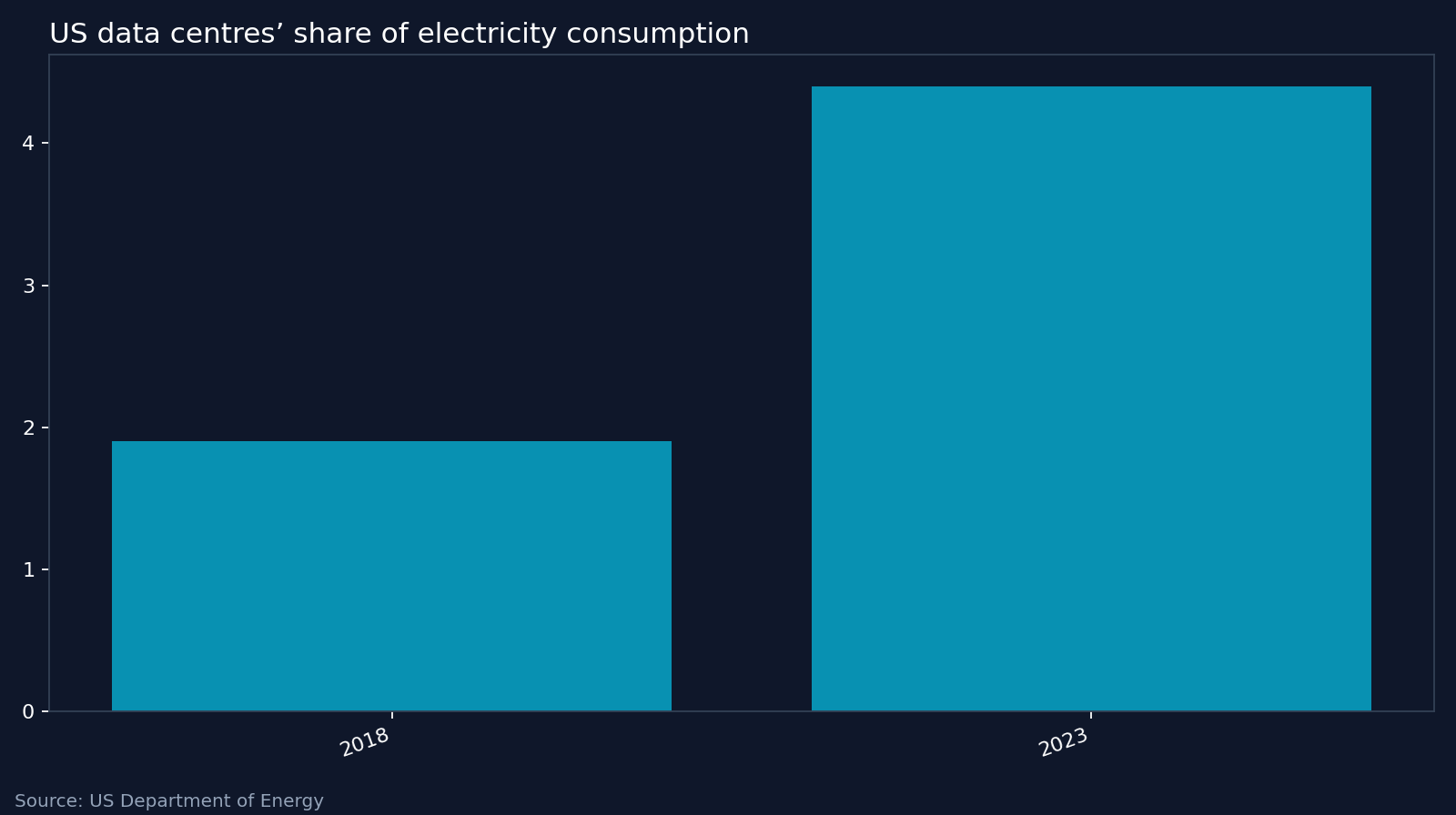
The electricity figures explain the interest. A move from 1.9% to 4.4% of US electricity consumption is already recorded; the projected 6.7% to 12% range remains uncertain. Those figures do not establish Britain’s future demand, but they justify asking whether a computing expansion plan has an equally credible energy plan.
My position is that UK technology procurement should make that question routine. A provider’s proposed capacity deserves more scrutiny when it depends on an energy project that has yet to deliver electricity.
For a small business, this means questioning the supplier rather than commissioning geological surveys. For a company developing or leasing substantial data-centre capacity, it means involving energy and facilities specialists before committing to a location.
Power generation and cooling storage solve different problems
Geothermal electricity addresses supply. Conventional hydrothermal resources use naturally occurring heated fluids; enhanced geothermal systems seek to improve fluid movement through hot rock. The 2024 technology baseline distinguishes these resource types and shows how temperature and plant design affect development assumptions.
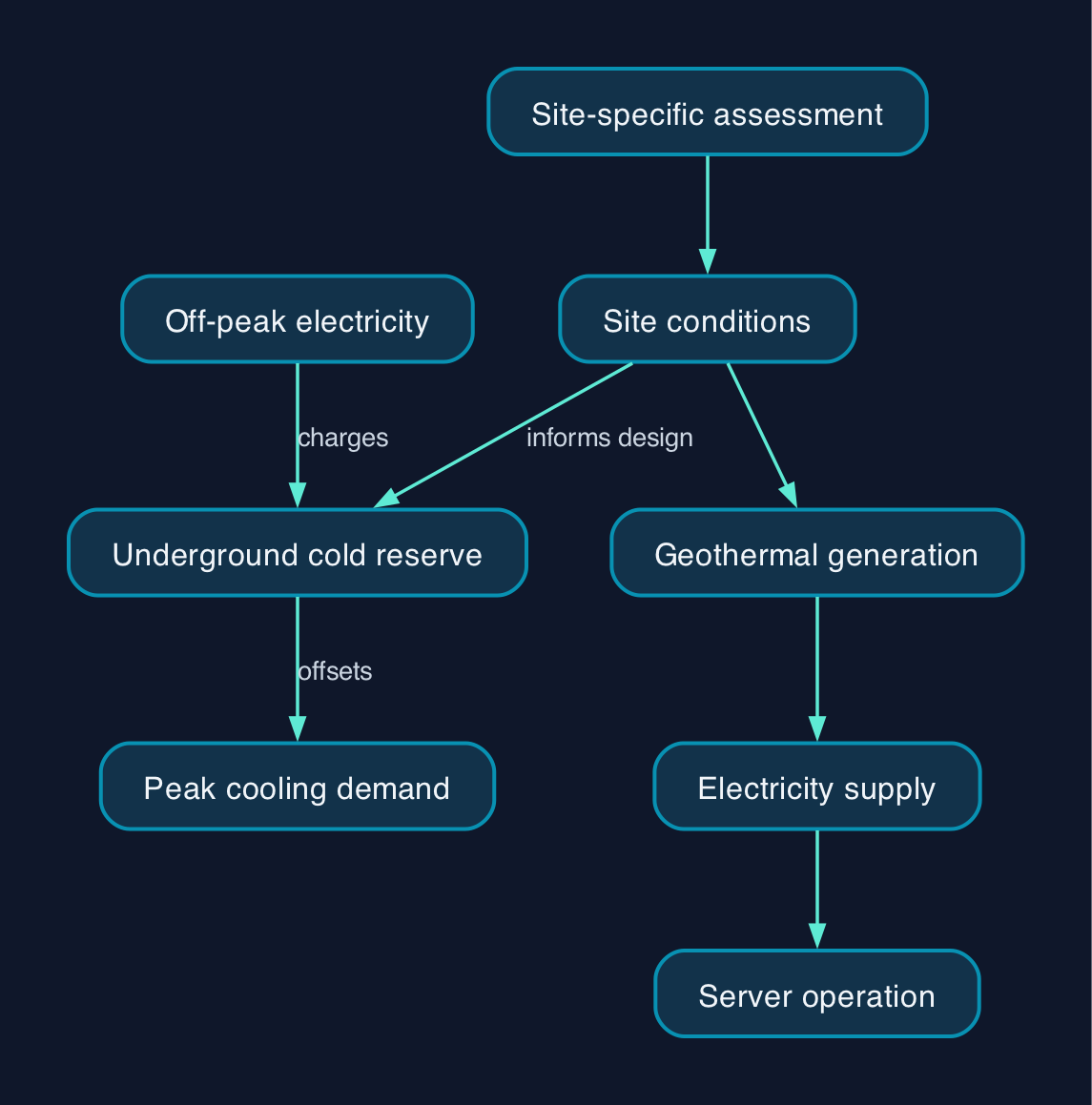
Cold underground thermal energy storage addresses cooling demand. In the research approach described by the Department of Energy, off-peak electricity creates a cold reserve underground. Operators can draw on that reserve during peak periods, potentially reducing the electricity needed for cooling at those times. The data-centre programme describes daily and seasonal storage potential.
That distinction should survive every sales presentation. Stored cooling does not itself supply the electricity that runs the servers. Nor does a geothermal electricity agreement establish that a facility has underground cooling.
Site conditions also matter to the storage design. The department’s technical overview distinguishes aquifer systems, which circulate groundwater, from borehole systems, which circulate fluid through a closed arrangement. A buyer should demand a design matched to the site and its cooling requirement, rather than accepting “geothermal” as a complete specification.
British buyers should procure deliverable capacity
The supplied American evidence does not establish which UK locations could support economical geothermal generation or storage. The useful British response is therefore a procurement change, not a national geothermal forecast.
For a hypothetical UK retailer planning more computing capacity, I would ask shortlisted providers to identify the proposed delivery location, the power available there and any unfinished infrastructure on which expansion depends. The comparison should record who owns each dependency and what happens to the customer’s timetable if it slips.
For larger commitments, request separate evidence for operating capacity, contracted future supply and proposed development. Do not allow a single total to obscure those distinctions.
I would also compare retaining and improving the existing setup with moving. Ask whether reducing cooling demand or unnecessary computing work could meet the requirement before funding additional capacity. Geothermal becomes relevant when it improves that specific decision, not because it supplies an attractive sustainability story.
Compare suppliers by what they have demonstrated
The market contains different capabilities, rather than one interchangeable class of geothermal supplier. The 2025 market report identifies Ormat and Calpine as the dominant operating companies, together accounting for 69% of installed US geothermal capacity in its reported snapshot.
The same report describes Fervo Energy’s commercial-scale enhanced geothermal reservoir development in Nevada and its larger Cape Station development. It also records Eavor Technologies’ deep multilateral well demonstration in New Mexico. These examples distinguish an operating generation portfolio, enhanced geothermal development and closed-loop technology development; they do not establish a universal winner.
For procurement, my judgement is to match the evidence requested to the promise being sold. An operating supplier should provide delivery and performance records. A developer should provide construction milestones, financing dependencies and contractual remedies. A technology demonstrator should show which results transfer to the proposed site.
None of those US examples, by itself, proves UK availability or suitability.
Price the unresolved work
The evidence does not provide a comparable UK geothermal tariff or installation quotation. Importing an American generation estimate into a British cloud business case would create false precision.
The 2024 Annual Technology Baseline is particularly useful for understanding the distinction between measured and modelled costs. Its enhanced geothermal projections depend on assumptions about drilling, reservoir performance and technological improvement. The page states that its data were compiled in June 2024, so it should not be read as a present-day project quotation.
For a UK proposal, request costs for resource assessment, drilling, plant, connection, financing, maintenance and contingency. A cooling-storage proposal should additionally identify integration work, charging electricity, pumping requirements and supplementary cooling.
Require each quotation to state who pays if the underground resource performs below expectation. Compare the resulting commitment with the cost and delivery risk of other available energy arrangements, including the option of choosing another site.
The strongest counterargument is that engineering can loosen geography
The strongest objection to the headline is credible. Better drilling and reservoir engineering could expand the places where geothermal works, while other energy sources could meet computing demand without relying on geothermal resources.
The Department of Energy explicitly says enhanced geothermal and other next-generation technologies can reduce location limitations. Its market report also records drilling time at Utah FORGE falling from 310 hours in 2020 to 110 hours in 2023, evidence of engineering progress.
That weakens any claim that geology fixes the cloud’s geography permanently. It does not remove the need to prove the economics and delivery schedule at a particular location.
Geothermal should therefore compete with other credible supply arrangements, including nuclear-backed supply and combinations of generation and storage. The evidence here cannot rank those alternatives for Britain. My argument is narrower: improving computing technology does not excuse a weak power plan.
Editorial analysis
The strategic advantage I would look for is a provider’s ability to turn an energy opportunity into capacity customers can actually use. That requires evidence of delivery, clear responsibility for failures and an expansion schedule that survives scrutiny.
British buyers need not predict the winning energy technology. They should insist that suppliers explain how the next increment of computing capacity will be powered and cooled. Geology may become the binding constraint at some sites; the procurement mistake would be discovering that after signing.
FAQ
Should a UK business choose a geothermal-powered cloud provider now?
Treat geothermal as one criterion, not the deciding factor. Compare service suitability, delivery commitments, costs and recovery arrangements, then ask for evidence behind the energy claim. The supplied research does not establish a shortlist of UK geothermal-powered services.
Does geothermal cooling also generate electricity?
Cold underground thermal storage stores cooling for later use; it does not itself generate the electricity that runs servers. The Department of Energy treats power generation and cooling storage as separate applications.
Does a high capacity factor guarantee uninterrupted cloud service?
No. The Department of Energy’s general capacity-factor figure of about 90% concerns generation performance, not a cloud service guarantee. Buyers should still request evidence covering the facility’s power distribution, backup arrangements and service commitments.
What should a British technology leader do next?
Add an energy-dependency review to the next significant hosting or capacity decision. Ask each shortlisted supplier to distinguish operating resources from future projects, identify accountable parties and explain the alternative if delivery slips. Use those answers to test the proposed timetable.
Sources
- US Department of Energy — Geothermal and Data Centers
- US Department of Energy — Geothermal Energy Storage
- National Laboratory of the Rockies — Geothermal, 2024 Annual Technology Baseline
- National Laboratory of the Rockies — 2025 US Geothermal Market Report