Britain’s driverless future may arrive behind fences first
Britain’s first substantial wave of autonomous vehicles may operate inside airports, ports and industrial sites. Singapore offers a practical lesson in controlling routes, measuring costs and planning the work people still need to do.

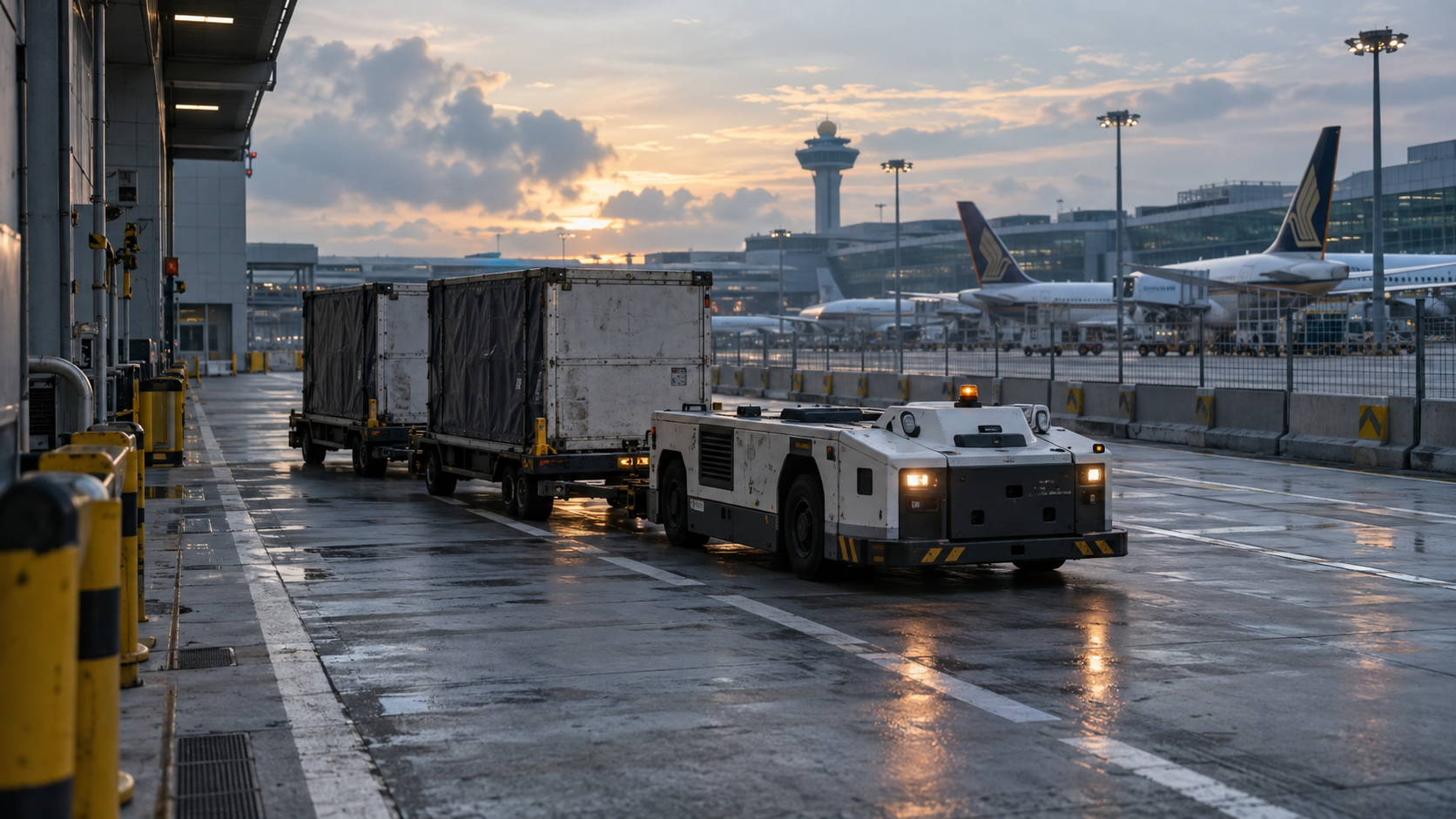
Britain should expect its first substantial wave of autonomous vehicle adoption in controlled workplaces, potentially years before widespread use on ordinary streets. That is an editorial judgement, not a dated forecast. Singapore’s deployment of driverless port vehicles and autonomous baggage tractors points towards a practical priority for British businesses. Investigate repeatable journeys inside sites where management can change routes, access and working procedures.
Key pointers
- Start with a recurring transport task whose delays and staffing requirements you can measure.
- Treat control over the route as a purchasing criterion.
- Ask suppliers to demonstrate recovery from blocked routes, equipment faults and lost communications.
- Include supervision, charging, maintenance and manual fallback in the business case.
- Compare automation with improving the existing operation before replacing vehicles.
- Set expansion conditions around safe, reliable service rather than a demonstration date.
Singapore shows where Britain should look
Singapore offers a useful sequence for British technology leaders to examine. In September 2026, transport minister Jeffrey Siow explained that the country had concentrated on airports, seaports and factories while driverless technology remained unsuited to the demands of city streets. His account explicitly describes closed environments as an earlier deployment focus.
The lesson for a British airport operator or distribution business is about control. Can you restrict access to a route, standardise loading points, schedule movements and decide what happens when a vehicle stops? Those are the conditions I would investigate before the sophistication of the driving software.
Consider a hypothetical British manufacturer moving components between buildings on its own site. Management could examine a defined route, record its workload and identify every crossing used by people or other vehicles. The investment decision would concern that transport task, with a measurable beginning and end.
A warehouse tenant with little authority over a shared yard would face a different decision. Ownership of vehicles is less useful than the ability to agree operating rules with the landlord, neighbouring tenants and delivery contractors.
“Behind fences” therefore means an environment the operator can meaningfully control. A perimeter alone does not establish that control.
Start with a route and define the exceptions
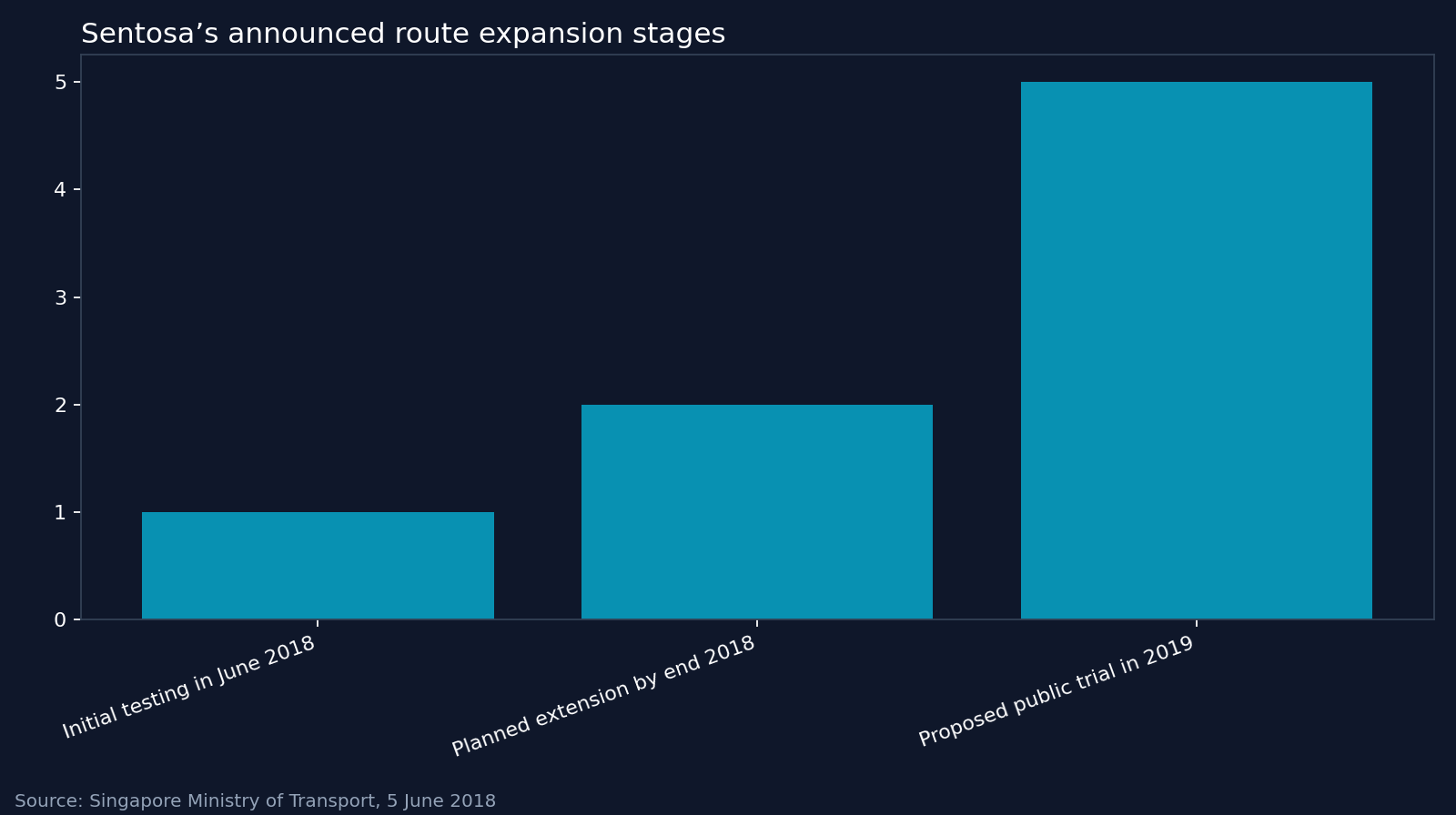
Singapore’s earlier Sentosa programme illustrates how deployment can be broken into bounded stages. Its June 2018 announcement described testing beginning on a 1 km service-road stretch, a planned extension to 2 km by the end of that year, and a proposed 5 km public-trial route in 2019. These were announced stages, not evidence that every subsequent milestone was achieved.
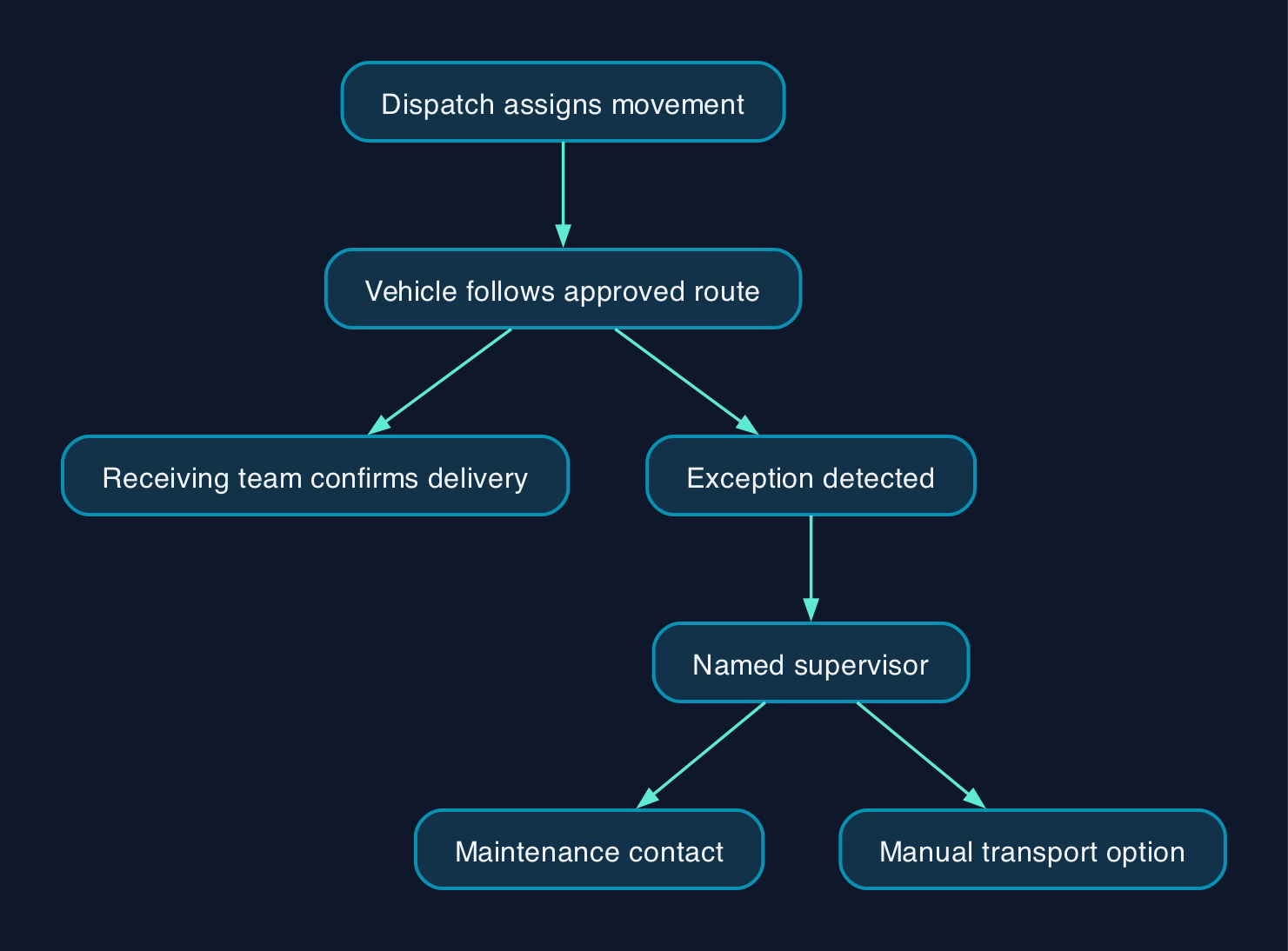
The useful principle is progressive exposure. For a British site pilot, I would propose a workflow in which dispatch assigns a movement, the vehicle follows an approved route, and the receiving team confirms delivery. An exception should enter a defined recovery process with a named supervisor, maintenance contact and manual transport option.
The procurement document should specify what counts as an exception. A pallet left across the route, a changed loading position and a communications failure need separate responses. Require the supplier to explain when the vehicle stops, what information reaches an operator and who has authority to resume movement.
That also creates a concrete role for the IT team. Before a pilot, agree access permissions, operating records, software change control and the connection between vehicle dispatch and existing business systems. A demonstration that bypasses those dependencies cannot establish whether the service will work during an ordinary shift.
Price the transport service and its remaining labour
The supplied evidence contains no comparable UK quotations or demonstrated payback figures. A British buyer should therefore build a cost model from the proposed service scope, rather than importing a savings percentage from Singapore.
Request separate prices for vehicles or leases, software, site preparation, system integration, communications, energy infrastructure, maintenance, training and support. Identify which charges recur, which depend on usage and which increase when the route changes. Include insurance, contract exit and access to operating data in the quotation questions.
Changi’s electrification programme shows why infrastructure belongs in that discussion. In April 2025, the airport reported more than 100 charging points and plans to expand to more than 300 over the following years. Those figures describe support for fleet electrification, not the incremental cost or success of autonomy.
Labour savings deserve equal scrutiny. Singapore’s September 2026 account identifies continuing work in remote operation, fleet management, maintenance, testing and data analysis. It describes training opportunities for drivers moving into those roles.
For the business case, count paid hours across the complete transport service. Include supervision, loading, fault recovery and any retained backup driver. A vehicle completing a journey without someone at the wheel does not establish how much labour the organisation has removed.
For a smaller British business, improving dispatch or changing the loading layout may be the better first investment. Automation should compete against that option on the same measures of completed work, reliability and total cost.
Compare suppliers by the work they perform
The Singapore evidence describes several distinct supplier roles. The ministry identifies an Aurrigo International baggage tractor trial at Changi and a logistics deployment involving FairPrice Group and Zelos Technology. These concern different freight-handling tasks.
ST Engineering’s historical Sentosa project combined autonomous shuttles with a fleet management system intended to analyse passenger demand and manage routes. The 2018 trial announcement supports that description, not a claim about its current UK offering.
Waymo represents a different proposition again. Singapore’s September 2026 announcement concerned preparations and testing for passenger services, including work and weekend travel. It did not establish a substitute for industrial baggage or container transport.
These examples are discovery leads, not an interchangeable shortlist. A British buyer should compare providers against the same load, route, operating hours, intervention requirements and support expectations. UK delivery capability, maintenance coverage and contractual responsibility would need checking before any of these examples became a procurement recommendation.
The strongest objection is that public roads are catching up
The strongest counterargument is that controlled workplaces may enjoy only a brief lead. Singapore already has public shuttle rides, and its September 2026 announcement outlined plans to move beyond fixed routes in Punggol and prepare for Waymo services. The minister reported about 20,000 people having taken rides in the local trials. Public-road deployment is progressing.
Nor does an industrial site automatically present an easier business case. A British buyer should test whether pedestrian crossings, visiting vehicles, changing loads or seasonal conditions undermine the supposed predictability of its chosen route.
The answer is to narrow the prediction. Singapore’s experience supports controlled environments as an early deployment route; it does not establish how many years separate mass adoption in British workplaces from mass adoption on British streets. There is no comparative UK fleet dataset in the supplied evidence.
My position still favours workplace assessment first. An operator with authority over a site can redesign the task around a vehicle’s demonstrated limits. That is a practical investment lever, even if public-road technology improves faster than expected.
Editorial analysis
Britain’s opportunity is to make specific transport services dependable enough to automate. For technology suppliers, I would prioritise integration, maintenance, supervision and recovery services alongside the vehicle itself. For buyers, I would make payment and expansion depend on acceptance criteria agreed before the pilot begins.
The first labour change may be narrower than an entire job disappearing. A recurring driving task could be removed while loading, inspection and exception handling remain. Management should establish where those responsibilities go and discuss the proposed changes with staff before claiming a saving.
The next useful step is a route assessment signed off by operations, IT and the people currently doing the work. If that assessment cannot identify the exceptions, their owners and a workable fallback, the site is not ready to buy an autonomous service.
FAQ
Does a private site make autonomous vehicles safe?
A fence is not sufficient evidence of safety. My recommendation is to assess the actual route, access arrangements, interactions and recovery procedures, then require testing against those conditions. Singapore’s historical Sentosa programme likewise began with operational and safety testing before its proposed public trial. Sentosa testing approach
Should a small British business invest now?
Start with a measured transport problem rather than a vehicle purchase. Record completed movements, staff time, delays and faults, then compare automation with changes to scheduling or layout. Commit only when the supplier can substantiate the proposed service and its full costs.
Will autonomous vehicles eliminate driving jobs?
They may remove particular driving tasks, but the evidence does not establish net job losses. Singapore’s transport ministry describes continuing requirements for remote operators, maintenance staff and fleet managers. A British business case should account for those responsibilities rather than assuming that driverless means unstaffed. Workforce requirements
What should a buyer demand before expanding a pilot?
Require evidence against agreed measures for completed work, interventions, downtime and recovery. Test the proposed staffing arrangement as well as vehicle movement, particularly where people need assistance. Singapore’s parliamentary reply on accessibility illustrates how an onboard operator can perform duties beyond driving that future services must address. Passenger assistance responsibilities
Sources
Source passages were supplied for this article on 28 September 2026; publication and update dates below are those stated in the supplied content.
- Singapore Ministry of Transport, Automated and autonomous vehicles, updated 31 July 2026.
- Singapore Ministry of Transport, Opening remarks by Minister for Transport Jeffrey Siow at Waymo’s launch event, 18 September 2026.
- Singapore Ministry of Transport, On-road testing of autonomous shuttles begins at Sentosa, 5 June 2018.
- Changi Airport Group, Tackling emissions in the air and on the ground, 28 April 2025.
- Singapore Ministry of Transport, Automated bus ramps and infrastructural upgrades for autonomous vehicles, 5 November 2025.