
Yes, UK exporters whose products fall within EU digital product passport rules need to prepare product information, but the requirements and deadlines depend on the product. The EU registry launched on 20 July 2026, while specified battery categories face a 18 February 2027 passport deadline. Our position is that British businesses should first establish who owns their product information, how suppliers substantiate it and how it survives a change of software provider.
Key pointers
- Establish which products you place on the EU market and which product-specific requirements apply.
- Give product-data preparation a business owner with authority across procurement, engineering and IT.
- Pilot one product family using records from its actual suppliers.
- Ask prospective providers to demonstrate corrections, controlled access and a complete data export.
- Budget for maintaining records after launch as well as creating them.
- Keep expected sector timetables separate from enacted obligations.
Britain’s opportunity begins with the product record
A digital product passport connects a physical product to accessible digital information. For batteries, the Commission describes a QR-linked record covering relevant identification, technical characteristics, performance and information supporting repair, reuse and recycling. Detailed information stays with the responsible economic operator.
That makes the exporter’s first question quite practical. Can the business connect a finished product to the records that support its description?
Consider a hypothetical British manufacturer supplying battery-powered equipment to European customers. Its procurement team holds supplier declarations, engineering maintains specifications and its service team records replacements. A passport project should establish how those records relate to the battery being supplied, who checks them and who approves a correction.
My expectation is that customers preparing their own passports will increasingly ask suppliers for structured information. That is a commercial forecast, not a claim that every British component supplier already has a direct registration duty. The Commission explicitly distinguishes the operator placing the finished battery on the market from suppliers of individual components or modules.
For UK technology companies, the useful work is connecting those records, preserving their provenance and making corrections manageable. A business able to demonstrate those capabilities has a stronger proposition than one promising that a QR label will settle the problem.
Scope the obligation before setting the budget
The registry’s launch does not establish a universal filing deadline for every British exporter. The Commission explains that specific requirements depend on the product’s delegated act or other applicable legislation.
Batteries provide a concrete starting point. The Commission’s August guidance states that, from 18 February 2027, each electric-vehicle battery, each light means of transport battery and each industrial battery with capacity greater than 2 kWh placed on the market or put into service must have a passport.
A UK exporter should therefore establish the product classification and the responsibilities of the manufacturer, importer and other participants before commissioning software. The relevant question is how the product reaches the EU market and which operator performs each obligation.
The guidance itself also needs careful handling. Its 71 data points include mandatory, optional, conditional and currently inapplicable entries. The Commission says the document does not introduce additional legal requirements or constitute an authoritative interpretation.
This is not legal advice; consult your legal counsel.
Build a route from evidence to product
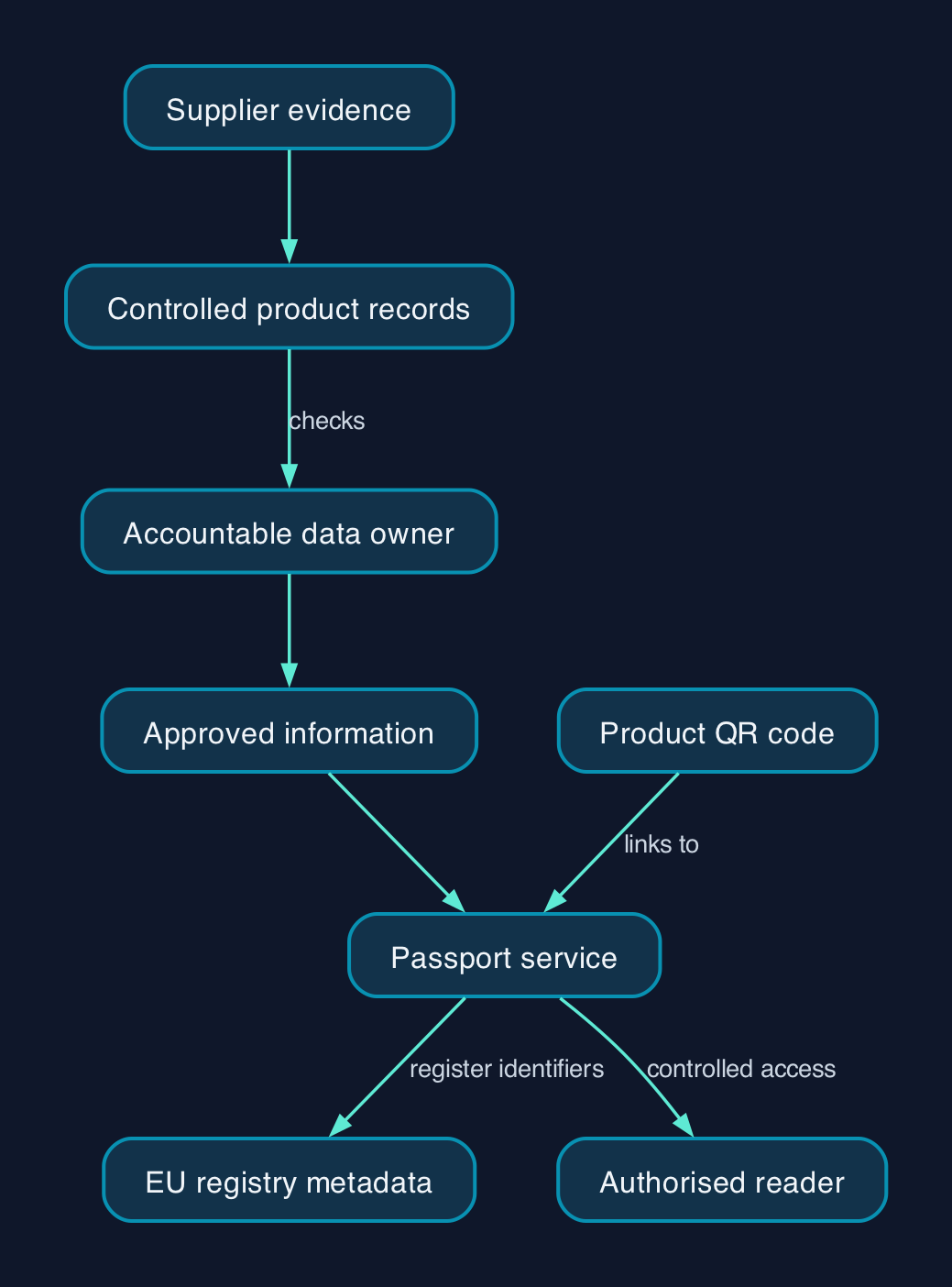
The Commission’s architecture separates the registry from detailed product data. It describes registration through a secure interface or an application programming interface, meaning a software connection, alongside a semantic repository intended to supply shared machine-readable definitions.
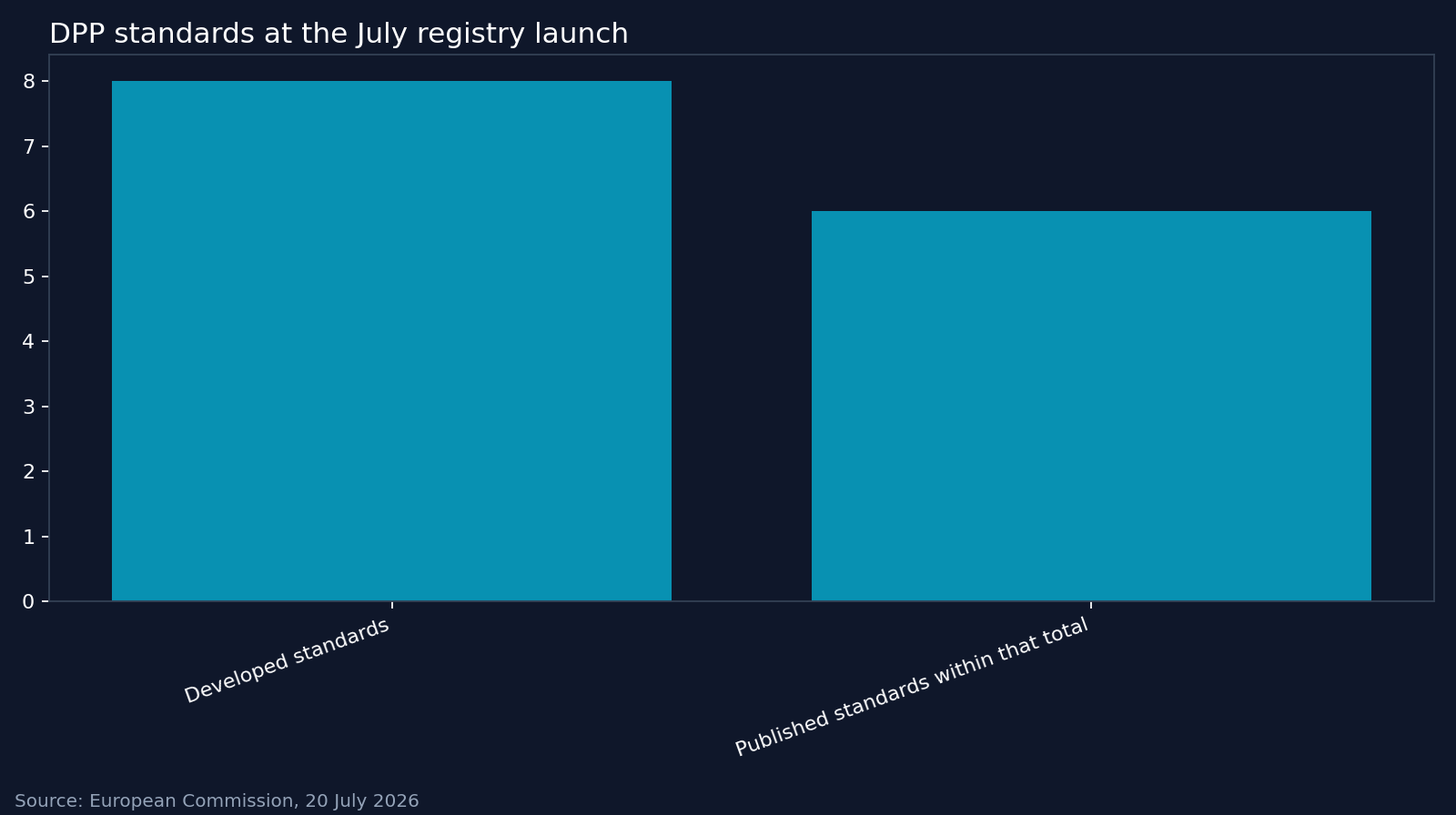
At the July launch, the Commission reported 8 developed interoperability standards, with 6 already published. Those published standards covered identifiers, interoperability, data carriers, APIs, data exchange protocols and storage. This is a snapshot of technical preparation at launch, not a measure of manufacturer readiness.
For a British exporter, I would organise a pilot around a traceable sequence. Supplier evidence enters a controlled product record. A named owner checks it. Approved information becomes available through the passport service, with the required identifier and registry interaction.
The pilot should then face an ordinary operational problem. Change a supplier declaration, correct an erroneous field or transfer responsibility to another employee. Check whether the record updates correctly and whether the business can explain what changed.
That exercise tests more than a successful scan. It establishes whether the organisation can maintain the information behind it.
The cost is in collecting and maintaining the information
The supplied evidence does not establish comparable UK prices for passport platforms. A credible budget must therefore begin with work packages and quotations.
Ask bidders to separate data discovery, supplier onboarding, integration, identifier management, hosting, access controls, support and exit assistance. Request the charging basis for records, updates, API usage and retained historical information. Those are quotation questions, not claims that every provider charges for each component.
Internal labour belongs in the budget too. Engineering must resolve conflicting specifications, procurement must chase missing evidence and an accountable person must approve publication. Include those responsibilities when comparing a managed service with an internal build.
For a small manufacturer, extending a reliable existing product system may be a sensible starting point. For an organisation handling numerous suppliers or frequent lifecycle changes, specialist software may justify its cost. The deciding evidence should be a pilot using the buyer’s own records and update processes.
Compare delivery approaches before supplier promises
The available supplier material illustrates several approaches. OpenDPP describes per-unit demonstrations with public and restricted access. Circularise emphasises selective information sharing. Wenture describes Wabric’s product-information management approach, including native passport functionality and QR or barcode generation.
These descriptions establish areas to investigate. They do not establish comparative performance, legal conformity, UK support coverage or a complete price.
Compare each approach against the same acceptance conditions. Can staff trace a field to its supporting evidence? Can an authorised person correct it? Can restricted information remain restricted? Can another provider take over without losing the relationship between the physical product and its record?
An internal build offers control but leaves integration, maintenance and operational support with the exporter. A specialist service can take on defined delivery tasks, provided its contract makes the scope and handover clear. Extending an existing product-information system deserves consideration where it avoids maintaining conflicting copies.
For all three routes, insist on a demonstration of export and migration before signing a long commitment.
The strongest objection is that preparation could be premature
A small exporter could reasonably object that spending now means paying to implement requirements that are still developing.
The objection has substance. Sector-specific rules determine the actual obligation, and the Commission says its battery guidance may develop further as implementation progresses. A business should not treat another sector’s timetable as its own deadline.
The proportionate response is to separate durable preparation from commitments that depend on unsettled requirements.
Assigning ownership to product records, identifying missing supplier evidence and testing data export can support existing business processes. Purchasing a large platform against an assumed future schema carries a different risk.
A limited pilot can answer whether the business has a data problem, an integration problem or simply an unclear responsibility. Let that result determine the next purchase. For exporters handling batteries within the specified scope, the February deadline makes that assessment more immediate.
Editorial analysis
The British commercial opportunity is to make product information dependable across organisational boundaries. That calls for manufacturing knowledge as well as software skills.
A useful service could help a supplier correct a declaration, help an exporter preserve the evidence behind a record and help a customer obtain the information they are entitled to use. The buyer should be able to observe each result in a working demonstration.
For technology leaders, the next move is to select a product family, assign its data owner and test the path from supplier evidence to accessible record. The platform decision should follow what that exercise reveals.
FAQ
Do all UK exporters need a digital product passport now?
No blanket requirement follows from the registry launch. The Commission says product-specific requirements depend on delegated acts or separate legislation, so exporters must establish their product’s scope and applicable date.
Which batteries face the February deadline?
The Commission specifies electric-vehicle batteries, light means of transport batteries and industrial batteries with capacity greater than 2 kWh. Each relevant battery placed on the market or put into service requires a passport from 18 February 2027.
Does the EU registry hold the complete passport?
Detailed product information remains decentralised, while the registry records unique product identifiers and associated metadata. Buyers should establish who will host, maintain and recover their detailed records.
Should a small business buy a passport platform immediately?
Start by confirming scope and testing the quality of existing product information. Then compare extending current systems, commissioning an integration and buying a managed service against the same practical requirements, including ongoing support and exit.
Sources
- European Commission — The Digital Product Passport Registry is now live, published 20 July 2026
- European Commission — Digital Product Passport
- European Commission — Guidance to support preparations for the Digital Batteries Passport, published 21 August 2026
- European Commission — Digital Product Passport for Batteries
- OpenDPP — EU battery passport requirements and examples, updated 12 June 2026
- Circularise — EU battery passport regulation requirements
- Wenture — Digital Product Passports for Manufacturers