A care home could soon need an IT operations model closer to a small hospital
Connected care equipment creates responsibilities beyond installation. British providers should require named ownership, tested fallbacks and realistic support budgets before making new technology essential to daily care.

British care providers should adopt stronger technical operating disciplines before connected equipment becomes essential to daily care. Japan’s expanded technology priorities for long-term care point towards a broader mix of devices and systems to support. My view is that care homes adopting these tools need named responsibility, tested fallbacks and support matched to care needs, with investment determined by the consequences of failure.
Key pointers
- Make responsibility for each connected care service a condition of purchase.
- Ask suppliers what continues working when power, connectivity or their application fails.
- Budget for maintenance, staff training and replacement alongside equipment.
- Test an alert through to staff acknowledgement before relying on it.
- Compare delivery partners against the same support and exit requirements.
- Keep residents’ preferences central to decisions about monitoring.
Japan is widening the operational brief
The revealing detail in Japan’s announcement is the change in its programme’s name. The ministries replaced a focus on robot technology with the broader category of technologies for long-term care, explicitly encompassing information and communications technology alongside robots and other tools. The stated aims include improving care quality, reducing carers’ workload and supporting older people’s independence. These are programme objectives, rather than evidence that every proposed technology achieves them.
That broader scope matters for British technology businesses. A device intended to help with movement presents different operating questions from software supporting nutrition or a monitoring system generating alerts. Before quoting for deployment, a supplier should establish which care tasks depend on the equipment and who takes responsibility when it fails.
Japan’s announcement does not establish how widely these systems have been adopted or when British homes will follow. It does give buyers a useful signal about the range of technology that a care organisation may have to maintain.
The British starting point is already connected
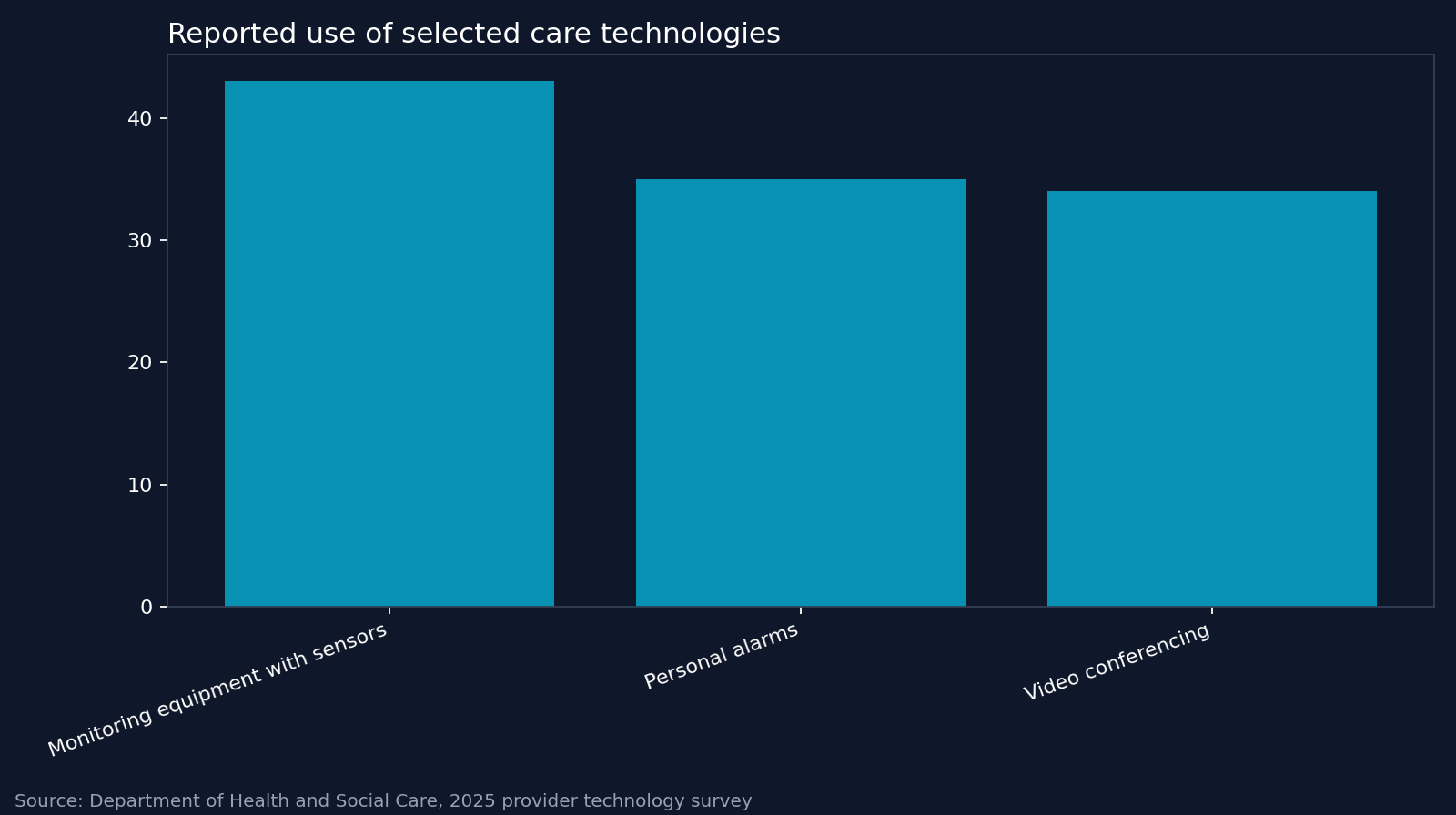
England’s evidence makes this more than a distant forecast. In the survey conducted during February and March 2025, monitoring sensors, personal alarms and video conferencing all featured among technologies used to deliver care and support. The findings were published on 6 March 2026.
The figures need careful handling. Participation was voluntary, respondents included domiciliary and residential services, and the survey could not consistently distinguish answers about individual locations from answers about whole organisations. Multiple technology selections were possible. These are reported usage figures among respondents, not adoption rates for British care homes as a whole.
My argument concerns the dependency created by each deployment. If staff begin to rely on an alert, the ability to generate, deliver and act on that alert becomes an operating responsibility. Buying the sensor addresses only part of that responsibility.
England’s digital working framework already places leadership, foundations, safe practice and workforce support within the same programme of improvement. Its jurisdiction is England; providers elsewhere in the UK should assess their own applicable guidance and commissioning requirements.
Follow the alert all the way to a person
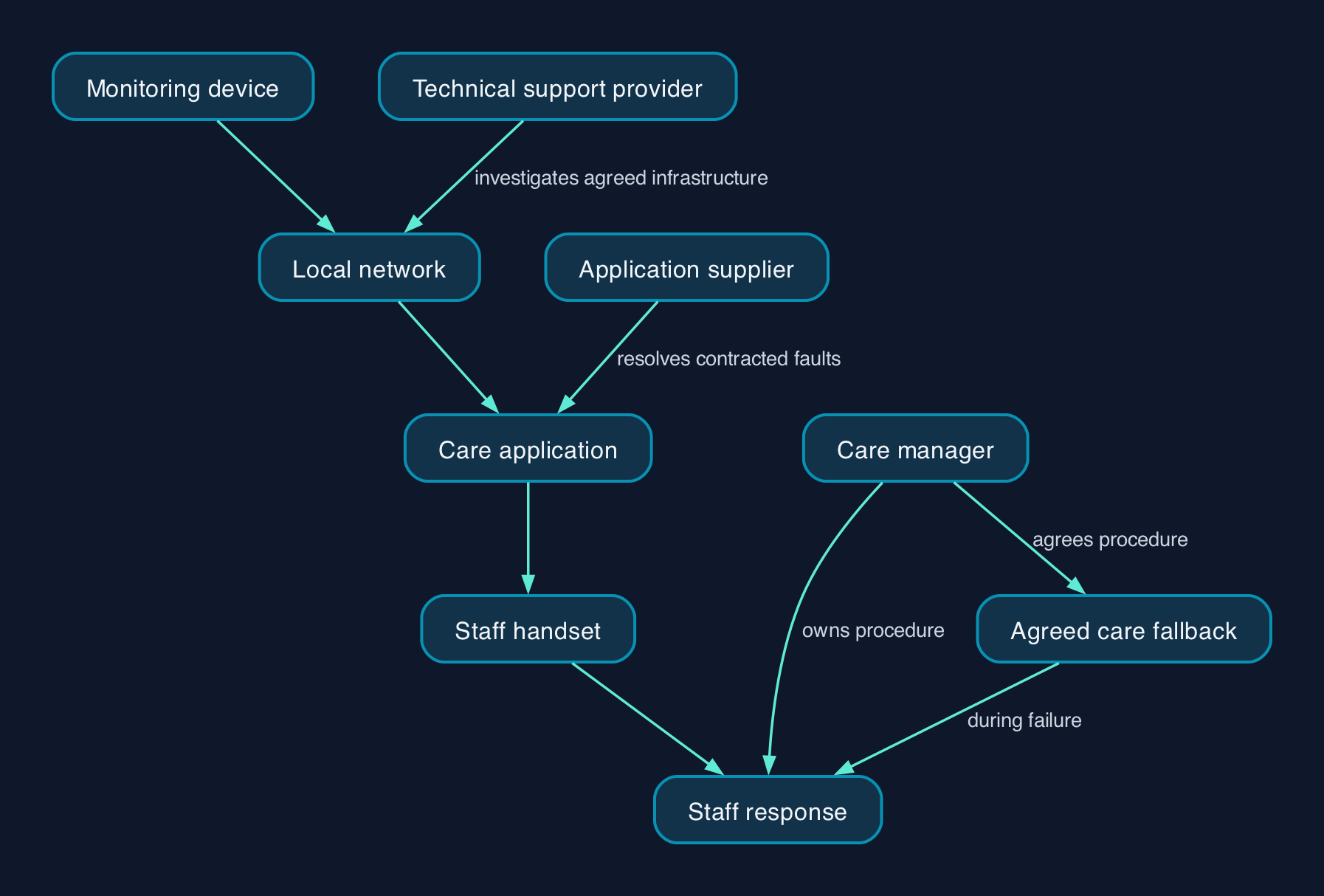
Consider an illustrative care home introducing connected monitoring. A device sends information through a local network to an application, which presents an alert to a staff handset. A member of staff then needs to acknowledge and act on it.
That proposed workflow contains several possible failures. The device may lose power, the network may become unavailable, the application may stop delivering notifications, or the handset may be inaccessible. A successful demonstration of the device alone cannot establish that the complete workflow is dependable.
I would require the care manager to own the response procedure, the technical support provider to own investigation of the agreed infrastructure, and the application supplier to own faults within its contracted service. Each contract should name the handover between those responsibilities. During a fault, staff need an agreed fallback and a clear escalation contact.
Network design belongs within that discussion. NHS England explains how segmentation restricts authorised traffic between groups of systems and can limit an attacker’s movement. It also stresses that segmentation needs supporting controls, including patching, monitoring and access management.
For a care home, my recommendation is to assess separation between care equipment, business systems and guest access against the actual devices and their communication requirements. Any change should be piloted with supplier involvement and a rollback plan, because a security rule that blocks a necessary alert creates its own problem.
Price the service through its working life
A credible budget should cover installation, connectivity, device management, software subscriptions, support, replacement equipment and staff time. It should also include training for new starters, practice during outages and the work required to leave a supplier.
Those are proposed quotation requirements, not published market prices. A buyer should ask each bidder to identify what is included, what triggers an additional charge and what remains the home’s responsibility. An equipment price cannot settle the cost of keeping a service available.
The strongest commercial test is a fault scenario. Ask who investigates when a device appears healthy but its alert does not reach the intended member of staff. Require bidders to distinguish the time to acknowledge a fault from the commitment to restore service, and to explain support outside normal office hours.
Measure the pilot against care work as well as technical uptime. Record whether staff can use the system confidently, whether alerts demand unnecessary attention and whether the agreed fallback works. Claimed time savings should survive those checks before entering the business case.
Compare delivery models before choosing suppliers
I would invite competing proposals from care-technology suppliers, UK managed IT providers and independent integrators, using the same responsibility map. Their relevant capabilities and support coverage need checking individually.
A supplier-led arrangement is worth considering when the proposed service includes responsibility across the device and application. The buyer still needs to establish where responsibility stops, particularly at the network and staff handset.
A managed IT arrangement is worth considering when the home wants a provider to coordinate connectivity, devices and support. The procurement question is whether that provider will investigate a failed care workflow or simply refer the issue to another supplier.
An internal or shared technical team is another option where the organisation can sustain the skills and cover. Its proposal should account for absence, specialist escalation and ongoing maintenance just as an external quotation would.
Keep improving the existing setup among the options. If the present equipment meets residents’ needs, a coverage repair, clearer support agreement or better training may deserve funding before replacement.
The strongest objection is that care homes need carers
The strongest counter-argument is that hospital-style IT expectations could consume money and attention that should support residents directly. A small provider might reasonably reject a proposal that adds dashboards, contracts and training without demonstrating a care benefit.
That objection should shape the buying decision. I would reject technology whose operating burden exceeds its demonstrated value, and retain a simpler approach where it meets the need. Residents’ preferences also matter: England’s framework explicitly recognises that digital approaches will not suit everyone.
The hospital comparison is useful only if it means proportionate discipline around consequential failures. A home can assign an owner, document a fallback and rehearse escalation without creating a large IT department.
Workforce development is already part of the policy response. In April 2025, the Department of Health and Social Care announced a digital leadership qualification covering adoption of technologies in adult social care. That announcement supports the importance of management skills; it does not prove that training or funding is available to every provider today.
Editorial analysis
The opportunity for British technology companies is to make connected care manageable throughout its working life. I would judge a proposal by whether a care manager can explain who responds to a failure, what staff do meanwhile and how the service returns safely.
The next purchasing meeting should begin with an existing care dependency. Trace it from equipment to staff action, assign each responsibility and test the fallback. If that exercise exposes an unsupported step, fixing it should take priority over adding another connected device.
FAQ
Does every care home need a hospital-sized IT team?
My recommendation is to match support to the consequences of a failure, the complexity of the equipment and the skills available. A small home could use contracted support while retaining a named manager responsible for care procedures and supplier escalation.
Does Japan’s programme prove that robots reduce staffing needs?
No. METI’s announcement describes priorities and intended benefits, including reducing carers’ burden, rather than measured staffing outcomes. Any staffing assumption would need evidence from the particular deployment.
Are the English survey figures representative of all UK care homes?
They should not be presented that way. The survey methodology describes voluntary responses from providers in England across multiple care settings, with uncertainty about whether some answers covered locations or organisations.
What should a provider ask before buying connected equipment?
Ask the supplier to demonstrate what happens when the device, network or application becomes unavailable. Then agree responsibility for detection, escalation, temporary care arrangements, restoration and eventual replacement before making the service part of routine care.
Sources
- METI and MHLW, Priority Fields in the Use of Robot Technology for Long-term Care Revised, published 28 June 2024.
- Department of Health and Social Care, Findings from the 2025 adult social care provider technology survey, published 6 March 2026.
- Department of Health and Social Care, Digital working in adult social care — What Good Looks Like, updated 17 May 2023.
- NHS England, Network segmentation — An introduction for health and care organisations, retrieved for the supplied evidence pack on 28 September 2026; publication date not supplied.
- Department of Health and Social Care, Cutting-edge tech introduced in social care, published 9 April 2025.