UK businesses should start moving beyond PDF invoices
UK businesses should prepare for structured invoicing now, starting with cleaner data and a tested customer connection. Replacing a working accounting platform should depend on requirements and measured results.


Yes. UK small and mid-sized businesses should start preparing for structured electronic invoicing now, with a limited pilot where customers and systems are ready. They should not replace a working finance platform solely to escape PDFs. Our view is that the useful first investment is cleaner invoice data, tested delivery and clear responsibility for rejected bills. A software purchase should follow evidence that the change reduces work.
Replace the handover before replacing the software
The distinction that matters to a finance manager is whether invoice fields reach the receiving system as usable data. A document arriving in an inbox and an invoice arriving in the purchase ledger are different operational outcomes.
Consider a hypothetical British engineering supplier whose customers repeatedly reject invoices because purchase-order references are missing. Sending the same incomplete information through a new connection would leave the underlying problem unresolved. The supplier should establish where the reference enters its order process and who checks it before billing.
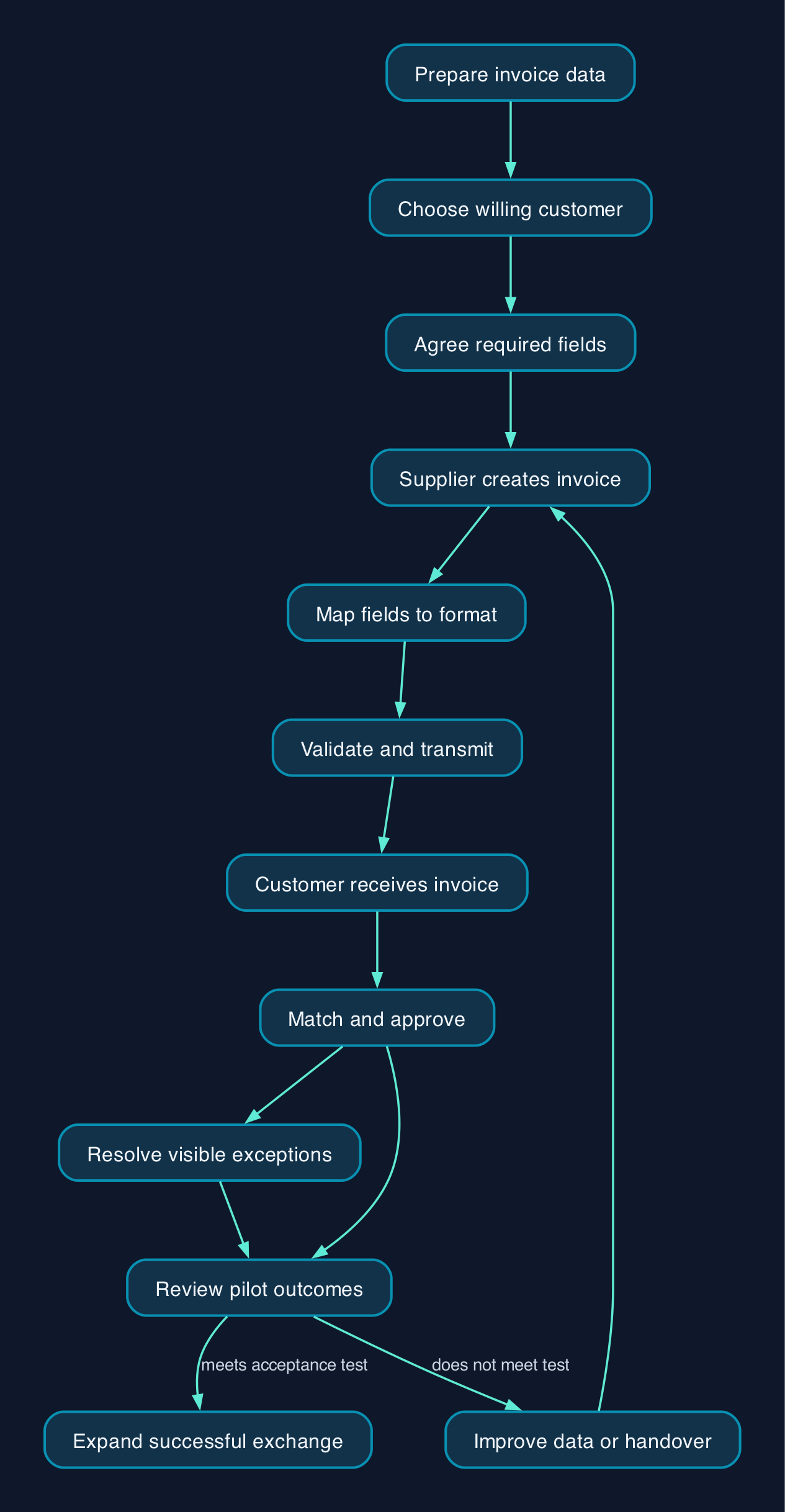
That is why our recommendation starts with the handover between supplier and customer. Select a willing trading partner, agree the required fields and trace an invoice from creation through receipt, approval and reconciliation. Treat successful delivery as one acceptance condition, not the whole test.
Keep payment approval separate from document receipt. A correctly delivered invoice may still concern disputed goods, an incorrect quantity or an unauthorised purchase. Automation should make those exceptions visible to the person responsible for resolving them.
The UK policy direction supports preparation
The supplied evidence reports an announced requirement for VAT invoices to become electronic from 2029, with an implementation roadmap due at Budget 2026. Prime Document’s account of the government consultation response also explains that ordinary PDFs are excluded from the structured e-invoicing definition used for that policy.
The underlying government documents were not supplied as extracted evidence. This article therefore uses 2029 as a reported planning horizon, without asserting an exact commencement day, final exemptions, penalties or technical specification.
For procurement, make the distinction between a supplier’s existing service and its promise to accommodate future UK requirements. Ask what is available today, what remains on its roadmap and who pays for subsequent changes. Put those answers in the proposed contract.
This is not legal advice; consult your legal counsel.
Assign responsibility beyond the connection
Peppol’s basic exchange model has four participants: the sender, the sender’s access point, the receiver’s access point and the receiver. An access point provides the connection to the network. Celtrino’s explanation of the four-corner model describes this separation between businesses and their connection providers.
For a small business, the practical issue is who investigates when an invoice does not reach the expected destination. The following is a proposed responsibility map to agree during a pilot, rather than a statement of any supplier’s contractual commitments.
| Stage | Proposed owner | Evidence to require |
| --- | --- | --- |
| Create the invoice | Supplier’s finance team | Correct customer, purchase-order reference, line items and tax treatment |
| Map accounting fields into the exchange format | Software provider or integration partner | Sample documents showing that required fields survive conversion |
| Validate and transmit | Connection provider | Delivery status, rejection details and a documented retry process |
| Match and approve | Customer’s finance team | Receipt in the intended workflow and an identified exception owner |
| Correct and reconcile | Both finance teams | Credit notes and replacements linked to the original transaction |
| Handle outages and exit | Business owner and contracted providers | Agreed fallback, recoverable records and an export procedure |
Give the pilot a named business owner with authority to involve finance, the accountant and the software provider. An integration specialist can investigate a failed connection; they should not be expected to decide whether a disputed charge is payable.
Price the process as well as the subscription
The available evidence gives a useful accounting-subscription reference, rather than a comparable market price for complete e-invoicing services.
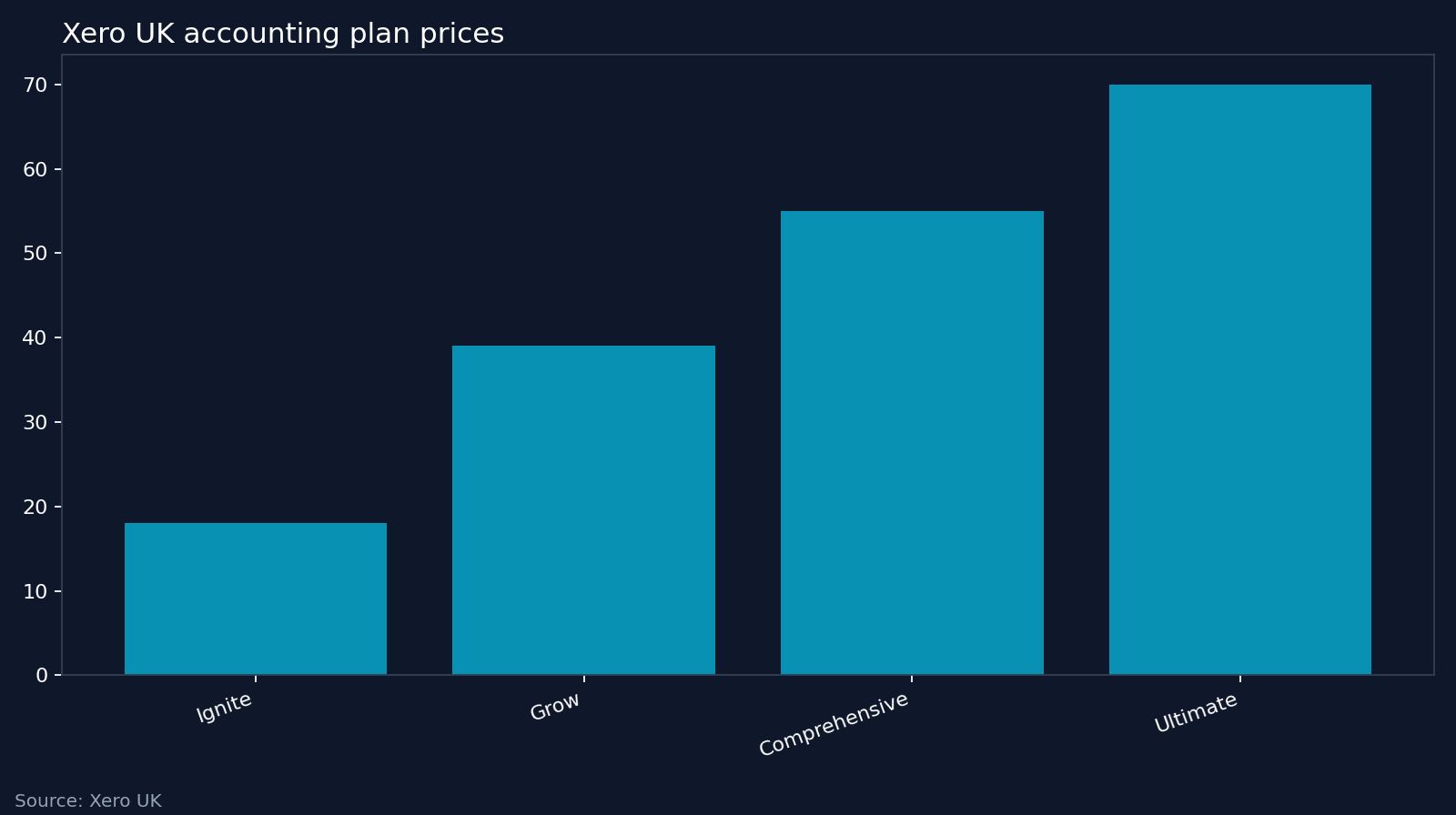
Xero’s supplied UK page lists regular monthly prices of £18 for Ignite, £39 for Grow, £55 for Comprehensive and £70 for Ultimate. These are the post-promotional figures in the evidence supplied on 28 September 2026. The plan figures and UK pricing terms identify GBP monthly subscriptions excluding VAT, renewing monthly until cancelled, with possible additional feature and usage charges.
Those figures describe different accounting plans. They are neither standalone e-invoicing tariffs nor evidence that a more expensive plan delivers a better invoice exchange.
For an existing customer, establish the incremental charge for the required capability. For a proposed replacement, include migration and retraining as well as the new subscription. Do not count the full cost of an accounting platform as an e-invoicing expense if the business would retain it anyway.
Request a quotation covering these components:
| Cost component | Question for the supplier |
| --- | --- |
| Connection and recurring service | What subscription, minimum commitment and document allowance apply? |
| Integration | Is connection to our exact software edition included, and who maintains it? |
| Data preparation | Who corrects customer identifiers, field mappings and incomplete records? |
| Operational support | Who investigates rejected or missing invoices, during which hours? |
| Training and testing | What staff instruction and customer acceptance testing are included? |
| Change and exit | What costs apply to rule changes, exports and switching providers? |
Measure the pilot against your own starting position. Record staff handling time, rejected invoices, duplicate work and unresolved exceptions. Avoid converting a vendor’s general efficiency claim into a savings forecast for your business.
Compare delivery routes against the same acceptance test
The sensible shortlist depends on what the business already runs and where invoices fail. The supplied evidence supports considering an accounting-platform route alongside specialist connection services.
| Route and supplier | What the supplier’s evidence establishes | Potential fit | What remains to prove |
| --- | --- | --- | --- |
| Existing accounting platform, illustrated by Xero | Its UK page describes in-product eInvoicing registration and direct receipt into accounting software | A business already using that platform and seeking limited operational change | Required sending and receiving workflows, customer reach, plan constraints and exception handling |
| Integration service, illustrated by Supply Lens | Its page describes access point services, finance-system connection, invoices, credit notes and returned delivery status | A business seeking to connect its current systems | Compatibility with the exact software version, field coverage, support responsibilities and charges |
| Access point service, illustrated by Open ECX | Its page describes sending, receiving and format conversion around existing systems | A business assessing a specialist connection alongside its existing finance platform | Integration effort, operational support, document handling and exit arrangements |
These are conditional buying routes, not performance rankings. The evidence does not provide comparable quotations, implementation results or support contracts for the three suppliers.
For businesses using Sage, Zoho or another accounting package, apply the same questions to the incumbent before considering migration. The supplied material does not establish those products’ current UK structured-invoicing capabilities, so a feature ranking would be speculative.
Certification claims also need a separate check before procurement. A supplier’s description of itself is useful discovery evidence; require current accreditation evidence and the actual service agreement before signing.
Editorial analysis
Our position is to begin preparation now and make wider adoption conditional on a successful exchange with real trading partners.
The strongest reason to move early is an identifiable processing problem. If staff repeatedly re-enter invoice fields, investigate whether structured receipt removes that work. If invoices already move through an effective process, establish the future connection path and concentrate first on data quality.
The counterargument deserves weight. A business with few invoices and customers unable to receive structured data may gain little from an immediate paid rollout. For that business, documenting requirements and testing its incumbent’s offering can be a better first step than adding another contract.
Do not make “PDFs eliminated” the project’s acceptance criterion. Require accurate ledger entries, traceable corrections, visible failures and a fallback that avoids duplicate billing. Expand only when the finance team can demonstrate those outcomes.
FAQ
Does emailing a PDF mean we have completed the transition?
No. For this decision, the acceptance test is whether invoice fields reach the customer’s system in a usable structured form. Ask the customer to demonstrate receipt and processing, rather than treating an email delivery notification as sufficient.
Should we replace our accounting software now?
Start by testing the incumbent’s route and comparing its incremental cost with a specialist connection. Replacement becomes more persuasive when the existing system cannot meet documented requirements, or when a broader finance-system change is already justified. Include migration, training and exit work in that decision.
Can a business already using Xero start investigating immediately?
Yes. Xero’s UK eInvoicing page describes registration within the product and says users can get started for free. Confirm the workflow needed by your business and trading partner before treating registration as a completed rollout.
Will structured invoicing make customers pay faster?
Do not make that promise in the business case. Measure invoice receipt, approval and payment separately during the pilot, so you can distinguish less processing work from an actual improvement in payment time. Keep disputed invoices visible in the results.
Sources
- Xero UK — eInvoicing and displayed accounting plans
- Xero UK — Invoicing software and pricing terms
- Supply Lens — Peppol Access Point and e-invoicing service
- Open ECX — Peppol e-invoicing and its access point role
- Prime Document — UK e-invoicing rules and reported policy timetable
- Celtrino Peppol — Guide to Peppol and the four-corner model