Satellite-to-phone backup should start with keeping staff reachable
Satellite-to-phone deserves a place in UK business continuity trials, with a defined task and a measurable result. Coverage figures alone cannot establish whether staff can communicate when it matters.


Satellite-to-phone services could become a useful backup for UK businesses, provided the job is defined narrowly. Our view is that keeping a field worker reachable is a credible starting point; keeping an entire business online demands much stronger evidence. Direct-to-cell connections still depend on ground infrastructure and mobile networks, as the Congressional Research Service’s architecture explanation shows. Buyers should therefore test a specific communication task before treating satellite coverage as business continuity.
Define the business task before choosing the connection
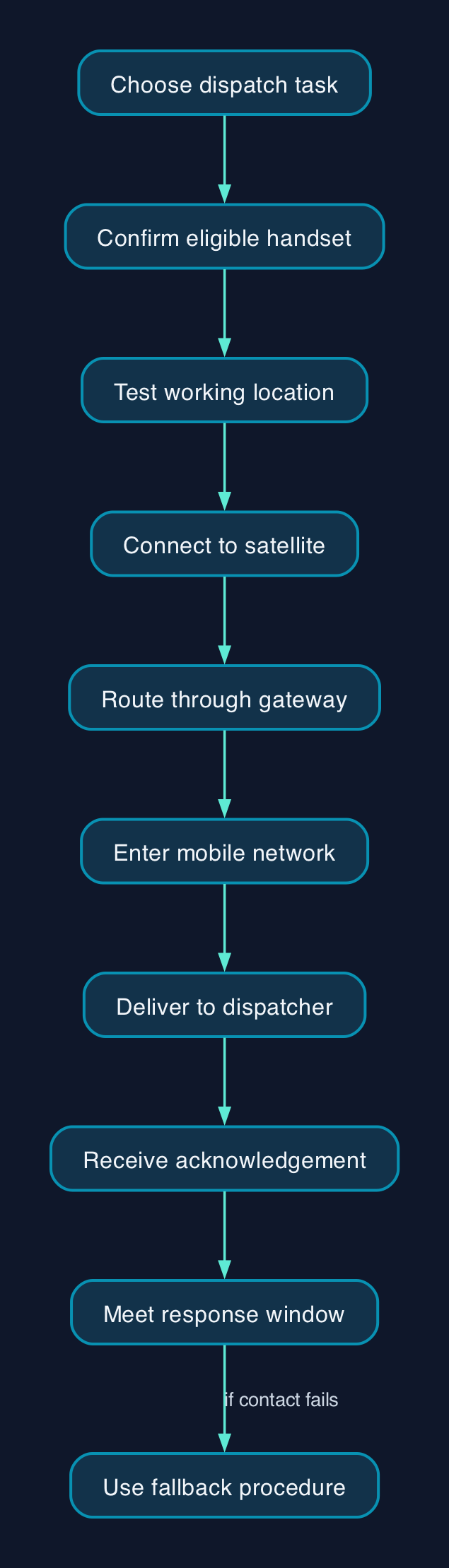
For a hypothetical rural maintenance firm, a useful backup might let an engineer send their location, report a delay and receive revised instructions. The acceptance test is whether those messages reach the dispatcher within the firm’s chosen response window.
A different requirement emerges when an office loses connectivity. Restoring access to accounting software, customer records and shared files requires evidence about application support, authentication and sustained capacity. A successful text-message demonstration does not answer those questions.
The distinction matters because the Wireless Infrastructure Association’s commissioned analysis identifies shared capacity and obstructed coverage as constraints. This is an infrastructure trade association’s assessment, rather than a neutral product test, but its emphasis on outdoor fallback is consistent with the conditions published by T-Mobile.
Our judgement is that small businesses should buy against a minimum useful task. “Send and acknowledge a dispatch message from this site” is a requirement a supplier can demonstrate. “Keep us connected everywhere” leaves too much undefined.
UK progress is real, but activation still needs checking
The strongest UK business evidence supplied is a 7 September 2026 ISPreview report on O2 Satellite for business customers. It reports a £2.50 monthly bolt-on excluding VAT for Business Plus customers, on a 30-day rolling basis, with inclusion in Business Ultimate plans. It describes selected compatible Apple, Google and Samsung phones, messaging and limited application data, but no standard voice calls, including emergency calls.
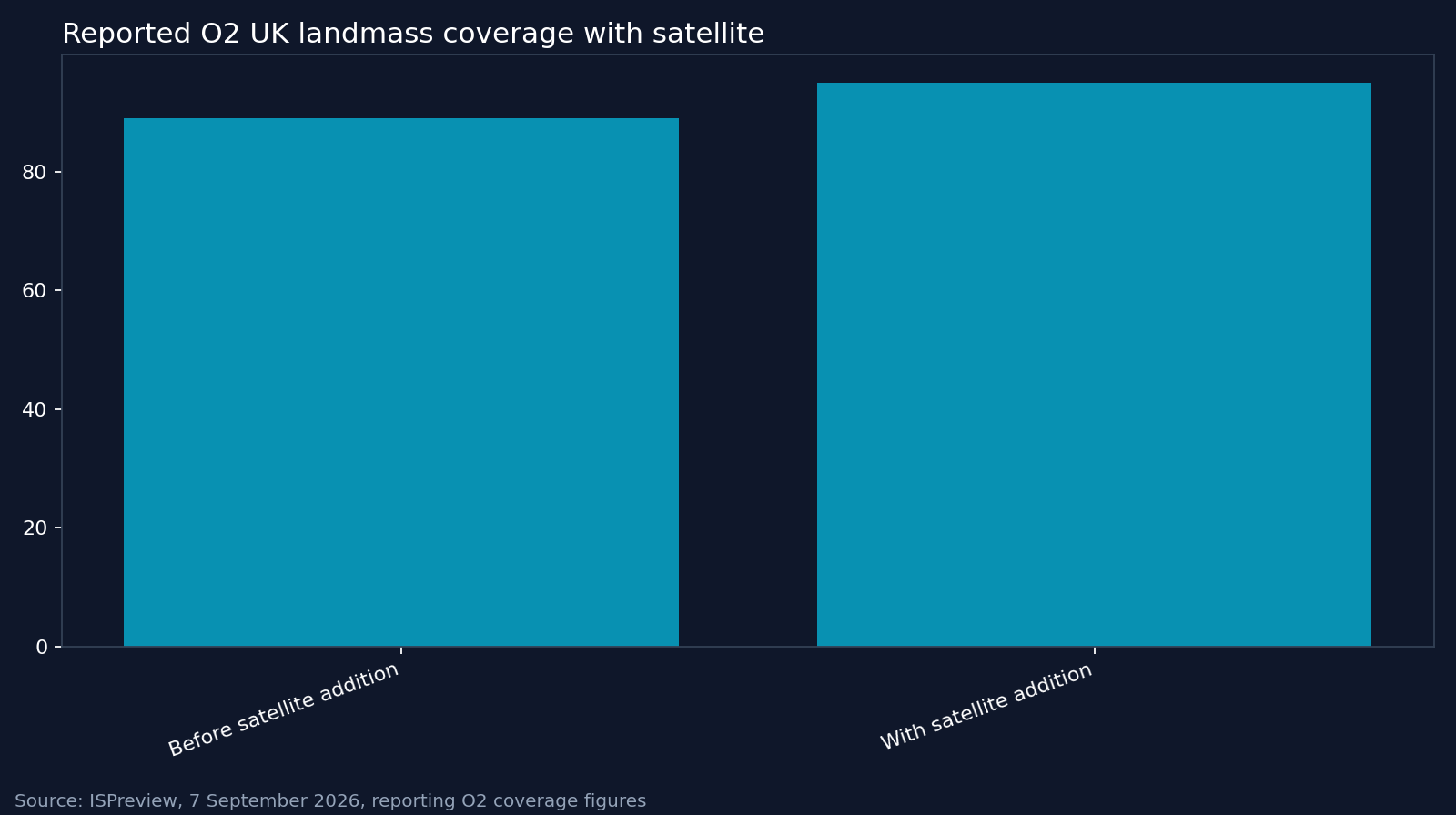
The report gives O2’s landmass coverage figures as 89% before the satellite addition and 95% with it. Those figures describe geographic reach, not throughput, indoor reception or the likelihood of completing a particular business task.
There is a material availability qualification. The reporter found the business page still saying “coming soon” on publication day. The supplied evidence therefore supports an announced business offer, but does not establish that a particular account can activate it on 28 September 2026. Obtain that confirmation before purchasing devices or changing contracts.
VodafoneThree represents another UK route. Its partnership with AST SpaceMobile is described in Real Wireless’s December 2025 account of satellite-to-mobile developments. The later Ofcom statement confirms the spectrum authorisation step. Neither source establishes a currently orderable business package with a price and service commitment.
Regulatory permission does not establish service quality
Ofcom’s licence exemption update explains the framework for qualifying handsets and SIM-enabled devices, alongside the operator licence variation. Its June statement says the additional exemption regulations were intended to take effect on 10 July 2026.
That is evidence about authorisation. It does not certify availability at a customer’s premises, application compatibility or a recovery time. Procurement should require those answers from the provider separately.
This is not legal advice; consult your legal counsel.
Follow the message all the way to its recipient
In the architecture described by the Congressional Research Service, traffic travels from a handset to a satellite, through a ground gateway and into the participating mobile network. Some traffic may pass through multiple satellites along the way.
The practical implication is that bypassing a local mast does not necessarily bypass the operator’s core network or the application receiving the message. Buyers should ask which failures the proposed service can survive.
The following responsibility map is our proposed approach for a business pilot.
| Part of the service | What to establish | Suggested owner |
| --- | --- | --- |
| Handset and subscription | Exact model, software version and account are eligible and activated | IT administrator or mobile provider |
| Working location | The required task succeeds from a safe, realistic place to use the phone | Field operations manager |
| Satellite and mobile network | Provider explains shared dependencies, support and known exclusions | Procurement lead |
| Application and recipient | Messages arrive, acknowledgements return and the receiving team has connectivity | Application owner and dispatcher |
| Failed communication | Staff know when to retry and when to follow another procedure | Operations manager |
For example, moving outdoors may be reasonable for a surveyor finishing a site visit. It may be impractical during work inside a large industrial building. Test the actual working conditions before making satellite contact part of an operating procedure.
Price the working arrangement, not just the bolt-on
The reported O2 subscription is only one input. A useful cost assessment must also establish whether the business needs different handsets, a different underlying tariff, staff training or additional administration.
The supplied evidence contains no complete UK business quotation or service-level agreement. A defensible total therefore remains conditional.
| Cost component | Question to resolve before approval |
| --- | --- |
| Subscription and underlying tariff | What is the incremental charge, VAT treatment, commitment and cancellation process? |
| Handsets | Which existing devices qualify, and what replacements would be necessary? |
| Setup and management | Who activates the service and keeps eligibility records current? |
| Training and testing | How much paid staff time is needed to demonstrate the required task? |
| Support | Who handles a failed connection and during which hours? |
| Retained backup | Which existing arrangements must remain because the satellite service cannot cover their tasks? |
Avoid crediting the proposal with savings from cancelling another connection until it has passed that connection’s acceptance tests. A low subscription charge does not make an incomplete replacement economical.
Compare services by what the business can actually use
Several approaches sit under the satellite-to-phone label. Their buying roles differ, so a feature comparison must preserve geography and availability.
| Approach | Evidence-backed position | Appropriate buying response |
| --- | --- | --- |
| O2 Satellite with Starlink | UK business offer reported, with the activation qualification described above | Seek written account eligibility and pilot the required communication task |
| VodafoneThree with AST SpaceMobile | Partnership reported and spectrum authorisation documented; supplied evidence lacks an orderable business specification | Request commercial availability, supported functions and contractual terms |
| T-Mobile T-Satellite with Starlink | Operator advertises messaging, selected apps and voice chat in supported markets | Use as evidence of possible functionality, not proof of a UK entitlement |
| Handset emergency satellite features | The [Congressional Research Service distinguishes these from cellular satellite services](https://www.congress.gov/crs-product/IF13198), including their specialised handset hardware | Assess emergency access separately from routine contact with colleagues |
The T-Mobile page names the United States, Canada, New Zealand and Japan in its service conditions. It does not establish UK availability. Equally, an emergency feature should not be assumed to provide dispatch messaging, ordinary calling or access to company applications.
There is no justified universal winner here. The right purchase depends on the task, handset fleet, locations and contract the business can obtain.
Editorial analysis
The most useful early market is likely to be businesses whose smallest valuable transaction is a message: a location, an acknowledgement or an instruction. That is an editorial assessment of the documented capabilities, rather than a measured forecast of adoption.
The counterargument deserves weight. Selected application support and voice chat already appear in a commercial operator’s offer, so describing the whole category as emergency texting would understate its development. Businesses should leave room to expand their use when their own provider supports more demanding tasks.
Our recommendation is to start with a small, paid pilot and a written success condition. Measure connection attempts, delivery delays and acknowledgements at representative locations. Confirm who responds when contact fails, and retain existing arrangements until the replacement has demonstrated the required behaviour.
Satellite-to-phone earns a place in a continuity plan when staff can complete an agreed task during a relevant failure. A larger coverage footprint is a reason to test it, not the test result.
FAQ
Can satellite-to-phone replace our office backup broadband?
The supplied evidence does not establish that it can. Documented services include selected applications and messaging, while the published T-Satellite conditions include device, location and availability limits. Require successful tests of your actual office applications before considering replacement.
Will it work on every employee’s existing phone?
Compatibility is not universal, according to the Congressional Research Service briefing. Ask the provider to confirm the exact handset model, software and subscription, then test the combination before allocating it to staff.
Will it keep working if our mobile operator suffers an outage?
That depends on which part of the operator’s service has failed. The documented direct-to-cell architecture still routes traffic into the participating operator’s core network. Ask which outage scenarios the provider supports rather than assuming the satellite path is fully independent.
What should a small business test first?
Choose one routine task, such as sending a location and receiving an acknowledgement from a dispatcher. Set an acceptable delivery window, test at representative sites and record failures as well as successes. Use the results to decide whether the service merits a defined role in your continuity plan.
Sources
The article uses supplied source extracts; the pages were not independently reopened for this draft.
- Ofcom — Direct to Device licence exemption regulations update, updated 18 June 2026
- Congressional Research Service — Satellite Direct-to-Cellular Service, updated 9 April 2026
- T-Mobile — T-Satellite with Starlink service and conditions
- Wireless Infrastructure Association — Satellite Direct-to-Device white paper overview, October 2025
- ISPreview — O2 Satellite service extended to UK business customers, 7 September 2026
- Real Wireless — Satellite-to-Mobile and What It Means for UK Connectivity, 11 December 2025