
British businesses should put their first robot-delivery budget into a repeatable route with named responsibility for failed deliveries. I would reject a proposal that promises labour savings while leaving staff recovery work unpriced. Starship’s parliamentary evidence describes mapped routes and remote human assistance. Recovery therefore belongs in the service being bought, and it should determine whether a business-site pilot earns further investment.
Key pointers
- Choose a recurring movement with fixed collection points and measurable staff effort.
- Require the supplier to explain who retrieves a stranded robot and who pays.
- Judge autonomy figures by what they measure, including crossings, distance or completed deliveries.
- Compare the proposed service with a scheduled trolley round and an existing delivery operator.
- Test loading and collection alongside the robot’s movement.
- Reject a rollout whose savings disappear when retained staff work is included.
Give the robot a route someone owns
My case for business-site delivery rests on the buyer’s ability to define the job. Choose a movement where someone can authorise the collection point, change the dispatch time and accept the goods. That gives a trial a testable purpose.
METI’s roadmap supplies a reason to examine this work. It identifies business-to-business transport alongside consumer services and anticipates that higher-capacity robots could carry larger loads and increase operating rates. Its proposed development path relies on repeated demonstration tests. Those ambitions justify investigation; they don’t establish a return for a British factory.
Consider a hypothetical engineering business moving components from stores to a workshop. I would back a trial where the operations manager can specify the container, agree receiving hours and record interruptions to the existing delivery round. I would withhold approval where nobody can say who handles a locked workshop door.
Even a familiar route needs scrutiny. Before calling an industrial estate “controlled”, establish who controls its crossings and shared loading areas. A buyer’s authority over the stores building doesn’t settle responsibility for the entire trip.
Autonomy leaves work behind
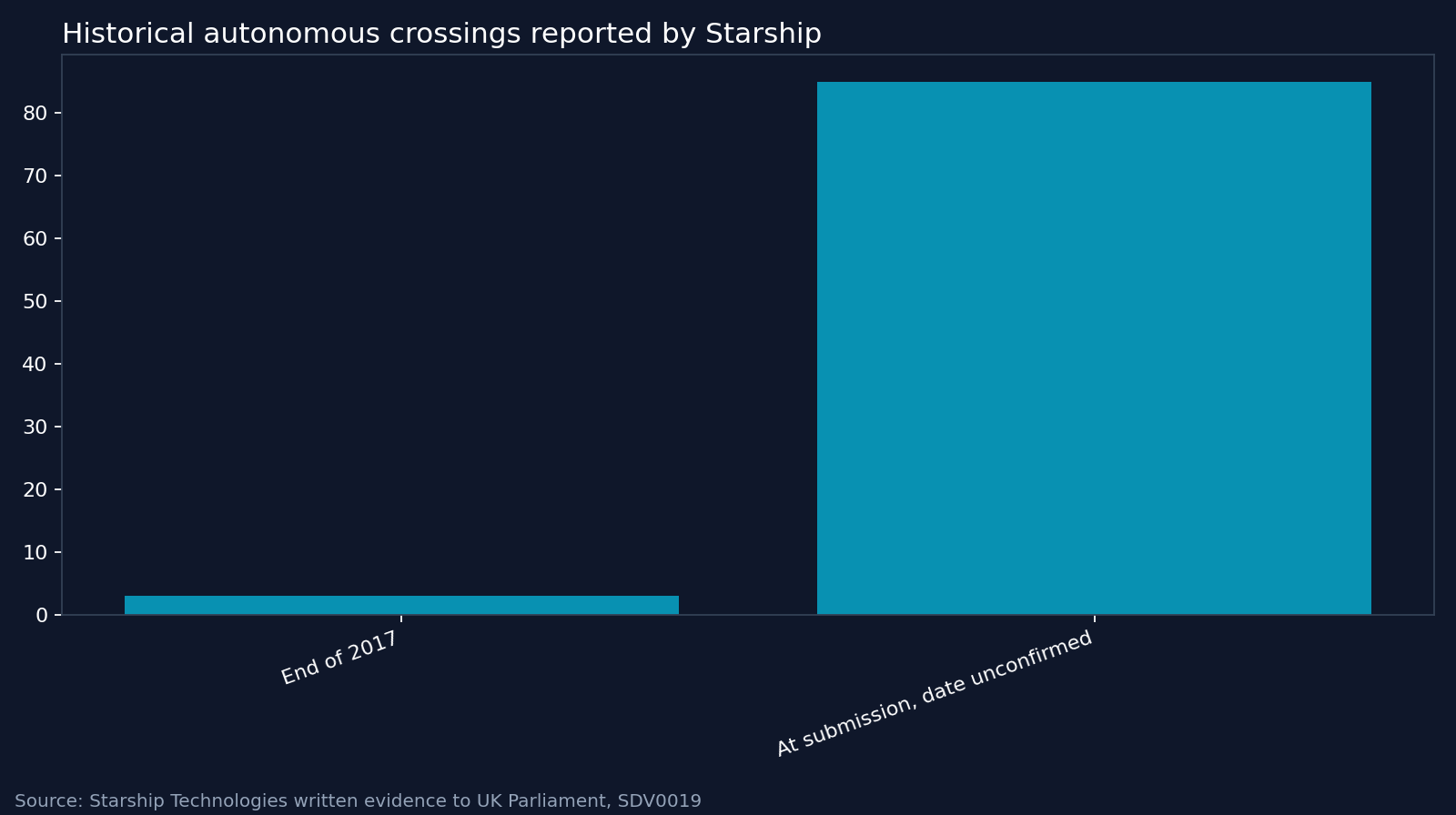
Starship’s historical crossing figures make the argument more precisely than a general warning about immature technology. Its submission reported that autonomous crossings increased from 3% at the end of 2017 to 85% at submission. It separately described its robots as 99% autonomous and UK remote assistance as necessary for only 1 mile in every 1,000. These are different measures in a supplier submission, not interchangeable descriptions of a completed delivery.
That distinction matters to the person approving a staffing budget. Distance under remote control does not establish how long a recipient waits, how much time loading takes or whether a local employee must retrieve a stopped machine. A buyer needs those measures before treating autonomy as a labour saving.
Starship’s account describes a robot notifying remote operations when conditions change, with an operator confirming that it can proceed or helping it negotiate difficult terrain. I take that as a reason to buy human support deliberately. A robot that stops safely can still leave a business waiting for its goods.
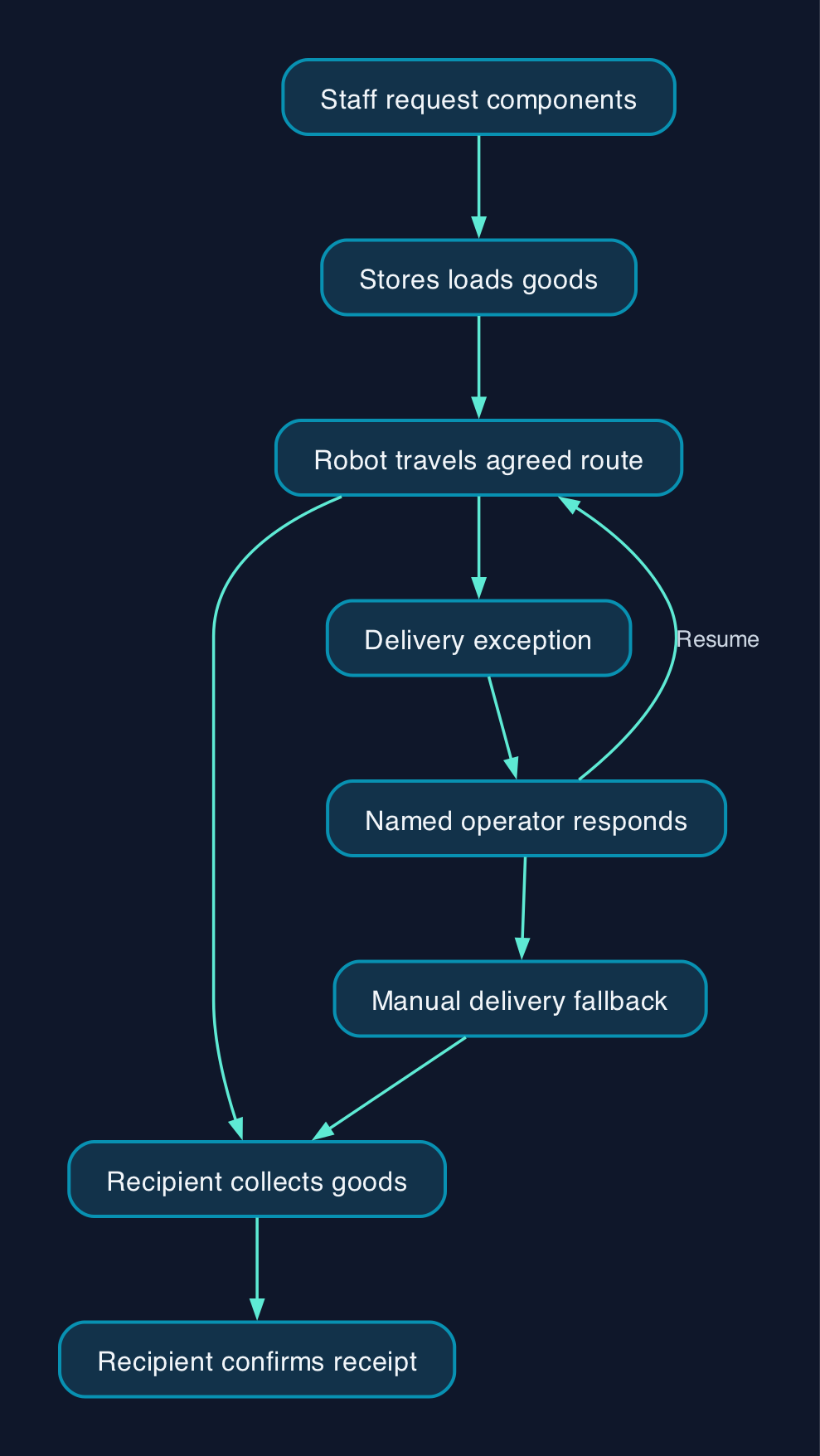
For the hypothetical workshop trial, I would specify this workflow. Stores loads the requested components; the robot travels the agreed route; the recipient collects them and confirms receipt. An exception goes to a named operator, with manual delivery available if the journey cannot resume. This is a proposed acceptance model, not a capability claim about every supplier.
The contract must then answer what happens when remote assistance cannot finish the job. Who attends, within what agreed time, and at whose expense?
A robot subscription does not settle the business case
No comparable UK quotation for that outdoor workshop route appears in the evidence. Pricing it from a restaurant robot or a pallet mover would give the budget a false foundation.
Commercial terms still deserve examination. Fresh Mango Robotics describes a typical 36-month service-robot subscription including maintenance and support, alongside purchase and hybrid arrangements. Its pricing page also states a commitment for the full subscription term. A monthly invoice should not be mistaken for a short, cancellable experiment.
My preferred comparison is the full cost per successfully completed delivery over the proposed contract period. Include commissioning, equipment and software, retained staff time, support, charging and recovery. Add manual fallback and exit charges where applicable. Ask for GBP quotations with VAT treatment stated and bundled services identified, so the same work is not counted twice.
Saved walking time needs an owner too. If the stores team spends that time loading and chasing collections, the labour case has changed. If the workshop uses the released time productively, record what work increases. Neither result follows automatically from a robot completing the route.
Match suppliers to the movement
Starship’s submitted description includes industrial-campus delivery, making it a candidate for a campus enquiry. Its current route acceptance and service obligations would still need a proposal.
For internal material handling, MiR belongs in a different enquiry. Robot Center’s MiR model guide distinguishes cart and shelf transport from heavier pallet work. That distributor evidence identifies applications to investigate; it does not establish that those machines can replace an outdoor delivery service.
I would compare the options by the job they must complete.
| Option | Enquiry it belongs in | Evidence needed before commitment |
| --- | --- | --- |
| Starship service | Small-goods movement across a proposed campus route | Accepted route, handover arrangements and recovery responsibility |
| MiR deployment | Internal cart, shelf or pallet movement | Suitable load equipment, floor demonstration and support scope |
| Existing manual round | The baseline for either proposal | Staff time, completed movements and service interruptions |
These are different delivery approaches, with the manual round retained as a credible choice. A small business should be willing to keep it if batching movements removes the problem at lower cost.
The strongest objection is that consumer delivery already works
Business sites have no claim to being robot delivery’s first useful setting. The Leeds launch reported in November 2022 was intended to serve 20,000 residents through a council, Co-op and Starship partnership. Consumer delivery had already moved beyond a demonstration.
That creates a serious economic objection to my position. An established shared service may spread mapping and support across enough orders to outperform a lightly used business deployment. Standardising a workshop route cannot rescue a machine that has too little useful work. The supplied evidence does not establish which model would be cheaper for a particular British buyer.
I would therefore favour an existing shared operator where its quoted service meets the business’s needs. Dedicated deployment earns consideration when the recurring movement and its handovers justify it. Owning the machine has no special merit.
This also rules out a confident prediction that business robots will become routine before doorstep delivery. The defensible position is narrower and more useful: a British business can make an investment decision about a defined route without waiting for nationwide consumer adoption.
Editorial analysis
I would give an operations manager authority to stop the pilot when loading, waiting or recovery cancels the expected gain. IT can assess system connections, but the people moving and receiving goods must decide whether the service improves their working day.
That changes the demonstration I want to see. Run the agreed route with an unavailable recipient or a blocked collection point, under safe test conditions. Show who receives the alert and how the goods reach their destination. Record the staff time alongside the supplier’s response.
A supplier that can explain recovery gives the buyer something to contract for. An unanswered recovery question leaves the investment unfinished.
FAQ
Should a small British business buy a delivery robot?
Only when a recurring movement supports the complete service cost. Compare purchase with a managed proposal and an improved manual round, including the staff work each option retains.
Why favour a repeatable business route?
My judgement is that fixed collection points and named recipients make the service easier to specify and test. That advantage disappears if the business cannot control access or generate enough useful work.
Does a high autonomy percentage prove labour savings?
No, because the measure may concern crossings or distance rather than staff time per delivery. Starship’s submission reports distinct autonomy measures, so request their definitions before using them in a staffing calculation.
Does Japan’s roadmap prove readiness for British deployments?
No. METI sets out expected uses and a development programme involving repeated demonstrations. A British buyer still needs evidence for the proposed route and service.
Who should retrieve a stranded robot?
Assign that responsibility before signing, with an agreed response and price. If your employees provide recovery, include their time in the business case and test whether they can leave their other work.
What would justify expanding a pilot?
Evidence that the complete workflow improves on the existing service under representative conditions. Count successful deliveries alongside loading, waiting and recovery effort, and retain the manual option if the proposed savings fail that test.
Sources
- METI, Future Perspectives on Autonomous Delivery Robots Compiled, 26 February 2025
- Starship Technologies, Introduces delivery robots to the Great British Public, 10 March 2016
- Starship Technologies, Written evidence to UK Parliament, SDV0019, submission date not established in the supplied extract
- Fresh Mango Robotics, Service robot pricing and commercial models
- Robot Center, MiR250, MiR600 and MiR1350 UK cost and application guide
- BBC News, Robot grocery delivery service launches in Leeds, 30 November 2022