UK estates should refuse another isolated smart building
UK estate owners should make cross-supplier connectivity a condition of their next controls renewal. Singapore offers a concrete model, but its savings ambitions cannot stand in for a British business case.


UK estate owners should reject new building controls that cannot demonstrate a supported connection to another supplier’s equipment. Make that a condition of the next renewal, even if a district operating system is years away. Singapore’s Open Digital Platform offers a concrete reason: JTC describes connecting each system once so it can communicate with others. Buying that option now is defensible; surrendering local control is not.
Key pointers
- Make a working connection to another supplier’s equipment an acceptance condition for new building controls.
- Keep functioning equipment unless a specific service requirement justifies replacement.
- Separate permission to read building data from permission to command equipment.
- Treat Singapore’s savings ambitions as questions to investigate, never as a British budget assumption.
- Require suppliers to price connection maintenance and handover alongside installation.
- Withhold shared control until an agreed test demonstrates continued local operation during disconnection.
The next controls renewal decides how much choice survives
A lift or cooling system has to perform its own job. My position is that, for an estate owner, a new purchase must also demonstrate how another authorised system can work with it. Accepting a promise to discuss that connection later gives the buyer too little to assess before signing.
Punggol supplies a specific alternative. In its February 2020 development account, GovTech described a shared data bus with connection specifications stated upfront. Its modular design was intended to let systems be removed or replaced without disrupting the systems connected to them. Those were documented design intentions, not proof that every replacement is effortless.
JTC’s 2022 account made the mechanism more tangible. Each system connects to common middleware, the software through which connected systems exchange information. JTC described mobile applications requesting room cooling or food delivery through links to air-conditioning systems and autonomous delivery robots. Its testbed account explains those connections.
That is enough to change a tender. Ask the controls supplier to demonstrate a useful exchange with equipment outside its own product family, using the proposed interface and permissions. Require documentation that another appointed contractor can use.
The acceptance test needs to establish what actually works. A catalogue entry saying “compatible” cannot answer who maintains the connection after a software update.
A district platform earns its place through a shared job
I favour buying equipment that can participate in shared services. I do not favour buying a district platform before identifying a job that individual building controls cannot adequately perform.
Singapore’s developer portal documents connections across heating, ventilation and air conditioning, access control and lighting. It also describes live data exchange between physical assets and applications. Those capabilities explain the platform’s potential scope; they do not establish which connections a British estate needs.
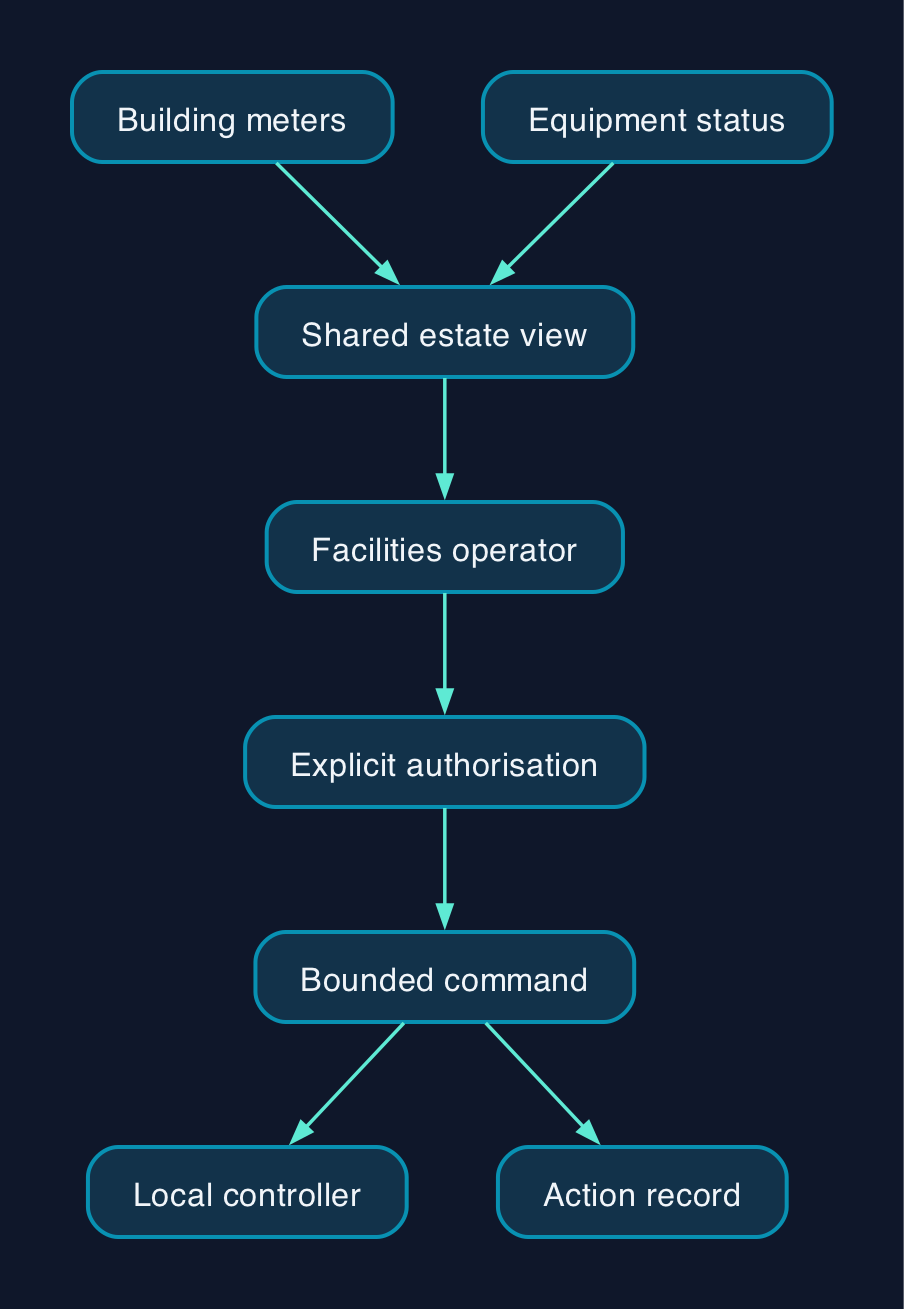
For a proposed UK pilot, I would start with building meters and equipment status feeding a shared estate view. A named facilities operator would investigate an alert. Any subsequent control phase would require explicit authorisation before a bounded command reached the local controller, with an action record identifying what changed.
That proposal deliberately puts the operating responsibility on the page. Before connecting another building, the owner has to decide who can approve a change and who handles a disputed reading.
A small business renting one unit has a narrower decision. Ask the managing agent what information the tenant receives, what changes the agent can authorise and what any shared-service charge includes. A tenant does not need to commission the district’s software to demand those answers.
The strongest objection is that shared control creates shared dependence
A sceptical estate director has a serious objection. Connecting working systems costs money, and concentrating authority could allow a platform outage or mistaken command to affect multiple buildings. Why accept that exposure when local controls already work?
Punggol also began with an advantage that cannot be assumed elsewhere. GovTech’s original account describes a new 50-hectare development and explicitly contrasts it with developments containing legacy infrastructure. That evidence does not establish a cheap retrofit route for a British estate.
I would accept the objection where a proposal requires wholesale replacement or cannot demonstrate continued local operation. Under those conditions, improving the existing controls is the better decision.
But the objection does not justify buying another generation of equipment whose external connections remain untested. A requirement to exchange data does not have to grant permission to operate a lift or change cooling settings. My preferred first contract would permit shared monitoring and reserve command authority until separate acceptance tests pass.
Before enabling control, require an agreed disconnection test, evidence that a monitoring account cannot issue commands, and a demonstration that control permissions stay within their stated limits. These are proposed purchasing conditions, not claims about tests ODP has passed.
Singapore’s documented tenant isolation and edge deployment options are relevant capabilities. Neither proves how a particular installation behaves when its shared platform disappears.
The savings claim cannot carry the business case
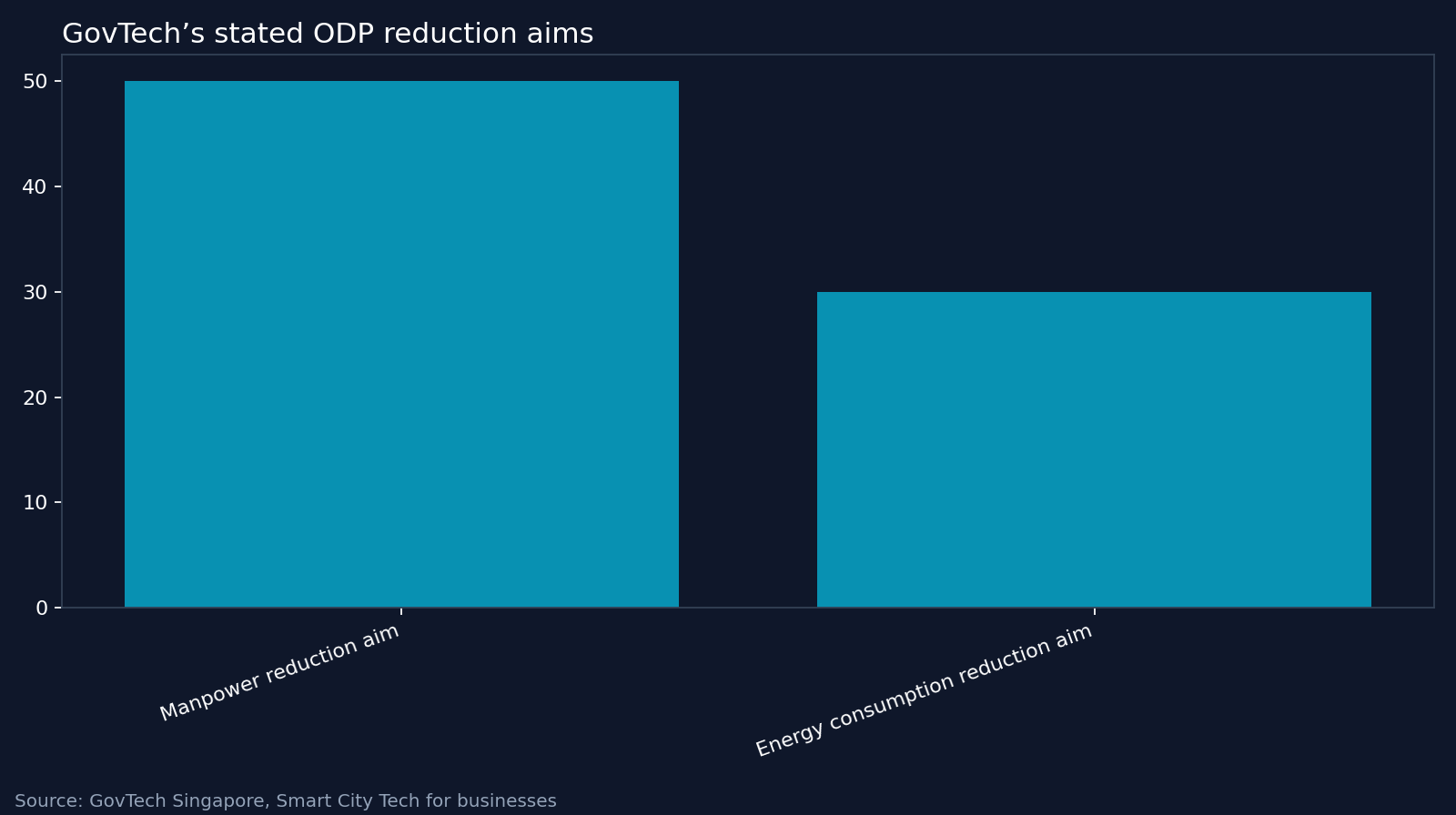
GovTech’s stated ambitions are striking: 50% less manpower and 30% lower energy consumption. Its business page presents them as aims. I would exclude both percentages from a UK financial forecast until comparable evidence supports them.
A manpower reduction also needs a precise definition before it becomes a saving. Does the proposal reduce hours spent on a task, move work to a service provider, or reduce staffing? Ask the supplier to state which outcome it is pricing.
For energy, my acceptance criteria would compare consumption alongside operating hours and occupancy, with comfort complaints recorded. For maintenance, I would assess time spent alongside unresolved faults. Those measures make it harder to count a reduction in service as a successful result.
Request prices for the equipment survey, connection development, network work, software and hosting. Add ongoing support, staff training and the work required when either connected system changes. Put handover in the quotation, including configuration, historical data and interface documentation.
The supplied evidence establishes neither UK commercial availability nor comparable British supplier prices for ODP. It supports a purchasing argument, not a supplier ranking.
Give competing suppliers the same problem
For the same estate requirement, I would invite proposals from the incumbent controls supplier, an independent systems integrator and a managed facilities provider. Compare the scope they will accept rather than treating their offers as equivalent software purchases.
| Delivery approach | When I would favour it | Evidence I would require |
| --- | --- | --- |
| Improve existing controls | The identified fault or waste sits within a building | A demonstrated correction and usable data access |
| Commission a shared connection layer | A defined service needs information from different systems | Working connections to installed equipment and a named maintenance owner |
| Buy a managed estate service | The owner also needs people to operate the service | Explicit response authority, service hours, exclusions and handover terms |
No option gets a free pass on exit. Ask a second appointed operator to explain how it would take over from the proposed documentation. Missing knowledge becomes visible before the contract depends on it.
Editorial analysis
Singapore’s useful contribution is a concrete account of how building systems can work together. JTC describes connecting systems once through common middleware; GovTech describes publishing the connection rules upfront. That makes interoperability a defensible requirement at renewal.
British estate owners can adopt that requirement without accepting an estate-wide replacement programme or an unproven savings forecast. Existing equipment gets to stay when it does the job. New equipment has to demonstrate how it will cooperate.
I would refuse a new controls contract that leaves that demonstration until after purchase. The supplier would be asking the owner to commit before showing whether the next contractor could participate.
FAQ
Is Singapore running every building through one city operating system?
The cited material does not establish that. Singapore’s Smart City solutions overview identifies ODP with Punggol Digital District, so a claim about universal city-wide control would exceed the evidence.
Should a UK estate buy ODP?
The evidence here does not establish UK availability, delivery terms or a British deployment price. My recommendation is to use its documented approach to challenge purchasing requirements, then assess offers against the actual estate and service needed.
Does open mean the software is open source?
No open-source licence can be inferred from the name. GovTech calls ODP proprietary, while the developer portal describes open architectures and interoperable interfaces. Request the licence and interface terms separately.
Must working building controls be replaced?
My position is to retain them unless a defined requirement justifies replacement. Test the proposed connection against the installed equipment before accepting a replacement programme.
Can a British owner budget for the advertised savings?
I would not use the percentages as a forecast. GovTech states aims of 50% less manpower and 30% lower energy consumption, which do not establish achievable savings for a British property portfolio.
What belongs in the first acceptance test?
For my proposed pilot, require an actual data exchange and identify who responds to the resulting alert. Before granting shared control, test continued local operation during disconnection and demonstrate that monitoring permissions cannot issue commands.
Sources
- Smart Nation Singapore, Smart City solutions, updated 18 August 2026.
- Singapore Government Developer Portal, Open Digital Platform overview, updated 8 June 2026.
- GovTech Singapore, Building an operating system for Punggol Digital District, published 5 February 2020.
- JTC, 5 questions with a JTC data scientist on building a smart district from the inside out, published 13 April 2022.
- GovTech Singapore, Smart City Tech for businesses, updated 15 May 2026.