UK businesses should make AI PC suppliers prove the upgrade
UK businesses should refuse early laptop replacement sold on future AI promises. Suppliers should demonstrate useful work on the proposed configuration, while buyers separate scheduled refresh decisions from accelerated upgrades.


UK businesses should refuse early laptop replacement when the justification is an AI badge and a promise of future usefulness. Our position is that the supplier must demonstrate a worthwhile improvement in the buyer’s actual work before functioning equipment loses its place. Microsoft’s own developer guidance says software must be programmed to use the NPU. That makes application evidence a purchasing condition, not something to investigate after delivery.
Key pointers
- Keep functioning laptops unless a demonstrated workflow improvement or a separate replacement need justifies the spending.
- Require the supplier to name the application, feature and configuration that will use the AI processor.
- Treat Copilot+ qualification as a hardware specification, not a productivity forecast.
- Compare completed work and correction time during the pilot, rather than accepting a successful demonstration as proof of value.
- Ask Dell, HP, Lenovo and other shortlisted suppliers to quote against the same application and support requirements.
- Consider additional AI capability during a scheduled refresh without pretending that future benefits are already savings.
A hardware threshold cannot authorise a fleet replacement
The decisive sentence in Microsoft’s NPU developer guidance concerns software. Applications must be specifically programmed to take advantage of the processor. Procurement should give that requirement more weight than the number printed beside the chip.
The 40+ TOPS Copilot+ requirement establishes eligibility for a device category. It does not tell a finance director how much faster an employee will complete a task, how often the relevant feature will be used or whether its output will need correcting.
Our objection is to approving the replacement before answering those questions. A supplier should be able to identify the application version, supported configuration and recurring task behind an AI-led proposal. If the answer remains “you will need it eventually”, the buyer is being asked to fund an assumption.
For a UK small business, the acceptance test should be a piece of finished work. Microsoft lists translated Live Captions and improved Windows search as business capabilities. Those are specific enough to test. “AI productivity” is not.
For example, a proposed captions pilot should compare how accurately staff understand the same recording and how much checking they need afterwards. A search pilot should establish whether employees find the correct material sooner. These are suggested tests, not claims that either feature has delivered measured savings.
Do not let the AI proposal claim the whole benefit of a new laptop
A replacement that solves an unreliable battery or inadequate performance may deserve approval without an AI argument. Buyers should require that case to stand on its own.
Otherwise, a pilot can produce a misleading conclusion. Staff prefer the new machine, so the purchase is recorded as an AI success, even though the evaluation never established whether the NPU contributed to the improvement.
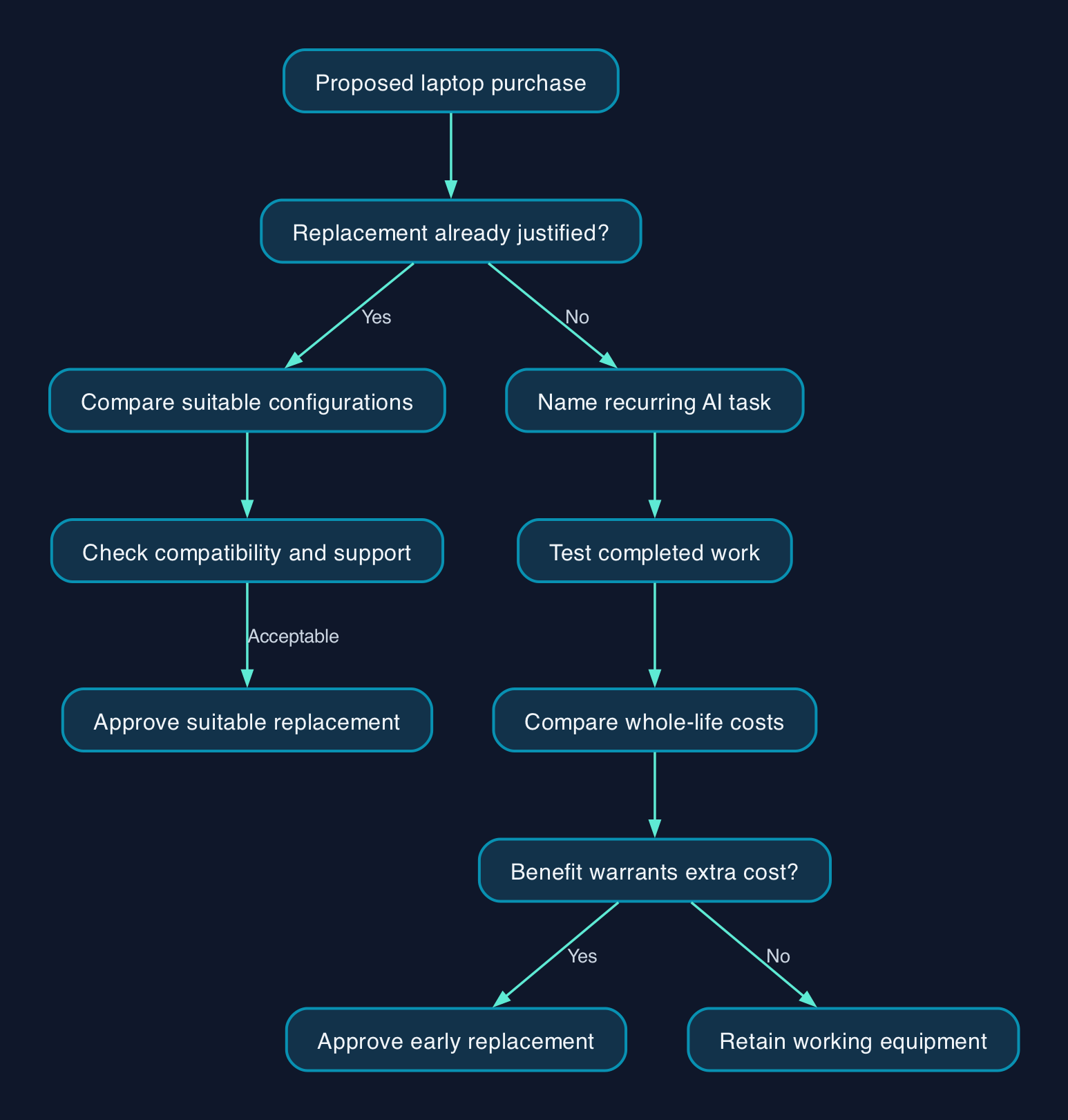
Compare the proposed device with the suitable replacement the business would otherwise buy. For early replacement, also compare it with keeping the existing machine. Those comparisons answer different questions, and combining them makes the more expensive decision easier to approve without making it better.
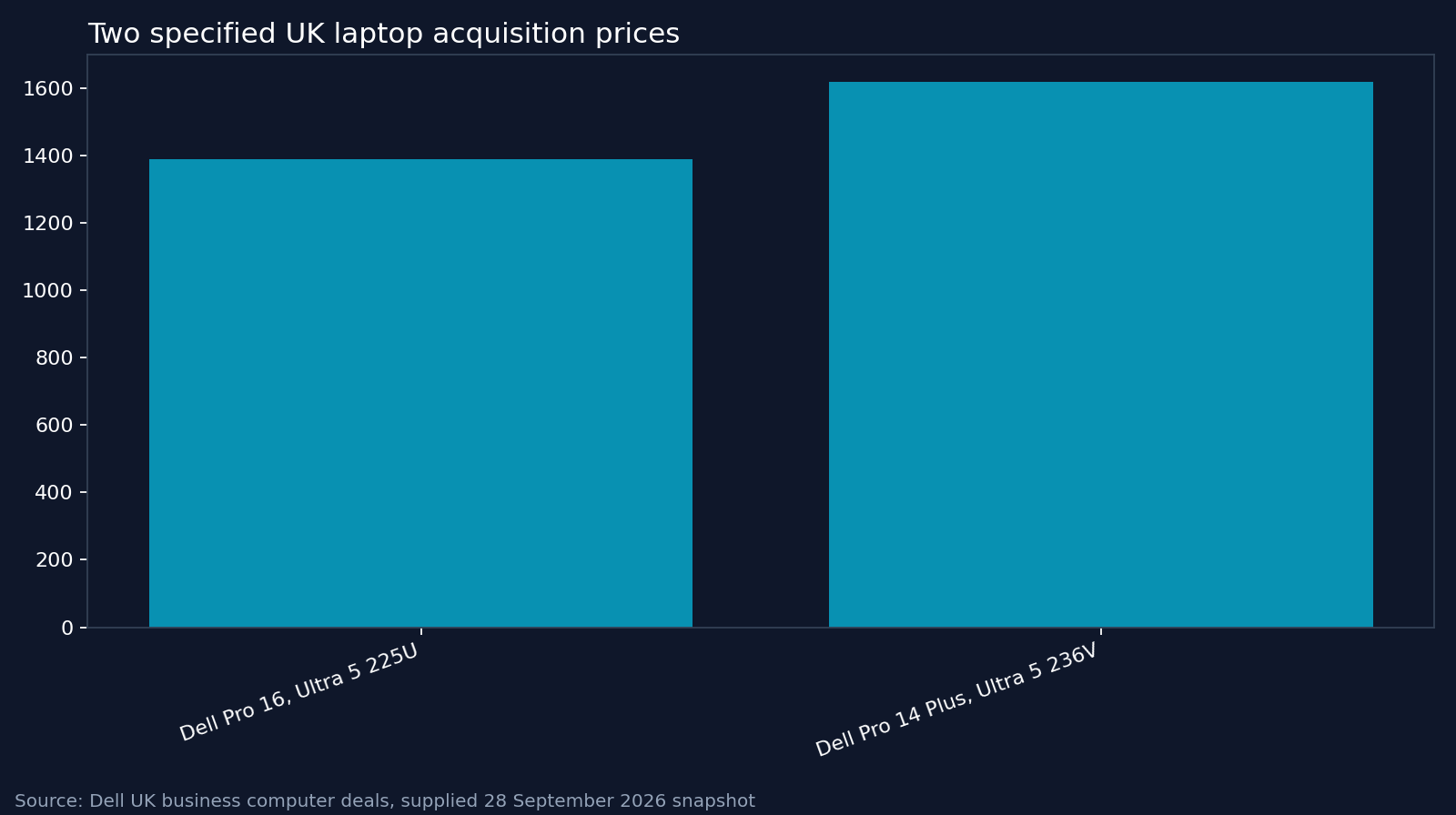
The same discipline applies to price. Dell’s supplied UK listing gives concrete acquisition costs, but it does not isolate the cost of AI capability.
| Specified configuration | Price per device excluding VAT | Price including 20% VAT | Processor and display |
| --- | --- | --- | --- |
| Dell Pro 16, offer pc16250_fixed_07 | £1389 | £1666.80 | Intel Core Ultra 5 225U, 16-inch display |
| Dell Pro 14 Plus, offer pb14250_fixed_05 | £1617 | £1940.40 | Intel Core Ultra 5 236V, 14-inch display |
Both listed configurations have Windows 11 Pro, 16 GB memory and a 512 GB solid-state drive. Prices and specifications come from the supplied Dell UK business deals snapshot dated 28 September 2026. They are purchase prices, not monthly commitments or complete deployment quotations; the extract does not establish equivalent support packages or delivery charges.
These machines differ in processor and screen size. Calling their price difference an “AI premium” would therefore manufacture a comparison the evidence does not support.
Ask for quotations that include the work required to make the device useful. Deployment, application testing, migration, training, subscriptions, support and disposal belong in the decision. Where those costs remain unknown, the business case remains incomplete.
The strongest objection is that waiting could mean buying twice
The strongest case for buying AI capability now is that a business could otherwise replace its laptops, discover a valuable application later and need another purchase. A buyer cannot demand certainty about every future requirement.
That objection deserves a concession. During an already justified refresh, a competitively priced Copilot+ configuration can be a sensible choice even without an immediate AI saving. We would not require a business to reject useful additional capability simply because its first application has not yet been selected.
But that supports choosing between replacement devices. It does not, by itself, justify bringing the replacement date forward.
Retiring a functioning machine means committing money now in exchange for benefits that still need demonstrating. Our judgement is that a general promise of future usefulness is insufficient grounds for that decision. The supplier should either demonstrate a relevant workflow or compete on the merits of the ordinary refresh.
There is also a middle course. Buy suitable AI-capable devices where replacement is already due, test the proposed applications there and use the results to decide whether any other roles warrant an accelerated upgrade. That gives the business evidence without making the entire fleet the experiment.
Give competing suppliers the same job to prove
The test should apply equally to Dell, HP, Lenovo and Surface. Microsoft’s developer guide names Dell Latitude 7455, HP OmniBook X 14 and Lenovo ThinkPad T14s among its Copilot+ examples. That identifies candidates, not equivalent UK configurations, support contracts or measured performance.
Invite those suppliers to answer the same brief.
| Candidate route | What the buyer should require |
| --- | --- |
| Dell configuration | Exact processor and configuration, with application results for the proposed device |
| HP configuration | The same workflow demonstration, plus a written UK support scope |
| Lenovo configuration | The same acceptance criteria, including the required peripherals and applications |
| Surface configuration | The same cost and support comparison, without assuming the platform owner’s hardware is preferable |
| Retain existing equipment | Evidence that it can continue meeting the required work and support needs |
A family name is insufficient. Dell’s own business catalogue distinguishes “AI PC options” from options including Copilot+. Procurement should approve an exact configuration and an accepted result.
For a small business using an external IT provider, make application validation a named deliverable in the quotation. Ask who investigates a failed feature, who maintains the relevant software and drivers, and who decides whether the pilot has passed.
Our approval rule is a demonstrated result
CTC’s editorial position is that early AI-led replacement should need a stronger case than scheduled replacement. The buyer is choosing to surrender equipment’s remaining useful service, so the proposal must explain what makes that worthwhile.
Before authorising the order, require a short written record containing:
- The recurring task, named feature and staff who will use it.
- The existing process and the result that would justify changing it.
- A comparison using the same inputs and quality standard.
- Correction, training and support effort alongside any time saved.
- The additional whole-life cost and the person accountable for the benefit.
Treat saved time as capacity until the business explains how it will use it. More billable work, reduced overtime or a shorter customer queue can form a proposal; a stopwatch result alone should not become a cash saving.
If the new laptop wins because it is a better laptop, approve it on that basis. If the AI feature earns its place, record the evidence. If neither case survives comparison with keeping the existing equipment, decline the early replacement.
FAQ
Does an NPU automatically make business applications faster?
No automatic improvement follows from its presence. Microsoft says software must be specifically programmed to use the NPU, so require evidence for the application and task being proposed.
Is every AI PC a Copilot+ PC?
No. Microsoft’s Copilot+ requirements include the qualifying NPU, memory and storage together. The specifications explicitly describe devices with powerful NPUs that do not meet the complete requirements.
Should we avoid AI PCs during a scheduled refresh?
No. Our recommendation is to consider them when the exact configuration, price, compatibility and support terms meet the brief. Additional capability can be a reasonable purchasing choice without an invented forecast of immediate savings.
What would justify replacing a working laptop early?
A demonstrated improvement in necessary, recurring work could justify it if the benefit warrants the additional whole-life cost. Set the acceptance criteria before the demonstration and include checking, training and support effort in the assessment.
Do the quoted Dell prices show what AI capability costs?
No. The £1389 and £1617 configurations have different processors and screen sizes, so they do not isolate an AI premium. They illustrate acquisition spending, not a controlled value comparison or complete ownership cost.
What should a supplier demonstrate before we buy?
Ask for the named application and feature running on the exact proposed configuration. Require completed work that meets your quality standard, a documented processing path and a named support owner. A specification sheet cannot substitute for that acceptance test.
Sources
- Microsoft Learn – Develop AI applications for Copilot+ PCs
- Microsoft – Windows 11 specifications and Copilot+ PC requirements
- Microsoft – Copilot+ PCs and AI features for businesses
- Dell UK – Business computer deals and specified configurations
- Dell UK – Business laptop catalogue