UK Smart Data should make software easier to leave
Smart Data could make software easier to leave, but powers to create schemes are not a complete migration service. UK businesses should demand tested transfers, clear responsibilities and priced exit work today.


UK Smart Data could let businesses authorise transfers between software suppliers without handling export files themselves. But the case for buying software on that promise is premature. The Act’s explanatory notes describe powers to create data-sharing schemes, while the digital markets response explicitly stops short of government policy. Our view is to demand a tested exit route today and judge future schemes by whether records remain usable after transfer.
The useful promise is a business that can leave
For a small business, the valuable outcome would be straightforward. Choose a replacement supplier, authorise a defined transfer and continue working with records that make sense in the destination system. The owner should not have to become a data-conversion specialist to change a subscription.
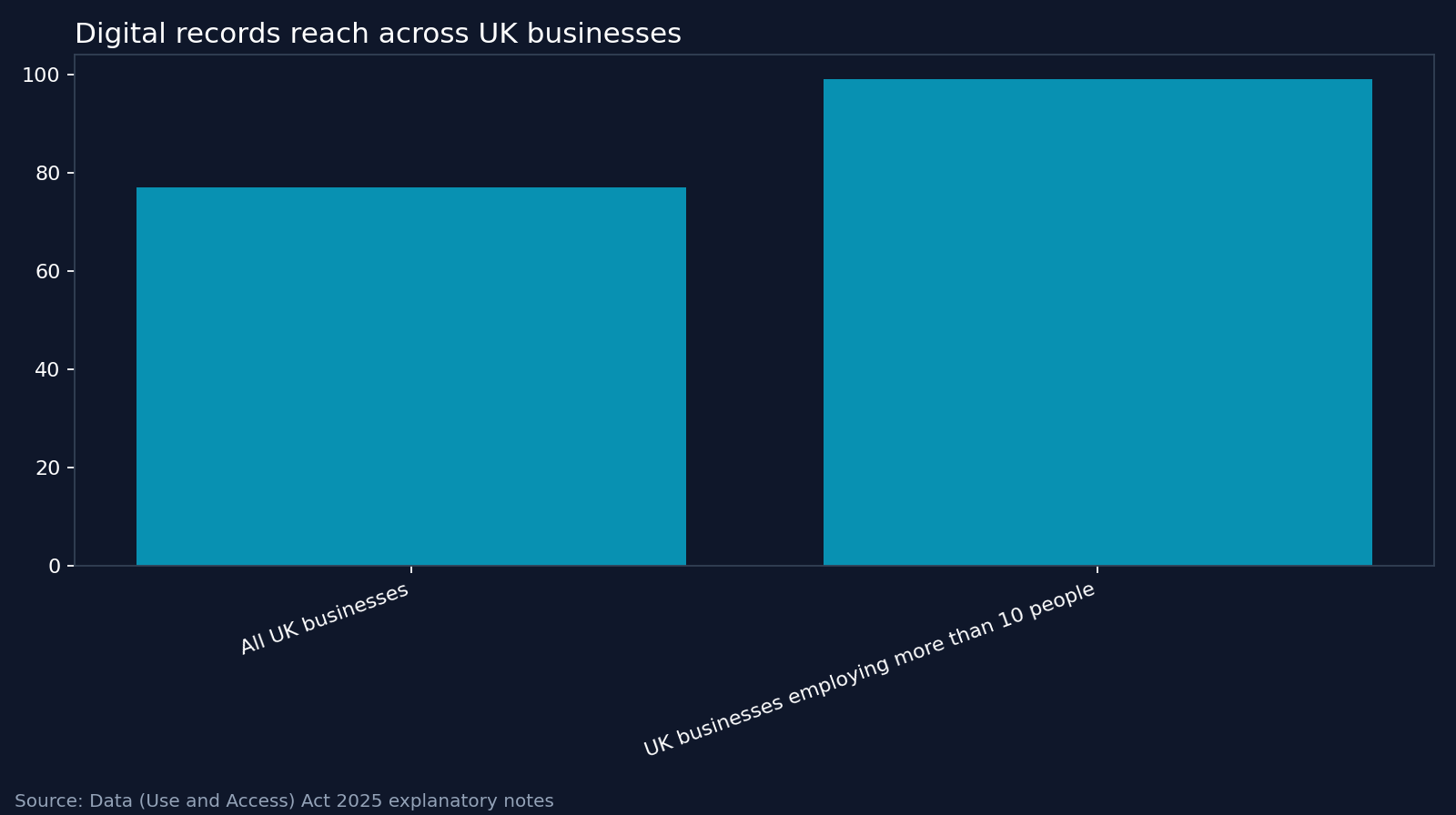
The potential audience is substantial. The Act’s policy notes report that 77% of UK businesses handle digital data, rising to 99% among businesses employing more than 10 people. These are background figures cited in the notes, rather than a measure of demand for switching software.
Our editorial position is that Smart Data should be judged on practical freedom to leave. A transfer that succeeds technically but leaves the business unable to explain an outstanding invoice is an inadequate result.
Consider a hypothetical wholesaler changing its accounting system. Moving a customer’s name and an invoice amount would be only part of the acceptance test. The finance manager should also check the associated credit note, payment allocation and supporting document. This is a proposed test of migration quality, not a claim about any particular supplier’s limitations.
What the UK framework does and does not establish
The legal distinction is between having powers to create a scheme and having an applicable scheme with defined obligations.
The Act’s explanatory notes describe powers to require access to customer data and contextual business data. They explain that these powers are intended to support enhanced portability where exercised. “Business data” in this context includes information about the supplier’s goods or services; readers should not assume it means every document, configuration and record belonging to a business customer.
The government’s commencement guidance confirms the position of the regulation-making powers. It does not establish a general entitlement to move an entire accounting or customer-management environment between suppliers.
Likewise, the digital markets government response describes evidence gathered to inform consideration of next steps. It expressly says that the analysis does not set government policy.
For procurement, the practical consequence is simple. Ask a supplier claiming a Smart Data obligation to identify the applicable scheme, covered records, implementation date and enforceable requirements. Do not substitute a strategy document for those answers.
This is not legal advice; consult your legal counsel.
A transfer needs someone accountable at each end
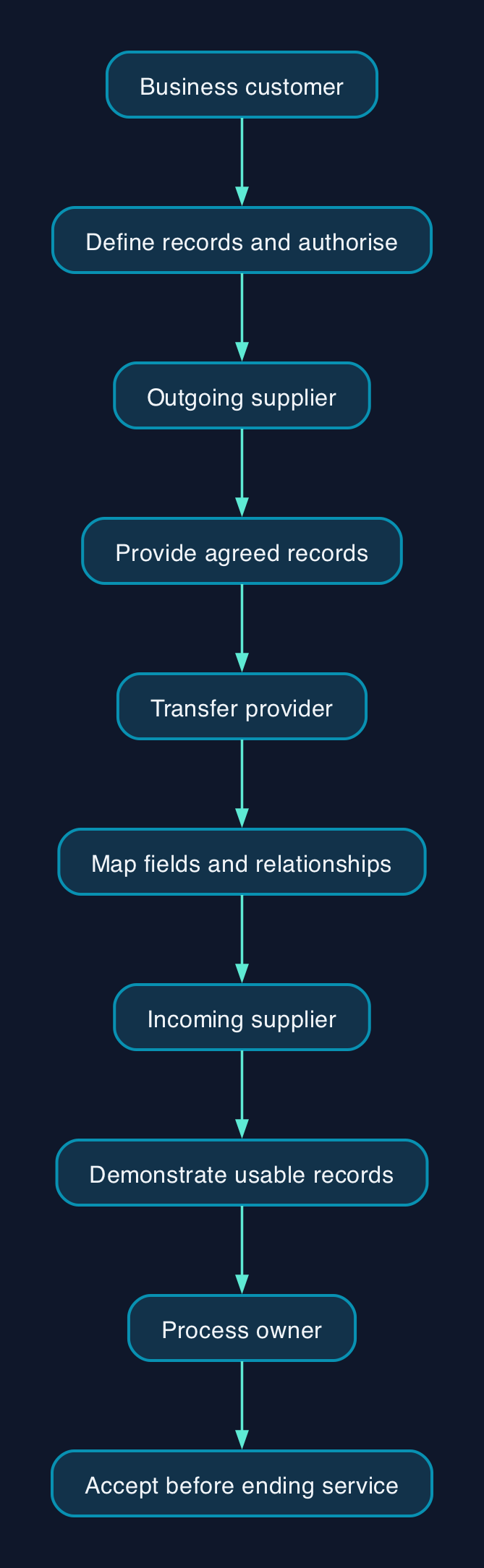
The following is an illustrative responsibility model for software switching. It is a procurement proposal, not a description of an established digital markets scheme.
| Participant | Proposed responsibility | Evidence the buyer should request |
| --- | --- | --- |
| Business customer | Define what must move and authorise access | An approved record inventory and named decision-maker |
| Outgoing supplier | Provide the agreed records with enough context to interpret them | A sample transfer and an explicit exclusions list |
| Transfer provider | Map fields, preserve agreed relationships and report failures | Mapping documentation, exception reports and access controls |
| Incoming supplier | Demonstrate that transferred records support the required work | Reconciled totals and completed business-process tests |
| Business process owner | Accept the result before ending the old service | Written acceptance and a workable recovery route |
The customer’s work would change rather than disappear. Instead of downloading and uploading files, the business would define scope, authorise access and check the result.
That distinction should shape scheme design. Respondents raised understandable and revocable consent, auditability, redress and clear accountability, as reported in the digital markets government response. Those are stakeholder priorities, not evidence that a future scheme has already adopted particular controls.
For the wholesaler, accountability means knowing who fixes a missing payment allocation. A successful transmission receipt would not answer that question.
Price the completed move
Smart Data is not a supplier quotation. The 2022 impact assessment anticipated that direct costs would arise when powers were put into practice through subsequent regulations. That historical assessment supplies no price for migrating a business’s software.
Our recommendation is to request an itemised migration quotation covering the work below.
| Cost component | What the quotation should explain |
| --- | --- |
| Record preparation | Who resolves duplicates, missing fields and inconsistent identifiers |
| Extraction and transfer | Included record types, history, attachments and transfer attempts |
| Mapping and configuration | Which relationships and settings are recreated, with exclusions |
| Validation | Who reconciles totals and investigates differences |
| Service overlap | How long both subscriptions or support arrangements remain necessary |
| Training and support | Who helps staff complete their actual tasks after the move |
| Exit and recovery | Access to retained records, reversal arrangements and deletion responsibilities |
Ask for GBP amounts, VAT treatment, assumptions and charges for additional work. Where a supplier cannot price an item, keep it visibly unresolved rather than treating it as free.
For a business with limited staff, management time belongs in the decision too. Our judgement is that a cheaper transfer can be a poor purchase if the owner becomes the unpaid coordinator between suppliers.
Compare suppliers on proof of exit
Apply the same test when considering Sage, Xero, QuickBooks or Zoho. A smaller UK provider or an open-source option should face it too. These are candidates for assessment, not a claim that they offer equivalent products or verified Smart Data participation.
The available supplier evidence is narrow. Xero describes several ways to move into its service, including accountant assistance and conversion services. That supports asking about assisted migration today; it does not establish which supplier offers the most complete transfer or the easiest eventual departure.
Compare competing proposals using your own representative records. Ask each bidder to demonstrate what arrives, what remains readable, what must be rebuilt and who resolves errors. Require the same evidence for leaving the proposed service later.
Keeping the current system is also a legitimate option. If its shortcomings can be corrected at lower cost, an unproven promise of future portability is a weak reason to migrate.
Editorial analysis
The strongest argument for Smart Data is that businesses should not have to negotiate every basic data-sharing arrangement from scratch. The Smart Data Strategy identifies schemes working together as part of the intended direction. Our view is that common requirements could give smaller buyers more credible alternatives when renewing software.
The counterargument deserves attention. Requiring every application to reproduce every rival’s configuration would be an ambitious and potentially expensive obligation. We would favour a defined, testable scope of portable records, with explicit exclusions and clear responsibility for completing the move.
The purchasing decision today should therefore turn on demonstrated portability. Ask for a sample migration and a written exit schedule before signing. A future scheme would earn its value by making those commitments easier to obtain and enforce.
FAQ
Can UK businesses already demand an automatic software switch under Smart Data?
The official legal background establishes powers for schemes, rather than a universal automatic switching service. The supplied digital markets evidence does not establish a scheme covering your chosen software. Ask which specific rules apply before relying on a claimed entitlement.
Would Smart Data remove manual exporting?
It could, where an applicable scheme enables an authorised provider to obtain the required data directly. The Act’s policy notes describe services including automatic switching and account management. That does not establish that every record or setting would be covered.
Would moving records also recreate reports and workflows?
The legal background does not establish universal recreation of application behaviour. Treat reports, permissions, approval workflows and connections as separate acceptance items. Ask the incoming supplier to demonstrate each item that your business needs.
Should a business delay migration until a scheme arrives?
Our view is to proceed when a tested migration solves a sufficiently valuable business problem. The digital markets response does not provide a commitment on which to schedule your software exit. Base the decision on available services, verified transfer scope and complete costs.
Sources
- GOV.UK — Data Use and Access Bill factsheet, growing the economy
- GOV.UK — Data Use and Access Act 2025 plans for commencement, updated 5 February 2026
- Department for Business and Trade — Smart Data Strategy, published 26 March 2026
- Department for Science, Innovation & Technology — Smart Data opportunities in digital markets, updated 12 May 2026
- Department for Science, Innovation & Technology — Smart Data opportunities in digital markets government response, updated 12 May 2026
- Department for Business, Energy & Industrial Strategy — Smart Data primary legislation impact assessment, dated 18 July 2022
- Xero UK — Moving from QuickBooks to Xero