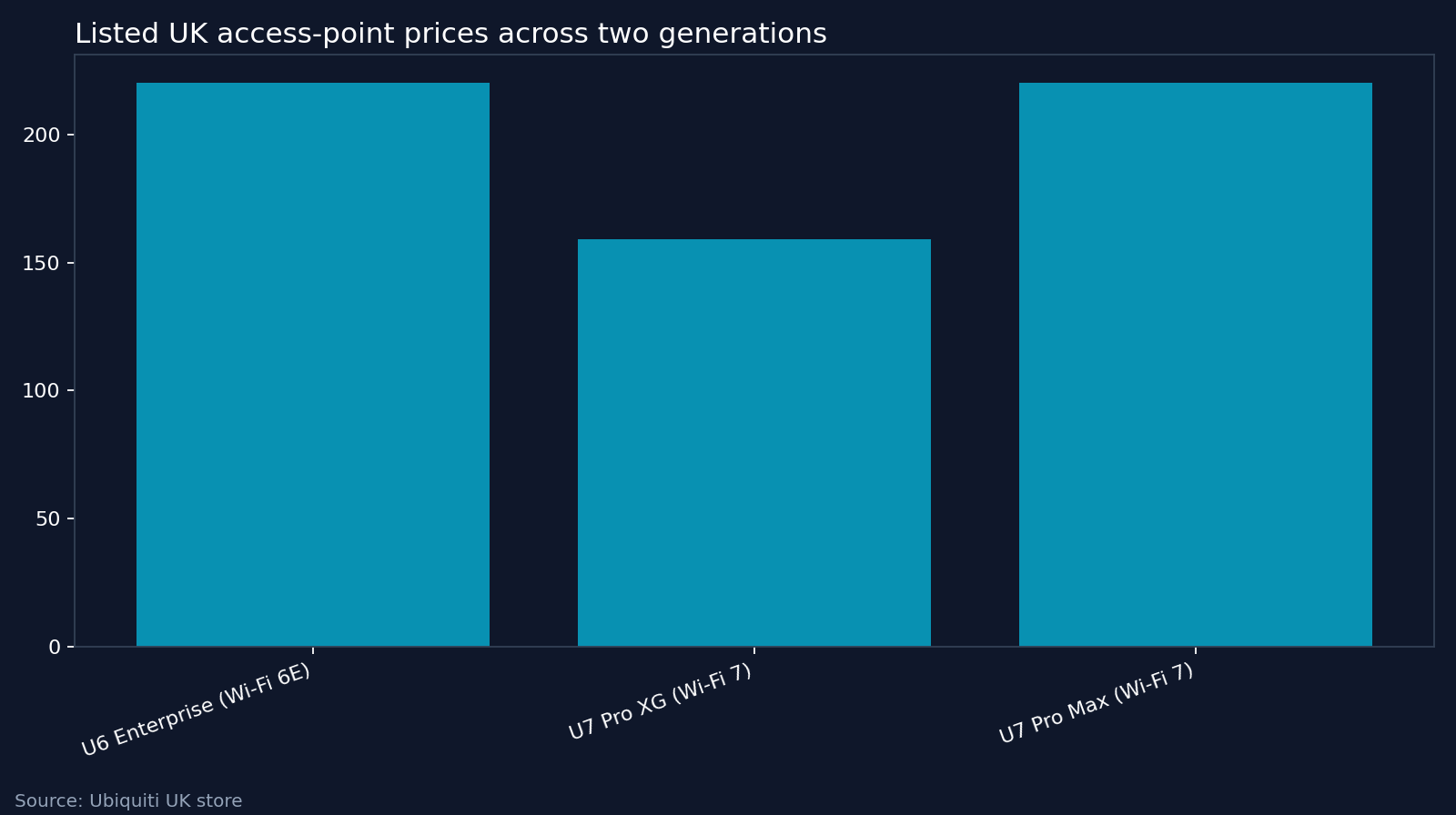
Yes, a UK company should still consider Wi-Fi 6E in 2027, particularly when extending an existing network. For a fresh installation, my starting shortlist would favour Wi-Fi 7, with 6E retained where the complete quotation justifies it. Older does not automatically mean cheaper. Ubiquiti’s UK catalogue already lists some Wi-Fi 7 access points below its Wi-Fi 6E model, although their specifications differ.
Give Wi-Fi 6E a job to justify
For a small business, the useful question is whether the proposed equipment solves a measured problem at an acceptable lifetime cost.
Imagine a company extending its office into an adjacent unit. Keeping the same management platform could simplify configuration, fault diagnosis and staff training. In that hypothetical case, another supported 6E access point deserves consideration even if a newer model has a lower hardware price.
A complete replacement creates a different decision. With no existing platform to preserve, I would require a positive reason to choose 6E, such as a stronger installed quotation, demonstrated suitability or a support arrangement that better matches the business.
The supplied evidence contains no comparable end-of-support commitments or controlled performance tests. It therefore cannot establish that either generation will last longer or perform better in this particular building. This opinion uses evidence supplied on 28 September 2026 to inform a 2027 purchase, rather than predicting next year’s prices.

UK spectrum policy is moving ahead of purchase certainty
The lower 6 GHz band, from 5925 to 6425 MHz, was made available for Wi-Fi and related technologies in a 2020 statement.
A statement published on 20 July 2026 sets out a sharing framework for the upper band. The page, updated on 24 September 2026, also describes draft regulations and interface requirements intended to implement the Wi-Fi-priority extension.
For procurement, distinguish three things: the regulator’s policy decision, the rules implemented by the purchase date, and support in the exact equipment and firmware offered.
Ask the supplier to identify the UK model and enabled channels in writing. Do not assign financial value to a promised future spectrum upgrade without a documented commitment. That purchasing rule applies equally to Wi-Fi 6E and Wi-Fi 7.
The installation includes clients, switches and an operator
An access point connects wireless devices to the wired network, as NETGEAR explains. The buying decision must therefore include both sides of that connection and the person responsible for keeping it working.
HPE’s planning guidance calls for client assessment, controlled security testing and coverage validation using end-user devices. Those are useful acceptance requirements for a small business commissioning an installer.
The following is a proposed responsibility split, rather than a supplier’s service commitment.
| Part of the installation | Suggested owner | Evidence to require before acceptance |
| --- | --- | --- |
| Laptops, phones and specialist devices | Internal IT lead or support provider | Representative devices connect and complete their normal tasks |
| Access points and radio design | Wireless installer | Survey and pilot results for occupied working areas |
| Cabling, switch ports and electrical power | Network installer | Compatibility with the selected access points and their intended operating mode |
| Staff and guest access | Business IT owner | Approved access settings and successful connection tests |
| Management and fault handling | Named internal operator or managed provider | Administrator access, configuration backup and an agreed escalation route |
If nobody owns the last row, resolve that before ordering hardware. My preference for a smaller firm would be a clearly supported installation over a technically ambitious one that its staff cannot administer.
Compare installed cost before comparing generations
The prices below are GBP amounts displayed in the supplied UK catalogue extracts on 28 September 2026. They are per-access-point hardware listings, not installation quotations. The extracts do not establish VAT treatment, delivery charges or minimum order quantities, so these must be confirmed before comparing final invoices.
| Access point | Listed generation | Displayed hardware price | Relevant distinction in the supplied listing |
| --- | --- | --- | --- |
| Ubiquiti U6 Enterprise | Wi-Fi 6E | £220 | 10 spatial streams and 6 GHz support |
| Ubiquiti U7 Pro XG | Wi-Fi 7 | £159 | 6 spatial streams, 6 GHz support and multigigabit Ethernet |
| Ubiquiti U7 Pro Max | Wi-Fi 7 | £220 | 8 spatial streams, 6 GHz support and a dedicated spectral scanning engine |
| NETGEAR WAX630E | Wi-Fi 6E | £367.99 | One year of Insight management included |
Sources are the Ubiquiti UK flagship catalogue and NETGEAR UK access-point catalogue.
These are different products, not a controlled performance comparison. Their prices support a narrower conclusion: choosing Wi-Fi 6E does not automatically reduce the hardware bill.
Assumptions for quotation comparison
Ask suppliers to price the same coverage requirements and ownership period. Include access points, survey work, installation, any switch or cabling changes, management charges, support, training and eventual handover. Require subscription renewal prices wherever an initial management period is bundled.
A cheaper access point should win only after those costs and responsibilities are understood. Conversely, familiarity alone should not justify paying more for an older model.
Put several suppliers through the same questions
The evidence supports considering different management approaches, but not declaring a universal winner.
| Supplier route | What the evidence establishes | When I would investigate it | What remains to verify |
| --- | --- | --- | --- |
| Ubiquiti UniFi | Its [UK catalogue](https://uk.store.ui.com/uk/en/category/wifi-flagship) lists both 6E and 7 models with GBP prices | A fresh shortlist or an extension of an existing UniFi installation | Management requirements, support arrangements and model-specific lifecycle |
| NETGEAR Insight | Its [UK catalogue](https://www.netgear.com/uk/business/wifi/access-points/) lists 6E and 7 products with included management subscriptions | A business comparing cloud-managed installations | Renewal charges, required features and installer responsibilities |
| Cisco Catalyst | The [Catalyst 9136 deployment guide](https://www.cisco.com/c/en/us/products/collateral/wireless/catalyst-9136-series-access-points/cat9136-series-ap-deployment-guide.html) documents a Wi-Fi 6E platform integrated with the Catalyst wireless stack | An organisation already operating that environment | UK model availability, controller compatibility, licensing and a complete supported quotation |
Cisco’s documented integration is a reason to investigate continuity, not evidence that it offers the best value for a small office. Likewise, a low catalogue price cannot establish that changing platform is worthwhile.
Editorial analysis
My recommendation is to make Wi-Fi 7 the starting point for a new 2027 shortlist, while giving Wi-Fi 6E a fair opportunity to win on the complete proposal.
Keep 6E in contention when it preserves a useful existing setup, passes testing with the business’s actual devices and comes with an acceptable written support commitment. Reject the argument that it must be economical simply because it belongs to an older generation.
Before signing, require a pilot acceptance record and a quotation that names the ongoing operator. Those two documents tell a buyer more about the likely outcome than the generation printed on the box.
FAQ
Is Wi-Fi 6E automatically obsolete in 2027?
No. The supplied Ubiquiti and NETGEAR catalogues still list Wi-Fi 6E equipment alongside Wi-Fi 7. A listing does not establish future support, so obtain the selected model’s lifecycle commitment before purchase.
Will our existing laptops use the 6 GHz band?
Only if their hardware and software support it. HPE’s deployment guidance identifies operating-system and driver support as requirements. Test representative devices instead of assuming that buying new access points upgrades the whole fleet.
Can we reuse our existing wireless security settings?
Do not assume so. HPE states that WPA2 is not permitted for 6 GHz operation, which requires WPA3 or Enhanced Open. Agree and test any configuration changes before rolling them out.
Should we replace a working Wi-Fi 6E network with Wi-Fi 7?
I would not approve replacement solely to change the generation label. Require a documented problem, a tested improvement and a complete cost comparison. Extending a satisfactory network and replacing an inadequate one are separate purchasing decisions.
Sources
The following pages were supplied in the research evidence dated 28 September 2026.
- Ofcom — Improving spectrum access for Wi-Fi, statement published 24 July 2020
- Ofcom — Expanding access to the 6 GHz band, updated 24 September 2026
- HPE Aruba Networking — Wi-Fi 6E planning and deployment
- Ubiquiti — UK flagship access-point catalogue
- NETGEAR — UK business wireless access-point catalogue
- Cisco — Catalyst 9136 Series Access Points Deployment Guide, updated 11 August 2024