UK retailers should control robot delivery before buying fleets
Retailers should control delivery promises and recovery before buying robots. Fleet ownership deserves investment only when a route-specific trial demonstrates an advantage over a contracted service.

British retailers should control delivery promises and failed-order recovery before committing to robot fleets. Fleet ownership should follow only when a trial demonstrates an advantage over a contracted service on the same routes. Japan’s delivery robot programme supports experimentation with higher-capacity machines, but supplies no business case for British retailers to own them. The purchasing decision should turn on completed deliveries, total operating costs and clear responsibility when something goes wrong.
Key pointers
- Set the customer promise and recovery responsibilities before choosing who owns the robots.
- Compare ownership with a contracted service on the same routes and operating hours.
- Include loading, supervision, maintenance and failed deliveries in the financial assessment.
- Ask who retrieves a stranded robot and pays for replacement delivery.
- Treat published battery duration as a specification requiring workload testing.
- Keep a fallback service for orders outside the trial’s agreed limits.
Japan supports a trial before a fleet purchase
Japan’s programme starts with practical problems, including logistics labour shortages and difficulties accessing shopping. Its report explores whether larger, faster robots could carry more goods, shorten delivery times and support additional uses. These are expected benefits to investigate through demonstrations. Programme rationale and proposed capabilities
British retailers should apply that distinction to their investment decisions. A machine that could support grocery delivery and mobile vending presents separate commercial possibilities. Each deserves a defined trial, with its own workload and success criteria.
The programme also contains an important qualification. A suggested maximum speed of 20 km/h is a potential specification for one proposed category. The ministry explicitly says its demonstration did not guarantee that the showcased robots could operate on Japanese public roads. Proposed specifications and demonstration limits
My position is that retailers should borrow the discipline of testing specific uses. This evidence cannot establish permission for a British route or demonstrate that owning the equipment will improve a retailer’s margins.
The strongest objection is that carriers can automate too
The strongest argument against retailer ownership is straightforward. A carrier serving several businesses might spread supervision and maintenance costs across more orders. That is a plausible economic advantage, although the supplied evidence does not quantify it.
There is a concrete British example of carrier-led deployment. Fleet News reported in November 2024 that DPD was deploying Ottonomy’s Ottobot from its Milton Keynes depot, using the traffic-free Redway network. The reported robot had a maximum payload of 70 kg and eight separate compartments. Reported UK locker-robot deployment
That example challenges any assumption that retailers must own robots to benefit from automation. A contracted operator can introduce the technology within its service.
The answer is to make ownership compete against a credible contracted offer. I would retain the contract when it meets the required customer promise at an acceptable total cost and the retailer cannot demonstrate an additional benefit from operating the fleet.
Selective ownership remains defensible. A retailer might demonstrate better recovery or lower costs on particular routes. Those advantages should survive measurement before they justify a purchase.
Put control into the service agreement
Control needs a practical definition. For a trial, I would require authority over order eligibility, visibility of delivery progress and an agreed response to unsuccessful handoffs.
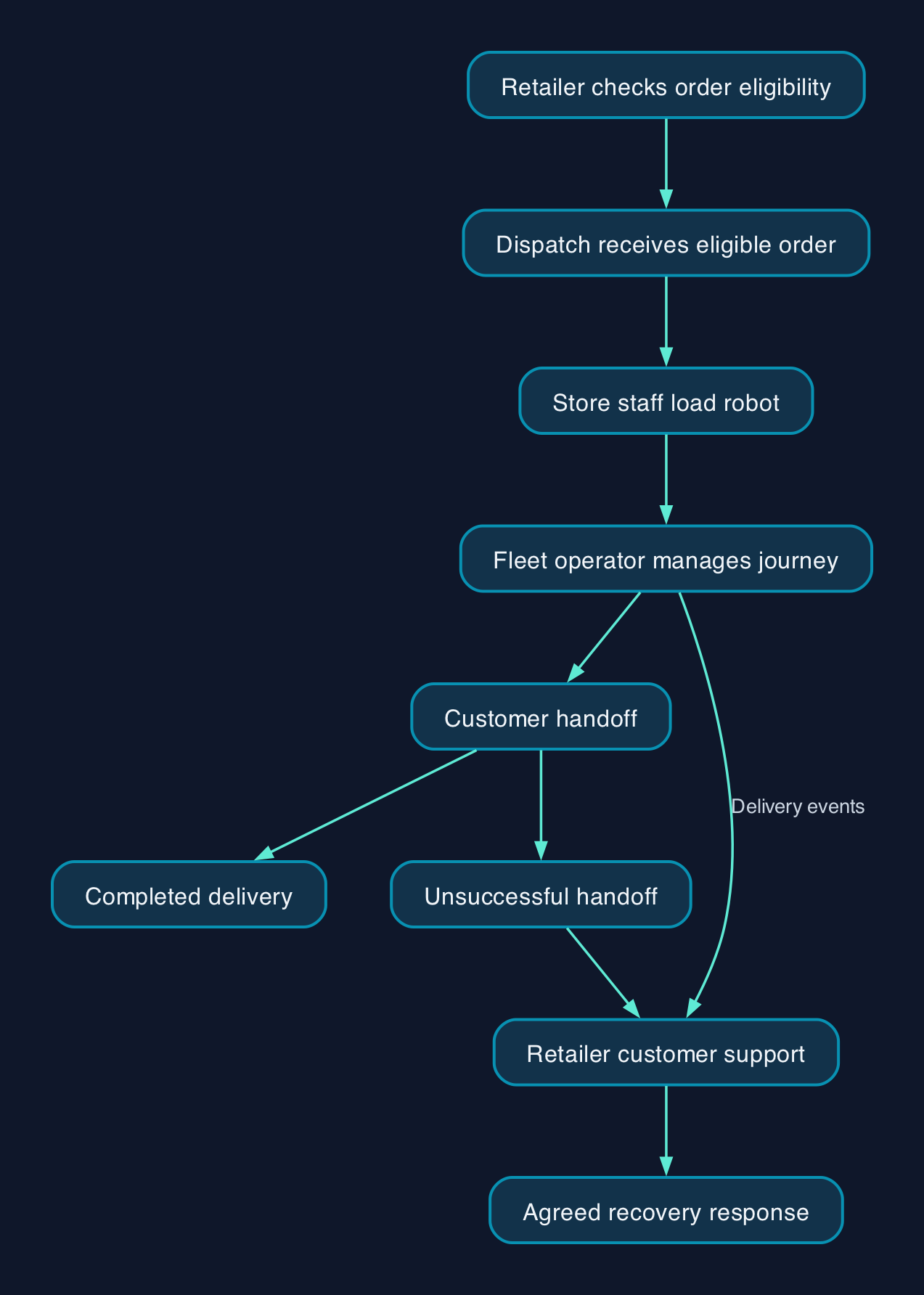
A proposed division of responsibilities would work as follows.
- The retailer checks whether an order qualifies for robot delivery.
- Dispatch receives the eligible order.
- Store staff load the robot and confirm readiness.
- An internal or contracted fleet operator manages the journey.
- Delivery events reach the retailer’s customer support team.
- A successful handoff completes the delivery; an unsuccessful one triggers an agreed recovery response.
This proposed workflow accommodates either ownership model. Its purpose is to expose responsibilities before a customer’s order becomes stranded between teams.
Human assistance deserves explicit treatment. The suppliers’ descriptions retain remote assistants on standby or supervisors handling exceptional situations. Buyers should ask who provides that support, what response is promised and what happens when remote assistance cannot resolve the problem.
For an independent shop, I would start with a contracted trial and named recovery duties. Measure the shop’s loading and customer-support work before considering responsibility for a fleet.
Compare delivery models before comparing machines
The available descriptions cover different commercial roles. They do not establish interchangeable services or availability for a particular British catchment.
| Option | What the evidence establishes | What a UK buyer should establish next |
| --- | --- | --- |
| Starship Technologies | Local delivery robots with a stated operating range and remote assistance. [Robot capabilities](https://www.starship.xyz/our-robots/) | Catchment availability, customer handoff and recovery commitments. |
| Robot.com | R Kiwi delivery robots and Remi software covering dispatch, diagnostics and remote operations. [Robotics platform](https://www.robot.com/robotics) | Who would operate, maintain and support the proposed UK deployment. |
| Fdata | Standard and customised manufacturing, buyer branding and documentation for software integration. [Manufacturing scope](https://www.fdatabot.com/market-served/last-mile-delivery-robots/) | Who assumes local operating responsibilities after manufacture. |
The distinction between manufacturing a robot and running a delivery service should shape the quotation. Ask each bidder to identify what it supplies, what it operates and what the retailer must arrange.
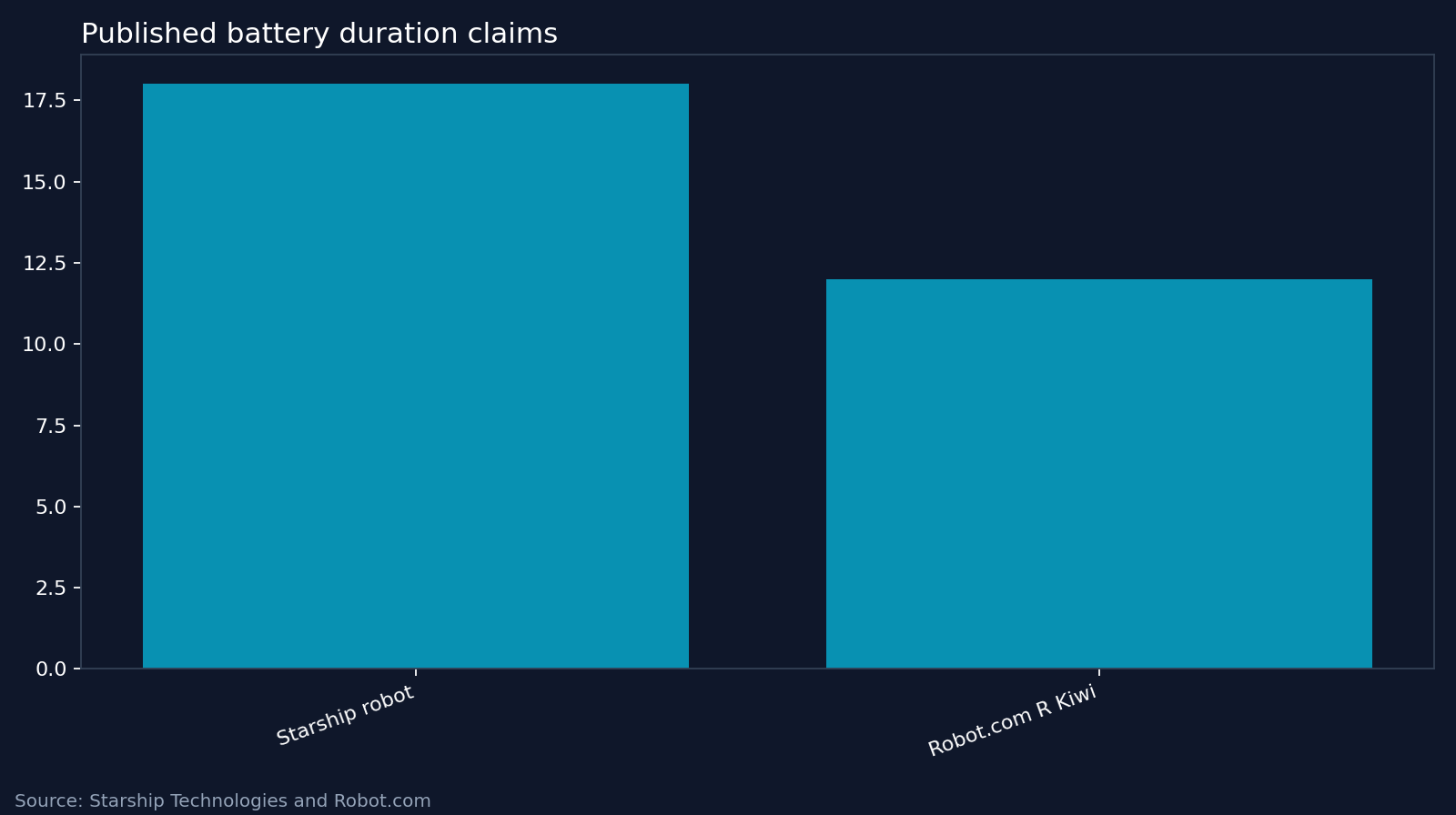
Published battery claims illustrate the limits of a specification comparison. The figures of 18 hours and 12 hours for R Kiwi lack common test conditions, payloads and duty cycles in the supplied material. They cannot establish which option completes more useful deliveries during a shop’s trading day.
I would give greater weight to demonstrated completion and recovery performance on the intended route.
Make ownership pass a full cost test
There are no comparable UK fleet quotations in the supplied evidence. Any claim that buying robots will save a particular amount would exceed it.
Instead, request quotations for the same catchment, order profile, operating hours and evaluation period. Use the following as proposed quotation requirements.
| Cost component | Question the quotation must answer |
| --- | --- |
| Hardware and software | What is purchased, leased or included in a service charge? |
| Deployment | Who pays for mapping, integration, charging provision and training? |
| Daily operations | Who loads orders, supervises journeys and handles customer queries? |
| Failed deliveries | Who pays for retrieval, redelivery and fallback transport? |
| Maintenance | What covers repairs, replacement equipment and downtime? |
| Exit | What costs and responsibilities remain when the arrangement ends? |
Count bundled services once. Include store staff time even when the trial requires no additional employee.
My preferred measure is total trial cost per completed customer delivery, accompanied by staff handling time, completion rate and recovery trips. Keep the inputs visible so that a low hardware price cannot conceal unpriced work.
Agree the acceptance criteria before starting. Expand only if the results support the service promise and financial case; otherwise, retain or improve the contracted alternative.
Editorial analysis
Ownership should have to clear a higher threshold than access to automation. It creates a question about who runs the service, alongside the question of which machine performs the journey.
The retailer should identify a specific advantage that a contracted operator cannot provide on acceptable terms, then demonstrate it on the intended routes. Better visibility alone may be obtainable through an agreement. Faster recovery might depend on having people nearby. The trial should establish which benefit actually matters.
A better carrier agreement is a valid outcome. The investment decision should reward reliable fulfilment and accountable support.
FAQ
Should a UK retailer buy delivery robots now?
I would authorise a defined trial before purchasing a fleet. Require a measured advantage over a contracted alternative, including the work and cost of handling failures.
Does autonomous delivery remove the need for staff?
The supplied descriptions retain human support through remote assistance and supervision of exceptional situations. A proposal should also assign responsibility for loading, maintenance, customer queries and recovery.
What can British buyers learn from Japan’s programme?
The useful lesson is to test defined applications before committing to wider deployment. The ministry’s roadmap does not establish British operating permission or the profitability of retailer-owned fleets.
Which supplier offers the best UK option?
The supplied evidence cannot establish a winner or confirm availability for a specific route. Compare equivalent delivery and support commitments, and distinguish a manufacturing quotation from an operated service.
Can battery duration settle the buying decision?
The published claims lack shared test conditions in the supplied evidence. Ask for workload testing that measures completed deliveries, interruptions and charging requirements during the intended operating hours.
When should delivery remain outsourced?
Keep it outsourced when the contracted service meets the agreed customer promise at an acceptable total cost and ownership offers no demonstrated advantage. Require delivery visibility and clear recovery duties within that agreement.
Sources
- METI, Future Perspectives on Autonomous Delivery Robots Compiled, 26 February 2025
- Starship Technologies, Our Robots
- Robot.com, Robotics
- Fdata, Custom Last-Mile Delivery Robots
- Fleet News, DPD deploys new fleet of larger autonomous delivery robots, 12 November 2024