British robot buyers should make repeatable tests a condition of purchase
China’s proposed humanoid robot standards should sharpen British purchasing decisions. Fund a defined trial, agree what failure means and require evidence before committing to wider deployment.

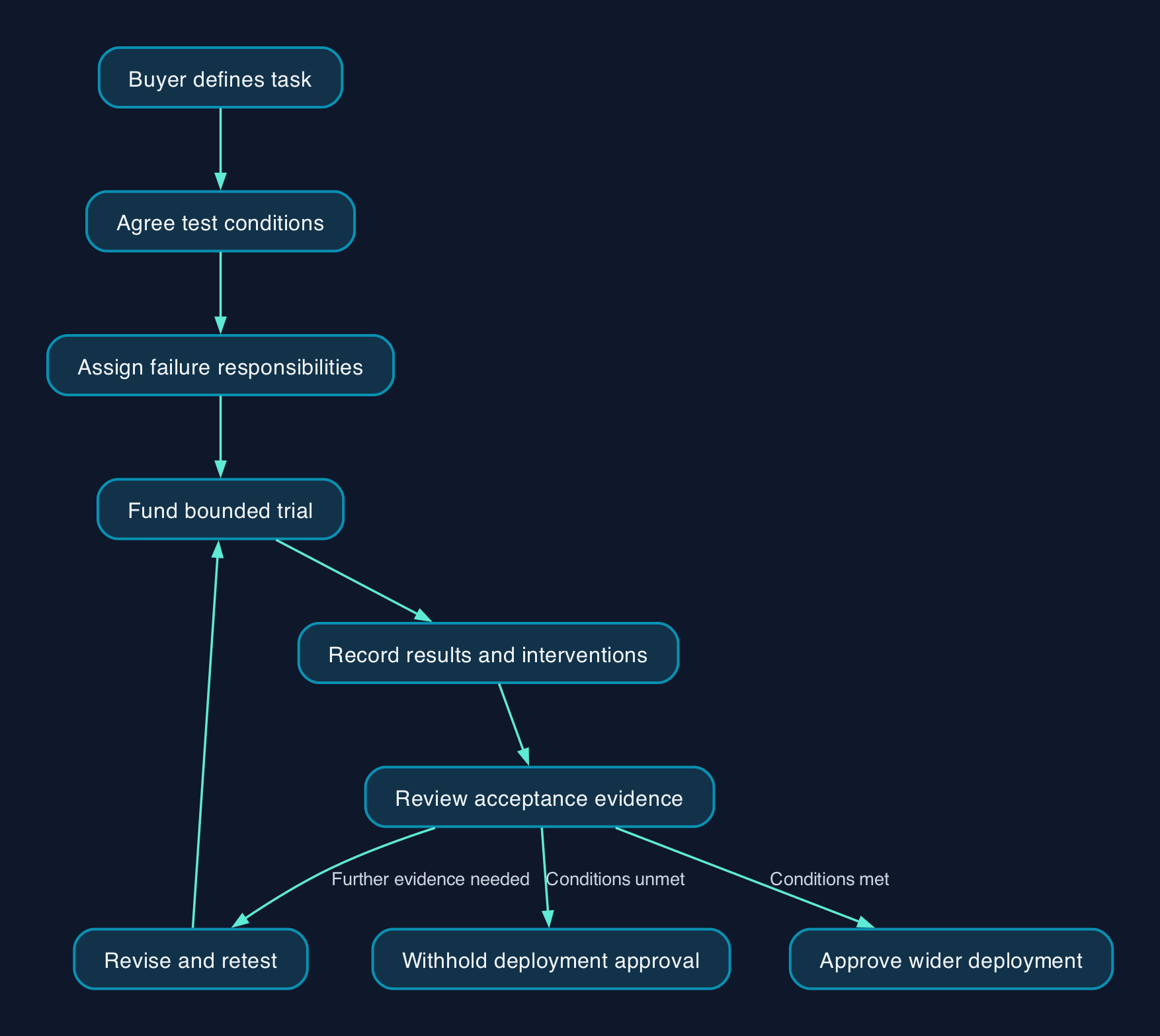
British businesses should make repeatable, task-specific evidence a condition of buying humanoid robots, and British suppliers should build that evidence into their sales offer. A standards roadmap should never be enough to release a deployment budget. Our position is that buyers should fund bounded trials, agree acceptance conditions before testing, and withhold a wider rollout until the supplier demonstrates the required performance and explains how failures will be handled.
Key pointers
- Agree the task, operating conditions and definition of failure before a supplier starts its demonstration.
- Separate approval for a learning trial from approval for a production rollout.
- Ask suppliers to identify the exact standard, edition and test evidence behind each conformity claim.
- Require an explanation of stopping behaviour for robots that actively maintain their balance.
- Give an engineering owner responsibility for acceptance evidence and a commercial owner responsibility for contractual consequences.
- Compare competing offers against the same requirements, including the option of improving an existing installation.
China’s proposal should change the purchase specification
China’s Ministry of Industry and Information Technology proposed at least 100 key humanoid-robot standards by 2028, with more than 200 enterprises promoting and implementing them. The reported draft includes capability grading, identifiers and requirements for industrial operating capability and environmental adaptability. The same report on the proposed framework identifies practical problems behind that work, including perception disrupted by reflections and dust, and the demands continuous operation places on heat management and component life.
For a British factory considering a purchase, environmental adaptability deserves more attention than the headline count. Our recommendation is to turn it into an acceptance question. Which conditions will the robot encounter on this site, and what evidence demonstrates performance under those conditions?
A demonstration should earn permission for further evaluation. It should not, by itself, earn approval for a production commitment.
The supplied reporting describes a proposal, rather than an adopted framework or a proven commercial outcome. It therefore supports a reason to scrutinise supplier evidence, not a prediction that Chinese standards will determine British purchasing.
Put failure conditions in the contract before the demonstration
A buyer should define what would make a trial fail before seeing the robot succeed. Otherwise, the supplier and customer can leave the same demonstration with different understandings of what has been proved.
For an illustrative factory trial, we would require a written task description, the objects to be handled, the relevant operating conditions, the permitted human intervention and the evidence needed for acceptance. These are proposed purchasing conditions, not claims about a particular robot or published standard.
Make the supplier record interventions and unsuccessful attempts alongside completed tasks. Ask what changes would require another test, and who pays for it. Require the supplier and integrator to agree who investigates a failure involving both the robot and its surrounding system.
Stopping behaviour deserves a separate question. Safety technology supplier FORT Robotics describes standards work addressing actively controlled stability, including the special considerations involved in stopping or cutting power to these machines. That is a concrete reason to ask how the proposed robot reaches a safe state, rather than accepting an unexplained reference to an emergency stop.
The purchasing consequence should be explicit. If the supplier cannot explain the test boundary, failure response and responsibility for remediation, the buyer should withhold approval for wider deployment.
A standards count cannot rank competing robots
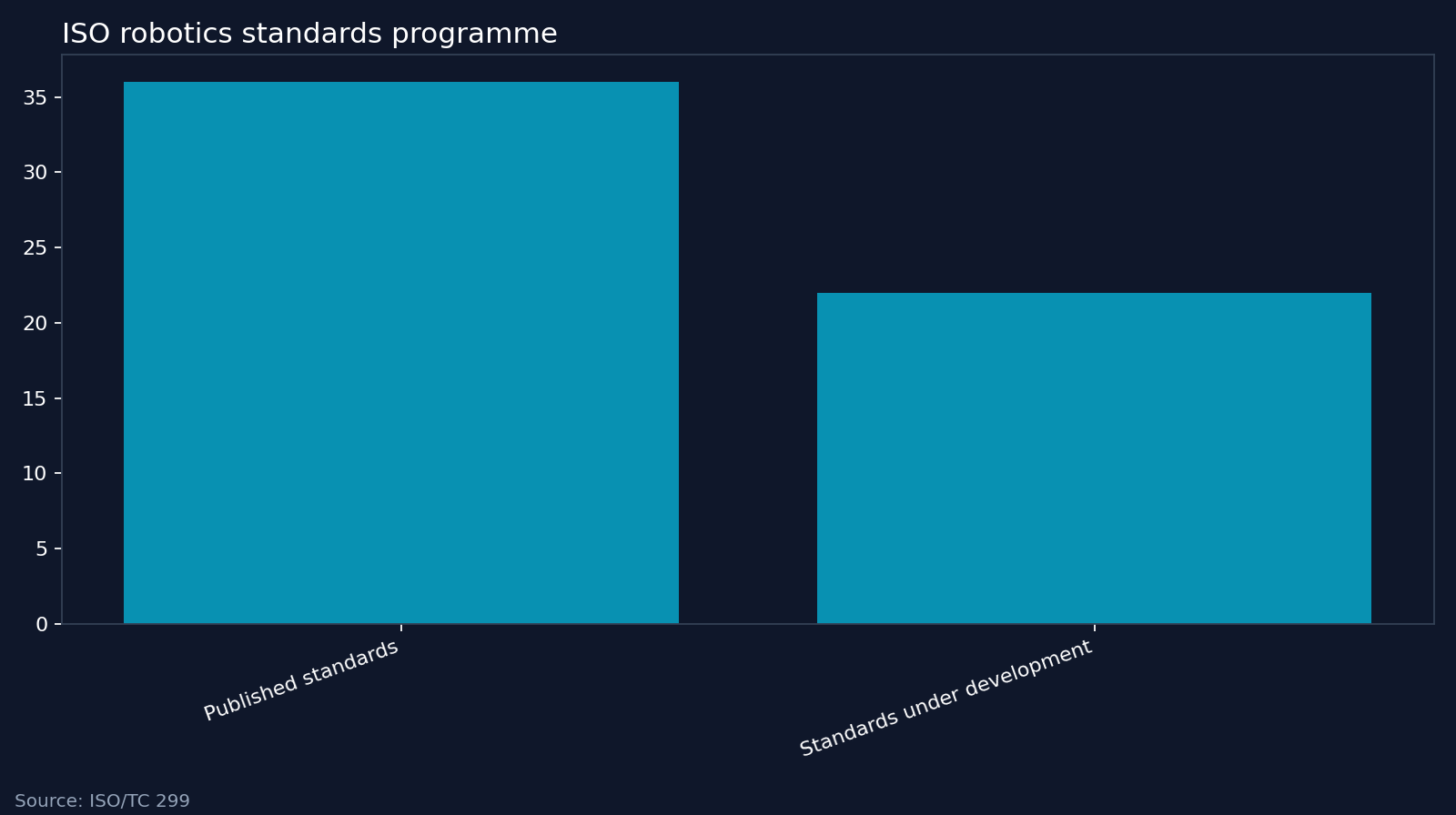
ISO’s programme and China’s proposed framework answer different questions. The former covers robotics broadly; the latter sets a proposed humanoid-focused programme. Their document counts cannot establish which robot will perform a British buyer’s task.
Nor should committee participation become a procurement shortcut. Our judgement is that participation deserves attention when assessing a supplier’s technical engagement, but acceptance should depend on evidence relevant to the installation.
Ask each bidder to distinguish a published requirement from work still under development. Then ask which part of its proposed system the cited requirement actually covers.
For an integrated package, require a named owner for system-level faults. For a multi-supplier installation, require an interface and responsibility map. For an existing installation, ask whether a targeted improvement could satisfy the same acceptance conditions.
The evidence here does not support a ranking of named robot manufacturers. The fair comparison is between offers tested against a common purchasing specification, including the choice to retain existing equipment.
The strongest objection is that demanding proof could stop useful experimentation
The objection has force. If buyers insist on a finished standards framework and exhaustive evidence before allowing any trial, they could block the practical learning needed to develop useful machines. Small suppliers could also struggle to justify extensive testing before a customer has shown serious interest.
That is why we support paid, bounded trials with their own deliverables. A trial can be valuable because it identifies a limitation or rules out an unsuitable task. Its success should be judged against the learning the buyer commissioned.
The dividing line should be the commitment being authorised. A trial budget buys evidence about a defined application. A production budget should require evidence that meets agreed acceptance conditions.
Shared standards can make that process more useful by providing common terminology and test methods. Buyers should ask suppliers to use relevant published work and explain any additional application-specific tests. They should not demand a bespoke test merely to appear rigorous.
But neither an unfinished framework nor the promise of future standardisation should excuse an undefined acceptance decision. Innovation is a reason to structure the trial carefully, not to leave the purchase conditions open.
British suppliers should sell an evidence package
For British robot makers, the commercial response should start with the customer’s acceptance decision. Which claim needs proving, under what conditions, and who will approve the result?
We would make the evidence package a product deliverable. It should identify the tested configuration, describe the task, record interventions, explain limitations and state which changes require reassessment. Engineering and sales should agree what the results justify promising.
A smaller supplier need not monitor every robotics working group. It should follow the tests and interfaces that affect its intended applications, then use that work to improve a demonstrable customer outcome.
Standards participation becomes strategically useful when it helps solve those specific problems. The measure of progress should be a clearer test, a resolved interface issue or an accepted requirement.
British buyers should make the same bargain with every supplier. Fund a defined opportunity to prove the machine useful. Commit to wider deployment only when the agreed evidence supports that decision.
FAQ
Should British buyers wait until 2028?
Our recommendation is to decide according to the proposed application and the evidence available. A bounded trial can answer a useful question before a wider standards programme is complete. The trial should have its own acceptance criteria and should not automatically authorise production deployment.
What should a buyer request before approving a trial?
Request a defined task, test conditions, permitted interventions and a written account of how failures will be handled. Agree who provides the evidence and what decision it will support. Make responsibility for changes and repeat testing explicit.
Does standards participation make a supplier the better choice?
We would not use participation as a substitute for application-specific evidence. Ask the supplier to connect its standards claims to the configuration and task being purchased. Apply the same acceptance requirements to competing offers.
How can a small British robotics supplier respond?
Start with the acceptance requirements of a specific prospective customer. Build a reusable evidence package around the relevant task, configuration and limitations. Pursue standards work where it can resolve a concrete testing or compatibility problem.
Sources
- Xinhua, China proposes formulating at least 100 key standards for humanoid robots by 2028, 25 August 2026.
- ISO, ISO/TC 299 Robotics, committee scope, programme and working groups.
- International Federation of Robotics, Standardization.
- FORT Robotics, Shaping the Robot Safety Standards of the Future.