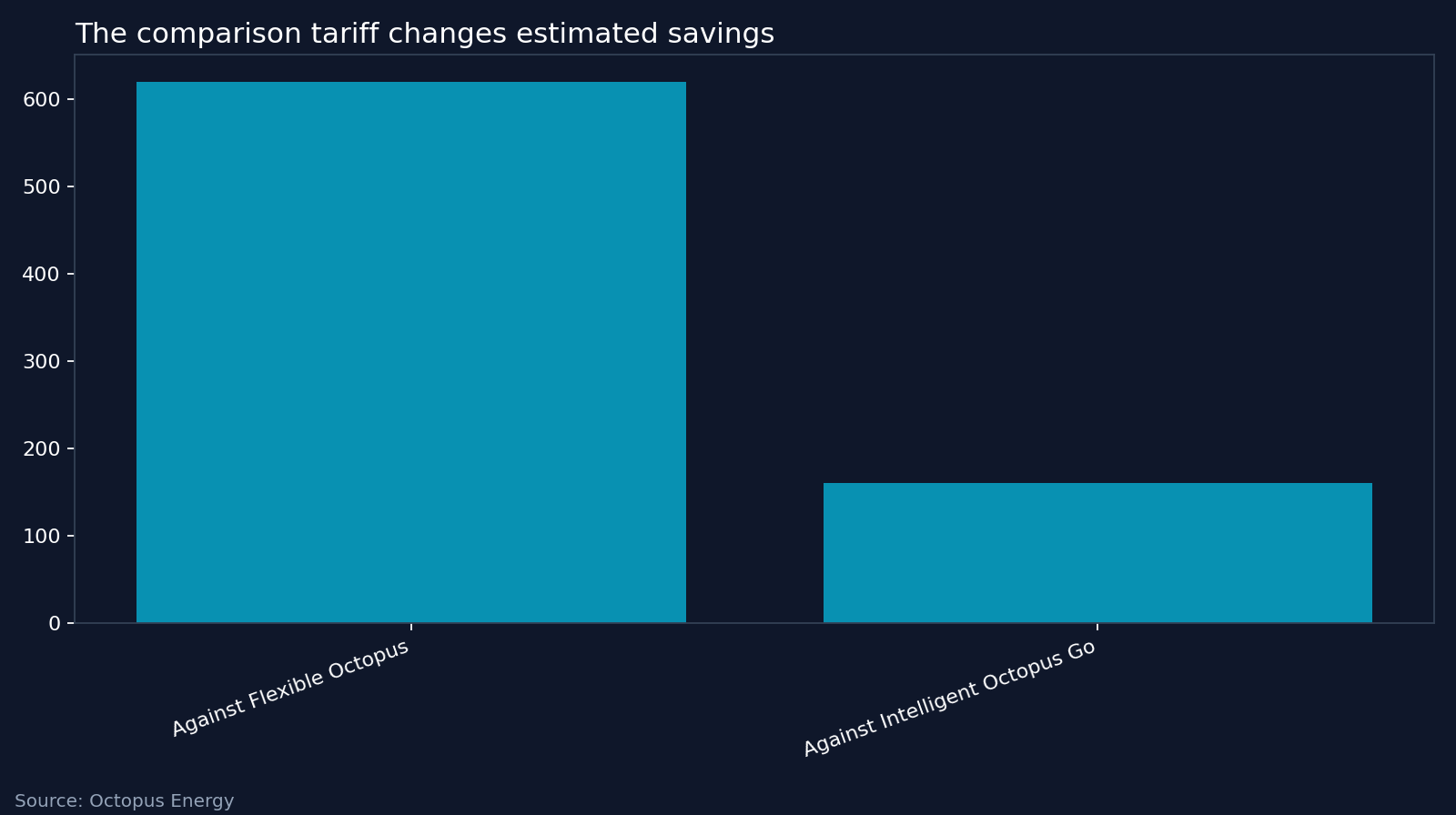


UK businesses should refuse a vehicle-to-grid (V2G) premium unless a complete cost comparison or a defined learning objective justifies it. The relevant test is what V2G adds to suitable smart charging while meeting transport needs. Octopus estimates annual charging savings of £620 against Flexible Octopus but £161 against Intelligent Octopus Go for the same domestic example. Neither figure establishes a return for a British business fleet.
Key pointers
- Ask what V2G adds compared with suitable smart charging.
- Compare complete transport packages over the same ownership or lease period.
- Confirm the exact vehicle, charger, tariff and warranty coverage before ordering.
- Test connection commitments and battery-reserve settings against essential journeys.
- Separate charging savings from export income to avoid counting benefits twice.
- Approve an experimental installation against a defined learning budget and acceptance criteria.
Make the supplier defend the relevant saving
The £161 comparison deserves more attention than the £620 headline. Both are Octopus estimates for the same driving example, but they answer different purchasing questions. The larger figure compares Power Pack with Flexible Octopus. The smaller compares it with Intelligent Octopus Go.
For a buyer who could use suitable smart charging, our view is that the second comparison is the more useful starting point. It asks what exporting electricity adds after charging has already been improved.
That does not make £161 a universal ceiling on V2G’s value. It makes the choice of baseline decisive. A supplier should explain why its proposed alternative matches the buyer’s vehicle use, charging access and contract period.
A complete comparison must also identify any additional vehicle or lease cost, installation work, support, administration and exit costs. Charging savings alone cannot establish payback when those inputs are missing.
For a small employer considering a home-charged company car, the next step is therefore a pair of complete quotations that meet the same transport requirements. These domestic offers provide useful questions for procurement; they do not establish employer eligibility or fleet returns.
Australia is funding answers that buyers still need
Amber’s expansion is a reason to take V2G seriously. It is not a reason to treat the commercial case as settled.
ARENA’s announcement describes an expansion from 50 to 1,000 V2G households, with 25 residential sites completed when it reported the programme’s progress. The distinction matters because a funded expansion target is not an operating record for the expanded population.
The project’s technical work is more informative than its scale alone. Its published scope includes a battery degradation study, interoperability work and testing of grid services. Those are precisely the areas a buyer needs to understand before relying on recurring returns.
Our interpretation is that the programme supports disciplined experimentation. Its workstreams do not establish that battery wear, integration or market participation have ceased to be purchasing risks.
British buyers should ask for ordinary operating results, written warranty coverage and evidence that the proposed combination works reliably. An Australian household trial cannot supply a UK business forecast merely by becoming larger.
Compare what each service asks of the driver
The commercial models differ as much as the technology.
Amber describes an Australian arrangement with automated access to wholesale electricity prices, customer retention of earnings and no minimum plug-in time. Those are Amber’s stated programme terms, not evidence that its approach is universally better.
Octopus describes a UK service that schedules charging and exports, then credits qualifying EV charging costs through the bill. Its Power Pack explanation therefore supports a charging-savings proposition, rather than a separate promise of export income that buyers can add to those savings.
Other Australian approaches broaden the comparison. Zecar reports that AGL’s residential trial covers several vehicle brands, while Origin Energy combines a vehicle, charger and energy subscription. These are examples of different delivery models, not evidence of UK availability or equivalent terms.
The useful supplier questions follow directly. Does the customer receive variable earnings, charging credits or an inclusive transport package? What connection commitment buys that benefit? Who handles a problem spanning the car, charger and energy service?
For Power Pack, the published connection schedule and reserve setting are concrete suitability tests. If essential journeys require a guaranteed reserve above the tariff’s permitted setting, that offer does not meet the requirement.
Also keep the offers distinct. The standalone tariff page specifies a monthly charging condition, while the Power Pack Bundle page describes included home charging up to 12,000 miles annually. Obtain the terms for the actual proposal rather than assembling a favourable contract from separate pages.
Give a pilot a purchasing question to answer
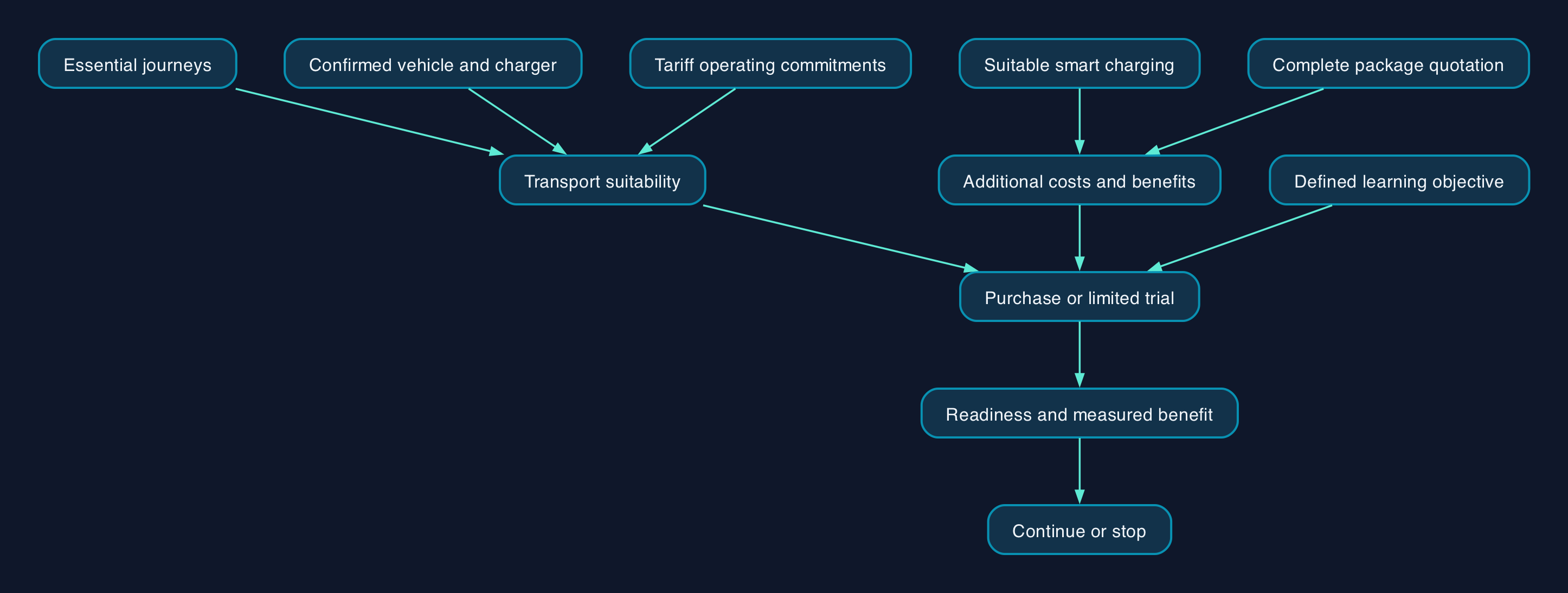
A useful pilot should establish whether the arrangement meets transport requirements and creates enough additional value to justify its costs.
Before approval, require:
- Written confirmation of the vehicle, charger, tariff and warranty coverage.
- A comparison with suitable smart charging over the same contract period.
- An itemised quotation showing included services and additional work.
- Agreement on departure charge, connection commitments and acceptable reserve settings.
- Clear responsibility for billing queries, support and extra costs.
- Acceptance criteria covering vehicle readiness, measured benefit and staff time.
These are proposed procurement requirements, not descriptions of any supplier’s contract.
For an employer funding a car charged at an employee’s home, agree who receives charging credits and who handles problems. A household benefit should not silently become a claimed saving for the business.
Where the purpose is learning, specify the questions, budget and conditions for continuing. That gives an experiment a defensible purpose without recording uncertain savings as committed returns.
The strongest objection is that a complete bundle can win
The strongest objection to this position is that buyers purchase a complete transport service. A competitive bundle could make V2G worthwhile even when its incremental charging saving is modest. Insisting that an isolated export feature pays for itself could reject a package that already meets the buyer’s needs at a competitive overall cost.
The evidence supports that objection. The Power Pack Bundle includes standard charger installation, servicing, maintenance and repairs alongside the leased vehicle. Adding those services again as separate costs would unfairly inflate the comparison. A buyer whose driving pattern fits should assess the complete offer on that basis.
But this strengthens the case for a complete comparison. It does not establish that a premium is justified. The bundle’s inclusions show what must be counted; they do not prove that its total cost beats an equivalent alternative.
Our position is therefore conditional but firm. Accept a competitive complete package when it meets transport needs. Fund a limited trial when the learning has an explicit value. Refuse an unexplained premium supported only by a savings headline.
FAQ
Should a UK business buy a car specifically for V2G?
V2G should not override transport suitability or the value of the complete offer. The Power Pack Bundle includes several services, so compare it with an equivalent transport package. Any premium should have an explicit commercial or learning justification.
Is the £620 figure export income?
No. Octopus describes it as estimated annual charging savings against Flexible Octopus. Its billing explanation says qualifying EV charging costs are credited back, so counting the same benefit again as export income would overstate value.
Why does the £161 comparison matter?
It is Octopus’s estimated annual saving against Intelligent Octopus Go. For someone who could use suitable smart charging, it provides a more relevant starting point for assessing V2G’s additional benefit. It remains a domestic supplier estimate, not a business fleet forecast.
Does the Australian trial settle the battery-wear question?
The supplied evidence does not establish that battery wear is negligible. ARENA’s expanded project includes a battery degradation study. Obtain warranty terms covering the proposed use rather than infer protection from participation in another programme.
Can any V2G-capable vehicle join Power Pack?
The supplied Octopus tariff page lists a specific V2G-enabled BYD Dolphin and V2G-enabled Zaptec Pro combination. It also requires a compatible smart meter and network export permission. General bidirectional capability does not establish eligibility.
When is early adoption justified?
A competitive complete package can be justified when it meets transport requirements. A limited trial can also be justified by a defined learning objective. Specify the budget, required evidence and conditions for continuing before committing.
Sources
- Octopus Energy Power Pack tariff, savings and participation conditions
- Octopus Electric Vehicles Power Pack Bundle
- ARENA expansion announcement and residential deployment figures
- ARENA Amber project scope and technical workstreams
- Amber programme expansion and commercial approach
- Zecar reporting on Amber, AGL and Origin trials