
Britain should make dependable, competitively priced electricity a condition of its industrial ambitions, starting with energy-intensive investment. Sweden’s HYBRIT trials show why that matters for steelmaking, using electricity both to produce hydrogen for ironmaking and to melt the resulting iron into steel. The British response should be to secure credible power arrangements before committing capital, while comparing domestic production with buying suitable feedstock or finished steel. (LKAB’s research results)
Key pointers
- Require a costed electricity supply and connection plan before approving an energy-intensive expansion.
- Compare making hydrogen and iron on site with buying feedstock or finished steel.
- Ask suppliers to separate demonstrated performance from planned commercial capacity.
- Assess storage savings after allowing for construction, maintenance and operating costs.
- Give operations, finance and technology teams named responsibilities for the investment’s energy assumptions.
- Check which electricity charges a support scheme covers before including relief in a forecast.
Sweden’s lesson is about the production process
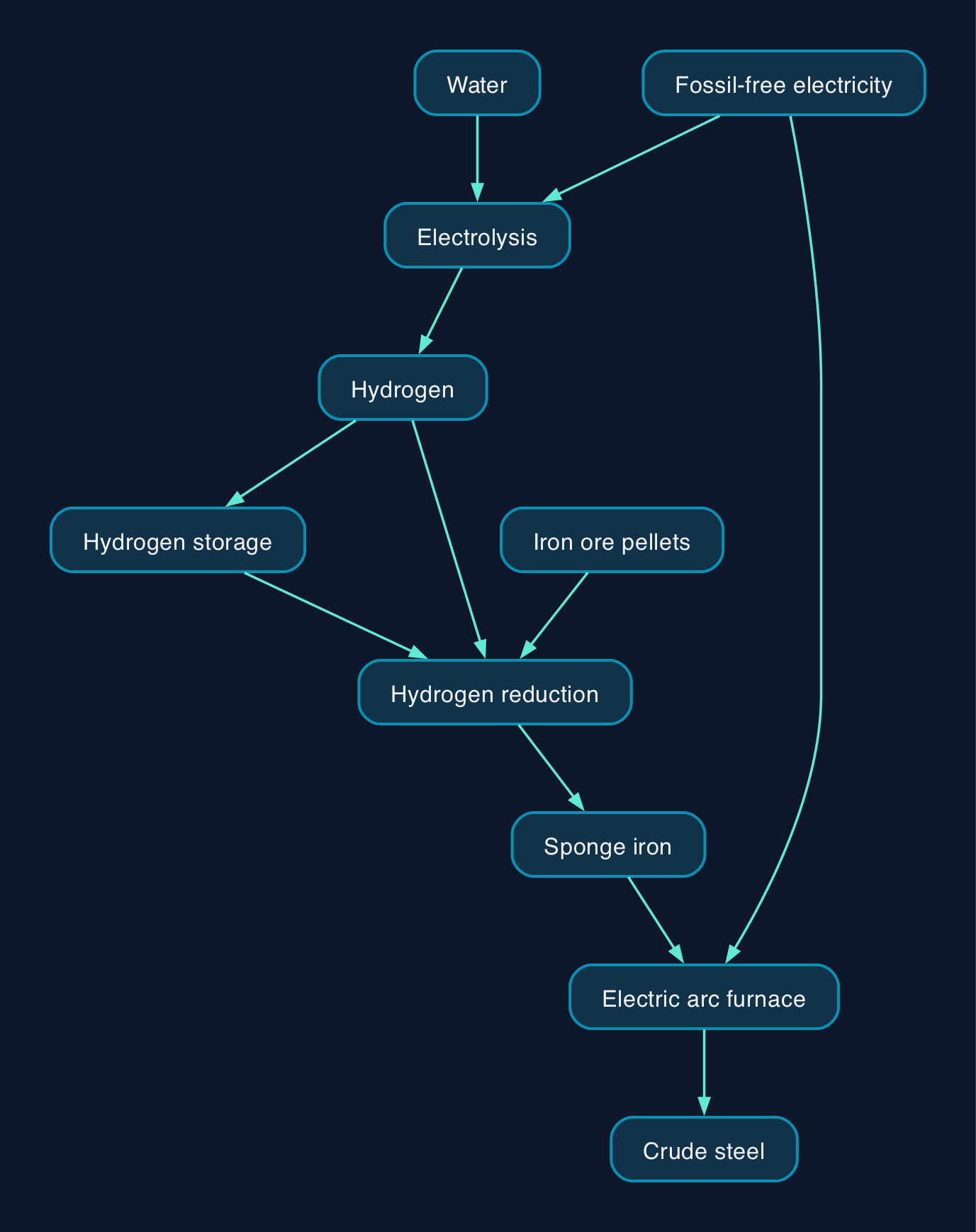
HYBRIT changes what energy does inside a steelworks. Electrolysers use electricity to split water into hydrogen and oxygen. Hydrogen removes oxygen from iron ore pellets, producing sponge iron, which is then melted in an electric arc furnace. Electricity therefore supports both the reducing agent and the melting stage. (LKAB’s explanation of the process)
That mechanism should change the order of an investment discussion. Before selecting equipment, a prospective producer should establish whether its proposed site can obtain the power required on commercially workable terms.
The evidence supports taking this route seriously. It does not establish that a British replica would be profitable. LKAB identifies plant design, construction, quality, reliability, availability and maintenance as substantial challenges in industrial implementation. (LKAB’s demonstration plans)
My position is that electricity belongs among the first investment tests. A project should not reach equipment procurement with its power arrangements still resting on an assumption.
Britain’s historical electricity costs justify that discipline
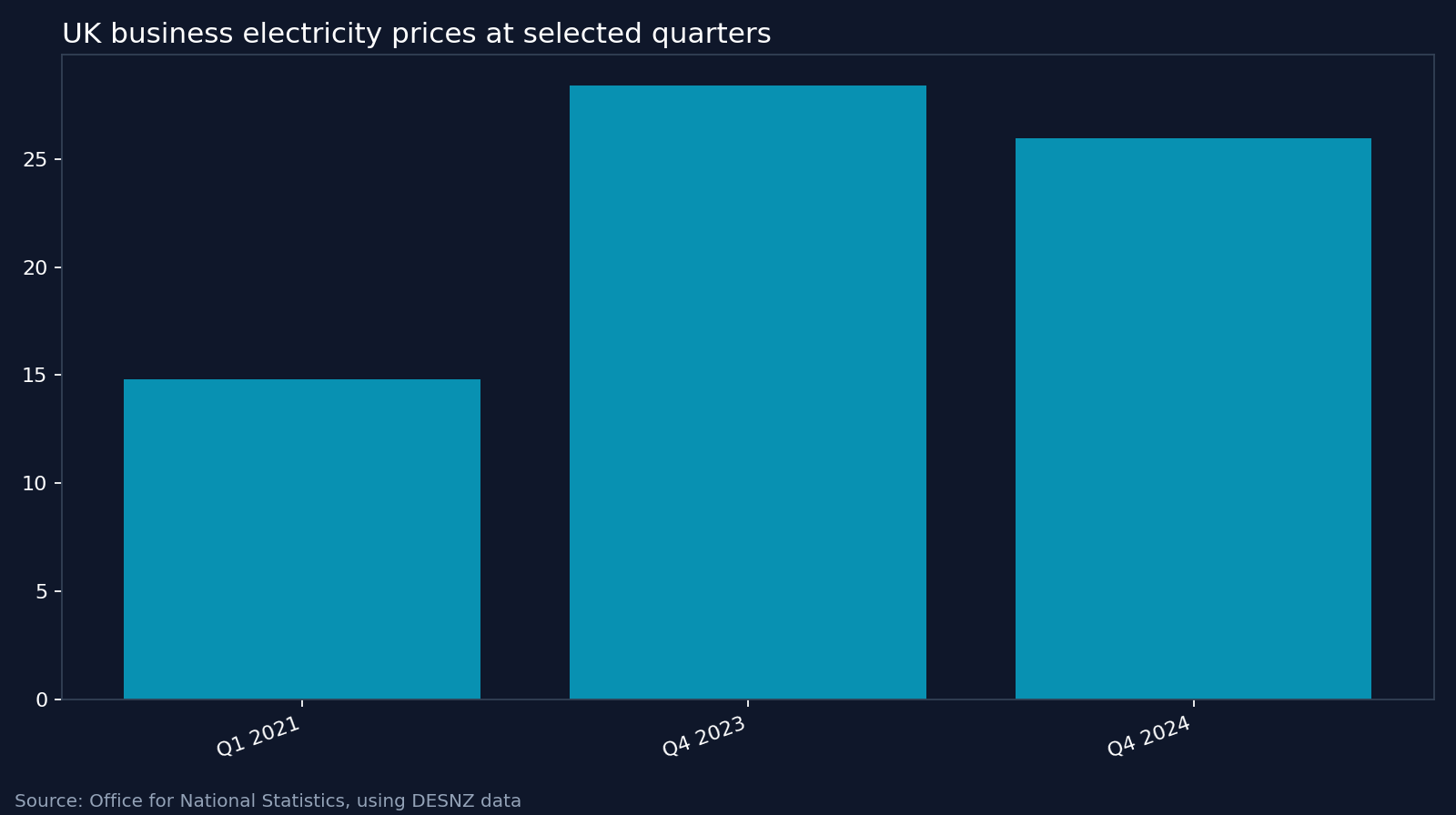
The Office for National Statistics reports average UK non-domestic electricity prices of 14.81 pence per kilowatt hour in Q1 2021, 28.39 in Q4 2023 and 25.97 in Q4 2024. These are historical averages across business electricity purchases, not quotations for a particular steelworks. (ONS energy-cost analysis)
Those figures show why an investment proposal needs more than an assumed unit price. I would require the expected consumption, connection requirements, operating schedule, contractual price exposure and consequences of an interruption to be signed off together.
For a smaller British engineering business buying steel, the decision is different. Ask competing suppliers for delivered prices, material specifications, availability commitments and the terms governing price changes. The useful comparison is what the business can buy and depend on.
Government support belongs in that assessment, with its scope made explicit. The October 2025 announcement set out increased network-charge relief and a separate British Industrial Competitiveness Scheme intended to reduce electricity costs for qualifying businesses from 2027. It does not establish what an individual company will receive. (Government industrial electricity announcement)
An investment committee should request a case with confirmed support and a sensitivity case without anticipated relief. That makes the dependence on policy visible before money is committed.
Storage makes electricity timing part of production planning
HYBRIT’s storage work offers a practical lesson about controlling demand. Vattenfall describes making and storing hydrogen when electricity is cheaper, then supplying it when electricity becomes more expensive. Storage separates the timing of hydrogen production from the reduction process’s need for hydrogen. (Vattenfall’s storage account)
The distinction between measured and modelled savings matters. Vattenfall reports 26–31% savings during real-time market operation and potential savings of up to 40% in simulated future scenarios. Neither figure is a guaranteed reduction in the total cost of steel. (Vattenfall’s reported results)
For a British project, I would ask the technology team to propose a control system combining electricity-price information, storage measurements and production requirements. Operations should set safe operating limits; finance should own the price assumptions and cost model.
Any trial should measure savings after accounting for the storage system’s costs. Its acceptance test should also establish that shifting hydrogen production preserves the required supply to ironmaking. A cheaper operating hour is useful only if the production plan still works.
Compare production choices before approaching suppliers
SSAB, LKAB and Vattenfall perform complementary roles in HYBRIT. Treating them as interchangeable suppliers would obscure the steelmaking, mining and energy responsibilities that the partnership combines. (LKAB’s project description)
British buyers should instead compare the production responsibilities they might retain.
An integrated producer considering hydrogen-based ironmaking should request a cost model covering electricity supply, electrolysers, storage, reduction equipment, melting, maintenance, staffing and finance. A business considering purchased iron feedstock should assess the delivered material alongside its melting requirements. A fabricator buying finished steel should concentrate on specification, availability, price and supplier accountability.
Scrap-based electric melting also deserves consideration where it meets the required product specification. HYBRIT’s own description distinguishes established scrap melting from the work needed to handle high proportions of hydrogen-reduced sponge iron and produce complex steel qualities. (HYBRIT’s explanation of electric melting)
These alternatives need comparable quotations. The research supplied here does not establish UK project prices or a commercial winner, so a defensible recommendation must remain conditional on the buyer’s requirements and costs.
The strongest objection is that Britain could buy the material
Britain need not reproduce every stage of Sweden’s production chain. Buying suitable iron feedstock or finished steel could be a better business decision than funding domestic hydrogen production and ore reduction.
That objection is substantial. Successful pilot work does not settle the economics of a full industrial plant. LKAB’s results describe semi-industrial validation and subsequent industrial implementation, rather than proof that every proposed installation will earn an acceptable return. (LKAB’s pilot findings)
My answer is to make domestic production compete against procurement on explicit terms. Compare delivered costs, material quality, supply commitments and the responsibilities each option leaves with the buyer.
Electricity strategy should make that comparison possible. If domestic production loses on a properly costed assessment, importing may be sensible. If a proposal cannot even obtain credible power terms, Britain has not established whether the industrial opportunity itself is competitive.
Editorial analysis
Britain should judge its industrial strategy partly by whether viable projects can obtain electricity on a credible schedule and under workable contracts.
For a manufacturer, the next step is a capital proposal with an accountable energy case. Name the person responsible for each assumption, identify the supplier commitment supporting it and specify what happens if the commitment fails.
For technology leaders, start with a bounded production process whose demand and output can be measured. Establish which operating decisions can change safely, then test whether better scheduling produces a worthwhile return. HYBRIT provides a reason to investigate that discipline; the investment decision still belongs to the business bearing the cost.
FAQ
What should Britain learn from HYBRIT?
Britain should assess electricity supply as part of the production model before committing to energy-intensive equipment. HYBRIT demonstrates why this matters by using electricity to produce hydrogen and melt hydrogen-reduced iron into steel. (LKAB’s process results)
Has HYBRIT proved sustained commercial-scale production?
The supplied evidence establishes pilot and semi-industrial results, including more than 5,000 tonnes of hydrogen-reduced iron. It describes industrial implementation as the next stage, so it should not be presented as evidence of sustained full-scale commercial performance. (LKAB’s research announcement)
Does hydrogen storage guarantee a 40% saving?
No. Vattenfall distinguishes real-time savings of 26–31% from simulated future potential of up to 40%. A British investment would need its own assessment of electricity prices, operating requirements and storage costs. (Vattenfall’s storage results)
Should every British steel producer install electrolysers?
No such conclusion follows from these trials. Producers should compare integrated hydrogen production, purchased feedstock and other suitable production routes against the same requirements. HYBRIT’s demonstration description itself distinguishes established scrap-based electric melting from adapting the process to hydrogen-reduced sponge iron. (HYBRIT’s production design)
What should a small manufacturer do first?
Start with the decision actually facing the business, such as buying steel, replacing machinery or expanding production. Request a complete cost quotation and identify who bears the consequences of price changes, delays and interruptions.
Does electricity support remove the investment risk?
The October 2025 government announcement described targeted network-charge relief and a separate scheme intended for 2027. Buyers should verify applicable support and test their investment assumptions with and without anticipated relief. (Government support announcement)
Sources
- LKAB research results and industrialisation plans, published 27 August 2024; updated 6 August 2026.
- LKAB HYBRIT Demonstration Project.
- HYBRIT demonstration project design.
- Vattenfall HYBRIT partnership and hydrogen-storage results.
- Office for National Statistics analysis of higher energy costs on UK businesses from 2021 to 2024, released 19 May 2025.
- Department for Business and Trade industrial electricity-cost support announcement, published 31 October 2025.