British cities should prepare for digital airspace without buying ahead of demand
British cities should prepare the digital connections between aircraft, landing sites and ground services. Limited integration trials make sense; citywide platform purchases need demonstrated demand, clear responsibilities and a credible operating case.

British cities should treat airspace as digital infrastructure by preparing the connections between aircraft operators, landing sites and ground services. They should fund limited integration trials, with wider investment conditional on demonstrated demand and aviation approval. The CAA’s ambition to enable initial commercial passenger operations from the end of 2028 gives that preparation a purpose, but does not justify buying a citywide platform before its operating case exists.
Key pointers
- Fund a defined operational trial before committing to a citywide platform.
- Ask who can suspend an operation when aircraft and landing-site information disagree.
- Keep passenger bookings separate from decisions that authorise aircraft movements.
- Assess the complete passenger journey before accepting a flight-time comparison.
- Require suppliers to demonstrate what happens when operational information becomes unavailable.
- Make incident ownership, data export and supplier replacement part of procurement.
Dubai shows why the ground matters
The most useful detail in Dubai’s air-taxi proposal is the work required before a passenger leaves the ground. Its planned vertiports, the facilities where aircraft take off and land, bring together passenger handling, security checks and electric charging. These dependencies appear alongside the aircraft in the transport authority’s project description.
For British technology buyers, that is the reason to think about digital infrastructure. A booking can establish that somebody wants to travel. The operational question is whether the aircraft, destination and ground services are ready to support that journey.
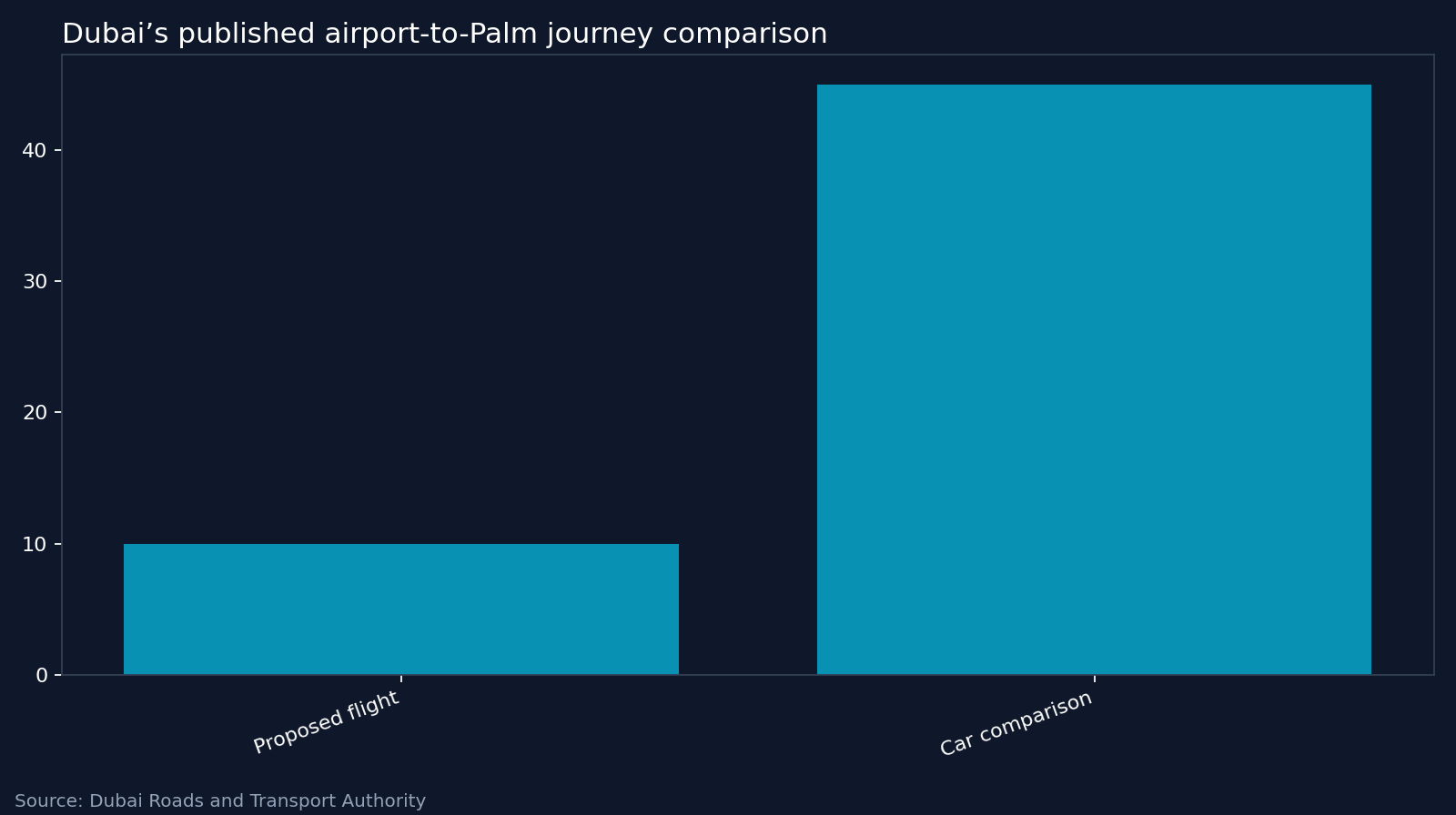
RTA presents a 10-minute flight between Dubai International Airport and Palm Jumeirah against 45 minutes by car. Those are the authority’s published comparison figures, not independently measured results. They do not establish the complete passenger journey, including access, security and waiting.
A British employer considering airport transfers should therefore ask for the journey from office door to airport terminal. My test would be dependable arrival time, including what happens when the service is disrupted. A shorter flight is useful only if the surrounding service preserves enough of that advantage.
Prepare around the CAA’s actual ambition
Electric vertical take-off and landing aircraft, or eVTOL aircraft, should not be treated as shorthand for autonomous transport. The CAA’s advanced air mobility programme says remotely piloted and autonomous aircraft are not its current focus.
Its end-of-2028 ambition is also an enabling milestone, rather than a guaranteed route launch. Buyers should tie project commitments to the aircraft, operator and infrastructure involved, instead of treating the date as proof of commercial readiness.
Britain already has relevant conceptual work. The CAA’s CAP2272 publication record, dated 19 October 2021, describes an Eve-led consortium developing a concept of operations for passenger transport over London. That is evidence of integration planning, not approval of a passenger service.
The practical preparation is to identify the participants and their dependencies. A council considering local infrastructure, an airport considering a landing facility and a software supplier considering scheduling tools should each know which aviation operator defines the use case.
Make the handovers the subject of the trial
The CAA’s safety research examined interactions between aircraft, software, hardware and people. Its findings included mechanisms for identifying deviations from expected aircraft performance and ground-service feedback on landing conditions.
That supports a specific editorial position. Integration trials should test the handovers between organisations, including the point at which somebody must stop or change the service.
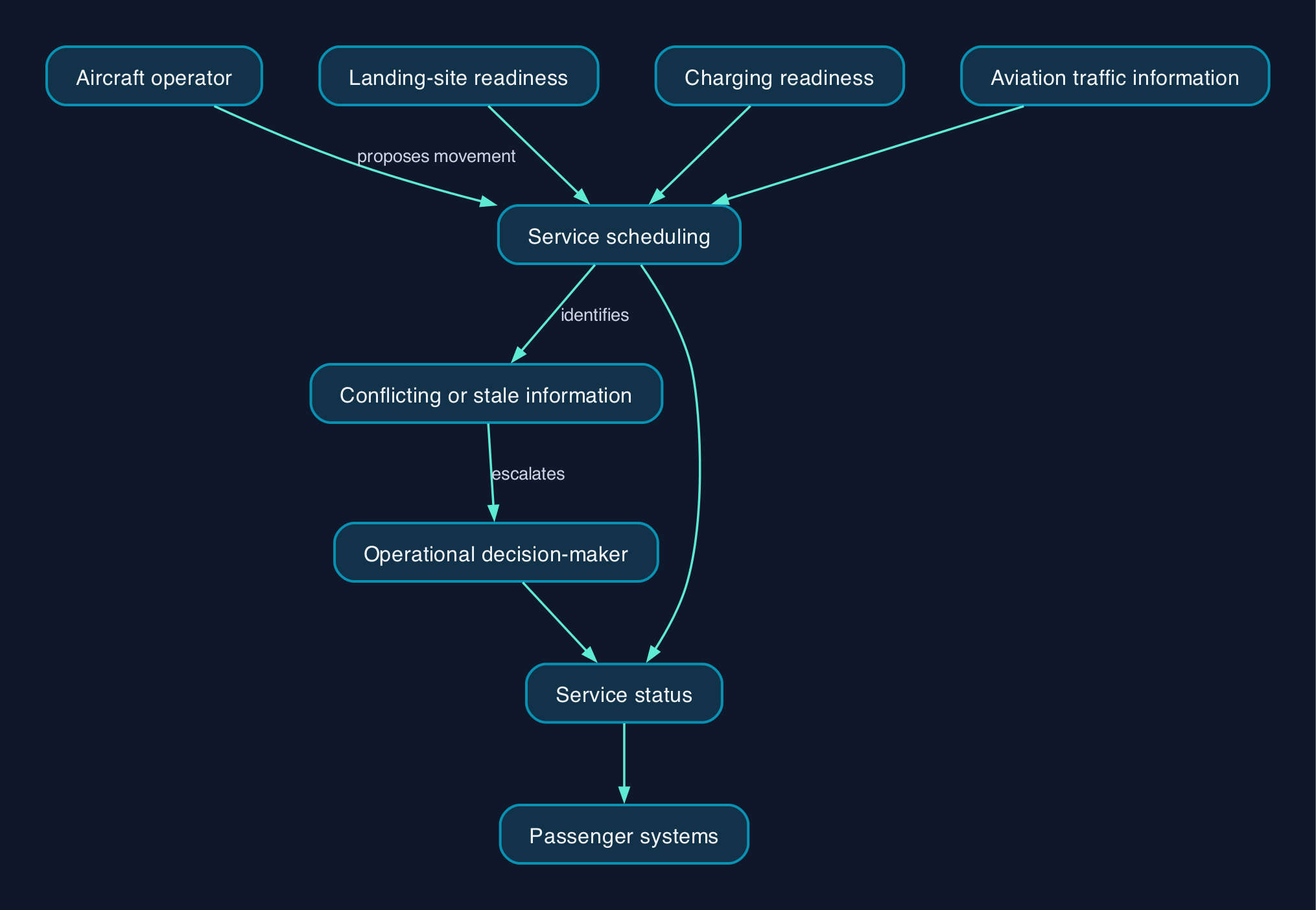
Consider an illustrative coordination design. An aircraft operator proposes a movement. Ground staff provide landing-site and charging readiness information. The relevant aviation service provides traffic information within its remit. Scheduling staff coordinate the service using those inputs, while passenger systems receive the resulting service status.
Conflicting or stale information would trigger escalation to a named operational decision-maker. This is a proposed trial design, not a description of an approved aviation procedure. A scheduling application would not gain permission to authorise a flight simply because it could exchange the relevant data.
I would require a trial to demonstrate that:
- Missing or contradictory readiness information produces a recognisable alert.
- Only authorised staff can change operational records.
- The incident record shows which information informed each decision.
- Passenger updates follow the operational decision.
- Records remain usable when a software supplier is replaced.
These are proposed acceptance criteria, not claims about a deployed Dubai system. They give smaller UK software and connectivity firms a bounded problem to investigate with an aviation operator.
Budget for the operation and its failures
The evidence does not establish comparable UK platform prices or a dependable cost per passenger journey. A buyer needs quotations against a defined operating scenario before making a financial commitment.
My procurement recommendation is to separate initial deployment from recurring operation. Ask for site preparation, power and charging, connectivity, software integration, staffing, training, assurance and maintenance to be priced where applicable. Require bidders to identify bundled work, customer responsibilities and exit costs.
Ground infrastructure cannot be treated as a minor addition to the software budget. The CAA’s January 2024 vertiport design consultation announcement covered operating areas, obstacle limitations, visual aids, and rescue and firefighting services. It explained why existing aerodromes were the starting point for those proposals.
Failure handling deserves a commercial answer as well as a technical one. Ask who informs passengers when a landing site becomes unavailable, who arranges alternatives and who pays for the response. A proposal that leaves those responsibilities unresolved is not ready for a procurement decision.
Compare responsibilities before brands
The evidence describes organisations performing different kinds of work. Skyports Infrastructure describes developing and operating ground facilities. The Eve-led consortium worked on a London operating concept. The CAA names Bristow and NATS as contributors of operational expertise to its safety study.
These roles do not establish that the organisations offer interchangeable services. The evidence provides no common set of prices, service levels or software specifications from which to rank them.
Buyers can still compare proposed delivery arrangements fairly. An integrated provider should explain its subcontractors and retained customer responsibilities. A group of separately contracted specialists should identify who owns integration and incident coordination. A proposal based at an existing aviation facility should show which facilities and processes can support the intended service.
Use the same operational scenario for every proposal. Require named responsibility for the landing site, software maintenance, aviation decisions and incident response. Judge each supplier on evidence relevant to its role.
The strongest objection is that demand may never justify the spend
British cities could prepare extensively for a service that remains too limited or expensive to attract sufficient passengers. The supplied evidence does not demonstrate sustained UK demand, viable fares or a business case for a dense urban network.
That is a serious objection to speculative infrastructure spending. It should determine both the scale of preparation and the conditions for further investment.
A limited trial is defensible only when it has a credible operating partner, a specific question and a stopping decision. Can participants exchange accurate readiness information? Can they respond to a failed connection without confusion over authority? Does the complete journey offer enough value to justify its quoted cost?
If the answers are weak, further spending should stop. The CAA’s enabling ambition does not oblige a city or business to purchase a platform.
This also limits the case for local-authority involvement. My argument is for coordination of local infrastructure and public interests alongside aviation organisations. It does not assign councils responsibility for air traffic control.
Editorial analysis
The strongest early proposition for a UK technology supplier is a demonstration of dependable operation under a defined failure condition. Show how the service handles an unavailable landing site, contradictory information or a failed connection, and preserve the record of who decided what.
For most business owners, monitoring developments is a sufficient next step. Firms already serving aviation or transport infrastructure can investigate a bounded partnership. A paying customer, a named operational owner and an agreed acceptance test provide a better basis for that work than a forecast of future passenger volumes.
FAQ
Should British cities buy an air-taxi coordination platform now?
A citywide purchase is not justified by the evidence supplied here. The stronger next step is a limited discovery or integration trial with a credible aviation operator, followed by a decision based on operational results and costs.
Does the end of 2028 guarantee UK passenger air-taxi services?
No. The CAA’s programme describes an ambition to establish the frameworks and operational systems needed to enable initial commercial passenger operations. It does not guarantee the launch of a particular operator or route.
Does a 10-minute flight establish a better airport transfer?
No. RTA’s comparison of a 10-minute flight with 45 minutes by car does not establish the complete passenger journey. A buyer should assess access, security, waiting and disruption before judging the benefit.
What should a small UK technology supplier do first?
Find an aviation operator with a specific coordination problem and agree the scope of a discovery project. Define the information exchanged, failure scenarios, responsible people and acceptance criteria before building a wider product.
Sources
- Dubai Roads and Transport Authority, Aerial Taxi in Dubai by 2026. Evidence supplied 28 September 2026.
- UK Civil Aviation Authority, Enabling advanced air mobility. Evidence supplied 28 September 2026.
- UK Civil Aviation Authority, New safety insights to guide future eVTOL regulation published. Published 12 August 2025.
- UK Civil Aviation Authority, CAP2272 airspace integration considerations for urban air mobility. Version dated 19 October 2021.
- UK Civil Aviation Authority, Vertiport design proposals at existing aerodromes. Published 24 January 2024.
- Skyports Infrastructure, Ground infrastructure development and operations. Evidence supplied 28 September 2026.