British farm robots should be sold on completed fieldwork
Trial a contract for completed robotic fieldwork before buying a machine. Compare the Cloud argues that timing, acceptance checks and responsibility for unsuccessful passes should determine whether a service deserves the grower's commitment.
Compare the Cloud’s view is that British growers should trial a contract for completed robotic fieldwork before buying a machine. We would make the supplier’s responsibility for timing, acceptable results and remedial work the deciding test. Agree those commitments before comparing payment schedules. Where a provider cannot credibly secure the farm’s working window, we would favour ownership or retaining the existing method, without assuming either approach is cheaper.
Key pointers
- Define acceptable fieldwork before commissioning a trial.
- Specify who returns and who pays when a pass fails its acceptance checks.
- Include sowing in the trial where subsequent weeding depends on recorded seed positions.
- Ask how the provider will handle competing bookings, interruptions and replacement equipment.
- Compare seasonal costs, including supervision, transport, repeat visits and fallback provision.
- Prefer ownership when control over timing outweighs the commitments available from a service provider.
Make the supplier responsible for an agreed result
Compare the Cloud’s proposed buying test is straightforward. Ask the provider to accept responsibility for completing a defined operation under agreed conditions, including specified remedial work. Give the grower equally explicit duties for field information, access and preparation.
Start with a bounded trial. Name the crop, field, operation and working window. Agree how both parties will assess the result and what happens if it falls short.
We would link acceptance to the quality of the completed work. A recurring payment alone would not meet our proposed test, nor would a demonstration that the machine can move autonomously across a field.
Keep the obligation fair to the supplier. Our recommendation concerns specified fieldwork under agreed conditions. It should not become an unlimited promise about the eventual harvest.
Match the trial to the operating method
FarmDroid UK explains that the FarmDroid FD20 records seed positions to guide mechanical weeding, including before germination. For that approach, we would assess sowing and subsequent weeding together, with the quotation identifying who performs each operation and retains the records.
Earth Rover describes CLAWS as detecting weeds for light treatment while also collecting crop data. We would assess treatment and scouting separately, asking the grower to define both an acceptable weeding result and a useful information deliverable.
igus describes a field robot developed with Ponchon SAS that positions a laser to treat weeds identified through AI. Our procurement question would concern the complete machine and service, including who integrates the equipment, operates it and responds when work stops.
Compare the Cloud does not regard these supplier descriptions as equivalent service offers or independent comparative trials. Use them to frame different tests, then require each prospective provider to demonstrate the operation it proposes to sell.
For scouting, specify what information the grower will receive, what decision it should support and how it will be priced. We would decline an undifferentiated package whose information outputs have no agreed purpose.
Take a narrow lesson from South Korea
The South Korean Ministry of Agriculture, Food and Rural Affairs said in its April platform announcement that it planned to establish the project company by the end of 2026. The ministry’s proposed allocation of responsibilities gave technology companies development duties and an agricultural operator responsibility for crop production and model validation.
Compare the Cloud’s interpretation is that British buyers should examine development and operational validation separately. Ask who builds the system, who tests it in crop production and who accepts responsibility for the work delivered on the customer’s farm.
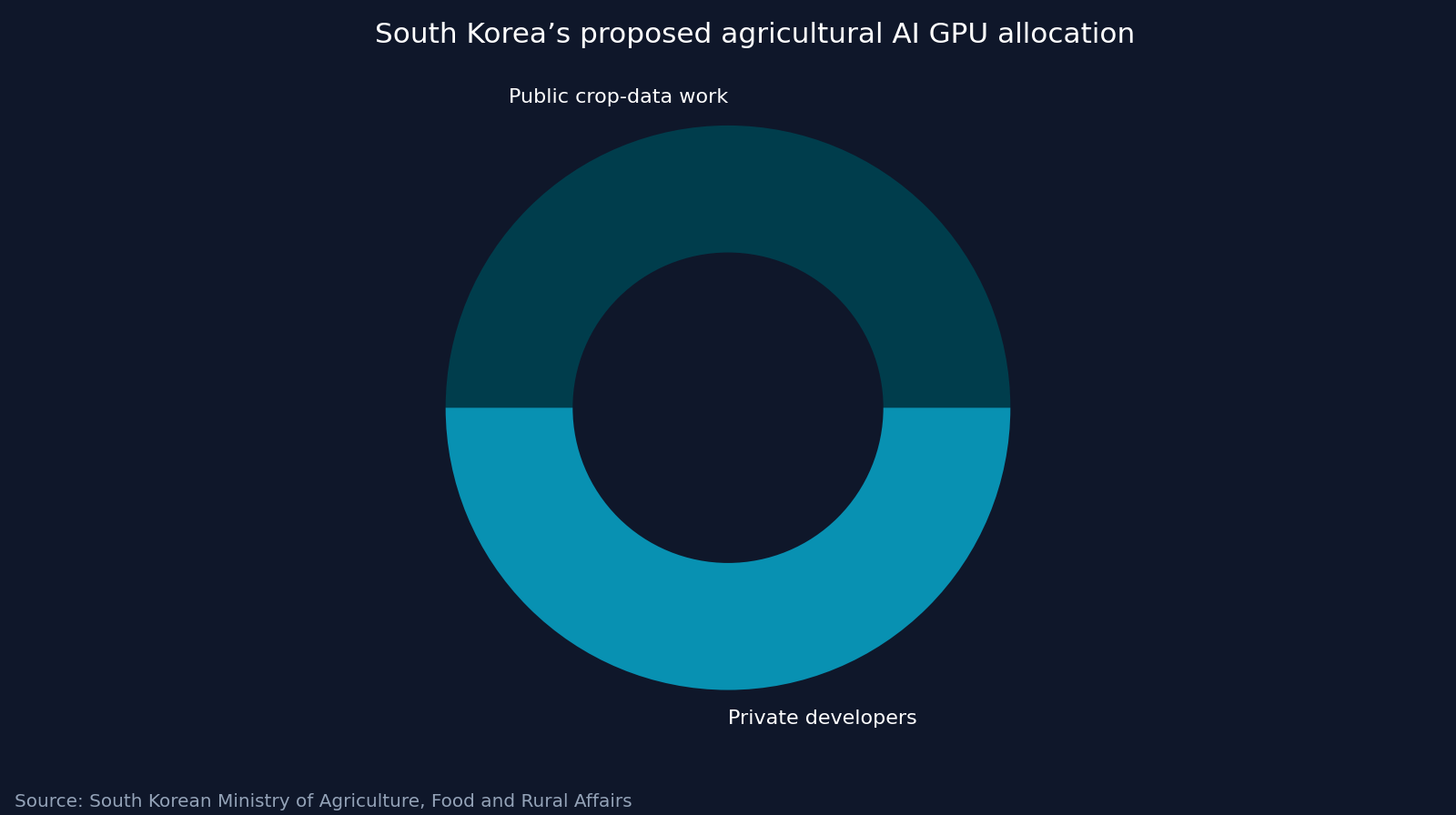
The South Korean Ministry of Agriculture, Food and Rural Affairs described its GPU allocation as supporting crop-data preparation and private AI development. We would treat that allocation as evidence of planned development resources, without using it to infer completed fieldwork, British service capacity or savings.
The useful procurement question is how a provider connects development work to a result it is willing to stand behind.
Put the unsuccessful pass in the contract
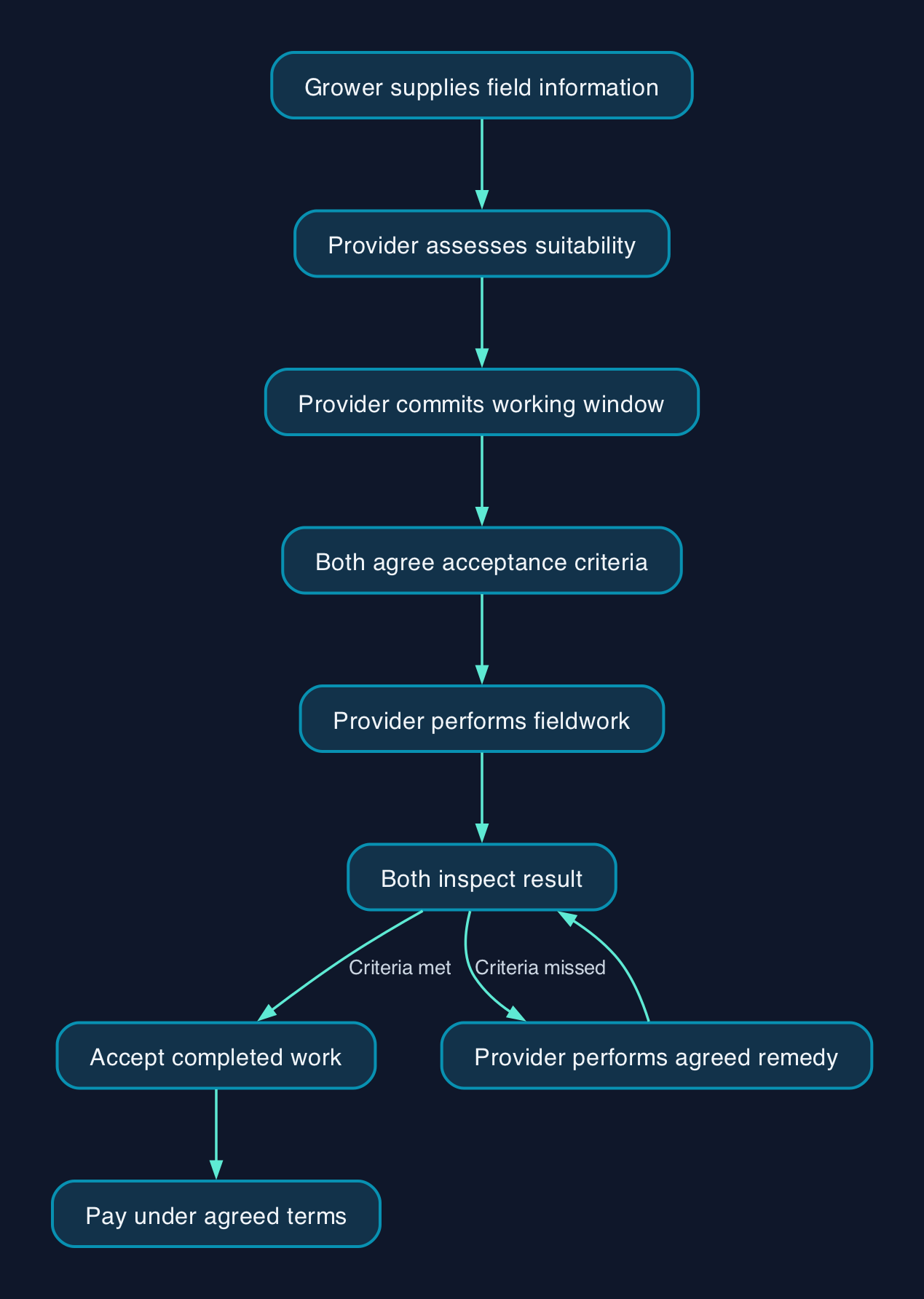
Our proposed service arrangement begins with the grower supplying field and crop information. The provider assesses suitability and commits to a working window. Both parties agree acceptance criteria before work begins, then inspect the result together.
Under this proposal, acceptance triggers payment according to the agreed terms. A failed check triggers the specified remedy and another inspection.
We would assess completed area alongside remaining weeds and crop damage. Define those checks before the trial, including who makes the assessment and how disagreements will be handled.
Compare the Cloud finds no comparable UK ownership and service quotations in the supplied evidence. We therefore make no savings estimate and would request GBP quotations for the same seasonal workload, with VAT treatment stated.
| Cost component | What to ask the provider |
| --- | --- |
| Equipment and operation | Which tasks does the price cover, and which remain the grower’s responsibility? |
| Setup and preparation | Does the quotation include mapping, configuration and operator training? |
| Travel and deployment | Who pays for transport and repeat visits? |
| Supervision and support | Who responds when work stops, and what support is included? |
| Remedial work | Which failed outcomes trigger a return visit, and who pays? |
| Reserved capacity and fallback | What does priority access cost, and what replacement provision is committed? |
These are Compare the Cloud’s proposed quotation requirements, not a completed cost estimate. Keep every unpriced responsibility visible until the offers can be compared on the same basis.
We would consider paying more for a service that accepts credible responsibility for remedial work. That preference should depend on the written commitment and the provider’s ability to fulfil it.
The strongest objection is control over timing
For Compare the Cloud, the strongest argument against outsourcing is the grower’s need to control the working window. Consider a shared provider receiving overlapping requests after an interruption. Our proposed contract would be inadequate if it promised a remedy without securing the capacity to perform it.
Ask the provider to show how booked work fits available machine time. Require an explanation of customer priorities, weather disruption and the person authorised to decide what happens when a machine stops.
We would also require the replacement arrangement to be specific. Identify the equipment or service available, the conditions governing access and who activates it.
Price reserved capacity explicitly, then compare that commitment with ownership over the same season. We would not accept compensation alone as a satisfactory answer to a missed operation.
Where those commitments remain unconvincing, our preference would be ownership or retaining the existing method. The case for a service trial rests on the provider accepting a responsibility it can demonstrate the capacity to meet.
FAQ
Does the Korean programme prove British robot subscriptions will work?
The South Korean Ministry of Agriculture, Food and Rural Affairs describes a proposed development structure in its April platform announcement. Compare the Cloud draws a lesson about allocating responsibility from that proposal, but would not use it as evidence of British subscription economics.
What makes the proposed service different from equipment rental?
Compare the Cloud’s proposed distinction is responsibility for completing specified work. Require the contract to identify who operates and supervises the machine, who provides support and who performs remedial visits, alongside the grower’s retained duties.
When should a grower choose ownership?
We would favour ownership when control over working windows outweighs the credible commitments available from a provider. Compare seasonal costs and support responsibilities before deciding, and retain the existing method as an option if neither offer is convincing.
What should determine whether a trial passes?
Our recommendation is to agree checks for completed area, remaining weeds and crop damage, together with the working window. Include sowing where the proposed operation depends on sowing records, and make expansion conditional on acceptable results and a workable response to interruptions.
Should scouting be included in the same contract?
Earth Rover says its CLAWS system combines weeding and scouting functions. Our recommendation is to give scouting separate deliverables and explicit price treatment, even when the same machine performs both jobs.
Can this evidence support a savings estimate?
Compare the Cloud finds no comparable UK purchase and service quotations in the supplied evidence, so we would not calculate a saving from it. Request prices for the same workload and make retained labour, support, repeat visits and fallback arrangements explicit before drawing a conclusion.
Sources
- South Korean Ministry of Agriculture, Food and Rural Affairs, ‘스마트농업 데이터 AX활용’ 본격 추진
- South Korean Ministry of Agriculture, Food and Rural Affairs, 초혁신·모두의 AI농업 실현을 위한 ‘국가 농업AX플랫폼’ 우선협상대상자 선정
- FarmDroid FD20 Robot - FarmDroid UK
- Earth Rover | Weed Control & Scouting Robotic Solutions for Farmers
- igus UK account of agricultural laser-weeding development