Britain should prepare for laboratory food factories
Britain should back cultivated food and precision fermentation through commercial trials. Singapore demonstrates a route to sale, but investment in British factories still needs repeatable production and customers willing to buy.

Yes, Britain should prepare for food factories that look more like laboratories than farms. British businesses should test cultivated food and precision fermentation through commercial trials, committing to factories only when repeatable production and customer demand justify them. Singapore’s documented cultivated-meat approvals show a route to sale there. The data-centre analogy is useful as a proposal for disciplined production records, but it provides no evidence that a British plant will be profitable.
Key pointers
- Test a specific ingredient or customer requirement before committing to a factory.
- Compare ingredient purchasing, commissioned production and plant ownership as separate investment decisions.
- Ask for accepted output from repeatable batches, alongside installed capacity.
- Give someone responsibility for connecting production records to laboratory results and batch release.
- Check authorisation for the exact product and intended market before promising a launch.
- Make further investment conditional on customers accepting the product at a workable price.
Singapore offers an industrial lesson
Singapore gives British businesses a reason to investigate how novel food is manufactured, beyond the appeal of an unfamiliar product.
SFA’s March 2024 factsheet described the ADM-backed ScaleUp Bio providing access to fermentation capacity and Cremer Sustainable Foods supporting plant-based protein manufacturing. It also documented research facilities and education programmes. These were different activities serving different production needs. Together, they suggest that participation can extend beyond owning a consumer food brand.
Those historical descriptions do not establish available capacity today. For a British ingredient developer, however, they raise a useful investment question: how much manufacturing capability needs to be owned before a product has earned its first substantial order?
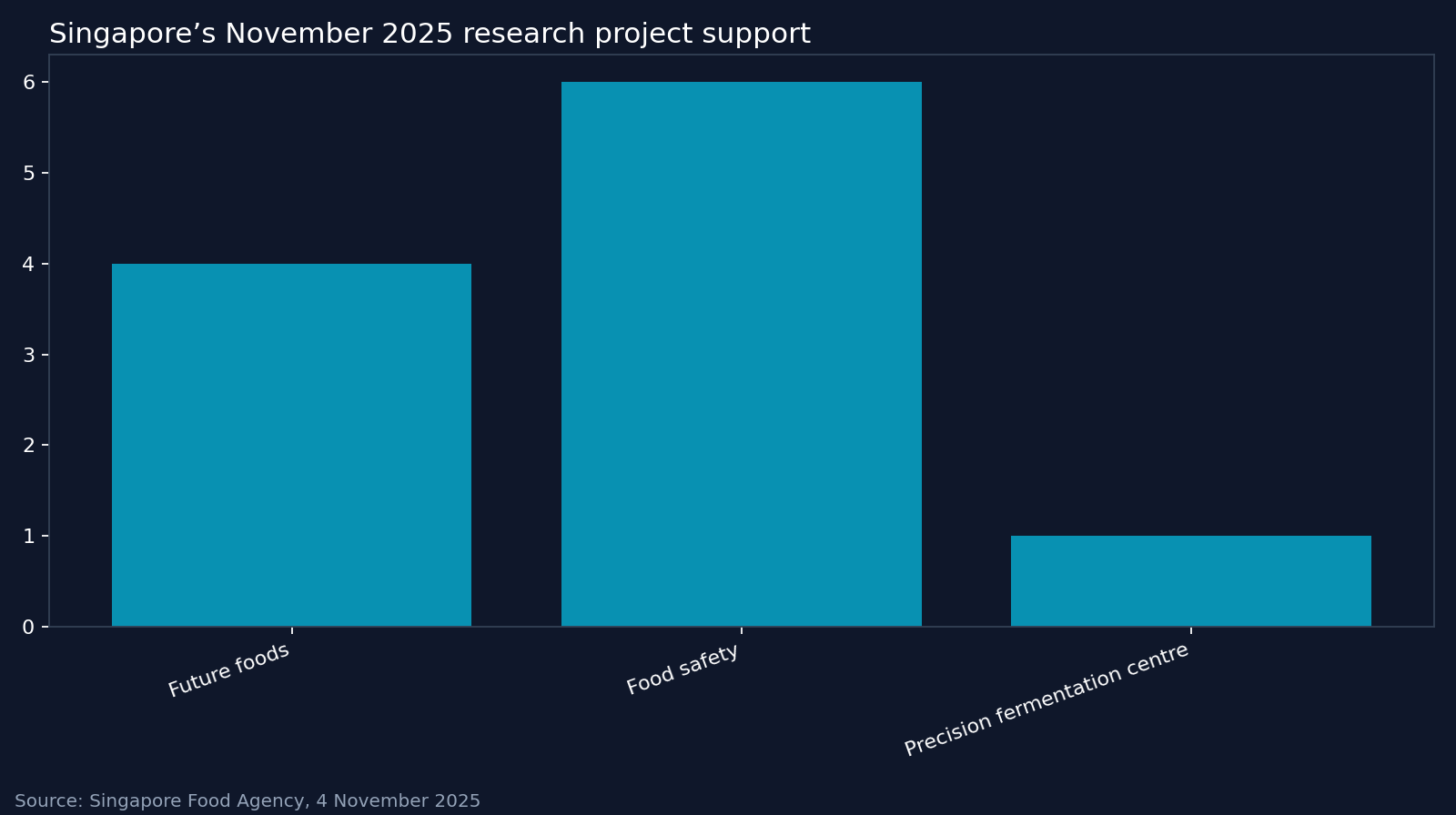
Singapore’s announcement of 4 November 2025 covered 4 future-food projects, 6 food-safety projects and 1 precision fermentation centre project, making 11 projects altogether. The published award details include work on flavour and nutrition, alongside safety assessment. These are project counts, not funding shares or evidence of commercial success.
My position is that Britain should support this capacity to make and evaluate food while leaving each factory proposal to prove its commercial case. Research funding and manufacturing investment answer different questions.
Choose a production route before choosing a supplier
“Lab-grown food” conceals distinctions that matter to a buyer.
Cultivated meat grows animal cells, as described in SFA’s alternative protein factsheet. Precision fermentation produces ingredients that are purified away from the microorganisms making them. Biomass fermentation uses microbial cells themselves as food, according to the fermentation guide.
A buyer seeking a particular ingredient function therefore faces a different decision from one developing a cultivated-meat product.
| Example | What the supplied evidence establishes | Decision it helps frame |
| --- | --- | --- |
| Eat Just and Vow | SFA reported cultivated-meat approvals involving both in its [October 2025 address](https://www.sfa.gov.sg/news-publications/newsroom/2025/opening-address-by-dr-tan-lee-kim--director-general--food-administration--and-deputy-ceo-of-the-singapore-food-agency--at-singapore-food-toxicology-conference-and-workshop--8-oct-2025). | Does the specific product meet the intended customer’s requirements? |
| Quorn | SFA’s [alternative protein factsheet](https://www.sfa.gov.sg/docs/default-source/regulatory-standards-frameworks-and-guidelines/factsheet-on-alternative-proteins_mar24.pdf) identifies it as an example of fungal protein. | Could an established alternative satisfy the product brief? |
| ScaleUp Bio | The [March 2024 factsheet](https://www.sfa.gov.sg/docs/default-source/regulatory-standards-frameworks-and-guidelines/factsheet-on-alternative-proteins_mar24.pdf) described access to fermentation capacity. | Could commissioned production help test the case for equipment ownership? |
| Cremer Sustainable Foods | The [same factsheet](https://www.sfa.gov.sg/docs/default-source/regulatory-standards-frameworks-and-guidelines/factsheet-on-alternative-proteins_mar24.pdf) described plant-based protein manufacturing. | Is plant-based contract production relevant to the proposed food? |
These examples illustrate different products and commercial roles. The evidence does not support a supplier ranking or establish comparable prices and delivery terms.
For a smaller British manufacturer, I favour testing a defined ingredient function in an existing recipe. That gives the trial a recognisable result: does the ingredient perform well enough for a customer to buy the finished food? Farmers and incumbent ingredient suppliers can use the same question to assess where a competing ingredient might affect their business.
Production records are a practical technology opportunity
The strongest technology opportunity in this evidence is helping manufacturers demonstrate what happened during production.
SFA’s fermentation guidance describes assessment of microorganisms, possible contamination routes and testing of the finished product. Its application guidance also identifies material changes to manufacturing methods or submitted information among the circumstances in which pre-market approval may be cancelled.
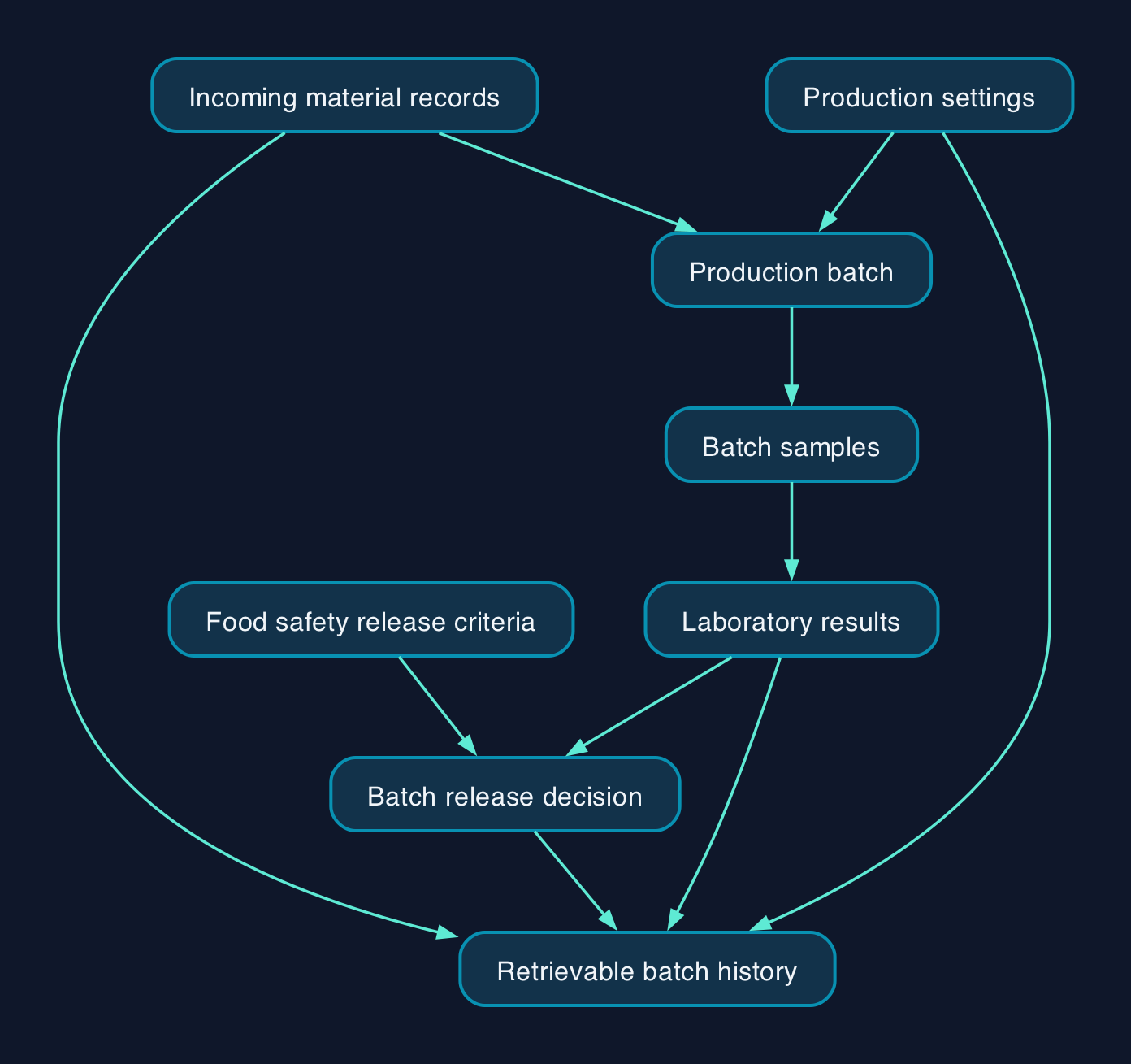
For a proposed British facility, I would connect incoming-material records and production settings to batch samples, laboratory results and the release decision. Food-safety staff would define the release criteria. Production staff would record execution, while the technology team would make the history retrievable and control changes to it.
That is a proposed division of responsibility, not a claim that the cited guidance mandates a particular software architecture.
A useful acceptance test for a software supplier would be to reconstruct one batch from its inputs through to release. Can the operator find the relevant result, identify who approved a change and explain the release decision? A demonstration that merely displays a vessel’s temperature does not answer those questions.
Price the output a customer can accept
The supplied evidence contains no comparable British production costs or selling prices. It cannot establish cost parity with conventional food.
I would require a proposal to account for the following components before describing it as an investment case.
| Cost component | Evidence to request |
| --- | --- |
| Production inputs | Consumption per accepted batch, including losses and rejected output |
| Equipment or commissioned production | Installation and maintenance costs, minimum commitments and production availability |
| Utilities and cleaning | Measured requirements for the proposed process |
| Testing | Sampling costs, laboratory charges and responsibility for failed results |
| Staffing and software | Operating cover, training and continuing support |
| Getting the product to customers | Formulation work, packaging, storage and distribution |
These are questions for quotations and trials, not established costs.
My preferred denominator is accepted, saleable output. Installed capacity is useful only when the investment case explains what proportion can meet the required specification and find a buyer.
Ingredient purchasing may be enough for an initial product-development trial. Commissioned production deserves consideration where suitable capacity is available. Plant ownership then needs its own argument about demand and utilisation, including who bears the cost when either disappoints.
British market access needs a separate decision
A Singapore approval is evidence about the product and uses assessed there. It does not establish permission for a British launch.
For Great Britain, the official register guidance explains that authorisations specify the novel food and its conditions of use. Entries also cover additional labelling requirements and any data-protection restrictions affecting which food business operator may place the product on the market.
Match the proposed ingredient and use to those particulars. A supplier’s general statement that it is “approved” leaves too much unanswered. The cited register covers Great Britain; it should not be treated as evidence of permission in Northern Ireland.
This is not legal advice; consult your legal counsel.
The strongest objection is that customers may not want it
A technically repeatable process can still produce food that customers reject at the required price. Nothing in the supplied approvals or research awards demonstrates profitable British factories, mass-market demand or lower environmental impacts under British conditions.
That objection limits the investment case substantially. It is a reason to withhold factory funding when the customer evidence is weak, even if the scientific work is impressive.
Singapore’s funding announcement includes research intended to improve flavour, nutrition and functionality. Its project descriptions show work under way, rather than completed solutions to those problems.
Commercial trials offer a bounded response. Define the customer’s specification and the conditions for further spending before commissioning production. If the results fail, stop. Conventional ingredients must remain eligible to win that comparison.
Editorial analysis
Britain should take laboratory-based food production seriously enough to test it, and seriously enough to reject projects that cannot earn a customer.
For technology leaders, that means looking closely at the handover between production and food-safety evidence. For food manufacturers, it means specifying the ingredient performance worth paying for. Neither decision requires a prediction about the eventual size of the industry.
I remain unconvinced that owning a factory is the right ambition for every promising food business. A successful trial might justify a supply agreement while leaving the case for construction unanswered.
FAQ
Why might future food factories resemble laboratories?
Cultivated meat grows animal cells in bioreactors using culture media, according to SFA’s alternative protein factsheet. That makes controlled biological production central to the process. The laboratory comparison describes this production method, rather than predicting that farms will disappear.
Are cultivated meat and precision fermentation the same process?
No. Cultivated meat grows animal cells, while precision fermentation uses microorganisms to produce ingredients that are subsequently purified. SFA’s cultivated-meat explanation and fermentation guide describe those distinct routes.
Does Singapore approval establish British market access?
No, it does not establish authorisation for the intended British market. For Great Britain, check the exact product and permitted uses through the official register guidance. Northern Ireland needs a separate jurisdiction check.
Should a British food business build its own plant?
My recommendation is to make ownership conditional on repeatable production and customer demand. Compare buying ingredients and commissioning production before accepting the commitments of running a plant.
What could a UK technology supplier contribute?
A narrowly scoped production-record or laboratory-handover system is worth investigating. SFA’s fermentation safety guidance explains why manufacturing inputs and contamination controls matter. A proposed system should demonstrate how it helps the operator reconstruct a batch and retrieve its testing evidence.
Do the research awards prove commercial demand?
No. Singapore’s funding announcement documents supported research projects, including work on product functionality and safety. It does not establish customer demand or profitable production.
Sources
- Singapore Food Agency, Opening address at the Singapore Food Toxicology Conference and Workshop, 8 October 2025.
- Singapore Food Agency, Factsheet on alternative proteins, March 2024 edition.
- Singapore Food Agency, New Foods from Fermentation, 16 May 2023.
- Singapore Food Agency, Research funding announcement for future foods and food safety, issued 4 November 2025.
- Singapore Food Agency, Guidelines on Applying for Pre-Market Approval for a Novel Food, updated 8 December 2025.
- Food Standards Agency, Guidance on using the Register of Novel Food Authorisations, publication date not shown in the supplied extract.