UK businesses should make stablecoin providers earn the switch
UK businesses should make stablecoin payment providers prove the case for switching. Singapore's redemption requirement and Britain's revised backing rules show why regulatory progress cannot substitute for a tested service.


UK businesses should reject a stablecoin payment proposal unless the supplier proves an improvement over the route it would replace. The burden of proof belongs with the provider. Singapore’s framework specifies redemption within five business days, while Britain’s revised policy changes issuers’ economics without demonstrating customer savings. Both developments justify closer scrutiny; neither justifies moving company money on the strength of a faster token transfer.
Key pointers
- Make the supplier identify the payment problem its proposed service would solve.
- Measure success when the recipient can use the money, with the payment reconciled.
- Ask which legal entity owes you money at each stage and who handles a failed redemption.
- Compare the full cost against your existing service, including staff time spent resolving exceptions.
- Give a pilot a written acceptance test and retain the existing payment route.
- Treat holding stablecoins directly as a separate decision requiring its own business case.
A transferred token is an incomplete buying argument
The five-business-day redemption requirement should be prominent in any discussion of Singapore’s stablecoin framework. MAS specified that issuers must return a holder’s face value within that period after a redemption request. It did not publish a measurement of typical payment speed or promise that every recipient would receive bank funds immediately. MAS framework requirements
For a British finance director, that distinction should determine the test. Ask the provider to demonstrate the complete payment, through to the recipient’s usable funds. A token-transfer timestamp alone should not satisfy acceptance.
My position is that the buyer should refuse responsibility for unexplained gaps between those events. If a supplier proposes conversion, transfer and redemption through different organisations, its contract should explain who handles each failure. The finance team should have a named escalation contact and a clear recovery process before money moves.
Singapore’s September 2026 proposals make that scrutiny more relevant. They include stress testing, recovery and orderly wind-down plans, alongside safeguards for customer money received before stablecoins are issued. These are proposed protections addressing identifiable failure points. MAS legislative consultation
A buyer should ask how those failure points are handled in the offered service. A regulatory presentation cannot answer a contractual question on the supplier’s behalf.
Better issuer economics do not establish a better customer deal
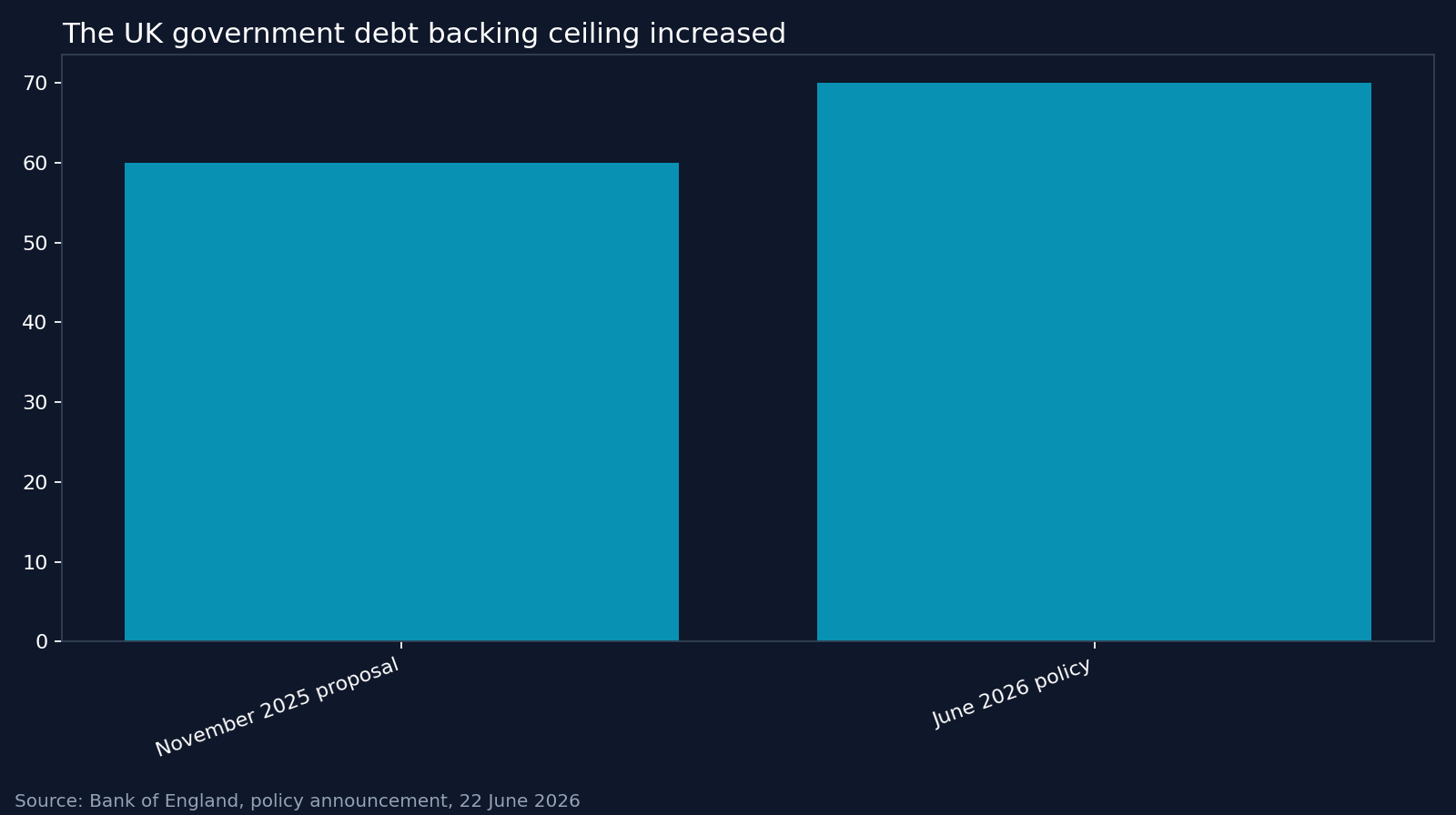
Britain’s revised backing policy gives issuers more room to earn income. The Bank’s June announcement raised the maximum share held in interest-bearing short-term UK government debt from 60% to 70%, leaving the remainder in central bank deposits. The Bank explicitly connected the change with supporting viable business models. Bank backing-asset decision
Those percentages are permitted ceilings, not observed portfolios or customer returns. They tell a buyer something about the proposed economics of issuance. They do not establish what a payment provider will charge.
That is where procurement should push harder. If a supplier claims lower costs, request a quotation covering conversion, transfer, redemption and support. Ask whether minimum commitments apply. Add the buyer’s software changes, training, reconciliation work and exit costs before comparing the proposal with the existing service.
The supplied evidence contains no comparable commercial quotations or measured savings for British customers. It cannot support a named supplier ranking. Retaining the current bank or payment service should remain a valid outcome, alongside assessing a provider-managed stablecoin route. Direct ownership of coins needs an additional justification for taking on custody and redemption responsibilities.
Regulators are creating conditions in which a service might succeed. Procurement must establish whether the offered service deserves the business.
The strongest objection is that waiting could forfeit useful gains
There is a serious case for moving early. A business that refuses even to test a new payment route could miss a useful improvement while competitors learn how to use it.
The evidence gives that argument substance. MAS reported that Project Guardian had tested live tokenisation use cases across foreign exchange, funds and fixed income in six currencies. Its planned Future of Finance Institute includes controlled testing environments and deployment resources. MAS institute announcement
The Bank of England also sees possible benefits from programmable payments and faster, cheaper settlement, including across borders. Its policy describes stablecoins operating alongside traditional and tokenised bank deposits. Bank assessment of payment uses
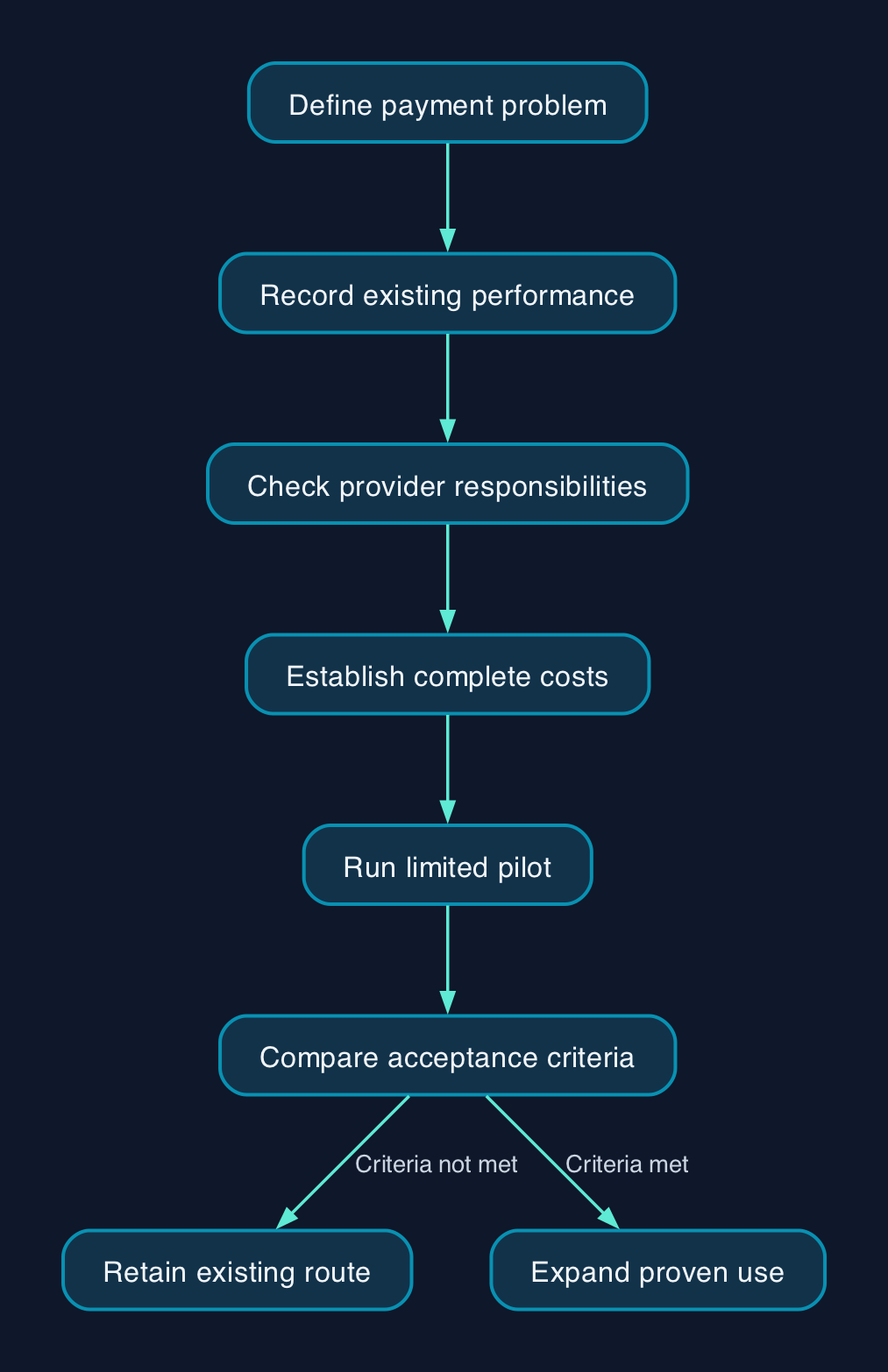
A blanket refusal would therefore be premature. But the answer is a bounded pilot with a decision attached to it. Select a payment problem, record the existing cost and recipient arrival time, then require the proposed route to improve the chosen outcome without leaving failures unowned.
Testing should be allowed to end in rejection. If the new route saves transfer time but adds enough reconciliation work to erase the benefit, stop. If it meets the agreed test, expand within the scope demonstrated.
This is the distinction the original adoption argument needs. Regulatory preparation and market trials justify an experiment. The experiment must justify the switch.
Make the payment provider carry the explanation
For a small business with limited finance and technical staff, my preference is to assess a managed payment service before considering direct coin ownership. The provider should explain the settlement chain in language the person approving invoices can use.
Require its proposal to identify the customer interface, transfer operator, issuer and redemption route. Finance should confirm what constitutes completed payment. The technology owner should check that status messages and transaction records support that definition, including when a payment fails.
Use that information in a simple approval process. Establish the payment problem and baseline, check responsibilities and charges, then run the limited pilot. Compare its results with the acceptance criteria. Keep the existing route if the proposal fails; expand only where the evidence supports it. This is a recommended procurement process, not a claim about a particular product.
The protection question deserves equal attention. MAS warned in October 2025 that stablecoins generally were not as safe as bank deposits in Singapore, which are tightly regulated and protected by deposit insurance. That statement concerns Singapore and should not be repackaged as a conclusion about UK protection. MAS parliamentary reply
The UK framework also needs to be read at the right stage. The June publication set out policy positions and consulted on draft rules; it was not evidence that every detailed requirement was already in force. Bank policy statement and draft Code
This is not legal advice; consult your legal counsel.
Editorial analysis
I would reject any proposal whose strongest evidence is that a regulator is making stablecoin issuance commercially possible. That answers the issuer’s question. A British buyer still needs a demonstrably better payment service.
The approval belongs to finance as well as technology. A working connection earns permission to test; a reconciled payment, acceptable total cost and a credible failure process earn consideration for wider use.
Stablecoins should have to compete for that approval. The supplier asking a business to switch should do the work of proving why.
FAQ
Should a UK small business start holding stablecoins?
My recommendation is to start with a payment problem and assess whether a managed service can solve it. Hold coins directly only if the business case justifies retaining responsibility for custody, redemption and accounting.
Does Singapore’s announcement mean its proposed legislation is already in force?
The 1 September 2026 announcement describes consultation on legislative amendments. It does not establish that those amendments have taken effect. MAS consultation announcement
Does the UK policy impose a holding limit on each business?
The Bank’s June announcement replaced its proposed customer holding limits with an initial £40 billion issuance guardrail for each systemic stablecoin. That addresses aggregate coin issuance rather than a balance allowance for an individual business. Bank revised policy
What should count as a successful pilot?
Set the criteria before testing and compare them with the existing service. I would require evidence of recipient access to funds, complete charges, usable reconciliation records and a tested response to payment failure.
Sources
- Monetary Authority of Singapore, MAS Finalises Stablecoin Regulatory Framework, 15 August 2023.
- Monetary Authority of Singapore, MAS Consults on Legislative Amendments to Implement Stablecoin Regulatory Framework, 1 September 2026.
- Bank of England, Bank of England launches policy statement and draft rules on regulating systemic stablecoins, 22 June 2026.
- Bank of England, Sterling-denominated systemic stablecoins, 22 June 2026.
- Monetary Authority of Singapore, MAS Establishes Future of Finance Institute to Scale Financial Innovation, 25 June 2026.
- Monetary Authority of Singapore, Written Reply to Parliamentary Question on Public Education Efforts and Impact of Stablecoins, 15 October 2025.