
British buyers should make a demonstrated repair and return to work a condition of any production humanoid contract. I would reject a bid that leaves that responsibility unresolved, however impressive its demonstration. Humanoid advertises modular HMND 01 hardware and software, but its product description does not establish support for interchangeable third-party components. Buyers should pay extra for component choice only when it comes with a tested recovery procedure.
Key pointers
- Make successful recovery after a component replacement part of production acceptance.
- Require one named contractor to own diagnosis and restoration of the agreed task.
- Give modularity a financial value only when the supplier demonstrates and prices the supported replacement.
- Record human interventions, rejected work and recovery time alongside successful output.
- Keep experimental hardware expenditure separate from the budget for a supported installation.
- Choose an integrated supplier when it proves the stronger repair and operating-cost case.
A successful task is only the first acceptance test
The case for industrial humanoids deserves a serious hearing. Aitu reports a 97 per cent success rate for separating fabric pieces within a single product category and fabric type, with more than 98 per cent of the resulting sewing work meeting quality standards. It estimates payback at about 18 months. Its general manager also acknowledges that the robots cannot yet run an entire production flow without human involvement. These are company claims reported in the supplied account of garment-factory trials, rather than independently audited results.
That combination makes a better starting point for procurement than a general claim of human-like capability. There is a defined operation, a quality measure and a proposed economic return. There is also a clear boundary around what has been demonstrated.
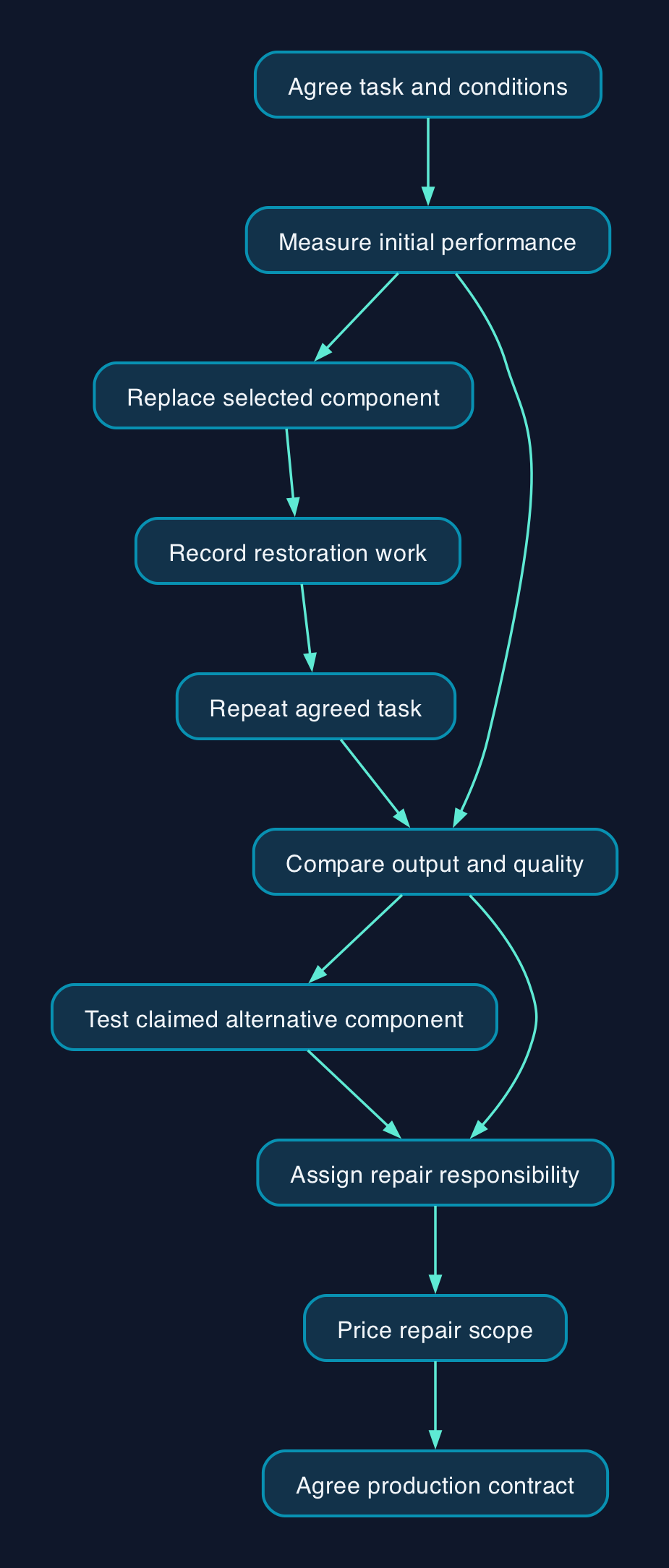
I would add a second acceptance test before committing production expenditure. After a supplier-approved component replacement, can the machine repeat the accepted task, and what does restoring it cost?
The reported garment results do not answer that question. Nor should we infer an answer from them. A buyer needs both the initial performance case and a credible way to recover it when something needs replacing.
Replacement must include restoring the learned task
The evidence from Beijing’s robot training facilities explains why physical replacement alone is an incomplete test.
At the Beijing Innovation Center of Humanoid Robotics, training specialists describe repeating tasks hundreds or thousands of times while changing objects and their positions. The centre’s training director describes training general models before adapting them with data from particular environments. The supplied report from the training base documents that work directly.
This does not establish that every repair requires retraining. It does establish that task-specific adaptation is part of the development process described there. My procurement judgement follows from that dependency: the buyer should require evidence that the repaired configuration preserves the behaviour being purchased.
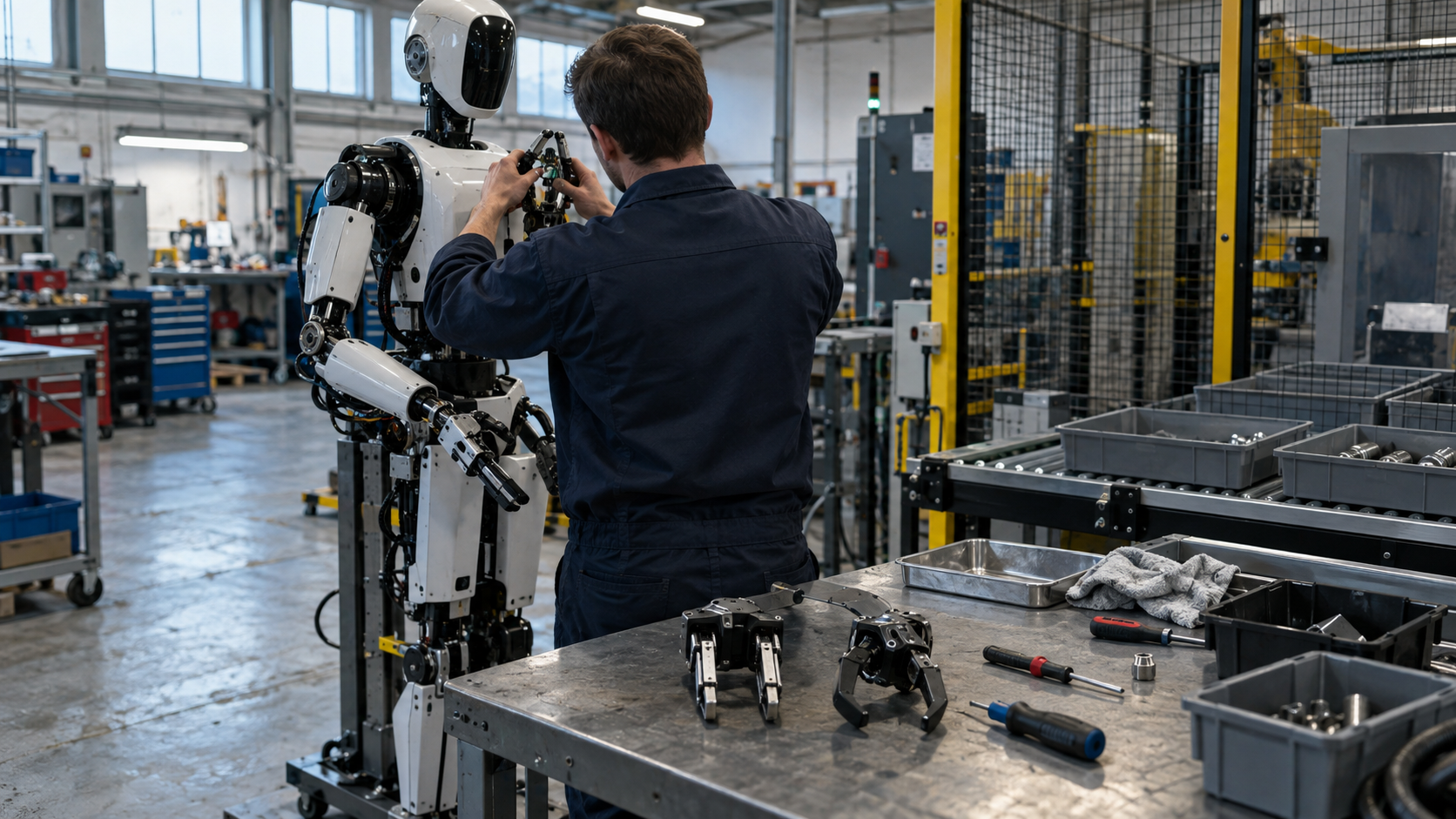
For a hypothetical British parts manufacturer, I would make the acceptance exercise concrete. First, agree the parts, operating conditions and acceptable output. Have the supplier carry out a planned, safe replacement of a selected component, then repeat the task under the same conditions. Record calibration work, software changes, human assistance and elapsed recovery time.
If the supplier claims that a different manufacturer’s component provides an escape route from future shortages or discontinuation, test that substitution separately. Replacing a gripper with an identical spare demonstrates repairability. Fitting an alternative gripper and restoring supported operation demonstrates something more valuable, and more demanding.
Modularity should earn its premium
Humanoid’s HMND 01, Berkeley Humanoid Lite and LeRobot Humanoid offer different propositions. The commercial product describes configurable hardware and software. Berkeley provides openly released designs and code. LeRobot offers an experimental platform for building and learning.
Those distinctions should determine what the buyer asks each option to prove. They do not establish a performance ranking.
For research, access to the design may itself justify expenditure. A team investigating control software can value the ability to modify hardware even when considerable engineering work remains.
For production, I would give openness no automatic discount in the cost comparison. Access to files does not answer who will restore a stopped installation. Equally, a modular product description does not establish that an independently supplied replacement will retain support.
This is where the original promise of component choice needs a commercial test. Ask the bidder to identify a supported alternative, price the change and demonstrate the resulting task. Until then, treat reduced supplier dependence as an unproven benefit.
The strongest objection is that integration may be cheaper
A tightly integrated supplier could reasonably argue that controlling the hardware and software makes validation more manageable. Supporting combinations from several manufacturers could add engineering work and create disputes over responsibility. For a small business without robotics specialists, transferring that work to one supplier may be the better bargain.
I accept that objection. Requiring interchangeable third-party parts in every purchase would turn a preference for openness into an unnecessary purchasing restriction.
The repair requirement survives it, however. An integrated supplier can pass by demonstrating replacement with its own supported parts and taking responsibility for restoring the task. A modular supplier can pass the same test, then justify any premium through a demonstrated alternative-component route.
I would choose the integrated proposal if it offered the stronger supported result over the agreed operating period. I would reject either proposal if nobody accepted responsibility for getting the machine working again. That is a purchasing condition both approaches should be able to address.
Put recovery into the quotation
For a UK production purchase, request a GBP quotation with explicit VAT treatment. Separate hardware from assembly, integration, task adaptation and acceptance testing. Ask bidders to identify maintenance charges, spare parts, staff training and the work required when the supported configuration changes.
These are proposed quotation requirements, not services established by the supplied product pages.
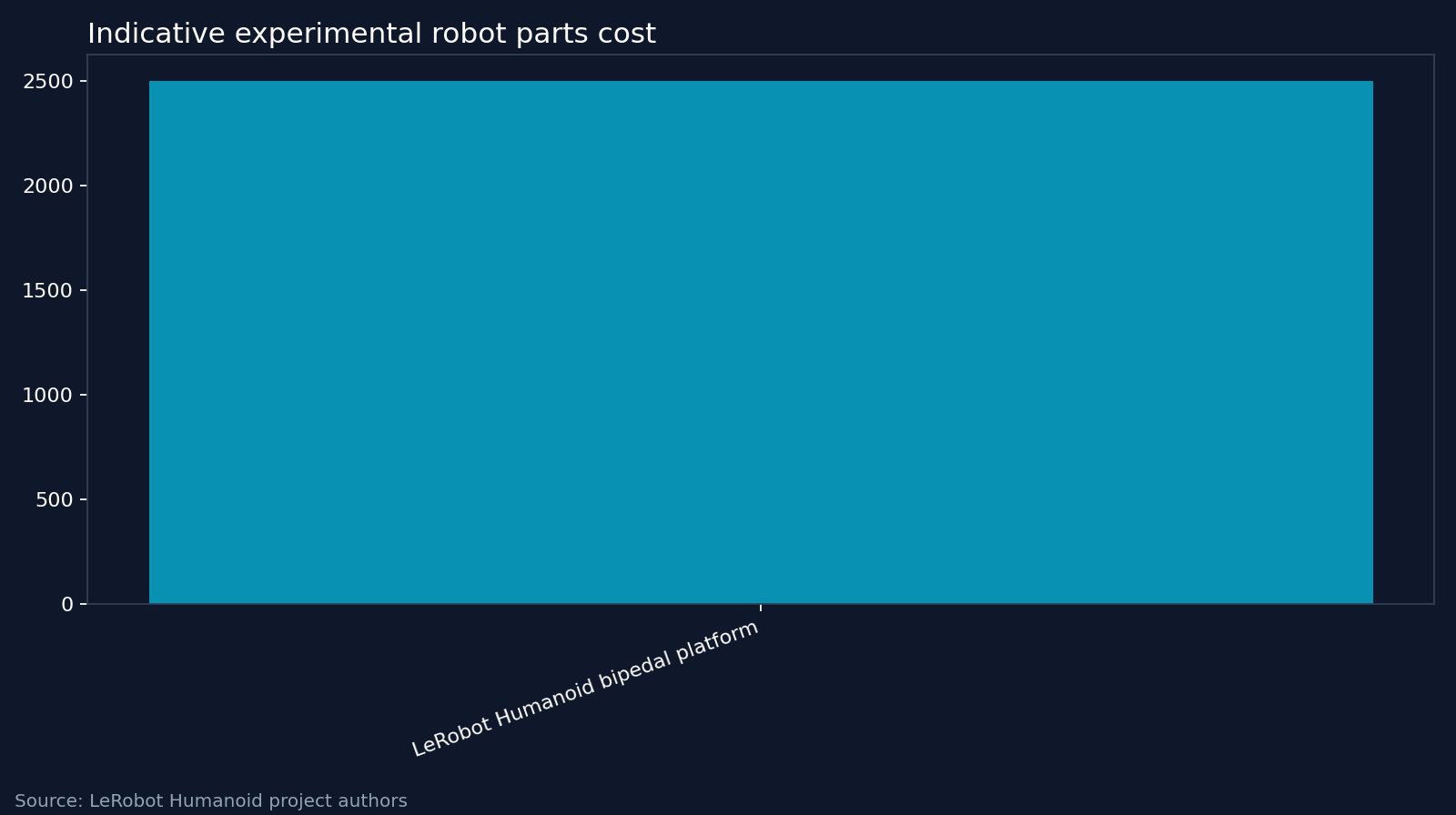
The experimental parts figures above belong in a different budget. They cannot establish the cost of a supported production installation. An engineering team should also allow for its own building, testing and operating time, with unknown costs left visible.
For support, I would require one contractor to own fault diagnosis and coordinate any component or software specialists. The customer should receive a written record of the supported configuration and the conditions for accepting the restored task.
Finally, put the demonstrated recovery procedure into the proposed service scope. If the pilot needs specialist recalibration, the quotation should say who supplies it and how it is charged. Otherwise, the buyer has watched an engineering exercise without establishing how it becomes a maintainable service.
FAQ
Should UK buyers insist on open-source humanoids?
I would insist on evidence appropriate to the intended use. Berkeley’s open hardware and software resources offer access for development, but a production buyer should separately require task acceptance and a supported repair arrangement.
Does modular hardware prove that alternative components will work?
No such assurance is established by the supplied HMND 01 product description. Ask the supplier to identify the exact supported combination and demonstrate its operation before assigning a value to that flexibility.
What should the repair test measure?
Measure the time and work required to restore the agreed task, including calibration, software changes and human intervention. Repeat the original output and quality checks so that successful reassembly alone does not count as acceptance.
Is a supplier’s payback estimate enough to approve a purchase?
I would use it as a starting assumption requiring examination. Ask for the task conditions, human input, maintenance allowances and recovery costs behind the estimate, then compare those assumptions with the proposed UK installation.
When should a buyer choose an integrated system?
Choose it when the supplier demonstrates the required task and offers the better supported recovery and cost case. The requirement is accountable repair; third-party component choice must justify any additional expense.
What does the parts-cost chart establish?
It reproduces the approximate experimental parts figure cited in Fast Facts. Treat it as a research-budget input, with separate allowances for building and operating the platform, rather than as a UK production quotation.
Sources
- Humanoid, HMND 01 product description
- University of California, Berkeley, Open-source, Accessible, and Customizable 3D-printed Humanoid Robot Platform, 18 December 2025
- LeRobot Humanoid project authors, An Open, Low-Cost, 3D-Printed Humanoid for Robot Learning, 21 May 2026
- Xinhua via China SCIO, China’s humanoid robots face their real test on the factory floor, 24 July 2026
- China SCIO, Beyond the showroom and how Beijing is building a humanoid robot industry, 3 June 2026