

Britain should refuse priority grid access to data centre projects that cannot identify who funds their power infrastructure and what happens if delivery slips. Strategic importance should earn scrutiny before preferential treatment. The government’s March consultation proposed reserving or reallocating scarce capacity for strategic demand. Canada offers a useful condition for that privilege through its development principles, which assign attributable electricity costs to developers and require verifiable disclosure of local impacts.
Key pointers
- Make a funded power plan a condition of preferential treatment.
- Separate capacity available at opening from expansion dependent on future network works.
- Identify the payer, delivery owner and completion milestone for each necessary upgrade.
- Ask suppliers which power-related delivery promises will appear in your contract.
- Assess the proposed location and service before giving weight to a corporate pledge.
- Limit developer contributions to justified project costs, with shared infrastructure costs allocated explicitly.
A strategic label cannot settle who deserves scarce power
The difficult question is which projects deserve preferential access when several credible applicants need the same constrained electricity infrastructure.
The government’s consultation identifies both speculative applications and the time needed to build network infrastructure as obstacles to viable projects. Its proposed prioritisation mechanisms could benefit data centres, electric vehicle charging hubs and manufacturing electrification. This is a choice between competing demands on the electricity system, with consequences beyond the technology sector.
My position is that a data centre seeking priority should have to explain why its claim is deliverable and what that priority buys the public. A large investment announcement cannot answer either question by itself. The application should connect the promised capacity to funded works, identifiable beneficiaries and milestones against which progress can be checked.
The supplied consultation establishes what government proposed, rather than the final implementation of those proposals. The editorial recommendation here is a condition Britain should apply when granting preferential treatment.
Canada puts the bill where the argument belongs
Canada’s most useful contribution is its explicit treatment of project-driven electricity costs. The principles say these costs should not pass to households and existing businesses. Developers should pay for infrastructure directly attributable to their projects, proportionate to scale and impact, and contribute supply, storage or demand flexibility where required. That makes cost responsibility part of the development case.
Britain should borrow that discipline. Before awarding priority, ask the developer to identify the required works, their funding and the parties responsible for delivery. Where an upgrade serves several users, require an explanation of the allocation. A project should neither conceal its own costs nor inherit unrelated network costs merely because it has arrived with an investment proposal.
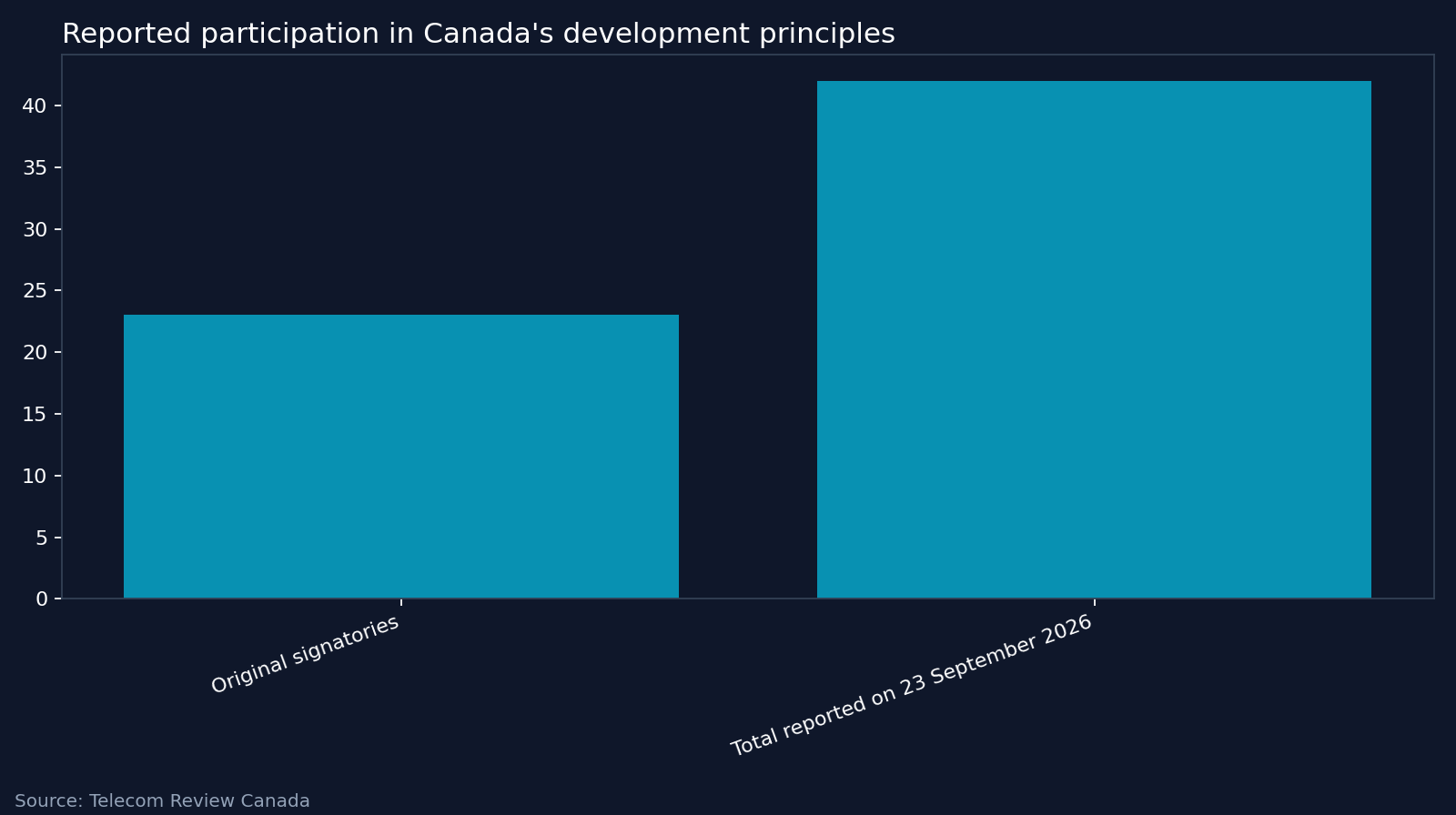
Industry endorsement gives the Canadian framework reach, but does not establish delivery. Telecom Review Canada reported 23 original signatories and 42 total signatories in its 23 September account of expanded participation. Those figures count organisations supporting principles. They provide no measurement of completed substations, water savings or benefits received by residents.
The distinction matters for procurement. A signature should prompt a request for project evidence; it should not earn a supplier an automatic advantage.
Give the power plan a consequence
A useful power plan must change the decision if its evidence is weak. Otherwise, it becomes another attachment that can be approved without resolving the underlying risk.
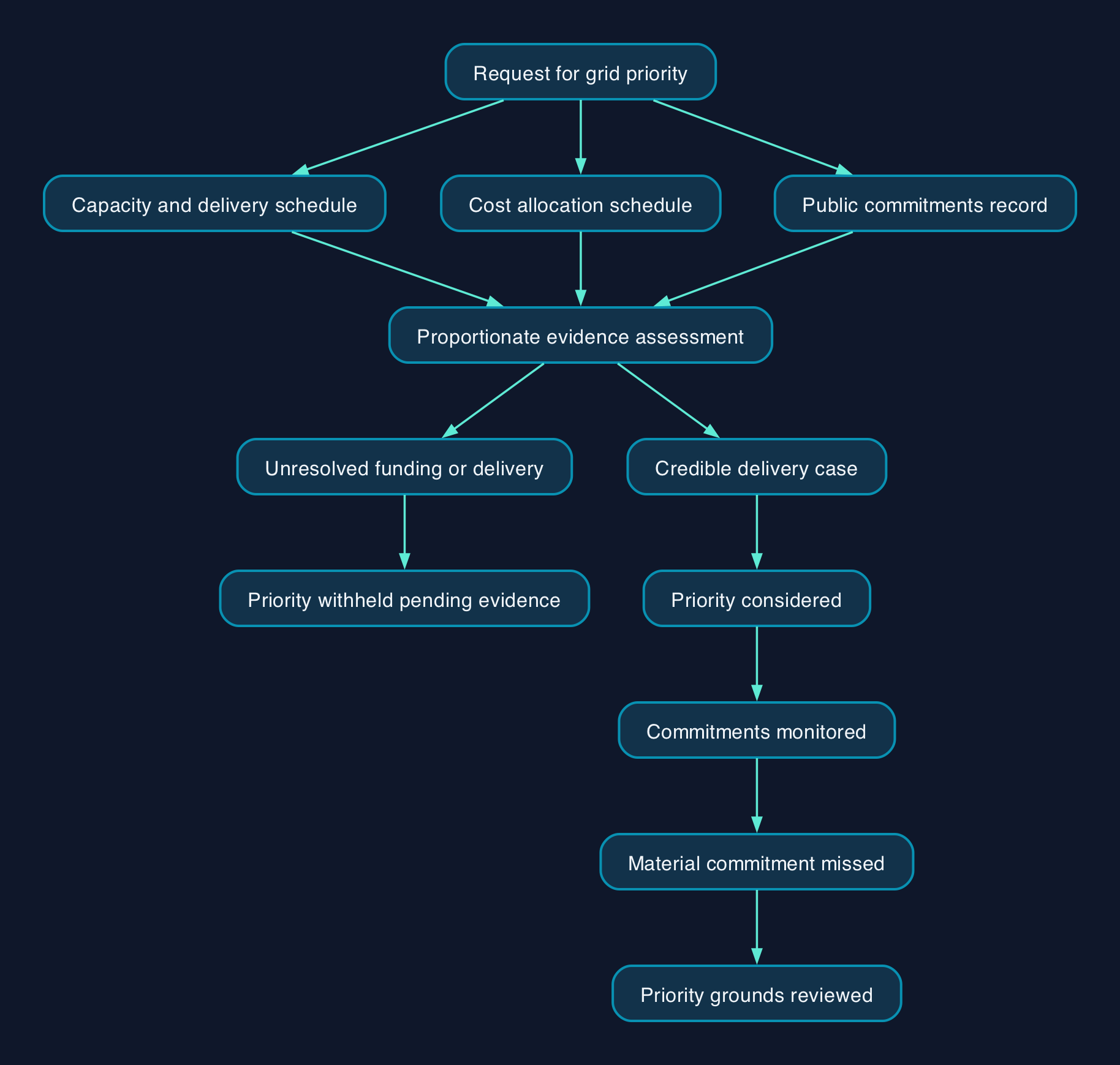
I would require three connected records from a developer seeking priority.
First, a capacity and delivery schedule. State what electricity capacity is available for opening, what depends on later works and who owns each milestone. Distinguish a committed dependency from an aspiration. Explain the response if an essential milestone slips.
Second, a cost allocation schedule. Identify connection works, attributable reinforcement, additional supply or storage where relevant, and responsibility for overruns. Buyers should ask which charges sit inside the service quotation and which could reach them later. These are recommended quotation questions, not claims about any supplier’s charging model.
Third, a public commitments record. Set out the project’s expected local impacts and promised benefits, with a reporting timetable and accountable owners. Canada’s principles already call for measurable, independently verifiable reporting over time, including power, water, infrastructure, sound and emissions.
My proposed consequence is straightforward. Unresolved funding or delivery dependencies should prevent preferential treatment until the applicant supplies adequate evidence. Missing a material commitment should trigger a review of the grounds on which priority was awarded.
That is an argument for accountable prioritisation. It does not require publishing sensitive engineering details or treating every uncertainty as grounds to reject a development.
The strongest objection is that another test delays capacity
The strongest objection is commercial. Additional evidence requirements could consume time, favour developers able to fund large advisory teams and make useful projects harder to deliver. If every community benefit becomes a separate negotiation, a supposed route to certainty could become an open-ended approval exercise.
The objection also has an operational basis. Industry body techUK argues that strategic criteria must reflect different types of data centre and compute, while flexibility proposals must recognise operational capabilities and development timelines. A requirement that assumes every facility can adjust its electricity demand in the same way would be poorly designed.
I would therefore limit the priority test to evidence material to the claimed advantage. Use a published checklist, proportionate disclosure and a defined assessment period. Accept justified differences between projects. Allocate shared infrastructure costs transparently, and do not demand an unrelated benefit simply because an applicant can afford it.
But the objection does not justify granting priority before anyone can explain the payer or delivery sequence. Preferential access needs a higher evidential threshold than an investment announcement. If government wants to support a project despite unresolved costs, it should explain that decision and the intended allocation openly.
The purpose is to resolve the bargain early enough for developers, network operators and customers to act on it.
Buyers should test the facility behind the promise
UK buyers can apply this approach without waiting for a policy change. For a proposed expansion or migration, ask which capacity supports the promised start date and which dependencies could prevent delivery. Then ask what remedy, alternative arrangement or exit provision the supplier is prepared to include in the contract.
AWS, Google and OVHcloud appear among Canada’s launch signatories, alongside facility operator Equinix. The launch announcement establishes their participation; it supplies no basis for ranking their facilities, prices or delivery performance.
Apply the same questions to each relevant offer and to UK providers. Compare the actual service and location, recognising that buying cloud capacity and contracting for colocation involve different responsibilities. A small business purchasing through a managed service provider should ask that provider to explain the dependencies and contractual consequences.
My procurement recommendation is to give greater weight to commitments the supplier will stand behind than to capacity it hopes to deliver. Where the expansion remains conditional, retaining existing capacity deserves consideration.
Editorial analysis
Britain should make preferential grid access conditional on a credible, funded and inspectable delivery case. Canada’s framework supplies useful questions about costs and local impacts; the British consultation supplies the reason those questions matter when capacity is scarce.
The decisive test is whether a developer can connect its request for priority to specific works, named responsibilities and measurable benefits. Public support should follow that evidence. Customers should insist that the commitments affecting their service reach the contract.
FAQ
What should earn a data centre priority grid access?
In this article’s judgement, a credible delivery case should accompany any claim of strategic importance. That means identifiable infrastructure funding, delivery dependencies and measurable benefits, assessed proportionately.
Does Canada’s framework create a British obligation?
This article proposes a British policy and procurement approach rather than describing a requirement imported from Canada. The Canadian launch announcement says its principles complement existing Canadian approval processes.
Should a developer fund every nearby network upgrade?
Canada’s principle concerns costs directly attributable to the development and proportionate to its impact. My recommendation is to establish that boundary explicitly, including how costs are shared when infrastructure benefits other users.
What should a small UK business ask its provider?
Ask whether the proposed service depends on new electricity infrastructure and which delivery milestones remain outstanding. Request a clear explanation of the contractual outcome if those dependencies delay service.
Must a developer publish sensitive technical details?
Canada’s transparency principle expressly protects security, privacy and confidential commercial information. My proposed approach would combine a public account of material impacts and commitments with appropriate scrutiny of supporting confidential evidence.
Does signing the Canadian principles prove delivery quality?
The announcement records industry support for the framework, rather than a comparative assessment of facilities. Buyers should request evidence for the specific service, location and delivery commitment they are considering.
Sources
- Innovation, Science and Economic Development Canada — Canada’s Responsible Data Centre Development Principles.
- Innovation, Science and Economic Development Canada — Launch announcement distributed through CNW, 3 September 2026.
- Department for Energy Security and Net Zero — Accelerating electricity network connections for strategic demand, updated 12 March 2026.
- Telecom Review Canada — Canada’s Responsible Data Center Push Reaches 42 Signatories, 23 September 2026.
- techUK — Ofgem outlines next steps for demand connections reforms, 13 February 2026.