Mistral deserves a place on the UK private AI shortlist
Mistral deserves a UK shortlist for private business applications. Its deployment choices matter, but the decision should turn on tested answers, controlled access and the full cost of running the service.


Yes, Mistral deserves consideration for private business applications, particularly where a UK organisation wants control over how a model is deployed. Its documented deployment options include managed services and running open-weight models on compatible infrastructure. Our editorial view is conditional, though. Choose it when a specific application passes your quality, security and operating-cost tests. The available evidence does not establish that it can replace every capability of the largest US platforms.
Buy an application outcome, not a replacement empire
For a UK small or mid-sized business, the useful question is whether Mistral can handle a defined piece of work within an acceptable operating boundary.
Consider a hypothetical engineering supplier that wants staff to search maintenance manuals and draft answers with supporting passages. Its buying decision should turn on whether the application finds the right document, respects staff permissions and recognises when the evidence is insufficient. A model that meets those requirements could be useful without replacing the organisation’s coding tools, office assistant or other AI services.
Mistral offers a credible route to investigating that narrower decision. Its documentation distinguishes Studio, which includes the developer console and API, from Admin, which covers organisation setup, billing and access policies. It also documents local model deployment. Those are relevant building blocks, rather than evidence that an entire business application arrives ready to use. Mistral platform documentation Deployment documentation
Our position is that buyers should welcome another viable model supplier while resisting the temptation to turn supplier diversification into an expensive infrastructure project.
Define what private must mean
A procurement brief should replace the word “private” with requirements somebody can test.
For one organisation, that might mean a contracted hosted service with acceptable retention and access controls. For another, it might mean processing on infrastructure it operates, with outbound connections restricted. Those are different projects, with different responsibilities.
There is also a distinction between changing the model supplier and changing the infrastructure supplier. Mistral’s documented availability through major cloud platforms means an organisation could evaluate its models while retaining an existing cloud relationship. That may suit a model-diversification objective, but it would not itself meet an objective to leave that cloud provider. Mistral deployment routes
The supplied evidence does not establish a UK-hosted Mistral service, binding retention commitments, complete model-specific licence terms or independently measured parity with US alternatives. Those gaps prevent a blanket privacy or performance recommendation. A UK buyer should require the proposed processing locations, support access, deletion arrangements and service commitments in writing before approving sensitive workloads.
Put responsibility around the model
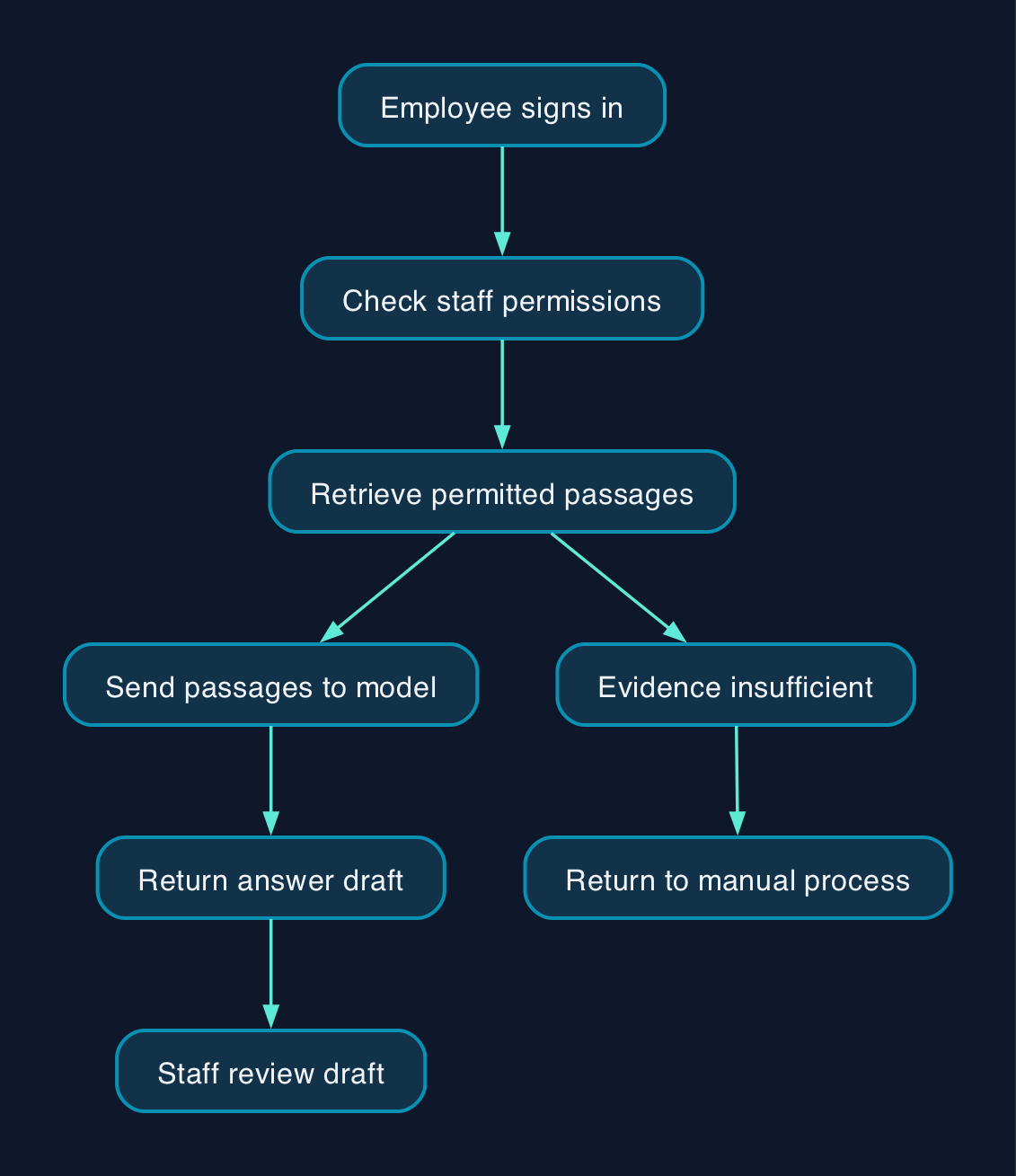
For the engineering supplier example, an illustrative application would authenticate the employee, retrieve permitted manual passages, send those passages to the chosen model and return a draft for review.
The model should sit inside that controlled process. It should not determine which confidential records an employee is entitled to retrieve.
The following is a proposed responsibility map, not a claim that every component is bundled with Mistral.
| Component | Recommended responsibility | Evidence to require before acceptance |
| --- | --- | --- |
| Staff access | Business IT owner configures identity and permissions | A user cannot retrieve another team’s restricted documents |
| Document retrieval | Application team maintains indexing and permission filters | Answers cite the correct, current manual passages |
| Model hosting | Named internal operator or contracted provider | Agreed processing boundary, capacity and recovery arrangements |
| Logs and backups | Service owner controls collection, access and deletion | Sensitive prompts do not appear in unintended monitoring systems |
| Business actions | Process owner approves what the application may change | Drafting cannot silently become an unauthorised transaction |
For a business without infrastructure staff, I would favour a supported deployment proposal over an unmanaged local installation. The quotation should identify who handles updates, incidents, capacity shortages and model changes.
If nobody owns those tasks, self-hosting has transferred responsibility without providing an operating service.
Price the service you will actually run
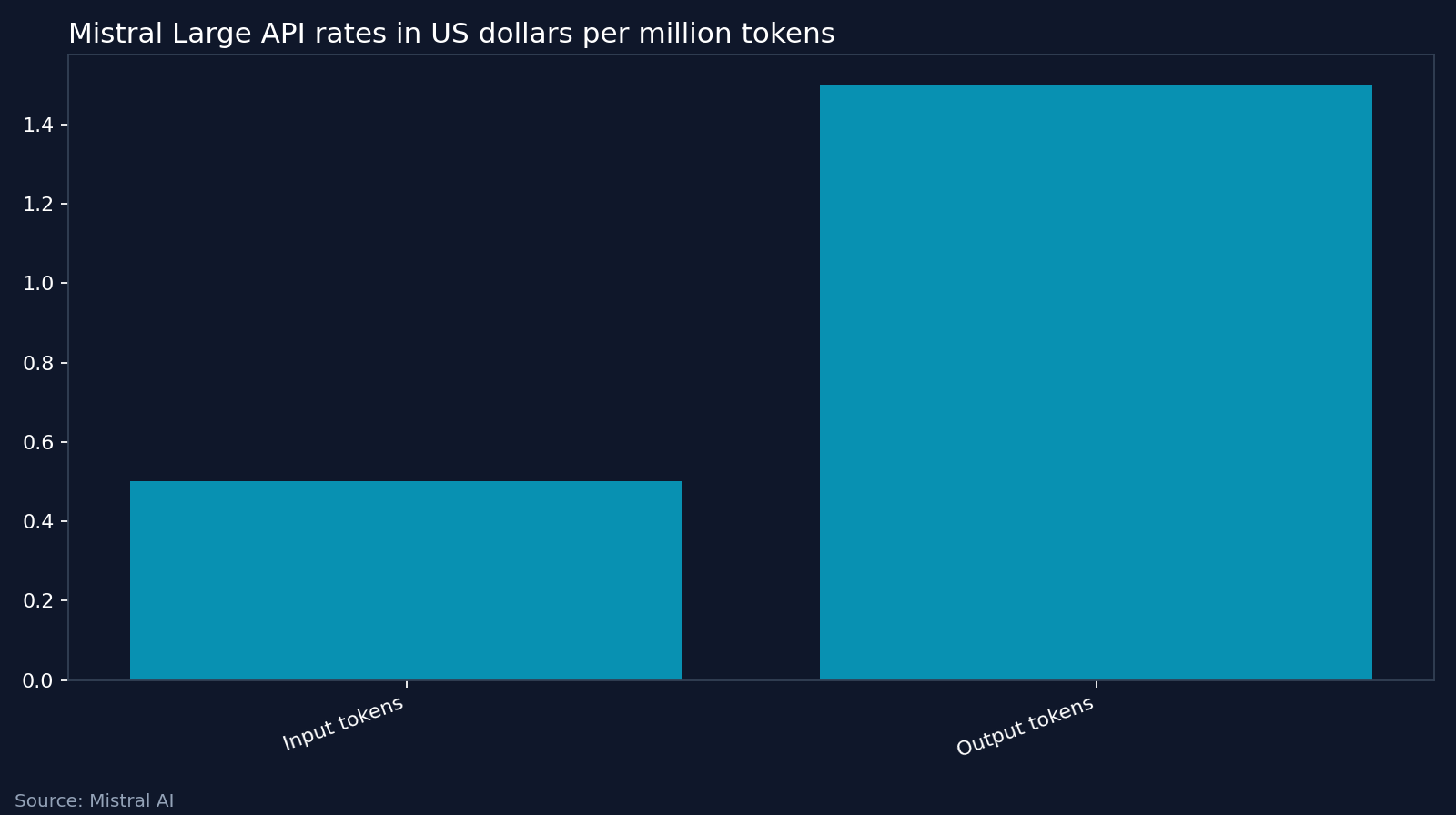
The official pricing extract supplied for this article on 28 September 2026 quotes Mistral Large input at US$0.50 per million tokens and output at US$1.50 per million tokens. Tokens are the units used to meter model input and generated output. Mistral pricing
These figures illustrate the API charging basis. They are not a GBP quotation, a hardware budget or a complete application cost. The supplied extract does not settle the exact model version, regional conditions, minimum commitment or applicable VAT treatment for that example. Obtain those details for the proposed route before purchase.
For a UK budget, request a GBP quotation where available. Otherwise, record the billing currency and conversion charges separately, and identify VAT rather than assuming it is included.
| Cost component | What the buyer should request |
| --- | --- |
| Hosted model usage | Separate input and output rates, expected traffic, retry behaviour and usage limits |
| Private infrastructure | Hardware or hosting charges, storage, power, spare capacity and replacement arrangements |
| Application delivery | Document preparation, identity integration, permissions, testing and user training |
| Ongoing operation | Monitoring, patching, incident response, model evaluation and staff cover |
| Exit | Data export, deletion, documentation and the work needed to change model or operator |
Ask suppliers to price these components over the same period and against the same workload. A low token rate is useful only if the resulting answers require an acceptable amount of checking and correction.
Hosted operation also needs a failure path for exhausted budgets. Mistral documents organisation and workspace spending controls, alongside an API suspension warning when the organisation limit is reached. The application owner should decide whether work queues, stops or returns to a manual process at that point. Mistral spending controls
Compare delivery routes before choosing a winner
Mistral’s deployment documentation supports both managed services and local deployment of eligible models. That makes the operating model a material part of the choice. Mistral deployment documentation
Our editorial assessment is that three routes deserve consideration.
| Route | When it belongs on the shortlist | What must be resolved |
| --- | --- | --- |
| Mistral through a managed service | The buyer wants to evaluate another model supplier with a contracted operator | Processing terms, model availability, integration effort and service support |
| An eligible Mistral model on controlled infrastructure | The processing boundary is essential and the organisation can fund its operation | Exact licence, hardware sizing, security ownership, recovery and ongoing staffing |
| Retain the existing platform | The current application meets the business requirement and switching has no demonstrated benefit | Whether identified quality, cost or control problems can be repaired within the existing arrangement |
Keeping the existing platform is a legitimate outcome. A Mistral trial should earn a change through better results against the buyer’s requirements.
For the hypothetical manual-search application, I would compare the routes using the same documents and questions. Include outdated instructions, missing answers and attempts to access restricted records. Measure answer acceptance, correction effort, response time and operating cost.
Do not award a deployment extra credit merely because it runs locally. Award it credit for passing the required checks.
Editorial analysis
Mistral’s strongest argument here is the documented choice of deployment routes. That creates room for a UK business to evaluate the model separately from some of its infrastructure decisions. Mistral deployment options
The counterargument is operational. A small company may value control over its infrastructure but have nobody available to maintain it when an application fails. In that situation, a well-defined managed service could be the more defensible purchase.
My recommendation is to shortlist Mistral for one bounded application, nominate a service owner and agree acceptance criteria before buying infrastructure. Expand only when the application demonstrates useful answers, controlled access and an affordable support burden.
That is a credible alternative strategy. Replacing an entire AI estate on the strength of a deployment option is not yet an evidenced business case.
FAQ
Can Mistral run on infrastructure our organisation controls?
Mistral documents local deployment of open-weight models on compatible hardware. Eligibility and requirements depend on the selected model, so obtain its exact licence and test the proposed hardware against your workload. Mistral deployment documentation
Would choosing Mistral remove our dependence on a US cloud?
Not if you deploy it through an existing US cloud provider. Mistral lists Azure AI, Amazon Bedrock and Google Cloud Vertex AI among its deployment integrations, so separate model-supplier diversification from infrastructure independence in the brief. Mistral cloud deployment options
Is self-hosting likely to cost less than the API?
The supplied evidence does not establish a break-even point for your workload. Compare the API’s separate input and output charges with infrastructure, application delivery, staffing, support and exit costs, then include the cost of correcting unacceptable answers. Mistral API charging basis
What should a UK small business test first?
Choose a task with an identifiable owner and answers that can be checked, such as drafting responses from approved manuals. Test permission boundaries, unsupported answers and manual fallback alongside quality and cost. Keep consequential actions subject to human approval until the application has demonstrated the required behaviour.
Sources
The article uses the supplied source extracts available on 28 September 2026. Publisher update dates were not established from their contents.
- Mistral AI — Documentation and model listings
- Mistral AI — Deployment
- Mistral AI — Pricing
- Mistral AI — Usage and limits