

UK businesses should not delay a justified connectivity improvement for 6G, or approve private 5G simply because it is available sooner. Our position is that the investment must solve a measured operational problem at an acceptable whole-life cost. Keep repairing existing networks in the comparison, require a pilot using actual devices and applications, and give an unspecified future upgrade no financial value in the business case.
Key pointers
- Define the failed transaction, interrupted task or coverage gap before selecting a network technology.
- Ask for a repair proposal alongside any private 5G quotation.
- Make suppliers test the devices and applications your staff actually use.
- Compare equipment ownership and managed service proposals over the same period.
- Put incident ownership, replacement responsibilities and exit deliverables into the contract.
- Require specific equipment, costs and commitments behind any promised 6G upgrade.
Start with the business process that fails
Private 5G can be worth evaluating without being the right answer for a particular site. The buyer’s first job is to establish what the existing network cannot do.
Consider a hypothetical British manufacturer whose handheld terminals lose connection between its factory and yard. The requirement should identify the terminals, walking routes, applications and acceptable interruption. A request to “install private 5G” chooses the solution before the cause has been established.
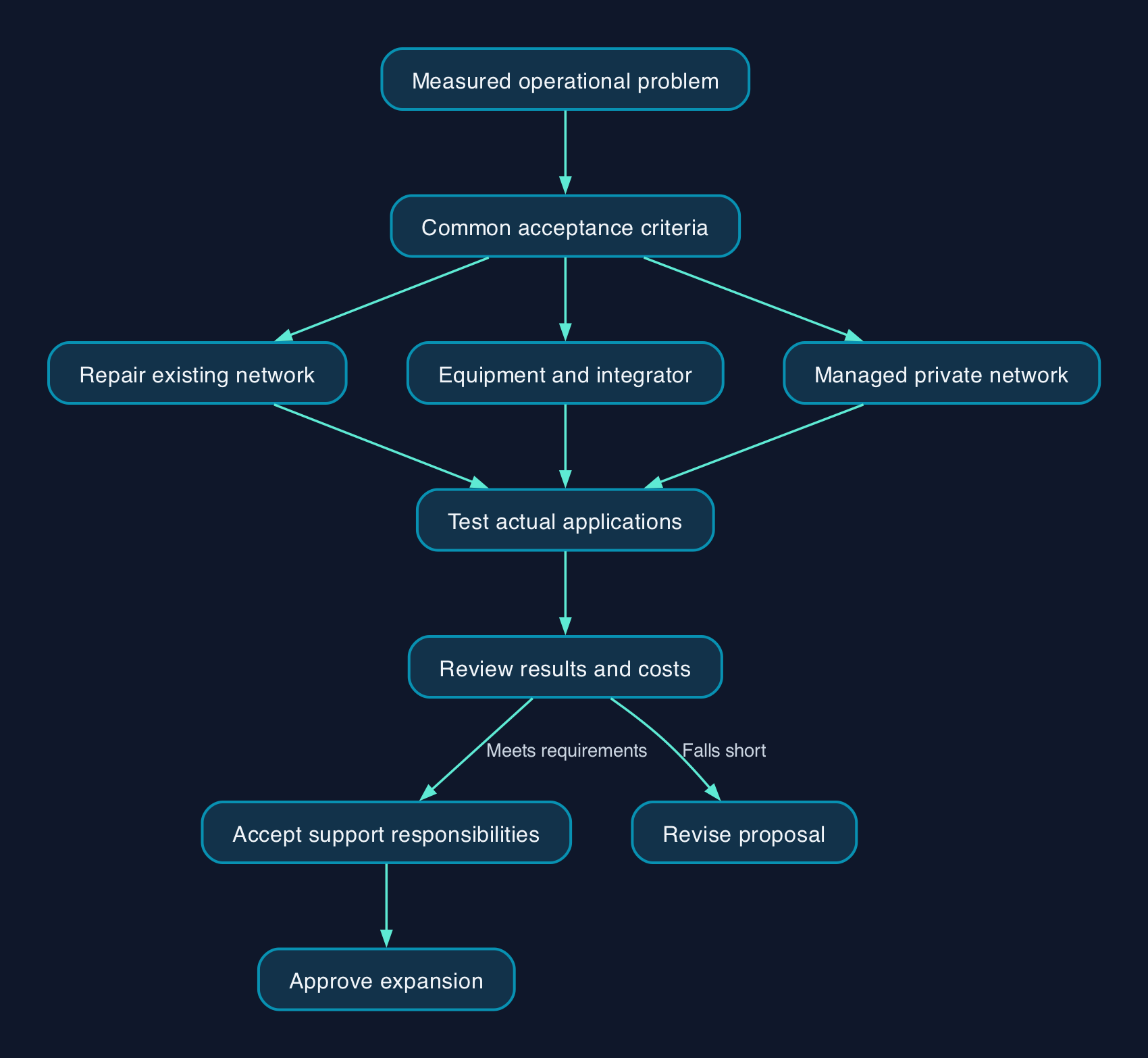
Ask each bidder to demonstrate how its proposal addresses that same failure. Include a proposal to repair the existing network and retain wired connections where practical. If a targeted repair meets the acceptance criteria, a replacement network needs a further business benefit to justify the extra spending.
For a small IT team, this is also a question of workload. Require the proposal to say who configures devices, investigates application failures and deals with suppliers when the service stops working. Put a price against any work retained by your own staff.
Keep spectrum developments separate from upgrade promises
UK spectrum announcements deserve attention, but buyers should read the actual proposal before attaching it to a purchasing decision.
In its upper 6 GHz spectrum-sharing announcement, Ofcom proposed different priorities for mobile and Wi-Fi in different portions of the band, subject to technical conditions and interference controls. The consultation invited responses by 20 March 2026. That announcement establishes what was proposed, not a final authorisation or a commercial 6G launch date.
For procurement, ask the supplier to identify the spectrum arrangement its proposed service actually requires. Request the applicable permissions, restrictions and responsibilities in writing. Do not accept a general statement about future spectrum policy as evidence that a particular installation is ready to operate.
The same discipline applies to the architecture research. A study of future computing or sensing capabilities does not establish that the equipment in today’s quotation will support them.
Compare delivery responsibilities before supplier names
A fair competition needs alternatives that address the same requirement, even when their commercial models differ.
For initial discovery, a supplier-authored UK provider directory lists Nokia, Ericsson and Mavenir among equipment vendors, and Boldyn Networks and Freshwave among managed service providers. Use those names as enquiry candidates. The directory does not independently verify their current delivery scope, partnerships or suitability for your site.
Ask every candidate to identify the proposed platform, the organisation installing it and the organisation responsible after handover.
| Option to evaluate | What the proposal must establish | What should stop approval |
| --- | --- | --- |
| Repair the existing network | The diagnosed fault, proposed changes and application acceptance tests | No evidence connecting the repair to the operational problem |
| Buy equipment with an integrator | Equipment, installation, ongoing operation and support ownership | A gap between installation handover and operational support |
| Procure a managed private network | Included components, customer responsibilities, service commitments and exit terms | A subscription price without a defined service boundary |
These are proposed evaluation criteria, not supplier ratings. An equipment manufacturer and a managed provider should not receive competing scores for responsibilities that only one has been asked to undertake.
For a small business, I would favour an accountable service over an impressive specification with unresolved support arrangements. That preference remains conditional on price, contractual scope and demonstrated application performance.
Make the cost model include the people
Equipment is only part of the buying decision. A private-network deployment cost discussion identifies both equipment and the manpower and technical knowledge needed to deliver the project as spending factors. That supports including implementation effort in the budget; it does not establish a reliable price for your site.
Require comparable quotations covering the following items.
| Cost component | What to ask the supplier |
| --- | --- |
| Survey and design | Which buildings, outdoor routes, devices and applications are included? |
| Equipment and software | Who owns each component, and which licences recur? |
| Installation and integration | What work connects the network to existing applications? |
| Spectrum and external connectivity | Which arrangements and charges are included? |
| Operation and support | Who monitors the service, attends faults and replaces equipment? |
| Training and internal administration | What must your staff learn and continue doing? |
| Change and exit | What does expansion, cancellation or supplier replacement cost? |
Use the same evaluation period for every option. Record GBP charges, VAT treatment, minimum commitments, renewal terms and exclusions. Count bundled work once, and leave missing prices visible.
Then test the benefit with equal care. For the hypothetical manufacturer, measure failed transactions along the working route before the pilot and repeat the test afterwards. Set the acceptance threshold before the demonstration.
A faster connection is useful only if it improves the task that justified the spending.
The strongest counterargument is the cost of buying twice
The strongest case for waiting is that a business might buy equipment now and replace it when the next generation arrives. A long-lived installation makes that concern reasonable.
My answer is to make replacement risk explicit in the contract and financial assessment. Ask which components could remain, which would need changing, who would perform the work and what costs are committed. An architectural objective to interwork with an earlier generation cannot answer those product-specific questions.
Early investigation can also be justified for a business developing communications equipment, sensing products or network software. Its own design decisions may depend on the direction of the research. That is a different investment case from a warehouse seeking reliable handheld transactions.
For the ordinary connectivity buyer, waiting should therefore face a business test too. Compare the documented cost of leaving the problem unresolved with the quoted cost and expected useful life of the proposed remedy. Neither “buy now” nor “wait for 6G” deserves automatic approval.
Editorial analysis
My recommendation is to fund a bounded pilot when there is a measured operational problem, a credible proposal and an owner for the service after handover.
Before the pilot, agree the working routes, devices, applications, failure tests and acceptance criteria. Before expansion, require the results, full operating costs and support responsibilities to be accepted by the people who will run the service.
Keep 6G in renewal and design discussions. Ask about support life, replacement exposure and exit, but assign no assumed saving to an undefined upgrade path.
The next network should earn its budget by improving a business process. The generation number belongs in the technical description, not in place of the investment case.
FAQ
Should a UK business wait for 6G before improving connectivity?
Our recommendation is to proceed when an improvement has a demonstrated business case and passes operational and financial checks. Waiting should be assessed against the cost of leaving the documented problem unresolved.
Is private 5G a better investment than repairing Wi-Fi?
This evidence does not establish a universal winner. Request proposals against the same devices, routes, applications and acceptance criteria, then compare their whole-life costs.
What should a small business request from a managed provider?
Ask for a written service boundary identifying what the provider owns, operates and supports. Include customer responsibilities, incident escalation, replacement arrangements and the deliverables required when the contract ends.
How should a buyer assess a promised 6G upgrade?
Require the promise to identify equipment, replacement work, charges and contractual commitments. Until those details are supplied, our recommendation is to give the upgrade no financial value in the business case.
Sources
- 3GPP — 6G Architecture to enable capabilities Beyond Connectivity
- Ofcom — Proposed sharing of upper 6 GHz spectrum between mobile and Wi-Fi
- Aerix — Private 5G Network Providers in the UK, supplier-authored directory
- UCtel — Cost of Private 5G and Private LTE Networks