LiFi could become a practical alternative for selected UK rooms and industrial links, but our view is that most small and mid-sized businesses should retain Wi-Fi as their general network. The immediate challenge is buying a supportable system. pureLiFi says it ceased trading on 31 August 2026 and entered administration. Buyers should therefore judge LiFi by a specific operational benefit, tested device compatibility and enforceable support arrangements, rather than its theoretical speed.
Where LiFi earns a place in a UK business
Our editorial position is to buy LiFi for a defined connection problem, with an acceptance test attached. A meeting room, an ambulance-station workspace and a factory production cell need different tests. A demonstration that impresses in one setting does not establish suitability in another.
For an ordinary office, the first question should be what is wrong with the existing network. Commission a diagnosis before choosing its replacement. If the problem is access-point placement, an overloaded connection or an application fault, ask the network provider to price the remedy alongside a LiFi proposal.
LiFi becomes more interesting when the requirement is narrowly bounded. A business might want wireless access within a particular room, or a factory might need a connection between two positions where installing a cable is awkward. These are proposed use cases, not evidence that a particular installation will work.
The device requirement deserves equal attention. The NHS trial’s external dongle is a useful reminder that the access point is only half the purchase. Before accepting a ceiling design, require the supplier to demonstrate the proposed receiver on the business’s actual laptops, operating systems and docking arrangements.
Offices need a reason to add another network
For a small professional-services office, our preference would be to retain a working Wi-Fi installation unless LiFi solves a documented problem that justifies another support responsibility.
A controlled meeting room is a more plausible pilot than an entire office floor. Test connection reliability while people move chairs, reposition laptops and stand between equipment. Include the person who will answer the support call after installation, not just the supplier’s demonstration team.
Hospitals need evidence for the actual workflow
The NHS account concerns an ambulance-station trial. It does not establish successful deployment across hospital wards or suitability for clinical devices.
A UK healthcare provider should therefore start with a bounded, non-critical workflow and involve its network, estates and clinical engineering teams where relevant. Ask how the connection behaves around equipment, screens and moving staff, and what happens when it fails. A claim about avoiding radio interference is insufficient grounds to approve a clinical installation.
Industrial sites should distinguish fixed links from roaming
Signify’s documentation separates meeting-room connectivity from industrial point-to-point links. Buyers should preserve that distinction in their specification.
For a proposed factory link, assess mounting stability, alignment, obstruction and maintenance access. Include machinery movements and the site’s normal operating conditions in the trial. For moving equipment, demand a demonstration of the complete route and recovery behaviour rather than extrapolating from a stationary test.
How the connection and responsibilities fit together
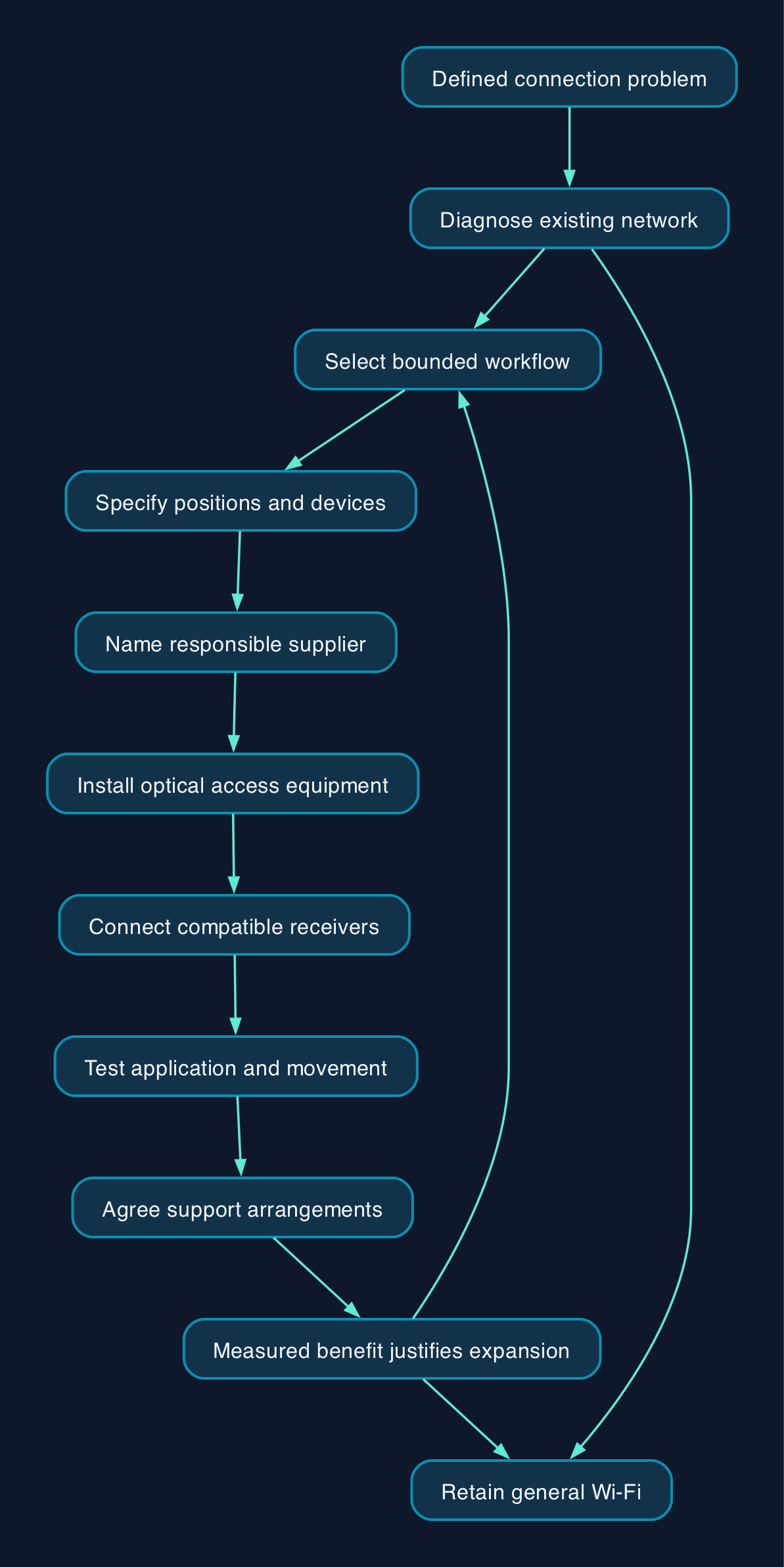
An illustrative deployment would connect optical access equipment to the business network and compatible receivers to the selected devices. The NHS trial describes a Power over Ethernet lighting design, using network cabling to supply power as well as connectivity.
That is one architecture, not a requirement for every LiFi product. For example, the published LiFi Cube description specifies an infrared link independent of room lighting. Its surviving product page should be read as a technical description, not confirmation of present supply.
For a pilot, allocate responsibilities explicitly.
| Part of the proposed installation | Responsible party to name | Acceptance evidence to request |
| --- | --- | --- |
| Optical coverage and mounting | Installer working with facilities staff | Connection tests at every intended working position |
| Device receivers and software | Internal IT team or managed service provider | Successful operation on each approved device configuration |
| Connection to the business network | Network administrator | Tested access permissions, monitoring and fault isolation |
| Movement and fallback | Network designer and application owner | Observed behaviour when a person moves or the optical path is blocked |
| Maintenance and replacement | Contracted support provider | Written fault-response terms, spare-parts arrangements and escalation route |
Do not assume automatic fallback to Wi-Fi. Specify whether it is required and test it with the actual application. In a room intended to exclude radio communication, automatic radio fallback could also defeat the design’s purpose.
Price the installed service rather than the transmitter
A reliable GBP installation price cannot be established from the available documentation. The Kitefin Office page requests a quotation, while Signify’s specifications identify components and separately sold roaming requirements without supplying a complete installed UK price.
For procurement, ask each bidder for a GBP quotation stating VAT treatment, validity, quantities, delivery, installation and support commitments. Use the same operating period and acceptance requirements when comparing it with repairing Wi-Fi or installing a wired connection.
| Cost component | What the quotation should establish |
| --- | --- |
| Survey and design | Covered positions, obstructions, mounting and acceptance testing |
| Access equipment and receivers | Quantities, compatible devices, accessories and replacement units |
| Network and electrical work | Cabling, power, installation access and making good |
| Controllers and licences | Required features, recurring charges and renewal conditions |
| Deployment and training | Configuration, application testing, documentation and staff handover |
| Ongoing operation | Monitoring, maintenance, internal staff time and fault attendance |
| Exit | Removal, replacement connectivity and recovery of reusable equipment |
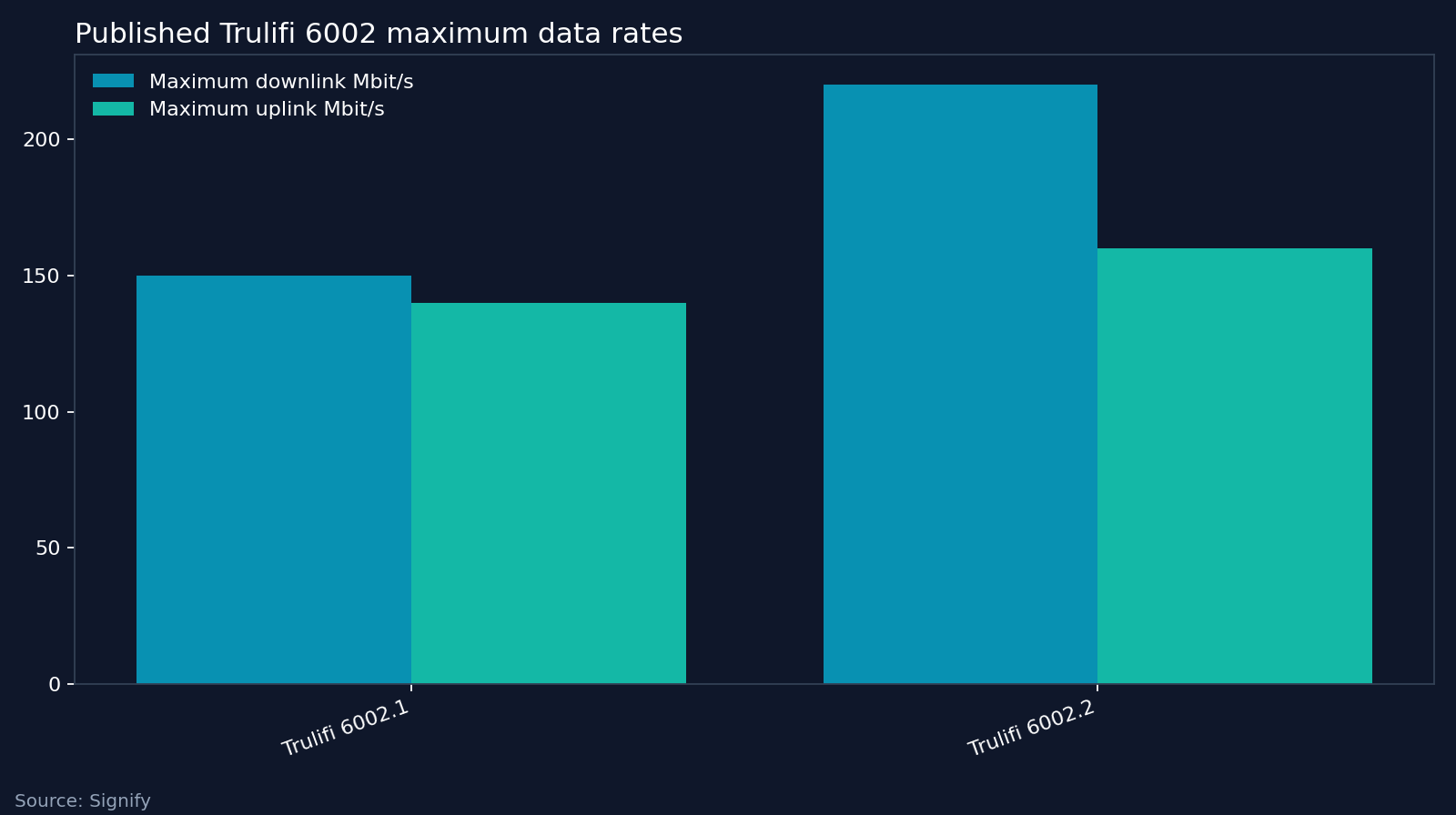
The published Trulifi rates illustrate why a single speed headline is a poor purchasing shortcut. Downlink and uplink maxima differ, and neither figure establishes how much useful throughput each person receives during simultaneous use. Require a loaded application test before accepting a capacity claim.
Compare suppliers and delivery approaches on equal terms
The available evidence supports detailed discussion of Signify and pureLiFi, but not a complete current supplier ranking. A broader manufacturer overview also identifies Oledcomm; without verified product specifications and UK delivery terms here, it is a procurement lead rather than an assessed equivalent.
| Supplier or approach | Evidence available | Buying implication |
| --- | --- | --- |
| Signify Trulifi 6002 | Documented meeting-room system, USB receivers and optional roaming arrangements | Assess desk coverage, device compatibility and the complete controller and licence bill |
| Signify Trulifi 6014 | Documented industrial point-to-point design | Assess the specific link geometry and mounting requirements rather than general office coverage |
| pureLiFi Kitefin Office and LiFi Cube | Published descriptions of office and portable optical connectivity | Historical specifications alone cannot establish a supportable new purchase |
| Oledcomm | Identified as a LiFi manufacturer, without equivalent primary product evidence in this assessment | Obtain current technical documentation, UK supply terms and a demonstration before comparison |
| Retain or improve Wi-Fi | Requires an assessment of the business’s existing installation | Price a targeted remedy against the same application requirements |
| Install a wired connection | Requires a site-specific cable route and installation quotation | Include it as an alternative for fixed equipment before deciding that wireless is necessary |
The product distinctions above come from Signify’s technical documentation, the Kitefin Office description and the LiFi Cube description.
For UK buyers, insist on a named contracting party responsible for the complete installation. Ask who handles a failure that could involve the receiver, optical coverage or the existing network. An arrangement that leaves the customer coordinating several suppliers should be costed accordingly.
Editorial analysis
LiFi’s strongest buying argument is a connection that does a particular job better under tested conditions. “The next Wi-Fi” is too vague to put into a purchase order.
The standards story supports a complementary approach. In an account of the light communications standard, the technology is described as working alongside Wi-Fi; the article also explains that reflected light can support communication in some circumstances. Buyers should therefore avoid both extremes, assuming that every optical link demands an entirely unobstructed direct path, or assuming that any room layout will work.
Optical containment should likewise be treated as one design property. Retain authentication, encryption, endpoint management and physical access controls in the specification. Require the security assessment to examine the actual room and system rather than accepting “light cannot pass through walls” as the whole threat model.
For most small and mid-sized organisations, the sensible next step is a tightly scoped trial with agreed pass and fail conditions. Select the application, device list, working positions and acceptable interruption behaviour before inviting demonstrations. Expand only when the measured benefit and support arrangements justify the additional system.
FAQ
Can LiFi replace Wi-Fi throughout a UK office?
Our recommendation is to assess selected rooms before considering a whole-office replacement. Signify’s meeting-room documentation makes the receiver, coverage and roaming requirements explicit, all of which need testing against the intended working pattern.
Does LiFi require the room lights to stay on?
It depends on the system. The published LiFi Cube specification describes infrared communication independent of room lighting, so visible illumination is not a universal requirement.
Is LiFi proven for hospital use?
The available NHS evidence describes an ambulance-station trial, not general approval for hospital or clinical-device use. A hospital should require evidence for its particular equipment and workflow before relying on the connection.
What should a small business ask for before buying?
Ask for a demonstration using its own devices and applications, followed by a complete installed quotation and written support terms. For systems such as Trulifi 6002, establish whether the proposed design needs separately sold controllers and licences, then test movement and connection loss before acceptance.
Sources
- pureLiFi — announcement of cessation of trading and administration
- pureLiFi — announcement of the IEEE 802.11bb light communications standard
- Signify — Trulifi product documentation and specifications
- NHS England Digital — Li-Fi and Internet of Things in ambulance stations
- pureLiFi — LiFi Cube product description
- pureLiFi — Kitefin Office product description
- Wikipedia — Li-Fi manufacturer overview
- Spectrum — Wi-Fi Boosts New, Ultrafast Li-Fi Standards, 5 August 2023