UK AI adoption programmes give technology partners a delivery opportunity
UK AI adoption support gives technology partners an opening to deliver practical implementation. Small businesses should demand measurable pilots, clear responsibilities and full costs before committing.


UK AI adoption programmes create an opening for managed service providers, resellers and consultants willing to take responsibility for implementation. Our view is that the strongest offer combines a specific business problem, a controlled pilot and ongoing support. The government’s announced expansion of adoption funding strengthens that opportunity, but small businesses should buy against measurable results and clear responsibilities, with funding eligibility checked separately.
The opportunity starts with an identifiable business problem
For a UK small business, the useful question is whether a particular task deserves investment. A technology partner should be able to identify the task, establish its present cost and explain what would justify changing it.
The government’s adoption research supports this starting point. Its survey covered 3,500 businesses and identified lack of an identified need and limited AI skills as common barriers. Respondents were people responsible for technology, so the research explicitly did not capture unauthorised or unreported staff use of AI. Research methods and findings
Our interpretation is that partners have an opportunity to sell useful diagnosis. That diagnosis must be allowed to conclude that the business should improve its existing software, tidy its records or leave a process alone.
Consider a hypothetical small wholesaler struggling to answer delivery enquiries. Before proposing an assistant, a consultant should establish whether order records are accurate and accessible. If staff cannot reliably locate an order’s status, connecting an AI tool to those records does not resolve the underlying problem.
The paid deliverable should be a decision the owner can act on, including a defensible reason to stop.
Separate programme announcements from available support
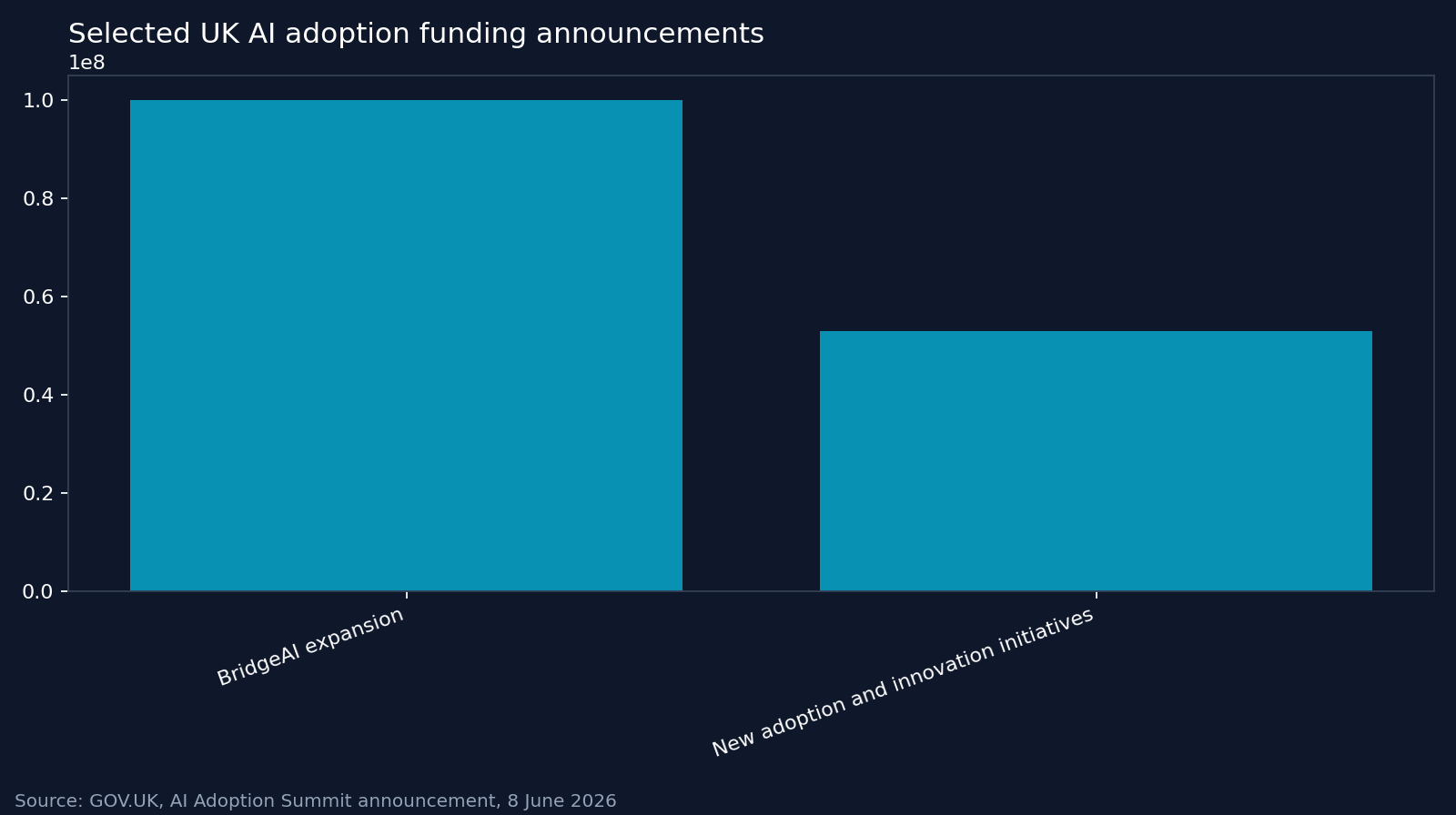
The June adoption package announced £100 million for BridgeAI expansion and £53 million for other adoption and innovation initiatives. It also described support for skills, assurance and practical implementation. That creates a policy direction around which partners can develop services; it does not establish an open procurement route for every provider. Government funding announcement
BridgeAI’s own programme page describes connections between businesses and AI experts, alongside funding, training and support opportunities. Partners serving its priority sectors have a reason to investigate participation and referrals. They still need to establish the terms of the particular opportunity before including public support in a customer proposal. BridgeAI support and sector focus
The SME Digital Adoption Taskforce’s June update reported roundtables to develop a further support package for announcement later in the year. That wording describes work in progress. It should not become a sales claim that a finished service is already available. Taskforce progress update
Dates matter at the individual scheme level. The supplied feasibility competition is closed, while the cited bespoke advice opportunity lists a closing date of 30 July 2025. Neither establishes an intake available today. Feasibility competition status, bespoke advice registration dates
For buyers, insist that a proposal identifies the exact scheme, eligibility conditions and funding decision required. Keep an affordable fallback if an application fails.
Give consultants, resellers and MSPs distinct responsibilities
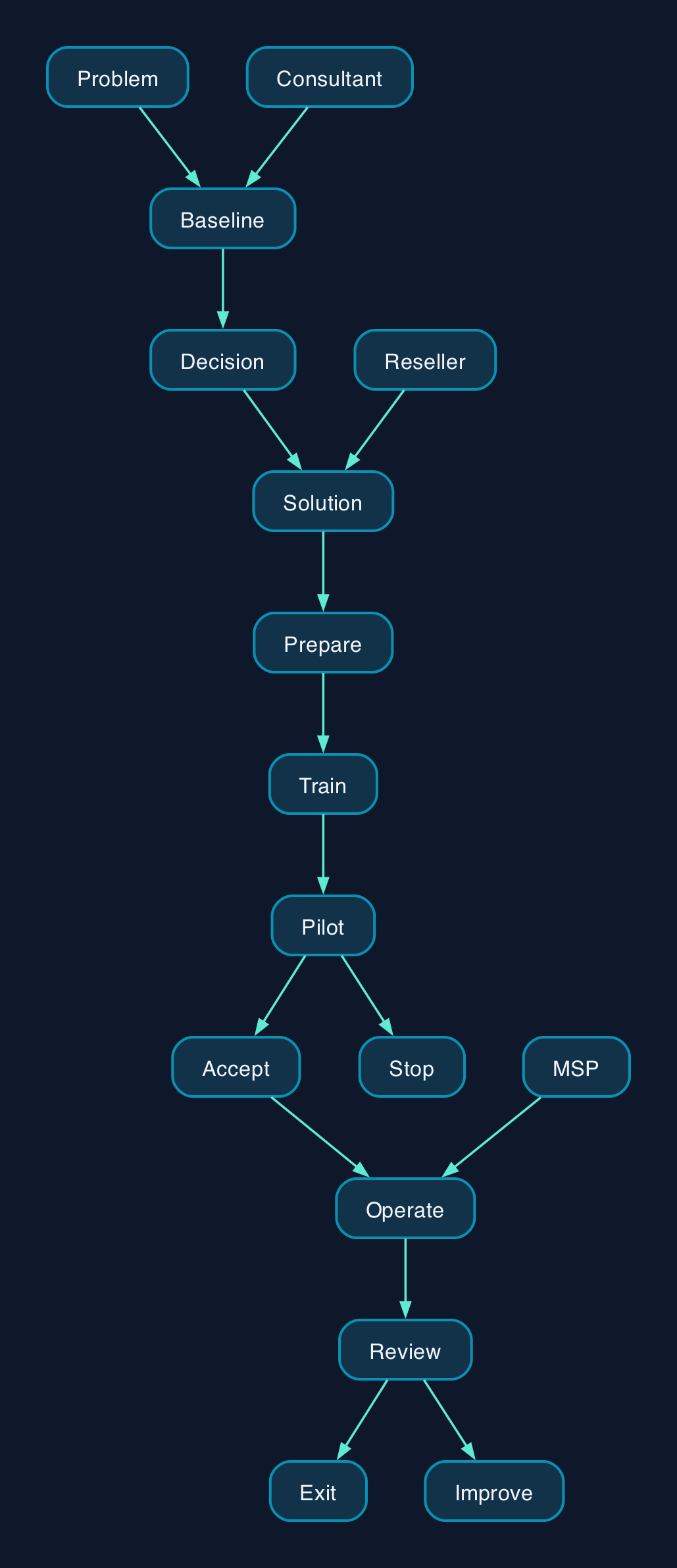
BridgeAI’s framework begins by asking whether AI is suitable, then addresses data, development and implementation. Its final phase includes maintenance and improvements. That sequence provides a useful basis for dividing commercial responsibilities. BridgeAI adoption framework
The following is our proposed delivery model, not an official programme requirement.
| Delivery stage | Lead responsibility | What the customer should receive |
| --- | --- | --- |
| Diagnose the problem | Consultant with the business process owner | A baseline, options and a recommendation to proceed or stop |
| Select the solution | Reseller or procurement adviser | Comparable proposals, licence conditions, exclusions and declared commercial incentives |
| Prepare and connect | Implementation specialist | Documented data access, tested connections and a recovery procedure |
| Train and accept | Partner with staff who perform the task | Practical exercises, exception handling and signed acceptance criteria |
| Operate and review | Managed service provider, or MSP | Named support contacts, monitoring scope, escalation and periodic outcome reviews |
| Exit or replace | Customer owner with the incumbent provider | Exported information, documentation, revoked access and agreed handover work |
One company may perform several roles. The contract should still identify who owns each obligation.
For a hypothetical construction business, a pilot might help staff find information in approved project documents. The customer should control which documents enter the system, who may search them and who checks answers before use. The provider should demonstrate those boundaries using representative tasks before requesting wider deployment.
Sector knowledge becomes valuable when the partner can identify consequential mistakes and design an appropriate review process. A generic demonstration cannot settle that question.
Charge for work the customer can inspect
Free foundational training changes the case for paid instruction. The January announcement made courses available to all UK adults and set the programme’s target at 10 million workers by 2030, including at least 2 million SME employees. Government and industry training offer
Our judgement is that partners should direct customers towards suitable free foundations, then charge for applying those skills to the customer’s actual work. Staff need to practise handling an incorrect answer, recognising unsuitable inputs and escalating a failed process.
No supplier pricing or service quotations are established by the available evidence. Buyers should therefore request an itemised GBP quotation, with VAT treatment, covering the following costs.
| Cost component | What to establish before approval |
| --- | --- |
| Assessment and pilot | Deliverables, customer staff time, test scope and stopping conditions |
| Software and usage | Edition, charging unit, commitment, allowances and overage controls |
| Data and integration | Record preparation, connection work, permissions and responsibility for changes |
| Training and supervision | Included sessions, review workload and support for new starters |
| Ongoing operation | Support hours, monitoring, incident handling and excluded remedial work |
| Exit | Export formats, documentation, transition assistance and termination charges |
Compare costs over the same contract period. Include internal staff time and retained review work, and distinguish one-off setup from recurring charges.
An MSP should justify a recurring fee with recurring obligations. Reviewing failures, controlling usage and maintaining connections are inspectable services. A subscription described only as “AI support” leaves too much room for disagreement.
Keep supplier choice open
Government participation provides no basis for choosing a product winner. Google, Anthropic, Microsoft and OpenAI appear as signatories to a government collaboration statement in the June announcement. The supplied evidence does not compare their product prices, integrations or suitability for small businesses. Government and technology company collaboration
Likewise, the SME Digital Adoption Taskforce included representatives from Xero, Sage and Intuit. That establishes participation in the policy discussion, not endorsement of a particular accounting product or AI feature. Taskforce membership
A fair procurement exercise should compare relevant proposals involving those suppliers with UK specialists and open-source approaches where suitable. Use the same customer tasks, acceptance criteria and cost period. Require each bidder to demonstrate supported connections, access controls, output quality and export arrangements.
Start with an existing supplier when the proposed work sits inside a system the business already uses, but test that proposal against alternatives. Consider a specialist when the task demands sector expertise. Consider a self-hosted approach only after naming who will maintain it and pricing that responsibility.
These are selection principles. The available sources do not support a feature ranking or a recommendation for a specific edition.
Editorial analysis
The strongest opportunity is ownership of the work between a promising demonstration and a dependable business process.
That view fits the advanced manufacturing plan’s emphasis on moving from pilots into sustained adoption, including workforce capability and organisational readiness. It remains a proposed pathway, rather than proof of commercial returns for technology partners. Advanced manufacturing adoption plan summary
There is a commercial counterargument. Free training and publicly supported advice may reduce what customers will pay for introductory consultancy. Small projects may also become uneconomic if every deployment requires extensive bespoke work.
Partners should respond with a bounded offer around a recurring sector problem. Reuse the assessment method, test process and support documentation, while checking each customer’s data and working practices separately.
For buyers, the most revealing question is what happens when the pilot misses its target. A credible partner will have an answer covering payment, rollback and the decision to stop. That answer is more useful than a promise to secure a share of a national funding announcement.
FAQ
Can an MSP obtain funding directly through these programmes?
The evidence does not establish a general entitlement for MSPs or resellers to receive funding. BridgeAI describes funding and collaboration opportunities, but eligibility must be checked against the specific opportunity. Customers should request that evidence before accepting a funding-dependent proposal. BridgeAI programme
Is free AI training enough for a small business?
The government offer covers foundational skills, including practical uses such as drafting and administrative tasks. Our view is that a business should then test staff competence against its own work, including errors and exceptions. Paid training should specify what it adds to the available foundations. AI skills programme announcement
Which sectors should technology partners investigate first?
BridgeAI identifies agriculture and food processing, construction, creative industries, and transport, logistics and warehousing as priority sectors. That gives partners a starting point for investigating relevant support, rather than evidence of guaranteed demand. Begin where the partner can demonstrate knowledge of the customer’s workflow and delivery constraints. BridgeAI priority sectors
What should a small business ask a prospective AI partner to deliver?
Request a baseline, a bounded pilot, named responsibilities and an itemised cost model. Agree the acceptance test and exit arrangements before expanding the work. This recommendation follows the progression from strategy and data through implementation and maintenance described in the BridgeAI framework. AI adoption support framework
Sources
The article uses supplied source extracts reviewed on 28 September 2026. Dates below are publication, update or closing dates stated in those extracts; live application availability was not independently rechecked.
- GOV.UK, Government to partner with tech companies, trade unions and industry leaders to boost AI adoption and equip workers with AI skills, published 8 June 2026.
- Innovate UK Business Connect, BridgeAI, publication date not stated in the supplied extract.
- GOV.UK, Free AI training for all, as government and industry programme expands to provide 10 million workers with key AI skills by 2030, published 28 January 2026.
- GOV.UK, AI Adoption Research, updated 13 February 2026.
- Innovate UK Business Connect, Support for all stages on your AI journey, publication date not stated in the supplied extract.
- GOV.UK, AI Champions’ Adoption Plans summaries, published 8 June 2026.
- Innovation Funding Service, Feasibility studies for AI solutions Series 2, competition closed 8 May 2024.
- GOV.UK, SME Digital Adoption Taskforce 2026 update, published 26 June 2026.
- Innovate UK Business Connect, Bespoke AI and Data Science Advice for SMEs, registration closed 30 July 2025.
- GOV.UK, SME Digital Adoption Taskforce final report, published 31 July 2025.