Britain’s next delivery robot may look more like a tiny van
The next useful delivery robot could resemble a tiny van. Japan’s roadmap gives British logistics firms a reason to examine consolidated loads, depot access and dispatch software, while demanding proof that bigger vehicles improve the complete service.

British logistics firms should prepare for delivery robots that carry consolidated loads between sites, rather than designing every experiment around a small grocery box. My view is that the bigger opportunity lies in connecting depots, shops and business premises. Japan’s roadmap for higher-capacity robots makes that direction credible, but British investment should depend on route economics, safe handovers and a verified basis for operation.
Key pointers
- Start with a recurring delivery route and its load profile before choosing a robot.
- Treat loading, unloading and failed-delivery recovery as part of the automation budget.
- Ask whether a larger compartment would consolidate deliveries or simply travel partly empty.
- Require route software to account for charging, loading space and human intervention.
- Make pedestrian accessibility an acceptance condition for any proposed service.
- Keep depot changes reversible until a pilot demonstrates lower costs or better service.
Japan is widening the delivery brief
The significant part of Japan’s roadmap is its choice of jobs. Alongside deliveries to homes, METI includes mobile shops and transport between businesses. Its announcement argues that larger, faster machines could increase carrying capacity and shorten delivery times, while setting out an intensive demonstration period rather than declaring the problem solved. METI’s development roadmap
That distinction matters. A robot taking groceries to a resident and a vehicle moving replenishment stock between premises have different loading patterns, destinations and service promises.
For British companies, I would prioritise the second category for investigation. A repeat journey between known loading points gives an operator something specific to measure. The question becomes whether automation improves that journey, including the work at either end.
Consider a hypothetical wholesaler moving small consignments from a depot to nearby trade counters. A larger robot might combine consignments that would otherwise require separate movements. But that advantage disappears if the receiving staff cannot unload it promptly, or if consolidation delays urgent orders. The vehicle’s shape matters less than the delivery schedule it can actually fulfil.
The tiny van is therefore a useful design direction, not a forecast that every pavement robot will grow wheels and join the carriageway.
British deployment needs its own evidence
METI explicitly warned that the robots demonstrated at its event were not thereby guaranteed permission to operate on Japanese public roads. Its proposed specifications should not be mistaken for a completed approval process. METI’s demonstration qualification
The supplied evidence also does not establish a current UK approval route for the larger vehicles envisaged here. Before commissioning a public-route pilot, a British buyer should obtain advice covering the particular vehicle, route, operating arrangements and insurance.
Nor should buyers infer cargo permissions from passenger transport announcements. The Department for Transport’s 21 July 2025 announcement concerns a proposed permitting scheme for taxi-, private-hire- and bus-like automated passenger services.
This is not legal advice; consult your legal counsel.
Design the handovers before buying the vehicle
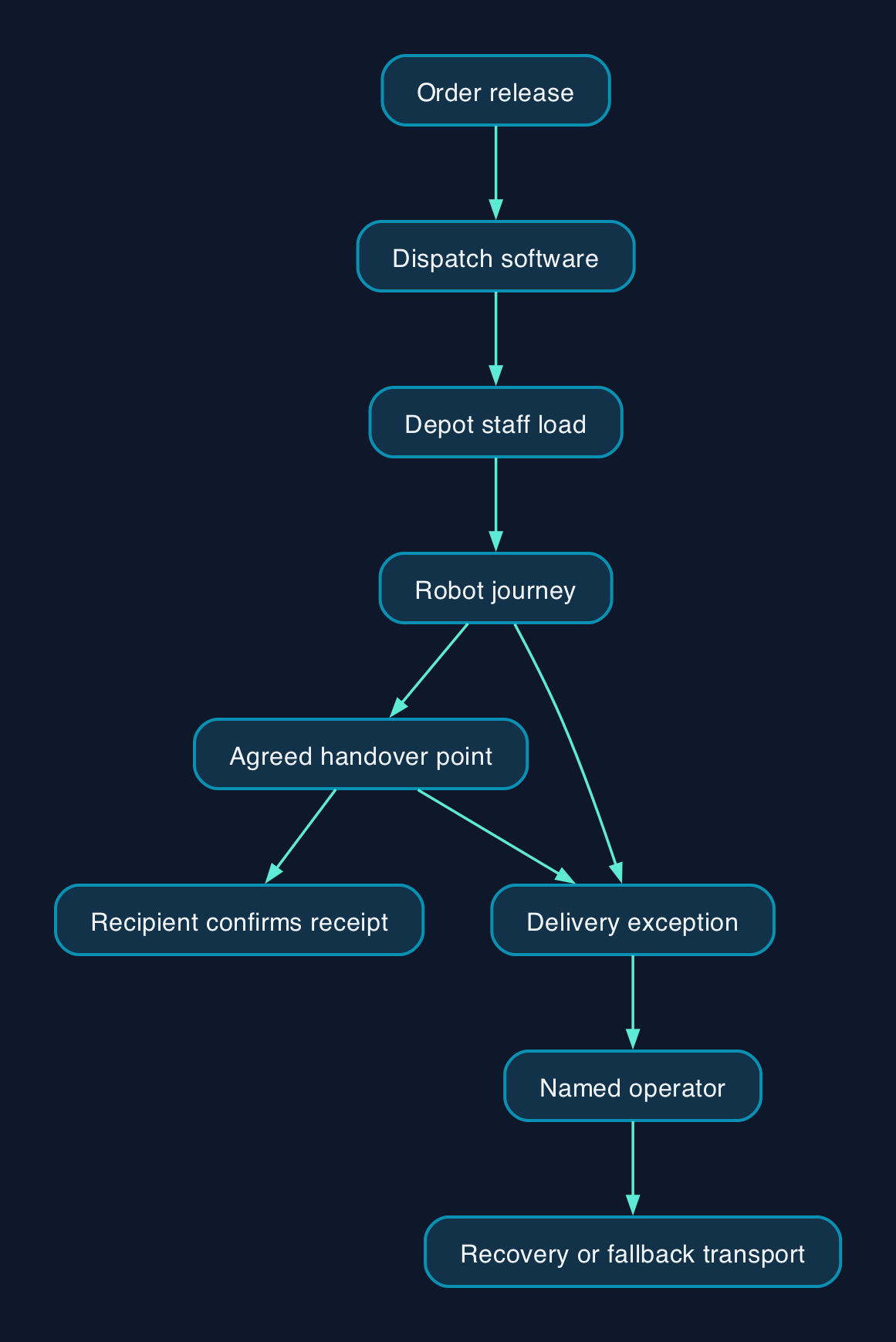
For a proposed British pilot, I would map the service from order release to confirmed receipt. Dispatch software assigns the job; depot staff load the vehicle; the robot travels to an agreed handover point; the recipient accepts the goods. A named operator owns exceptions, including a blocked route or an unavailable recipient.
Every supplier demonstration should show that entire sequence. Ask who intervenes, how quickly they respond and who physically retrieves a stranded machine.
There is evidence that fleet coordination deserves attention alongside vehicle autonomy. Rakuten said its expansion involved both new Avride robots and changes to its proprietary delivery management system to improve allocation. Its existing fleet used Cartken robots customised by Melco Mobility Solutions. Rakuten’s expansion announcement
That is a useful procurement lesson. A British retailer should ask whether its dispatch system can accommodate different vehicle capacities and operating constraints without rebuilding the order process for each manufacturer.
Loading areas deserve the same scrutiny. Before changing a depot, measure access widths, turning space, waiting time and the distance staff carry goods. Specify how charging and maintenance fit around normal deliveries. Those measurements remain useful if the eventual answer is to improve the existing van operation.
Price the complete delivery cycle
The evidence supplied contains no comparable UK quotations or independently verified operating costs for these options. It cannot support a payback claim.
A buyer can still define the quotation properly. Request separate costs for the vehicle or service subscription, integration, site preparation, charging, maintenance, remote support, staff training and recovery. Identify which costs are bundled and which rise with operating hours or deliveries.
For a pilot, my preferred measure would be total service cost divided by successfully completed deliveries over the same period. Include loading labour, supervision, unsuccessful attempts and fallback transport. Compare that result with the existing service using equivalent loads, routes and delivery promises.
Capacity should earn its place in that calculation. A larger machine creates value only where the order pattern uses the extra space or avoids another journey. A maximum speed is also not an average delivery speed.
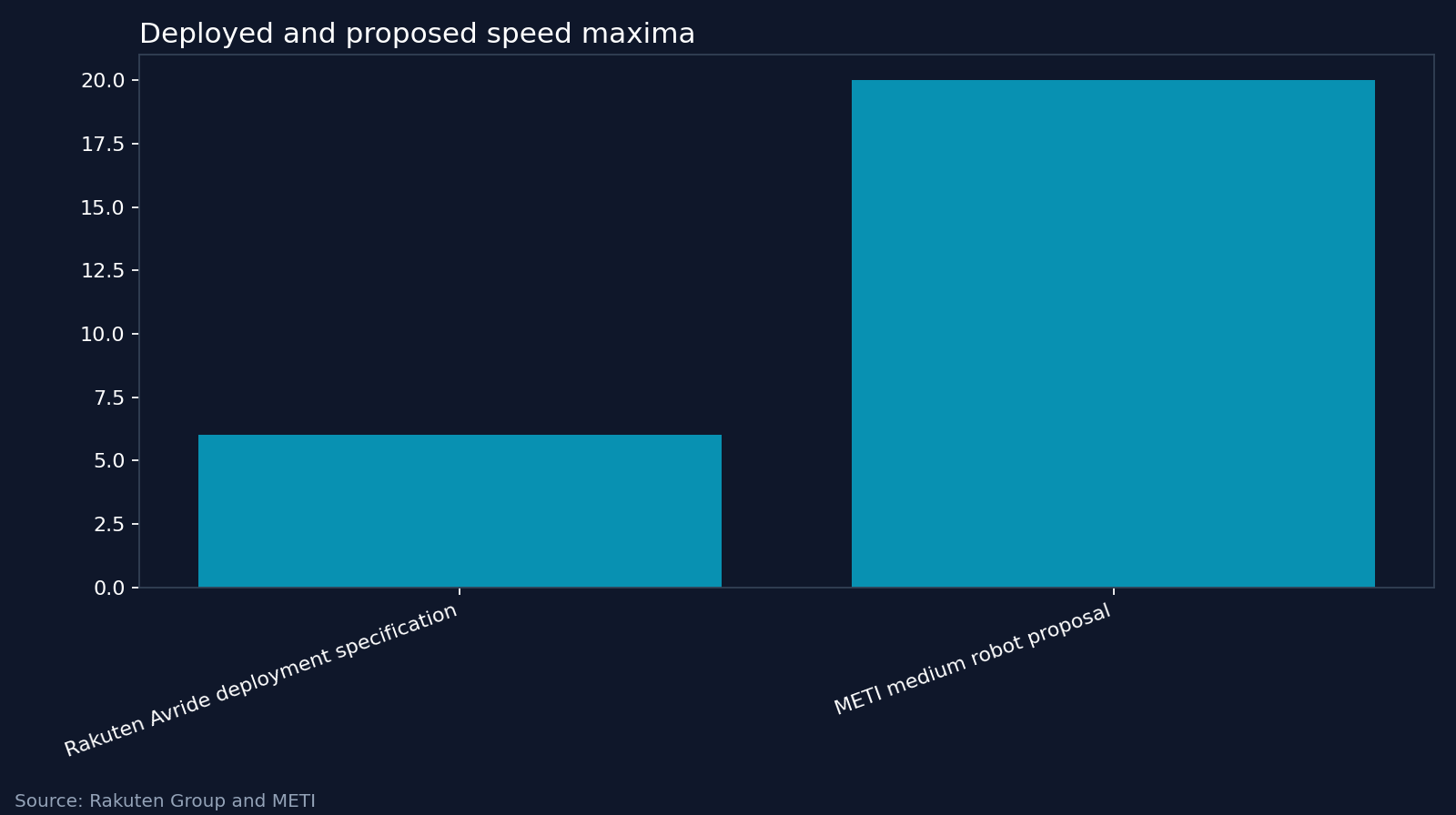
The distinction is visible in the evidence. Rakuten specified 6 km/h for its Avride deployment; METI discussed 20 km/h as a potential maximum for a different, proposed robot category. Those figures illustrate different operating concepts, not a measured productivity improvement. Rakuten specifications, METI proposal
Compare suppliers against the job they actually serve
Avride and Cartken offer relevant evidence for neighbourhood delivery through their participation in Rakuten’s service. The supplied material does not provide equivalent Cartken specifications or comparable commercial terms, so it cannot establish a winner between them. Rakuten’s fleet description
Pudu’s T300 addresses industrial material movement. Its manufacturer describes gate and lift integration alongside its load specifications. That makes it relevant to a buyer investigating movement within facilities, but its product page does not establish suitability for an outdoor British delivery route. Pudu T300 capabilities
METI’s larger road-going concept belongs in a third category. It is a development direction, not a supplier quotation or a ready-made replacement for either of those applications.
For a small British business, I would compare all proposed automation with retaining a staffed delivery service and improving dispatch. For a logistics operator with repeat movements between sites, I would investigate whether a larger vehicle could consolidate work. For a factory, internal material transport may deserve attention before public-road delivery.
These are different investment decisions. A procurement exercise should preserve those distinctions.
The strongest objection is that bigger could mean worse
A larger robot could occupy more space, require more demanding loading arrangements and introduce harder interactions with traffic. If those costs exceed the value of its extra capacity, the smaller machine is the better choice.
There is a serious accessibility objection to address too. In its June 2026 campaign, Living Streets raised concerns about pavement obstruction, particularly for wheelchair users and people with impaired sight. That is an advocacy position, not a quantified comparison of robot designs, but it identifies a practical acceptance test that buyers should take seriously.
Moving a machine towards the carriageway does not automatically answer that objection. Loading points and crossings still need examination. A service that saves delivery labour while creating barriers for other people has transferred a cost rather than removed it.
Small robots also have a credible use case. Rakuten explained that it selected its Tokyo operating area partly for broad roads and pavements, alongside population density and local shopping needs. Rakuten’s account of route selection
My argument is therefore conditional. Larger robots deserve a place in British logistics planning where consolidated loads and suitable routes justify them. They should not displace smaller devices, vans or human delivery simply because they look like the next generation.
Editorial analysis
British technology companies should pay particular attention to dispatch, handover records and exception management. Those are useful problems to solve across vehicle types, and Rakuten’s investment in allocation software provides a concrete example of the work involved.
For logistics buyers, the next step should be a route study with an operations manager, a facilities lead and whoever owns customer service. Record what moves, where it waits and who resolves failures. Use those findings to decide whether to invite a robot supplier.
The tiny van earns its place when it improves a complete delivery service. Until then, preserve the loading space, integration flexibility and operating data that will let the business make that decision properly.
FAQ
Are larger delivery robots already approved in Japan?
METI’s February 2025 announcement presented potential specifications and a roadmap for demonstrations. It explicitly said the robots shown at its event were not guaranteed permission to operate on public roads. METI’s qualification
Would a larger robot necessarily reduce delivery costs?
No. Extra capacity helps only when the workload uses it, and additional loading, supervision or recovery costs could outweigh the benefit. Require a pilot comparison based on completed deliveries and the full cost of providing the service.
Should a British business consider an industrial robot instead?
Yes, if its actual problem is moving goods within a facility. Pudu’s T300 documentation describes industrial transport and integration with gates and lifts, which is a different brief from neighbourhood deliveries. Match the procurement to the route rather than treating all mobile robots as substitutes. T300 product documentation
What should an initial pilot prove?
It should demonstrate reliable handovers, acceptable intervention demands and a measurable improvement against the existing service. Set stopping conditions for blocked access, unsafe behaviour and unresolved failures before operations begin. Expansion should depend on those results.
Sources
- METI, Future Perspectives on Autonomous Delivery Robots Compiled, 26 February 2025
- Rakuten Group, Autonomous delivery service expansion and specifications, 26 February 2025
- Pudu Robotics, PUDU T300 product documentation, undated extract supplied 28 September 2026
- Department for Transport, Next steps for self-driving vehicles, 21 July 2025
- Living Streets, Delivery robots taking over UK pavements, 27 June 2026
- Rakuten Today, Rakuten’s robot revolution rolls up on Tokyo, 17 March 2025