Britain’s last mile should split between robots and people
Japan’s delivery-robot roadmap points towards a divided last mile. British businesses should automate suitable journeys while funding the people, recovery services and accessible handovers that keep delivery working.

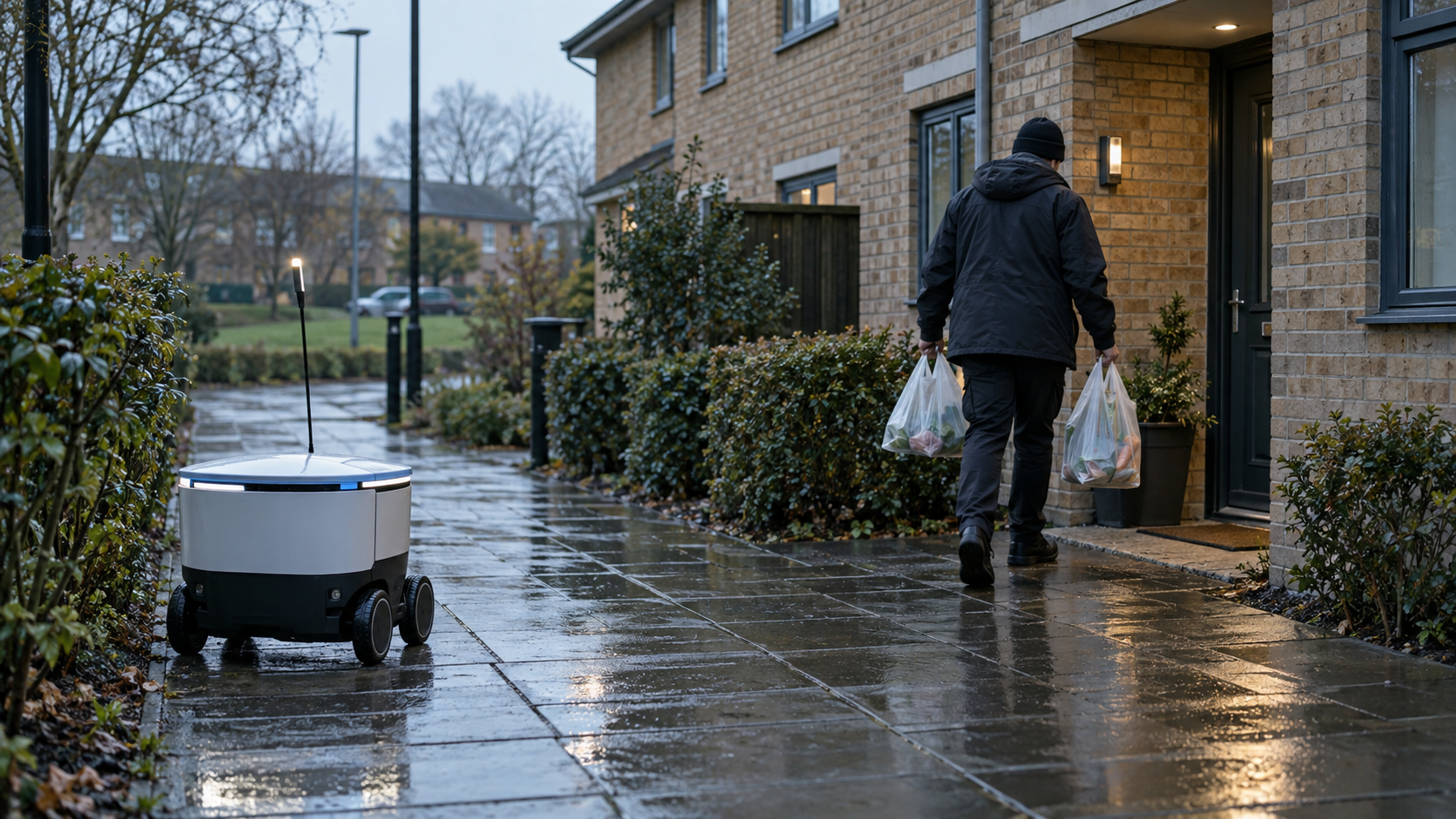
British delivery businesses should plan for robots to handle repeatable local journeys and people to handle deliveries needing judgement, access or assistance. The opportunity is to divide work by difficulty while keeping responsibility for the whole service. Japan’s delivery-robot roadmap points towards that division, but British operators should expand only where completed-delivery costs, pedestrian access and customer service justify it.
Key pointers
- Classify deliveries by route, load and handover difficulty before selecting a robot.
- Keep human delivery available for customers who cannot collect goods from a pavement.
- Ask suppliers to price remote assistance, stranded-robot recovery and failed deliveries.
- Judge the combined human and robot service against your existing delivery operation.
- Treat Japanese proposals as evidence of direction, rather than permission to deploy in Britain.
- Give an operations manager responsibility for every handover between machines and people.
Japan shows the value of a bounded delivery service
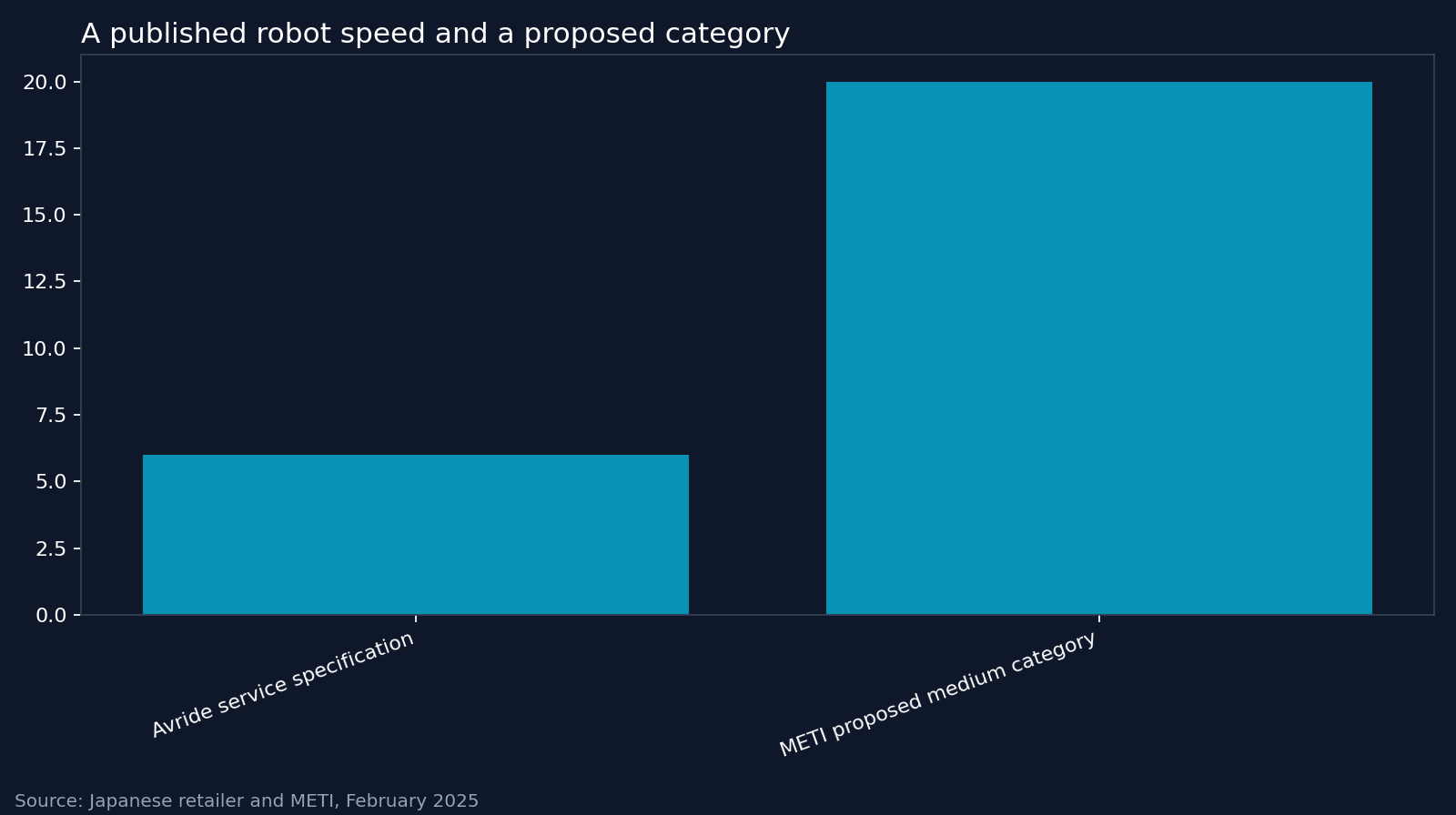
The revealing detail in the Japanese retailer’s announcement is the designated collection point. Its February 2025 service offered delivery to specified locations, supported by a delivery management system that allocated robots. That is a defined operating service with boundaries, rather than a promise to reach every doorstep.
British retailers should adopt that discipline. “Routine” should mean a suitable load, a surveyed route and a handover the customer can complete. A short journey should not qualify automatically.
Consider a hypothetical British grocer serving nearby homes. A customer who can meet a robot at an accessible collection point presents a different job from someone who needs shopping carried upstairs. The dispatch decision should capture that difference before either order leaves the shop.
Japan’s proposed higher-capacity machines broaden the question. METI envisages mobile shops and business-to-business movements alongside home delivery. That gives British technology leaders a useful alternative to the doorstep obsession: investigate repeatable movements between premises where loading and receiving responsibilities can be agreed. These are candidate applications, not proven British business cases. METI’s proposed use cases
Permission belongs to the route and jurisdiction
Japan’s roadmap does not establish a British deployment timetable. Even within Japan, METI distinguishes the small, low-speed robots permitted under the April 2023 legal changes from the higher-capacity machines under discussion. METI’s legal and demonstration context
The Vehicle Certification Agency’s guidance, updated on 22 May 2026, directs automated-vehicle trials towards the relevant Code of Practice and explains the role of exemptions for more complex trials. That general guidance should not be presented as blanket authorisation for a particular pavement delivery service. VCA trialling guidance
For a British project, establish the applicable position for the vehicle, route and operating model before committing to deployment. The evidence here does not establish a UK-wide commercial permission. This is not legal advice; consult your legal counsel.
Build one service with two ways to deliver
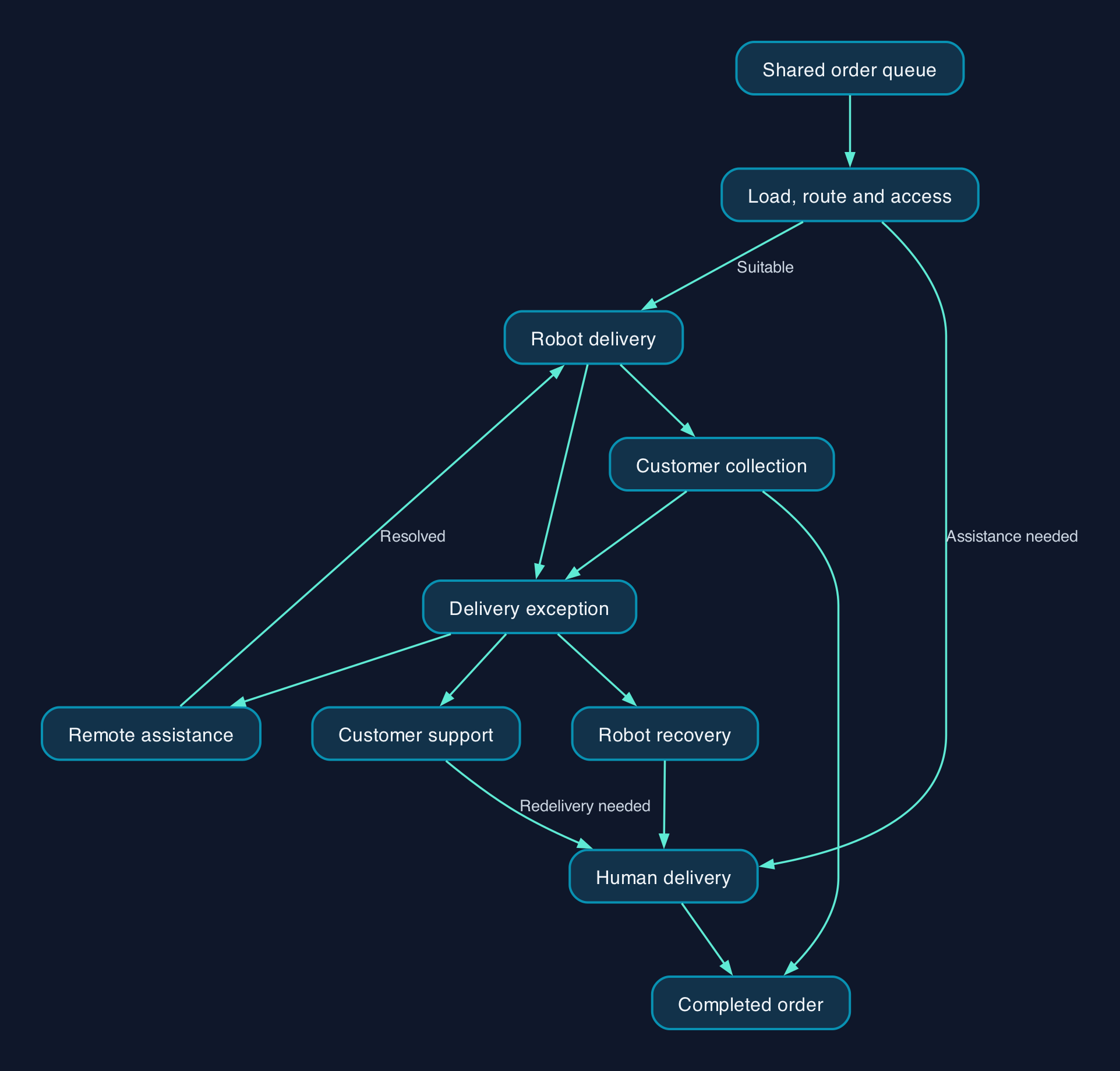
My proposed operating model starts with a shared order queue. Dispatch checks the parcel, route, customer’s collection needs and available capacity, then assigns the job to a robot or a person.
A robot job needs an explicit exception path. If the route becomes unusable or the customer cannot retrieve the order, a named team must decide whether to assist remotely, recover the robot or arrange human delivery. The retailer should retain responsibility for resolving the customer’s order throughout.
Human involvement is already visible in overseas operations. In a February 2025 interview with PYMNTS, Serve Robotics’ chief executive described employees providing remote help and people assisting with intersection crossings. That is a supplier’s account of its operation at the time, not an independently measured staffing ratio. Reported assistance arrangements
For British software teams, the useful work is connecting dispatch, assistance, recovery and customer support. Require a shared delivery record showing who has the goods, what has failed and who owns the next action. A robot’s arrival notification should never close an order that the customer has not received.
Count the labour that remains
The commercial test should be cost per successfully completed delivery across the combined service.
The retailer listed a customer delivery fee of 100 yen, including tax and excluding goods, in February 2025. That was a retail charge, not a disclosed operating cost or a British supplier quotation. It cannot establish the savings available to a UK retailer.
A British business case should include equipment or service charges, integration, loading time, charging space, maintenance, communications, remote assistance, recovery and customer support. Add the cost of maintaining human capacity for unsuitable orders and disrupted routes.
Then examine the remaining human rounds. If robots take the easiest stops, human deliveries could become more dispersed and demanding. A cheaper robot journey would not necessarily reduce the total bill.
Before a pilot, agree how to measure completed orders, assistance time, failed handovers and recovery work. Compare the result with improving the existing service through better dispatch or consolidated delivery windows. The supplied evidence supports investigating the economics; it does not prove a saving.
Compare operating models before robot brands
The available examples show different divisions of responsibility.
The announcement describes Avride machines joining an existing fleet developed by Cartken and customised by Melco Mobility Solutions. The retailer supplied its own delivery management system. Buyers examining that model should ask who owns integration, maintenance and fault resolution across those participants.
Starship Technologies provides a British reference point through the retailer and delivery-platform arrangements documented by Living Streets. Those examples establish deployments worth investigating, but do not supply equivalent commercial terms or independently comparable performance figures. Documented UK operating examples
Serve’s described operation highlights remote assistance as another purchasing criterion. An operator seeking minimal internal staffing should scrutinise the managed-service scope; a larger logistics business integrating several fleets should scrutinise interfaces, operational control and exit arrangements.
None of this evidence supports ranking the suppliers. Request comparable proposals against the same routes, hours, loads, handover requirements and recovery commitments.
The strongest objection is that two networks could make delivery worse
The strongest counterargument combines operational duplication with the use of scarce pavement space. Businesses could retain their human delivery costs, add robot support costs and make walking harder for everyone else.
Living Streets argues that pavement robots create particular difficulties for wheelchair users, visually impaired people and others who depend on unobstructed footways. That is an objection to the operating model itself, not merely a request for better publicity. The charity’s accessibility concerns
A bounded robot service only answers that objection if its boundaries protect pedestrians. Route assessment should involve disabled users, test passing space and identify places where a stopped machine would obstruct essential access. An operating plan should explain how quickly an obstruction will be removed and who will do it.
Customer accessibility matters too. A robot service that requires collection outside should preserve a human option for people who need assistance. Otherwise, the business has transferred part of the delivery job to the recipient.
Some routes should therefore remain entirely human-operated. The split is a conditional operating choice, not a target percentage of jobs to automate.
Editorial analysis
British companies should invest first in understanding delivery exceptions. Record why jobs require assistance, which routes repeatedly fail and what customers need at handover. That information can improve today’s dispatch operation and reveal where a robot trial might earn its place.
The human network should be staffed and priced as a service requiring judgement. Removing routine journeys must not become an excuse to leave drivers with an unmanageable concentration of difficult stops.
The decision to expand should rest on whether the whole service becomes more dependable and affordable while preserving access. A successful machine journey is only one part of that result.
FAQ
Will delivery robots replace British couriers?
My expectation is selective substitution on suitable journeys, with people retained for assistance, difficult access and recovery. The cited Japanese roadmap identifies particular applications and demonstrations, rather than proving that complete delivery networks can dispense with couriers. METI’s deployment approach
Which deliveries should a small retailer investigate first?
Start with repeat orders involving manageable loads, surveyed routes and customers who can use an agreed collection point. The designated-location model offers a documented example of bounded delivery, although its Tokyo operation does not establish suitability for a British neighbourhood.
Are robots already cheaper than human delivery?
The evidence supplied does not establish comparable UK costs per completed delivery. Ask for a quotation covering assistance, maintenance, recovery and integration, then measure the combined service against the existing operation.
What should stop a pilot from expanding?
Expansion should stop if the service obstructs pedestrian access, leaves customers without suitable assistance or fails its agreed cost and completion tests. Those acceptance conditions should be written before deployment, with an accountable manager able to suspend robot dispatch.
Sources
- METI — Future Perspectives on Autonomous Delivery Robots Compiled, 26 February 2025
- Japanese retailer — Autonomous delivery service expansion and specifications, 26 February 2025
- Living Streets — Delivery Robots, supplied extract dated 28 September 2026
- Vehicle Certification Agency — Automated Vehicles Trialling, updated 22 May 2026
- PYMNTS — Can Delivery Robots Solve Last-Mile Logistics Issues?, 3 February 2025