Britain should build the businesses that service spacecraft
Japan's debris-removal programme and Europe's servicing projects point towards a business around existing spacecraft. British firms should pursue specific engineering contracts while testing the economics of repeat services.


Yes. Britain should build orbital servicing businesses by starting with inspection and debris removal, where missions are already testing the engineering, and then developing towards repair. The commercial case depends on paid missions and demonstrated capability. Japan’s ADRAS-J2 mission targets a launch between April 2027 and March 2028, but repeatable services will require customers who can justify the cost.
Key pointers
- Choose a specific customer problem, such as inspecting an uncertain object or removing a failed satellite, before developing a servicing product.
- Ask prospective partners which capabilities have flown successfully and which remain development objectives.
- Build a revenue case around an identified payer and acceptance criteria, rather than the overall amount of debris.
- Include testing, launch, mission operations and failure recovery when assessing commercial viability.
- Treat accessible capture interfaces and usable spacecraft records as design questions for future procurement.
- For a smaller British supplier, consider supplying one qualified component or software capability before attempting a complete mission.
Japan is testing a business Britain should help build
The useful development in Japan is the progression from examining an existing object to attempting its removal. Astroscale says ADRAS-J2 will approach the rocket body previously inspected by ADRAS-J, capture it using robotic arm technology and remove it from orbit. Its selected launch provider is Germany’s Isar Aerospace, with departure planned from Andøya Space in Norway. This is a Japanese mission with a European launch arrangement, illustrating how the work crosses national supply chains. The launch announcement sets out those roles.
For British technology businesses, my argument is to pursue the tasks inside that operation. A company considering this market should identify whether it can improve relative navigation, image interpretation, capture mechanisms, propulsion control or the software that decides when an approach has become unsafe. Those are narrower propositions than promising to build an entire orbital maintenance business.
There is already a direct UK connection. Astroscale Ltd, the group’s UK subsidiary, has selected Isar Aerospace for its ELSA-M demonstration. The announced mission involves capturing and removing an end-of-life Eutelsat OneWeb satellite, with UK Space Agency support through a European Space Agency programme. Astroscale says it is funding the majority of the mission itself. That funding and delivery arrangement gives British suppliers something more concrete to investigate than a distant market forecast.
The immediate question for a business owner is therefore specific. Which mission requirement could your company satisfy, and which organisation has the budget and authority to buy it?
Inspection comes before the robotic arm
Orbital servicing starts with uncertainty about the object being approached. ADRAS-J’s target did not provide its own GPS data, so the initial approach used ground-based observations of its approximate orbit. The spacecraft then had to gather information about the rocket body’s movement and condition. Astroscale’s launch account describes that dependency.
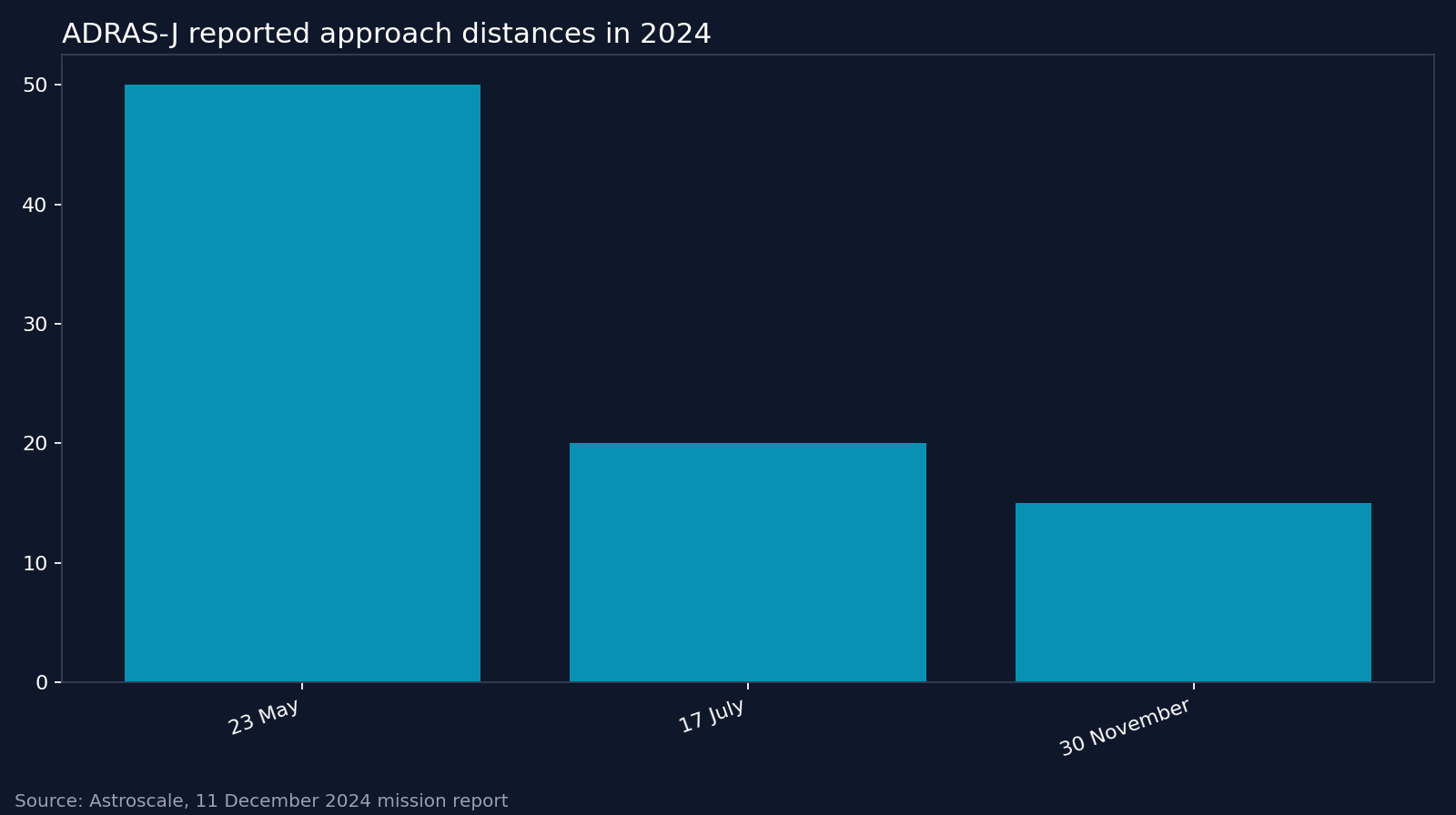
The reported approach milestones make the progression tangible. ADRAS-J reached 50 metres on 23 May 2024, 20 metres on 17 July 2024 and approximately 15 metres on 30 November 2024. These are individual mission milestones, rather than a measure of commercial readiness. The December mission report records all three.
That final approach also exposes the engineering buyers should examine. An unexpected relative attitude anomaly, concerning orientation, triggered an autonomous abort. ADRAS-J withdrew safely before reaching its intended capture initiation point. The same report says the inspection observations helped assess the structure intended for a later capture. Successful retreat and useful inspection data were both outcomes.
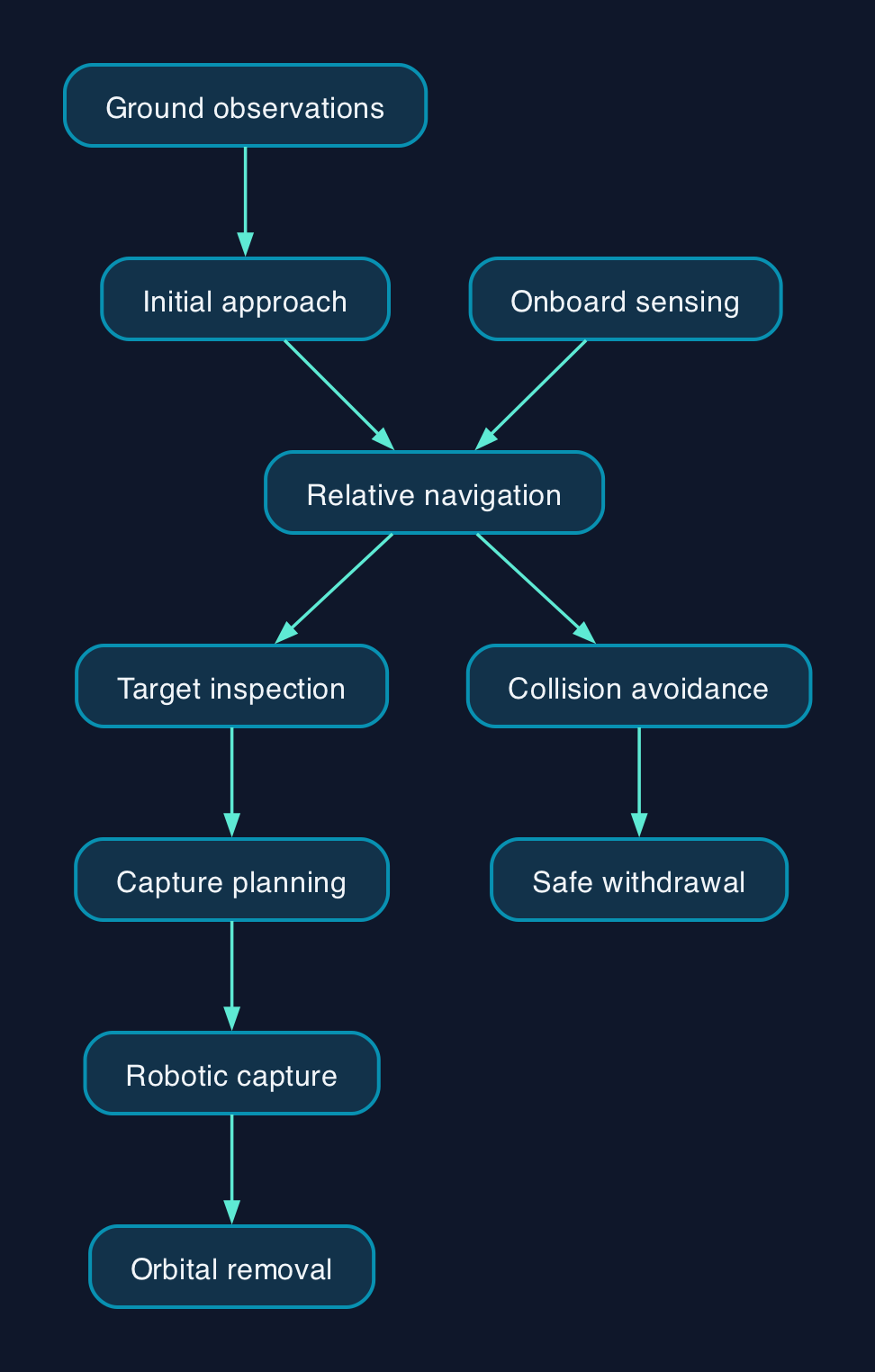
This suggests a practical division of work. Ground observations support the initial approach; onboard sensing supports relative navigation; inspection informs capture planning; and collision avoidance must remain able to interrupt the operation. Capture and removal then add further tasks. A prospective UK supplier should be able to explain exactly where its product fits and what evidence proves that it works under the relevant conditions.
Repair remains a further proposition. Removing a rocket body does not demonstrate that a spacecraft can replace a failed component or refuel another satellite. ESA’s original ClearSpace announcement identified servicing and refuelling as possible applications of related technologies, but described them as a future direction. That distinction matters when assessing the repair-market thesis.
The commercial question is who pays
A difficult engineering problem becomes a business opportunity when someone purchases a defined outcome. JAXA’s approximately 13.2 billion yen contract, including tax, was announced in August 2024 for the second phase of its debris-removal demonstration. It is evidence of a funded development programme, not a published price for routine removal. The contract announcement describes its purpose.
ESA’s €86 million agreement, announced in December 2020, offers a different commercial lesson. The agency bought a removal service from a ClearSpace-led team and stated that the company would raise the remaining mission funding commercially. The original announcement explicitly explains the service procurement approach.
Those amounts should not be ranked as competing quotations. They concern different missions, contract dates, currencies and funding arrangements. Neither establishes a current British price per satellite removed or a reliable margin for a future operator.
For a UK entrant, the cost model should include development, qualification testing, integration, launch access, mission operations, insurance requirements and contingency work. A component supplier should also price the engineering support demanded by its customer, including documentation, investigation of anomalies and changes to the mission design.
I would require an investment proposal to name the buyer, define acceptance and explain who pays when the target or launch date changes. A demonstration contract can finance useful expertise. Repeat orders require a separate commercial case.
Compare mission responsibilities before suppliers
Astroscale and ClearSpace provide distinct routes into the servicing argument. Astroscale’s Japanese programme links completed inspection work with a planned removal attempt; its UK ELSA-M programme targets the removal of a constellation satellite. ADRAS-J2’s announced scope and ELSA-M’s proposed demonstration should be evaluated separately.
The ClearSpace-1 programme offers another engineering route. Its October 2024 presentation, involving ESA, OHB System and ClearSpace, describes objectives spanning approach, inspection, collision avoidance, synchronised motion, capture and relocation. It also records a change from Vespa to PROBA-1 after a debris collision increased the risk associated with the original target. That revised technical baseline supersedes the target described in the earlier material.
The available ClearSpace evidence does not establish its September 2026 delivery schedule, so the original 2025 launch plan should not be treated as current. What the documents support is a comparison of procurement approaches and engineering objectives.
Launch suppliers occupy a different position. Rocket Lab launched ADRAS-J in February 2024, while Isar Aerospace has been selected for ADRAS-J2 and ELSA-M. The completed ADRAS-J launch and ADRAS-J2 agreement show why servicing remains dependent on launch capability. British businesses should identify whether their customer is the mission operator, spacecraft integrator or launch provider before treating these organisations as interchangeable prospects.
The strongest objection is that replacement may remain cheaper
The strongest commercial objection is straightforward. An operator might prefer a replacement spacecraft to a servicing mission, particularly when repair would preserve an ageing asset while replacement could deliver new capability. The evidence here does not establish that servicing wins that calculation.
Debris removal also presents a harder revenue question than restoring a customer's productive asset. A proposal must explain why its buyer will pay for the particular removal, rather than relying on the general benefit of a safer orbital environment.
My response is to make the investment thesis narrower. British companies should develop capabilities with defined mission customers and test whether those capabilities can support further orders. Inspection software, navigation systems or capture hardware should earn investment through requirements, qualification evidence and contracts.
Servicing also cannot sensibly be presented as the end of launch demand. The cited missions require launches themselves. The opportunity is a broader range of work around objects already in orbit, with launch remaining part of the delivery cost.
Editorial analysis
The most useful long-term change would be to make serviceability a purchasing requirement. Satellite buyers could ask how a future servicer would identify the spacecraft, assess its condition and attach to it. They could also require an explanation of what records and interfaces would remain available after a failure.
That is a recommendation for future procurement, not a claim that a universal servicing system already exists. ADRAS-J2’s intended target was never prepared for removal, while inspection of its proposed capture point has informed the follow-on mission. The mission account shows the value of knowing what a robot will encounter.
Britain should pursue orbital servicing because it offers specific engineering work around existing assets. The next sensible step for an interested technology company is a paid, bounded feasibility project with a mission customer, ending in agreed technical requirements and a decision on qualification. A repair economy will become credible through those purchasing decisions.
FAQ
Does ADRAS-J2 prove that satellites can already be repaired?
No. ADRAS-J2 is intended to capture and remove an existing rocket upper stage, and its launch is targeted for Japan’s fiscal year 2027. Its stated mission does not demonstrate component replacement or routine repair.
Where could a small British technology company participate?
A sensible starting point is a specific capability such as image processing, navigation software, testing or a capture subsystem. The ClearSpace-1 technical objectives show how many separate functions a removal mission must perform. The commercial recommendation is to secure a customer requirement before funding substantial development.
Can the announced contracts establish a price for orbital servicing?
No. The JAXA contract announcement and ESA agreement concern specific demonstration programmes. Their different scope and funding arrangements prevent a meaningful comparison as routine service prices.
What should a buyer ask a prospective servicing supplier?
Ask which relevant operations have been demonstrated, how the system detects unsafe conditions and who controls the decision to abort. ADRAS-J’s reported autonomous withdrawal illustrates why safe failure handling belongs in the assessment. Require clear acceptance criteria, responsibilities and treatment of mission changes alongside the technical proposal.
Sources
- Astroscale, Astroscale Japan Selects Isar Aerospace to Launch ADRAS-J2, 01 September 2026.
- Astroscale, ADRAS-J Achieves Historic 15-Meter Approach to Space Debris, 11 December 2024.
- Astroscale, Contract for Phase II of JAXA’s Commercial Removal of Debris Demonstration Program, 20 August 2024.
- European Space Agency, ESA purchases world-first debris removal mission from start-up, 01 December 2020.
- ESA, OHB System and ClearSpace, ClearSpace-1 In-Orbit Demonstration Mission, 08 October 2024.
- Astroscale, ELSA-M In-Orbit Demonstration Launch Agreement, 16 March 2026.
- Astroscale, Successful Launch of ADRAS-J, 19 February 2024.