AI Growth Zones should change your hosting shortlist before your postcode
AI Growth Zones could broaden the UK hosting market. Smaller companies should use them to widen supplier shortlists, then judge actual capacity, support responsibilities and total cost.


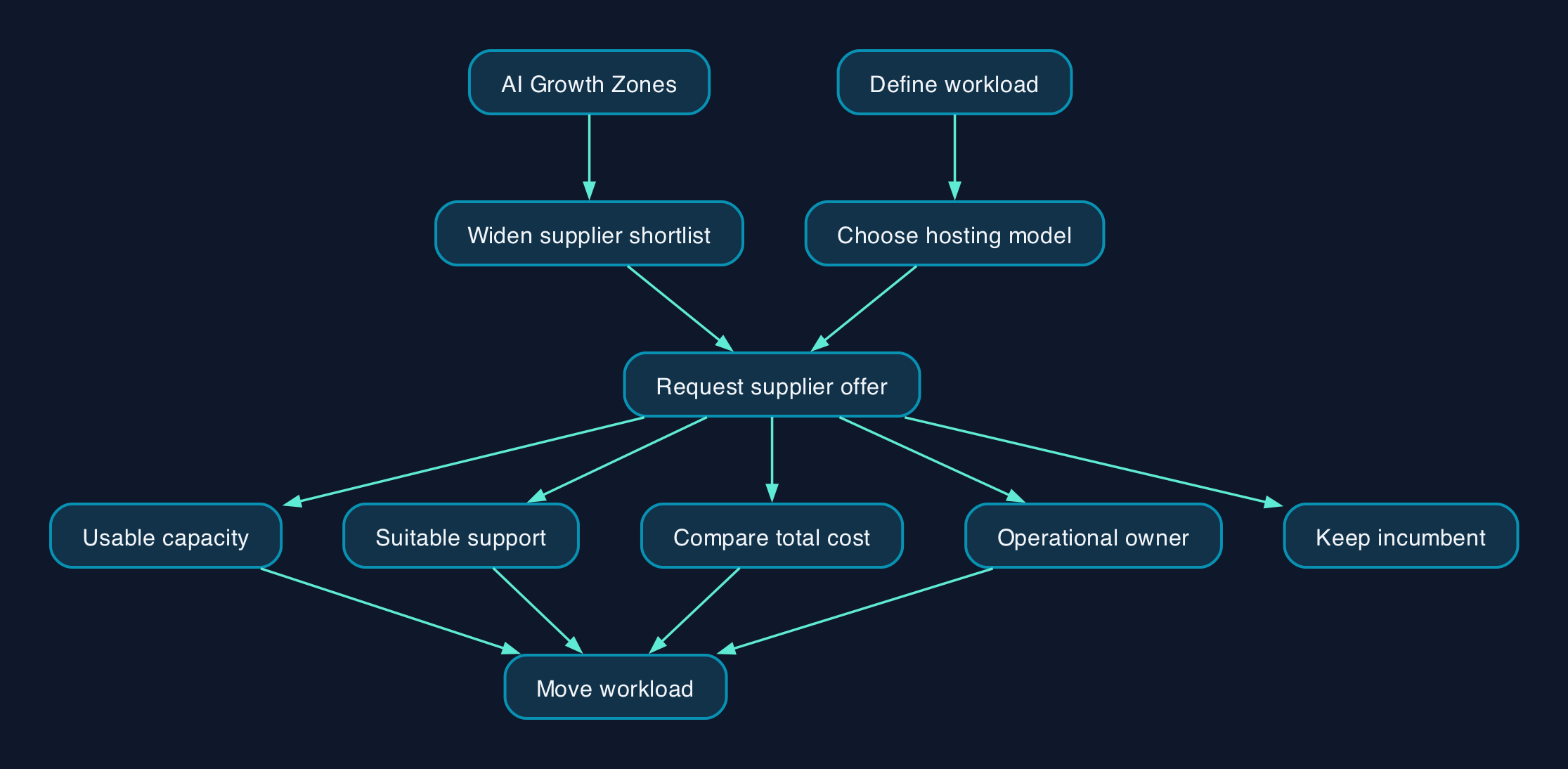
AI Growth Zones could change where British companies buy GPU hosting by supporting new infrastructure beyond their existing supplier networks. The government’s policy targets power access, planning delays and selected operating costs. Our view is that small and mid-sized companies should widen their procurement shortlist, but move workloads only when a supplier can demonstrate usable capacity, suitable support and a better overall deal.
The buying opportunity is broader competition
For a British company, the useful question is whether these zones will produce another credible supplier for its workload. A new regional facility matters commercially when it offers capacity, contract terms or operational support that improve the buyer’s options.
The government’s delivery policy explicitly connects infrastructure development with faster power access, planning changes and targeted operating-cost support. Our inference is that successful delivery could broaden the geography of viable hosting. It does not follow that every customer will receive a cheaper GPU hour.
Consider a hypothetical engineering consultancy running occasional simulation jobs alongside an AI development project. We would recommend testing a rented service before committing to hardware ownership. A mid-sized software company with a measured, sustained workload should also investigate dedicated hosting or colocation, provided someone has responsibility for operating the equipment.
Those recommendations turn on workload and staffing. A Growth Zone address should enter the comparison after those requirements are clear.
Read the capacity announcements carefully
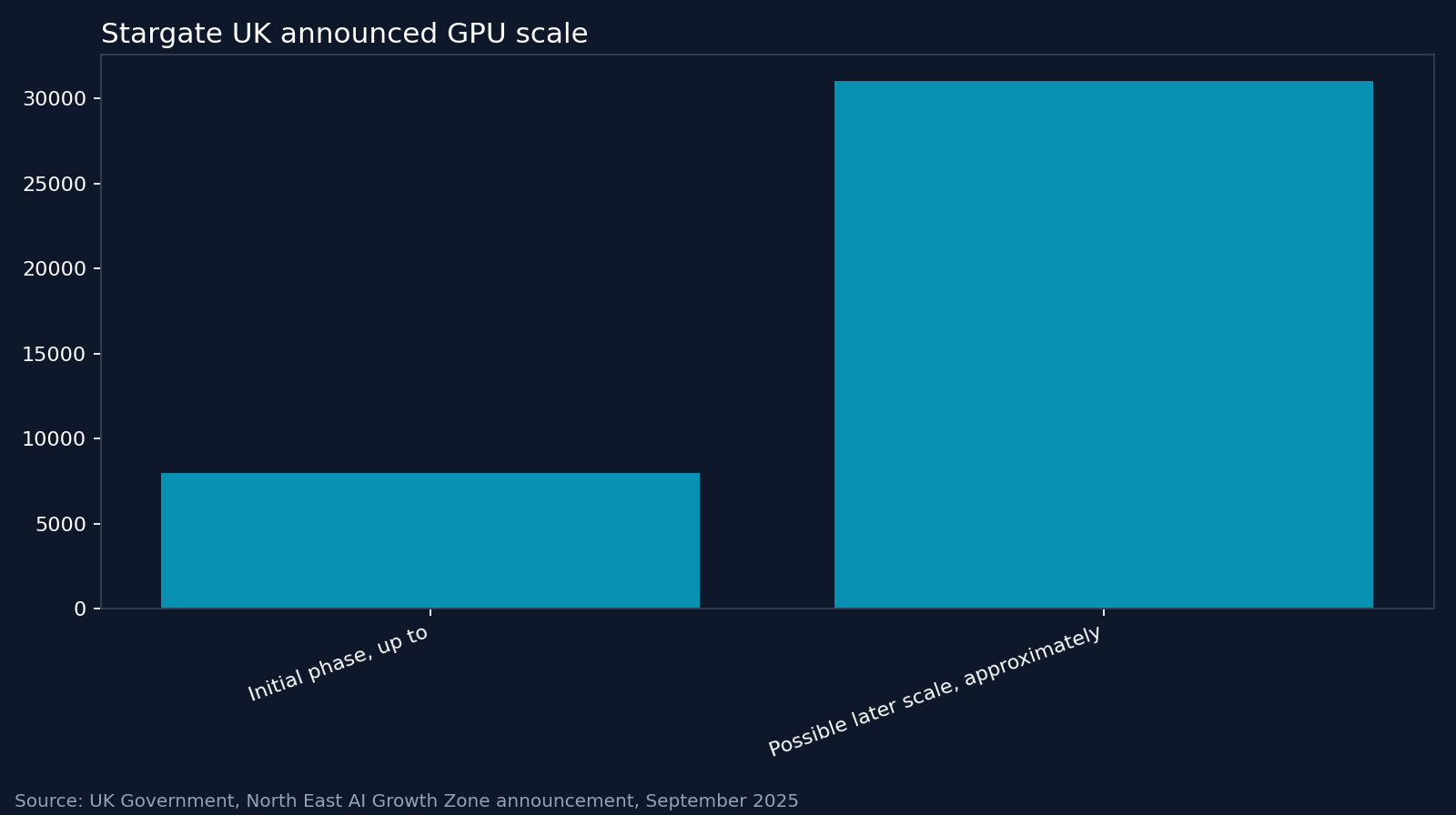
The North East announcement described an initial Stargate UK phase in which OpenAI would take up to 8,000 GPUs, with possible expansion to approximately 31,000 GPUs. GPUs are graphics processing units used here for computational workloads.
These figures describe an announced initial allocation and a possible later scale. They are not two separate pools to add together, and they do not establish inventory available to smaller customers.
That distinction should shape procurement. Ask whether the proposed service has installed equipment, an agreed delivery date and capacity reserved for your contract. Where a supplier depends on unfinished facilities, ask what happens to your deposit and workload if delivery slips.
The announcements and policy extracts cited here do not establish current bookable capacity, comparable supplier tariffs or service-level terms. They support a procurement watchlist, rather than a claim that a particular zone is ready for your deployment.
Decide who will run each layer
Buying infrastructure also means allocating responsibility for failures. For a company without a dedicated infrastructure team, the support boundary deserves as much attention as the GPU specification.
The following is a proposed responsibility map to settle during procurement. Actual allocations must appear in the contract.
| Layer | What the buyer should specify | Responsibility to establish |
| --- | --- | --- |
| Business application | Required output, acceptable response time and recovery needs | Who validates results and authorises changes |
| GPU and software environment | Workload compatibility, configuration and update process | Who maintains drivers, software and access controls |
| Storage and networking | Data volumes, transfer needs and recovery arrangements | Who investigates slow jobs or failed transfers |
| Physical infrastructure | Sustained power, cooling and equipment compatibility | Who handles facility faults and hardware replacement |
| Service management | Support hours, escalation and exit deliverables | Who owns an incident spanning several suppliers |
Carbon-Z describes colocation as separating customer hardware ownership from facility operation. Buyers should therefore request an explicit list of any additional management services. Do not assume that renting rack space includes maintaining the model-serving software or recovering a failed application.
For a small team, our preference would be a service with a clearly accountable operational owner, even where its infrastructure price is higher. The comparison should include the work that would otherwise fall to employees.
Compare the whole cost before changing location
The supplied evidence does not support a like-for-like GBP price ranking across Growth Zone suppliers. Nor does it establish whether any site-level energy support reaches the customer’s bill.
The government’s policy paper describes targeted support intended to reduce operating costs in locations where additional demand benefits the energy system. Our judgement is that buyers should seek the resulting commercial advantage in a quotation, rather than assume it exists.
Request prices against the same workload and evaluation period.
| Cost component | What to request |
| --- | --- |
| Compute or equipment | Exact hardware, usable allocation, minimum commitment and replacement responsibility |
| Power and cooling | Included allowance, charging method and treatment of price changes |
| Storage and connectivity | Required capacity, transfers, connections and installation charges |
| Deployment | Configuration, migration, testing and staff training |
| Ongoing operation | Monitoring, support coverage, maintenance and retained staff time |
| Exit | Data export, equipment removal, termination charges and transition assistance |
Require quotations to state currency, VAT treatment, billing commitment and exclusions. Keep unpriced work visible rather than treating it as free.
For an existing deployment, include the cost of moving and the evidence required to accept the replacement service. A lower infrastructure bill is insufficient if migration disrupts revenue or leaves the company with an operating model it cannot support.
Compare suppliers at the right service layer
The evidence identifies several participants, but their roles and documented propositions differ. The useful comparison is between the service each could deliver for your workload.
| Supplier or option | What the evidence establishes | What should determine its place on a shortlist |
| --- | --- | --- |
| Nscale | [NVIDIA describes UK infrastructure deployment and participation in Stargate UK](https://nvidianews.nvidia.com/news/nvidia-and-united-kingdom-build-nations-ai-infrastructure-and-ecosystem-to-fuel-innovation-economic-growth-and-jobs) | Obtain the specific customer offer, available allocation, delivery date and minimum commitment |
| CoreWeave | [NVIDIA names it among partners expanding UK AI infrastructure](https://nvidianews.nvidia.com/news/nvidia-and-united-kingdom-build-nations-ai-infrastructure-and-ecosystem-to-fuel-innovation-economic-growth-and-jobs) | Establish whether the proposed configuration, support and contract fit your workload size |
| Microsoft | [The South Wales announcement names it alongside Vantage Data Centers](https://www.gov.uk/government/news/ai-to-power-national-renewal-as-government-announces-billions-of-additional-investment-and-new-plans-to-boost-uk-businesses-jobs-and-innovation) | Require the exact purchasable service and location commitments, rather than infer them from participation |
| Carbon-Z colocation | [The provider describes a UK service for customer-owned AI infrastructure](https://carbon-z.co.uk/ai-colocation/) | Assess equipment compatibility, facility scope and who will operate the hardware and software |
These are candidates for different procurement conversations, not an independently tested ranking. The evidence also does not establish that every named provider operates inside a Growth Zone.
Keep an incumbent supplier in the exercise where its service already meets the requirement. Ask it to quote against the same workload and support specification. A credible challenger can improve the renewal discussion without making migration the predetermined outcome.
Editorial analysis
The strongest small-company outcome would be infrastructure expansion that produces services smaller customers can actually buy and operate. That requires accessible contract sizes, clear support boundaries and dependable delivery.
There is a credible counterargument to putting much weight on the zones. Large infrastructure projects may principally serve customers whose commitments bear little resemblance to a small company’s requirements. The announced Stargate UK allocation to OpenAI demonstrates why aggregate GPU counts should not be read as general market availability.
Our position is to use the zones as a reason to reopen supplier discovery. Do not postpone a necessary project on the strength of announced capacity. For the next renewal or deployment, send a measured workload specification to credible alternatives and compare executable offers.
The postcode becomes relevant when it changes the service you can buy.
FAQ
Should a small company wait for an AI Growth Zone before buying GPU hosting?
Our recommendation is to proceed with a suitable service when the project has a clear business case. Include emerging suppliers in procurement, but make any dependency on future capacity conditional on a contractual delivery commitment.
Does an AI Growth Zone guarantee cheaper hosting?
The cited government policy describes infrastructure support and targeted operating-cost measures, rather than a guaranteed customer tariff. Ask suppliers to demonstrate the price advantage in a complete quotation covering your workload and support needs.
Should we rent GPUs or own equipment in colocation?
We would start with measured demand, available capital and operating responsibility. Carbon-Z’s explanation makes the ownership distinction clear, but the choice still requires a full cost comparison that includes staffing, maintenance and exit.
Must our company move into the zone to benefit?
The programme description concerns investment in data centres and supporting infrastructure; it does not establish an office-relocation requirement for hosting customers. Check the supplier’s service eligibility and any local funding conditions separately before making a property decision.
Sources
- Department for Science, Innovation and Technology — AI Growth Zones collection, published 13 November 2025
- Department for Science, Innovation and Technology — AI Growth Zones application guidance, updated 13 June 2025
- Department for Science, Innovation and Technology — Delivering AI Growth Zones, published 13 November 2025
- UK Government — North Wales AI Growth Zone and local support announcement, published 13 November 2025
- UK Government — North East AI Growth Zone and Stargate UK announcement, published 16 September 2025
- UK Government — South Wales AI Growth Zone and wider investment announcement, published 20 November 2025
- NVIDIA — UK AI infrastructure and ecosystem announcement, published 16 September 2025
- Carbon-Z — AI colocation in the UK