Proxmox VE can cut private AI costs if the hardware earns its keep
Proxmox VE can underpin private AI on existing servers, but savings depend on hardware suitability, workload performance and paid-for operating responsibility. Start with a measured pilot before committing to production.


A UK business can use Proxmox VE as the foundation for private AI infrastructure, but lower cost depends on the workload, hardware and people running it. Proxmox provides virtual machines and containers on a single server or cluster. Our view is to reuse suitable equipment for a measured pilot, then fund production only when application performance, recovery and operating costs justify keeping the work in-house.
Reuse should start with a business task
Opinion. The strongest case for Proxmox is a business that already has suitable equipment, someone capable of operating it and a defined job worth bringing in-house. Buying accelerators first and searching for useful work afterwards reverses that decision.
For a hypothetical UK engineering consultancy, the first candidate might be an internal assistant that retrieves approved technical documents. The pilot should establish whether its answers are useful, whether document permissions hold and whether staff can tolerate its response times. A successful hypervisor installation answers none of those questions.
Proxmox supplies the infrastructure layer. Its administration guide describes virtual machines, Linux containers, storage and management. The business must still select, deploy and maintain the model, inference software and application. Here, inference means running a model to produce results.
For a small business, I would start with that bounded application rather than a proposal to build a general-purpose AI platform. Training a model should be a separate investment decision with its own workload evidence.
An existing server still needs to qualify
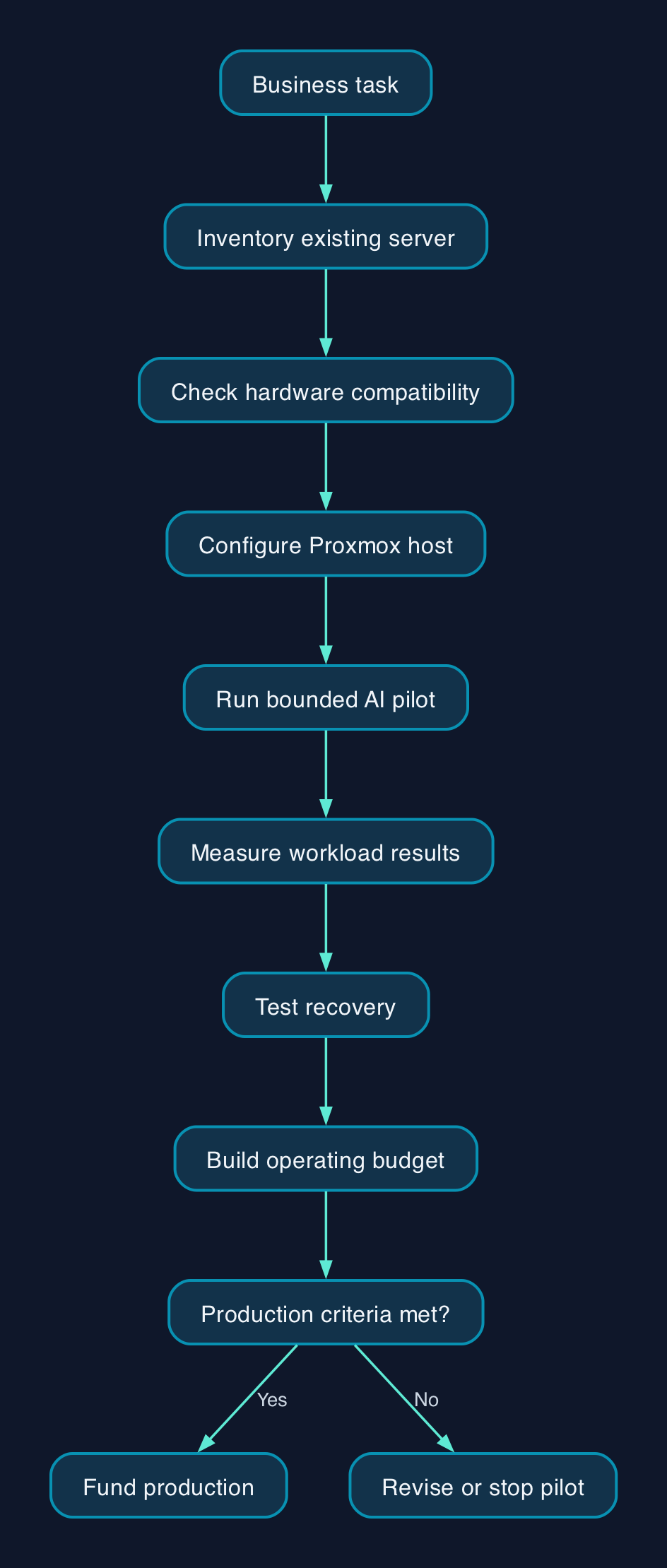
Start with an inventory of processor, memory, storage, expansion slots, firmware and remaining hardware support. Before ordering a GPU, have the server supplier or competent engineer confirm physical fit, power, cooling and compatibility with the intended software.
Proxmox’s installation requirements distinguish evaluation hardware from production recommendations. They recommend high-quality server hardware, fast redundant storage and SSDs with power-loss protection. A machine that boots the installer has passed only the first test.
GPU access also needs a deliberate choice. Full-device passthrough and virtual GPU sharing are different arrangements. The technical guide from 3os explains that full passthrough gives one virtual machine control of the physical GPU, making it unavailable to the host and other virtual machines while assigned.
For sharing between virtual machines, Proxmox’s NVIDIA vGPU documentation specifies supported hardware and software combinations, alongside licensing and support requirements. Do not turn a successful passthrough demonstration into a promise that any existing graphics card can provide supported vGPU sharing.
Before accepting the hardware, run the actual application under representative concurrent demand. Record response time, output quality, memory use, power consumption and behaviour after a restart. Set acceptable results before testing, so enthusiasm for reused equipment cannot quietly lower the standard.
Keep the first architecture understandable
For an initial deployment, my preference would be a clearly bounded AI virtual machine, an authenticated application endpoint and restricted access to approved business data. This is a proposed design, not a tested configuration.
Proxmox supports both virtual machines and Linux containers. Its FAQ explains that containers share the host kernel, whereas a virtual machine runs a guest operating system. Choose the arrangement your team can maintain and recover confidently.
| Proposed component | Responsibility | Evidence required before production |
| --- | --- | --- |
| Existing server and Proxmox host | Infrastructure administrator or contracted provider | Hardware checks, documented updates and a working management access route |
| AI virtual machine and GPU configuration | Linux and application administrator | Compatible drivers, successful workload tests and restart tests |
| Application and document access | Application owner and business data owner | Approved users can access permitted material; unauthorised requests fail |
| Backup destination and recovery procedure | Named recovery owner | A restored application works with its configuration and required data |
| Monitoring and incident handling | Internal team or managed provider | Alerts reach someone with the authority and instructions to act |
In this design, staff requests enter through the application rather than the Proxmox management interface. The application retrieves only authorised documents and passes the necessary content to the model service. Administrative access follows a separate, restricted route.
Define “private” in those terms. Require the design review to account for model downloads, outbound connections, logs, backups and remote support access. Keeping a server in a UK office should not substitute for checking where its application sends information.
Price the service around the server
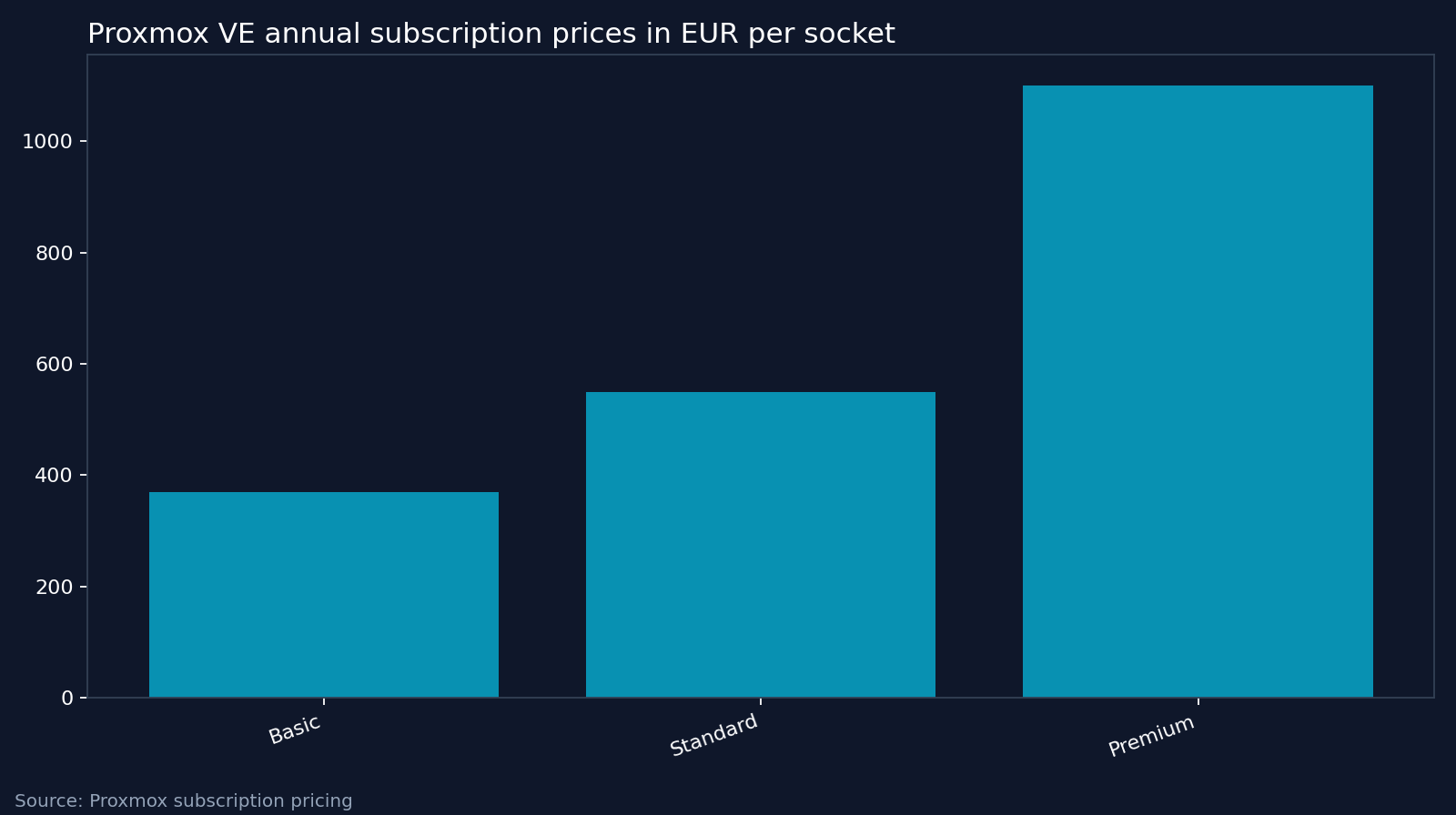
The subscription figures in the supplied evidence, used for this assessment on 28 September 2026, are in euros. The Proxmox pricing page states a one-year term from purchase and net prices, with VAT added where applicable.
| Subscription | Published annual price per CPU socket | Included support tickets |
| --- | --- | --- |
| Basic | €370 | 3 per year |
| Standard | €550 | 10 per year |
| Premium | €1,100 | Unlimited |
All figures and ticket allowances above come from Proxmox’s subscription pricing. They are subscription charges, not complete infrastructure costs. No GBP conversion is supplied here because the evidence contains no exchange rate or UK quotation.
The support start dates matter. The same page says Premium 24/7 support becomes available on 19 October 2026, while Standard 24/7 support is due by the end of 2026. Neither future commitment should be presented as already available on the assessment date.
For UK procurement, obtain a dated quotation stating the chargeable socket count, currency, VAT treatment and exact support coverage. If an external provider will operate the system, ask it to distinguish platform support from responsibility for the model, guest operating system, backups and application incidents.
Build the business case over a stated period using:
- Hardware upgrades, replacement parts and any value forgone by retaining the server.
- Proxmox support, GPU software entitlements and application or model licence charges.
- Installation, data preparation, security configuration and staff training.
- Electricity at the business’s contracted tariff, cooling, storage and backup capacity.
- Routine administration, monitoring, incident response and recovery exercises.
- Export, migration and disposal work when the service ends.
Use one-off costs plus recurring costs over the chosen period, with usage charges calculated separately. Avoid counting bundled support twice. Leave unknown inputs visible rather than presenting the subscription subtotal as total cost of ownership.
A cluster is a separate purchase decision
I would resist adding distributed storage simply because Proxmox makes it available. Its Ceph guidance requires at least three servers for the described hyper-converged setup and warns that storage consumes processor and memory resources alongside the guests.
Cluster coordination also needs planning. The cluster manager documentation calls for at least three nodes for reliable high-availability quorum, while describing an external voting device for smaller two-node arrangements. It also recommends dedicated networking for cluster traffic.
Those are infrastructure conditions, not proof that an AI application will recover successfully. Make any resilience proposal demonstrate recovery with the intended GPU configuration, model files, application state and data access.
For a pilot with an accepted interruption window, I would favour a simpler setup and a demonstrated restore. Expand only when the business can explain what extra availability it is buying and show that the design delivers it.
Editorial analysis
Proxmox deserves consideration where virtualisation itself solves a problem, such as managing the AI application alongside other services or providing familiar administration and recovery processes.
It should still compete with retaining the existing platform, running the application directly on a dedicated server, or buying a hosted service. Ask each proposal to meet the same output-quality, availability, data-handling and support requirements. An alternative deserves to win if it delivers the required service with less total work.
The supplied evidence establishes platform capabilities and published subscription charges. It does not provide AI workload benchmarks, measured electricity use or comparable hosted-service quotations, so it cannot establish a saving percentage or break-even point.
My recommendation is to approve a bounded pilot with a named owner and written acceptance criteria. Fund production when that pilot produces acceptable answers, survives a recovery test and has a credible operating budget. If the project depends on unpriced administrator time or unresolved hardware compatibility, the lower-cost claim has not yet been earned.
FAQ
Can we reuse an older server without buying a GPU?
Do not make a GPU purchase the starting assumption. Proxmox’s platform requirements do not list a GPU as necessary for ordinary virtualisation, but that says nothing about your chosen model’s requirements. Confirm those separately and test the application on the proposed hardware.
Does an open-source licence remove support costs?
Proxmox VE uses the GNU AGPL version 3, while its enterprise package repository requires a valid subscription. Decide who will handle updates, faults and application incidents, then price that responsibility explicitly.
Can several virtual machines share our existing NVIDIA GPU?
NVIDIA vGPU on Proxmox VE supports sharing a compatible physical GPU between virtual machines. Eligibility depends on the hardware and software combination, and supported operation requires the specified NVIDIA entitlement and Proxmox subscription. Check the exact equipment rather than assuming an existing NVIDIA card qualifies.
Should a small UK business build a cluster immediately?
My recommendation is to start with the availability requirement and an agreed interruption window. Proxmox can operate on a single node or a cluster, so clustering is a choice to justify. Require a recovery demonstration before paying for additional infrastructure.
Sources
The assessment uses supplied source extracts provided for the 28 September 2026 assignment.
- Proxmox VE Administration Guide
- Proxmox VE Frequently Asked Questions
- Proxmox VE Installing Proxmox VE
- Proxmox subscription pricing
- Proxmox NVIDIA vGPU on Proxmox VE
- Proxmox Deploy Hyper-Converged Ceph Cluster
- 3os Proxmox GPU Passthrough to a VM
- Proxmox Cluster Manager
- Proxmox Host System Administration