UK businesses should reject a blanket 40+ TOPS laptop rule
Reject a blanket 40+ TOPS laptop requirement. Buy stronger NPU capability for a required application or an explicitly priced future need, and make suppliers demonstrate what the extra spending achieves.


UK businesses should reject a blanket 40+ TOPS requirement in laptop tenders. Our position is that stronger neural processing unit capability earns its place through a required application or a clearly priced allowance for future use. Microsoft says software must be programmed to use an NPU. Without that connection, a higher hardware score gives the buyer no demonstrated reason to replace a working laptop or pay more.
Key pointers
- Require the application supplier to name the feature that uses the proposed NPU.
- Separate a requirement for a particular Copilot+ feature from a general laptop refresh.
- Compare the exact quoted configuration with a working device from your existing fleet.
- Treat extra spending on unspecified future features as a budget decision with an uncertain return.
- Give competing laptop suppliers the same application test and support requirements.
- Reject any calculation of an “AI premium” based on differently configured catalogue models.
A feature requirement cannot justify every employee’s replacement
Microsoft’s developer guidance supplies the strongest reason to resist a blanket purchasing rule. It describes an NPU as a hardware resource that software must be specifically programmed to use. It also identifies Windows features that require 40+ TOPS capability. Both statements appear in the same technical guidance.
That creates a defensible requirement for a role that needs a qualifying feature. It leaves a missing step for everyone else.
A tender that specifies 40+ TOPS without naming the application has decided the hardware threshold before establishing the work. Compare the Cloud’s view is that this reverses the buyer’s responsibility. The person approving the purchase needs to explain what staff will do differently and why that difference warrants the cost.
Consider a hypothetical UK business replacing laptops used mainly for existing office work. Its application supplier cannot identify a required feature that uses the proposed NPU. We would reject additional spending justified solely by the NPU score. A replacement could still earn approval for a documented support or hardware need, but the AI claim has contributed nothing measurable to that decision.
This is a purchasing judgement, not a claim that NPUs lack useful applications. Microsoft’s own documentation makes the software connection explicit. Buyers can insist that the sales case makes it explicit too.
Intel’s numbers show why the label matters
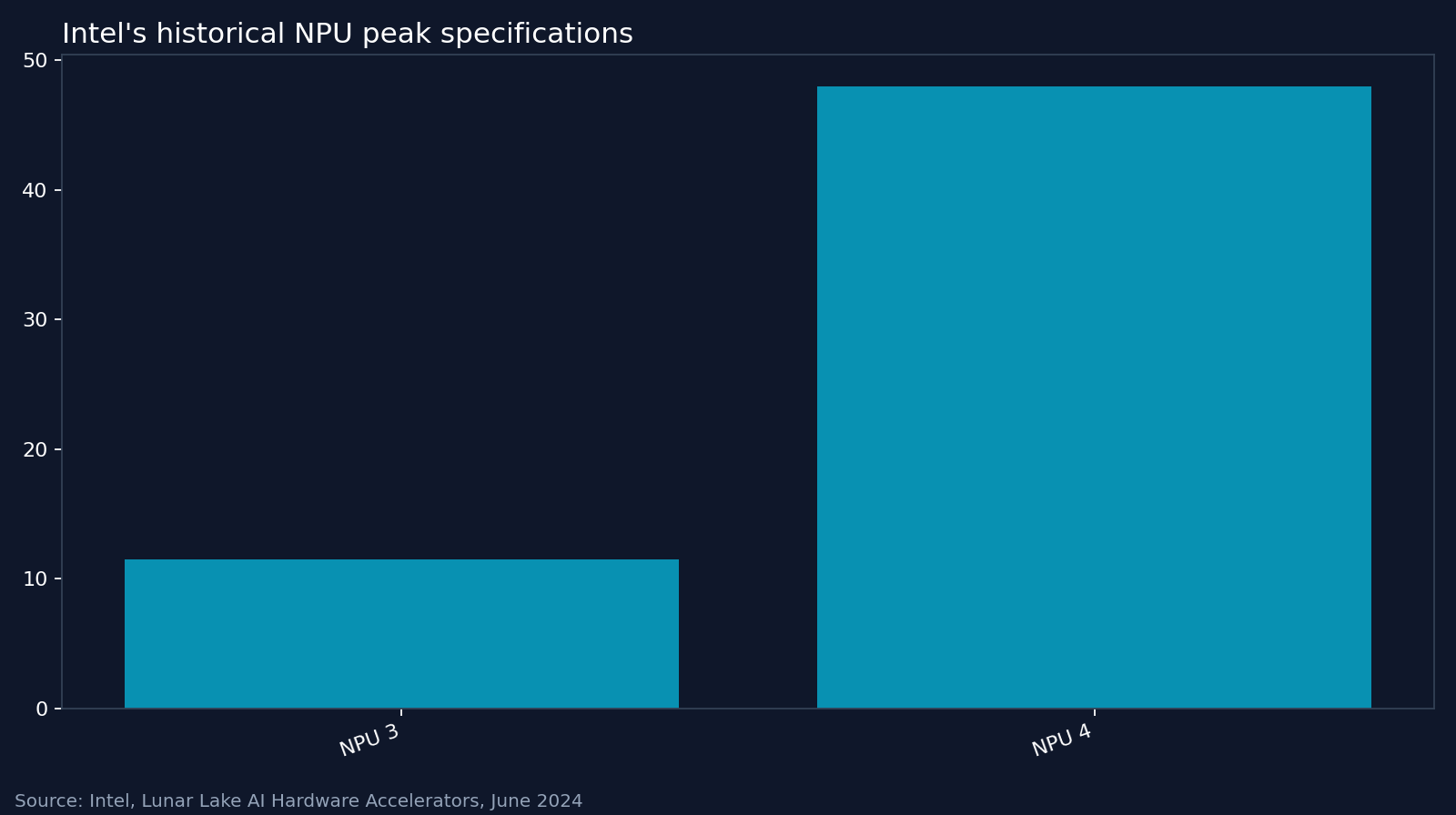
Intel’s historical figures demonstrate a real change in stated hardware capability. Its June 2024 presentation lists 11.5 peak TOPS for NPU 3 and 48 peak TOPS for NPU 4. TOPS means trillions of operations per second; Intel qualifies the figures by precision and configuration in its accelerator presentation.
Those figures describe peak hardware throughput. They contain no measurement of how much work a UK employee completes.
Even the component being measured needs attention. Intel’s Core Ultra desktop Series 2 brief advertises up to 13 NPU TOPS and up to 36 total platform TOPS. A buyer cannot substitute the larger combined figure for the NPU figure when checking an NPU-specific requirement. This desktop example illustrates the distinction; it is not a laptop recommendation.
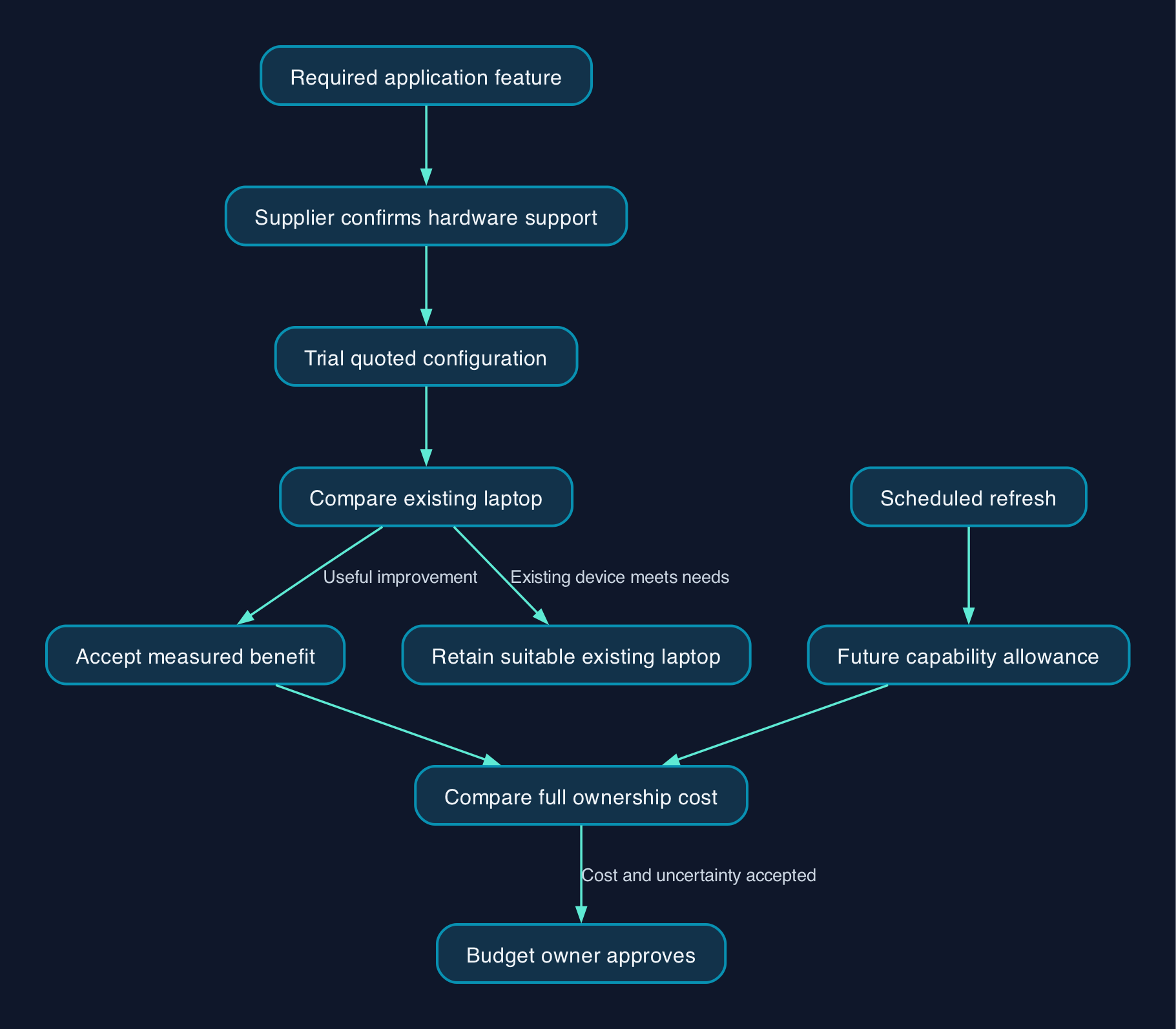
Our proposed acceptance test starts where those specifications stop. Run the required application version on the quoted laptop, using agreed input files and output settings. Compare completion time and output quality with the existing device. For mobile roles, record battery behaviour under the same task.
Ask the application supplier to identify which work runs on the NPU and which runs elsewhere. A demonstration of a remote service does not, by itself, establish what the laptop’s accelerator contributed.
The strongest objection is avoiding a second purchase
Buying more capability during a scheduled refresh can be sensible even before the business has proved an immediate productivity gain. A buyer may reasonably prefer hardware that leaves room for features it expects to adopt. Microsoft’s documented 40+ TOPS requirements give that argument a concrete basis.
We would accept that argument where the qualifying machine meets the business’s other requirements and carries no material additional ownership cost. Requiring a separate productivity case for every included component would be needless bureaucracy.
We would also accept a deliberate extra payment for future capability when the budget owner understands the uncertainty. A planned application rollout can support that choice before every employee has completed a trial.
That concession does not support compulsory early replacement across a fleet. The evidence supplied here establishes neither a timetable for the buyer’s future software needs nor the financial return from preparing every employee for them. Calling the expenditure “future-proofing” cannot supply either figure.
Our dividing line is therefore spending and timing. During an otherwise justified refresh, NPU capability can be a useful tie-breaker. When it drives a higher bill or brings replacement forward, the buyer owes the business a specific explanation.
UK catalogue prices cannot reveal an NPU premium
Dell’s supplied UK catalogue snapshot, dated 28 September 2026, shows how easily a price comparison can overreach.
| Model | Published starting price per device | Catalogue description |
| --- | --- | --- |
| Dell Pro 14 Essential, PV14250 | £1,048.96 | Intel Core processors and Windows 11 Pro |
| Dell Pro 14, PC14250 | £1,552.80 | Up to Intel Core Ultra processors, with AI PC options |
| Dell Pro 14 Plus, PB14250 | £1,881.60 | AI PC options including Copilot+ PC |
All rows come from Dell’s UK business laptop catalogue. Dell states that configuration and support selections can change the starting price.
These are different model families. The extracts do not establish matching memory, storage or support, and do not specify the VAT basis. Nor do they establish that every advertised option is included at the starting price. Subtracting these prices would produce a difference between listings, not a defensible charge for the NPU.
For a UK purchasing decision, require GBP quotations with VAT stated separately. Match the operating-system edition and support term, then account for deployment, application licences, testing, training and eventual disposal. Leave unquoted work visible rather than treating it as free.
We would not approve an NPU premium that the quotation cannot identify or the application trial cannot explain.
Competing suppliers need the same burden of proof
A fair shortlist can include different manufacturers and processor choices without pretending the supplied evidence ranks them.
Dell’s Pro 14 Plus offers AI PC options including Copilot+ configurations in its UK business catalogue. Microsoft’s UK page for the seventh-edition Intel Surface Laptop for Business specifies an Intel AI Boost NPU with up to 48 TOPS.
HP and ASUS also belong in the discovery stage. Laptop Outlet’s supplied UK listings identify an AMD Ryzen AI HP EliteBook 8 G1a configuration with Windows 11 Pro and an AMD Ryzen AI ASUS ProArt P16 configuration with Windows 11 Home. Those retail descriptions justify investigating the machines, not declaring equivalent business suitability; manufacturer specifications and support remain checks before approval.
At processor level, Microsoft’s developer guide covers Qualcomm Snapdragon X Elite and identifies AMD Ryzen AI 300 and Intel Core Ultra 200V options. Nothing in the supplied evidence establishes a common application-performance winner.
Apply one decision rule across those candidates. The application supplier confirms support and processing location. Internal IT or its managed service provider verifies deployment and compatibility. The budget owner accepts the demonstrated benefit or explicitly approves spending for uncertain future use.
For staff whose current laptop still meets the agreed requirements, retention remains a valid outcome. A tender ought to allow that answer.
FAQ
Should every UK business laptop tender require 40+ TOPS?
No. Microsoft documents 40+ TOPS requirements for Copilot+ features, which supports specifying qualifying hardware where those features are needed. Our position is that a blanket requirement needs a fleet-wide business case.
Can a higher NPU score justify replacing a working laptop?
A score alone does not demonstrate a useful application improvement. Microsoft says software must be programmed to use the NPU, so require the supplier to show that connection on the proposed configuration. Compare the result with the working laptop before approving replacement on AI grounds.
Is buying extra capability for future use always wasteful?
No. During a scheduled refresh, we would favour additional capability where it meets the other requirements without a material extra ownership cost. Paying more can also be reasonable, provided the budget owner accepts that the future benefit remains uncertain.
How can a UK buyer establish the actual NPU premium?
Request quotations with matched specifications and support, with VAT shown separately. Dell’s catalogue says configuration and support selections can change starting prices. Differences between unrelated catalogue models cannot isolate the cost of NPU capability.
Sources
- Microsoft Learn — Develop AI applications for Copilot+ PCs
- Intel — Lunar Lake AI Hardware Accelerators, June 2024
- Intel — Core Ultra Desktop Processors Series 2 product brief
- Intel — How to check whether a processor has an integrated NPU
- Dell — UK business laptop catalogue, supplied snapshot dated 28 September 2026
- Microsoft — Surface Laptop for Business, seventh edition, Intel
- Laptop Outlet — UK Copilot+ laptop listings