

British professional services firms should start with a business AI assistant on a bounded task, such as drafting proposals from approved material or preparing internal project summaries. My recommendation is to test the assistant closest to the firm’s existing work, then compare a standalone alternative. Keep a human responsible for the finished output. Expand only when measured savings survive checking, correction, training and subscription costs.
Start with a task whose finished quality you can judge
Editorial position: buy assistance for a repeatable piece of work before buying automation that changes client records.
For a British consultancy, accountancy practice or design firm, I would start with proposal preparation, internal briefing or rewriting approved material. These tasks give the reviewer an existing source against which to check the output. I would postpone autonomous client advice, financial postings and changes to the firm’s core records.
Consider a hypothetical consultancy preparing a proposal from an approved service description, a scope template and staff biographies. The pilot could ask an assistant to assemble a draft, identify missing information and suggest questions for the partner. The partner would check every commitment, fee and credential before the document reached the client.
That is a testable use case. “Make everyone more productive” is not.
The measurement should end at an acceptable finished proposal, rather than the arrival of the first draft. If the assistant writes quickly but the partner spends longer removing unsupported promises, the pilot has failed its purpose.

Compare suppliers without confusing evidence volume with suitability
The supplied evidence supports specific discussion of OpenAI and Microsoft. It contains no equivalent product, pricing or contractual evidence for Google, Zoho, Sage, Xero or UK specialist providers, and no independent productivity measurements. That limits this article’s product recommendations; it does not establish that those alternatives are less capable.
For the first shortlist, compare the same task and acceptance criteria across suppliers.
| Candidate | First task to investigate | What the supplied evidence establishes | What must be settled before selection |
| --- | --- | --- | --- |
| ChatGPT Business | Drafting or revising material from an approved document pack | OpenAI describes document-based comparisons and rewriting in its [small-business guide](https://openai.com/business/guides-and-resources/chatgpt-business-smb-guide/) | Relevant plan features, UK commercial terms, administration, retention and performance on the firm’s task |
| Microsoft Copilot Business | Assistance within an existing Microsoft working environment | Microsoft describes work-content assistance in applications including Word, PowerPoint and Teams on its [business add-ons page](https://www.microsoft.com/en-gb/microsoft-365/business/additional-services-plans-and-pricing) | Eligible base subscription, deployment readiness and the exact features required |
| Google Gemini | The same drafting or briefing task, particularly for a firm already considering Google’s tools | The supplied pack does not establish its relevant edition, capabilities or terms | Obtain equivalent product and commercial evidence before scoring it alongside the other candidates |
| AI within the firm’s existing Zoho, Sage or Xero products | An existing application task that the firm wants to improve | No relevant feature or edition is verified in the supplied pack | Establish whether an applicable capability exists, what it costs and how staff review its output |
My preference would be to test an existing supplier first where that avoids migration, then use a standalone assistant as a challenger. That is a procurement judgement about disruption, not a claim that embedded software produces better answers.
For a firm whose main bottleneck is invoice administration, a proposal-writing assistant may be the wrong purchase altogether. Start with the bottleneck, then investigate the corresponding application.
Keep the first workflow under human control
For the initial pilot, I would use a deliberately limited workflow. A staff member selects approved material, the assistant produces a draft, and a named reviewer accepts or rejects it before it enters the normal client process.
This proposed arrangement leaves the accounting, customer relationship management and case-management systems in place. It also makes the staff time needed to move material between tools visible.
| Stage | Responsibility | Acceptance condition |
| --- | --- | --- |
| Select source material | Task owner | The material is current, relevant and approved for use with the selected service |
| Configure access | IT administrator or support provider | Pilot users and connected accounts have only the access needed for the task |
| Produce the draft | Staff member using the assistant | The output distinguishes supplied facts from missing information |
| Check the work | Named professional reviewer | Figures, sources, commitments and client-specific statements have been checked |
| Release and retain | Existing document owner | Only the approved version enters the client workflow |
Connections deserve their own decision. OpenAI says connected access remains subject to source permissions; that is a reason to inspect those permissions, not permission to connect everything.
Ask whoever administers the pilot to demonstrate how access is removed, how retained material is handled and who resolves a failure. Keep client-data approval separate from enthusiasm for the tool.
Price the reviewed result
The relevant cost is the cost of producing acceptable work. Include subscriptions, setup, permissions review, training, support, checking and correction. Include exit work if the pilot creates templates or processes that depend on the supplier.
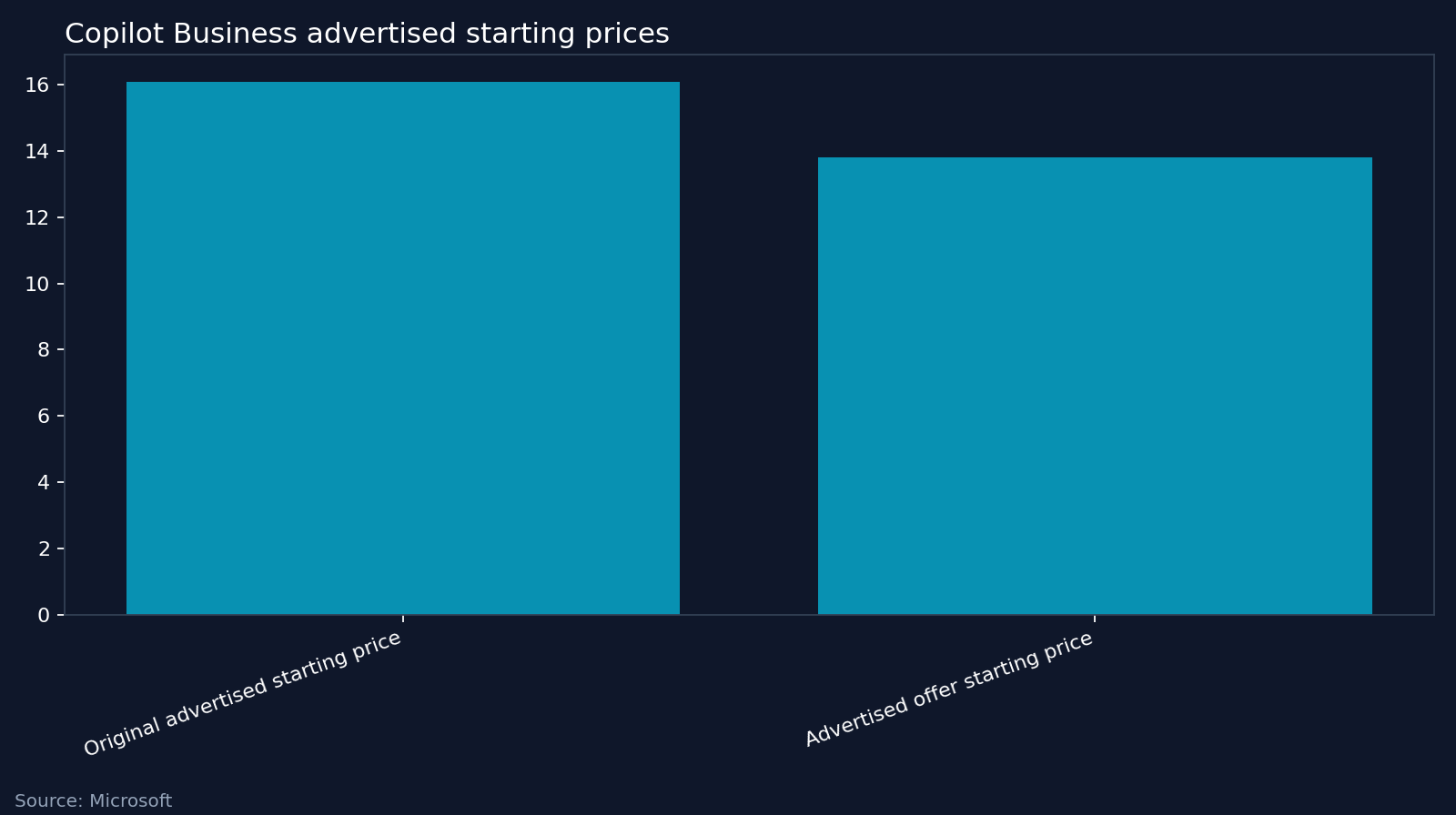
The supplied Microsoft UK pricing extract, dated 28 September 2026, provides a useful illustration of why headline prices require care.
| Published price reference | GBP per user per month | Commitment and exclusions |
| --- | --- | --- |
| Copilot Business original advertised starting price | £16.10 | Paid yearly, excluding VAT; eligible Microsoft 365 subscription required |
| Copilot Business advertised offer starting price | £13.80 | Paid yearly, excluding VAT; eligible Microsoft 365 subscription required; offer conditions apply |
Both figures come from Microsoft’s business additional-services pricing page. They are two advertised price references for the same add-on, not competing products or complete operating costs. The supplied extract does not contain the full offer conditions, so confirm eligibility, duration and renewal pricing before budgeting.
The evidence does not provide comparable ChatGPT or Google prices. A cross-supplier cost ranking would therefore be unjustified.
For the pilot, record the following calculation without assigning invented monetary values.
Net time saved per accepted task = previous completion time − assisted completion time, including preparation, checking and rework.
Then compare the value of usable capacity released with the full pilot cost. For a fee-earning firm, distinguish time available for other work from cash saved. A shorter task does not automatically reduce expenditure or produce another billable engagement.
Expand only after measuring the whole job
I would make renewal depend on evidence from comparable work completed before and during the pilot.
Record elapsed time, active staff time, reviewer corrections and whether the output met the agreed quality standard. Keep task complexity visible so that a simple assisted proposal is not compared with a difficult unassisted one.
Give the reviewer authority to reject an output even when it arrived quickly. Track those rejected drafts as part of the result, rather than removing them from the sample.
Training also belongs in the measurement. Record how much help staff need to select source material, phrase the request and check the answer. A pilot dependent on constant intervention from its most enthusiastic user has not yet demonstrated a repeatable operating method.
The decision can then be specific. Retain the tool for proposal drafting, change the workflow for project summaries, or stop paying for a use case whose review burden outweighs its benefit.
Editorial analysis
The strongest argument for an assistant inside an existing application is continuity. The strongest argument for a separate assistant is the opportunity to test a different tool without first changing the core system.
Neither argument establishes a winner. I would favour the option that produces acceptable work with less total effort and a clear owner for mistakes.
For British professional services firms, the first adoption decision should therefore be modest but demanding. Choose a task, name its reviewer and measure the completed job. A successful pilot earns the next connection or licence; a convincing demonstration alone does not.
FAQ
Which AI tool should a British professional services firm try first?
Start with the tool that can address a defined task with the least disruption to the existing workflow. ChatGPT Business and Microsoft Copilot Business are candidates supported by the supplied evidence; Google Gemini and application-specific alternatives need equivalent checks before a fair selection. Test the same task and quality standard across the shortlist.
Can we begin without paying for another subscription?
Eligible Microsoft 365 users may already have Copilot Chat at no additional cost. Check the account’s eligibility and whether the available features match the pilot. Staff training and review still consume time even when the incremental licence charge is absent.
Do connected business AI tools make client information safe automatically?
No supplier statement should replace a decision about the particular information and workflow. OpenAI says connected apps respect source permissions and that app-accessed business data is not used for training by default, but those statements do not settle every retention, access or client-contract question. Have the responsible person approve the intended use before supplying client material.
What counts as a measurable productivity gain?
Count the reduction in total effort needed to deliver work that passes the normal review standard. Include preparation, corrections and failed attempts, then assess subscription and operating costs separately. More drafts or more frequent tool use do not, by themselves, demonstrate a gain.
Sources
The following pages are cited from the supplied evidence pack. Changeable pricing should be reconfirmed before purchase.
- OpenAI — Think Bigger, How Small Teams Win with ChatGPT
- OpenAI — Plugins and connected-app permissions
- Microsoft — Microsoft 365 Business additional services and pricing
- Microsoft Learn — Minimum requirements to deploy Microsoft Copilot, updated 8 September 2026